









ALTERNATIVES GUIDE
8 Best EasyPost Alternatives for Shipping APIs (2026)
 Written by
 Reviewed by
-
EasyPost is shipping software built around an API, and it is still a solid pick for developer-led US teams: 3,000 free labels a month, $0.08 per label after that, and an AI layer that picks carriers on real delivery performance.
-
Brands start looking when platform fees climb with volume, tracking, returns, and insurance become separate add-ons, and international orders need duties shown at checkout.
-
Want another developer-first platform? ShipStation is the closest like-for-like move: its API (formerly ShipEngine) replaces EasyPost’s, and its web app is there if ops take over. Shippo suits smaller teams that also want a dashboard.
-
Handing shipping to an ops team instead of engineers? Look at ShipStation’s web app, or Veeqo if Amazon is your biggest channel.
-
Selling abroad? Easyship shows duties and taxes at checkout. Shipping only USPS and UPS on a tight budget? Pirate Ship charges nothing beyond postage.
-
Running a high-volume warehouse on ERP and WMS systems? ProShip is built for that scale.
-
Want order edits, branded tracking, exchange-first returns, and Returns Protection in one post-purchase platform? That is ClickPost, built for US DTC brands.
Why brands outgrow EasyPost
Most teams choose EasyPost for a sensible reason. A developer needs to buy a USPS label from inside the order system, the documentation is clear, the sandbox works, and the first 3,000 labels each month cost nothing beyond postage.
The reasons to look elsewhere usually show up a year or two later, and they rarely involve printing labels. Volume passes the free allowance, and the per-label fee becomes a line finance asks about. Customer service wants a returns portal. Marketing wants the tracking page to look like the brand. EasyPost's product family can solve each of these, but each one means another product, another invoice, and another integration ticket.
This guide covers eight platforms US brands use instead of EasyPost, or alongside it. Some are developer-first platforms like EasyPost. Some trade code for a dashboard an ops team can run without engineering help. One is free if you only ship USPS and UPS. ClickPost, which publishes this guide, is covered separately after the list as the post-purchase option for US DTC brands, with its limits stated alongside its strengths.
Each entry covers who the platform suits, what has changed compared with EasyPost, what to watch for, the published price and the date it was checked, and the current G2 rating.
What EasyPost does well, and why brands compare alternatives
EasyPost is shipping software for developers. It has been building since 2012, and it integrates with over 100 carriers. Its core product is a REST API with SDKs in seven languages and a full sandbox. Luma AI Select chooses a carrier for each shipment using zone, package profile, cost, and carrier performance history from more than a billion comparable shipments. On G2, it has a 4.2/5 rating from 122 reviews. For a developer-led team shipping domestically with USPS, UPS, and FedEx, that is a strong setup.
Four reasons usually come up when brands start comparing it with other platforms.
Platform fees grow with every label past 3,000
EasyPost moved to two plans on 23 February 2026. Free Access uses EasyPost’s own carrier rates, paid through a prepaid wallet. Bring Your Own Carrier Accounts costs $20 a month for brands with their own contracts. Both include 3,000 labels a month and then charge $0.08 per label. On Free Access, 20,000 labels a month means $1,360 in platform fees before postage, and 50,000 labels means $3,760. Tracking, insurance, and Luma AI are priced separately.
The post-purchase layer comes in separate pieces
Branded tracking pages and email or SMS notifications come through Advanced Tracking, which EasyPost built on WeSupply’s tracking technology. Returns and exchanges run through WeSupply’s returns product or another returns app connected to EasyPost labels. Every piece works, but CX and operations end up managing several products, invoices, and dashboards for one customer journey.
Duties and taxes run through a partner
EasyPost calculates landed cost through Zonos, and only for FedEx, UPS, DHL, and Canada Post on your own carrier accounts. Brands handle Zonos billing directly. For a store where international orders are a growing share, that adds a second vendor at the moment shoppers decide whether the final price is acceptable.
100+ carriers cover the US, less of the rest of the map
For domestic US shipping, EasyPost’s carrier list covers what most brands need. Platforms built around cross-border and multi-region shipping work with larger libraries: Easyship lists 550+ courier services, and ShipStation API counts over 200+ carrier integrations. That difference matters most for regional last-mile carriers abroad and for marketplace or 3PL orders shipped on carriers the brand did not choose.
EasyPost alternatives at a glance
EasyPost sits in the first row as the baseline. Prices are list prices on the date shown and exclude postage.
| Platform | Best for | Starting price (date checked) | Carriers | G2 rating |
| EasyPost (baseline) | Developer teams building shipping into their own systems | Free up to 3,000 labels a month, then $0.08 per label | 100+ | 4.2 (122) |
| Shippo | Small teams wanting an API and a dashboard | Free up to 30 labels; Pro from $17 a month | 40+ | 4.2 (77) |
| ShipStation (API and app) | Developer teams via the API, ops teams via the web app | API: free plan on platform carriers. App: $14.99 a month for 50 shipments (Jun 2026) | 200+ carrier integrations | 4.3 (593) |
| Easyship | Brands selling internationally | Free for 50 shipments; Plus $29 a month (2026) | 550+ courier services | 4.4 (172) |
| Veeqo | Amazon-heavy multichannel sellers | Free; postage only (2026) | UPS, USPS, FedEx, DHL, Amazon Shipping | 4.5 (47) |
| ProShip | Enterprise warehouses on ERP and WMS stacks | $40,000+ (Q1 2026 FedEx listing) | 100+ carriers | 4 (25) |
| Pirate Ship | Small sellers shipping USPS and UPS only | Free; postage only (Jun 2026) | USPS, UPS | 4.5 (24) |
| ShippingEasy | Small stores wanting shipping plus email marketing | Free plan; paid from $19.99 a month (Oct 2026) | USPS, UPS and others | 4.6 (114) |
| Stamps.com | Offices printing postage and Certified Mail | $14.99 a month (Aug 2026) | USPS, UPS, FedEx, DHL Express | 4.4 (141) |
We read G2 ratings from G2 comparison pages in October 2026. Because review counts change frequently, check the current numbers if ratings guide your choice.
Top 8 EasyPost Alternatives for Shipping API in 2026
1. ShipStation API and web app (formerly ShipEngine)
Best for: Teams that want to leave EasyPost without leaving developer-first shipping, and want a dashboard ready if operations later take shipping over from engineering.
ShipEngine is being rebranded as ShipStation API, and it sits in the same Auctane family as ShipStation and Stamps.com. For an EasyPost team, the shape is familiar: rate, buy, track, and validate through REST endpoints, with discounted carrier rates available without a subscription.
What changes from EasyPost: ShipStation API is what ShipEngine became in February 2025, and it sits alongside the ShipStation web app in the Auctane family. For an EasyPost team, the API works the same way: rate, buy, track, and validate through REST endpoints.
You gain:
- A free API plan on ShipStation’s discounted carrier rates, paid as you ship, similar to EasyPost’s Free Access.
- 200+ carrier integrations, plus endpoints for order imports, rate shopping, address validation, tracking, pickup point search, and LTL rate comparison.
- A web app with marketplace and cart orders in one queue, 300+ integrations, and automation rules for carrier, service, and packaging.
- Branded labels, a returns portal, and an in-app tracking page.
Watch for: The API and the app are billed separately, so price whichever one your team will use. The API’s Advanced plan allocates 1,000, 5,000, or 10,000 calls a month per endpoint, with overage fees past that, so size it against your real rate-shopping volume. In the app, API access and your own carrier accounts start on the Standard plan, so the $14.99 Starter price rarely applies to brands coming from EasyPost.
Pricing:
- API: free plan for platform carriers. Advanced is tiered by API calls, with Enterprise pricing above roughly 25,000 shipments a month.
- App: Starter from $14.99 a month, Standard from $29.99, and Premium from $349.99, per ShipStation’s pricing page (updated June 2026).
Rating: 4.3/5 (593) on G2.
Verdict: The closest like-for-like switch for developer teams, and the only one on this list that lets the same vendor carry you from code to dashboard.
2. Shippo
Best for: Startups and small teams that want an API and a dashboard non-developers can use from the first day.
What changes from EasyPost: you gain
- API access on every plan, including the free tier.
- A dashboard for manual shipping alongside the API, so a team can start by hand and automate later on the same account.
- Predictable subscription tiers based on label volume, which some finance teams prefer over a per-label platform fee.
Watch for: Shippo lists 40+ carriers against EasyPost’s 100+. Its free Starter plan covers 30 labels a month compared with EasyPost’s 3,000, and it charges $0.05 per label when you connect your own carrier account. Above 10,000 labels a month, a $0.08 per-label overage applies.
Pricing: Starter is free for up to 30 labels. Pro starts at $19 a month billed monthly ($17 annually) for up to 200 labels and rises to $199 a month for 5,001 to 10,000 labels (as of July 2026).
Rating: 4.2 out of 5 from 77 reviews.
Verdict: A better fit when the people shipping orders are not the people writing code.
3. Easyship
Best for: Brands where international orders are a growing share of revenue.
What changes from EasyPost: you gain
- Duties and taxes calculated in-house and shown at checkout, with options to prepay them or pass them to the customer, without a separate landed-cost vendor.
- A network of 550+ courier services with reach into 220+ countries and territories.
- Customs documents generated automatically with each international label.
Watch for: Every plan caps monthly shipments, and the free plan cannot link your own courier account. Easyship now sells API access separately, with a pay-as-you-go free tier and paid API plans from $29 a month, so app and API costs need to be read together.
Pricing: Free for 50 shipments a month, Plus at $29 a month for 500, Premier at $69, and Scale from $99.
Rating: 4.4 out of 5 from 172 reviews.
Verdict: The stronger choice when the price shown at checkout matters more than developer flexibility.
4. Veeqo
Best for: Amazon-heavy multichannel sellers that want shipping and inventory tools without a subscription.
What changes from EasyPost: you gain
- No software fee at any volume. Veeqo earns from shipping volume passed to its carrier partners.
- Discounted UPS, USPS, FedEx, and DHL rates, plus credit back through Veeqo Credits for US sellers.
- Amazon Buy Shipping protections on labels bought through Veeqo, which shield your account from late-delivery claims when orders ship on time.
- Inventory sync, picking, and warehouse tools included.
Watch for: The product is built around Amazon’s ecosystem and the major US carriers. Teams building shipping into their own software will find EasyPost or ShipStation API more developer-oriented.
Pricing: Free; you pay postage only (2026).
Rating: 4.5/5 (47) on G2
Verdict: Hard to beat on cost if Amazon is your largest channel.
5. ProShip
Best for: Enterprise shippers moving large daily parcel volumes through WMS, OMS, and ERP systems.
What changes from EasyPost: you gain
- On-platform or private cloud deployment, with perpetual license or subscription options.
- Rate shopping and custom business rules in one carrier-agnostic system that integrates with warehouse and ERP software.
- Capacity for 500 to 1,000,000+ shipments a day.
Watch for: ProShip is sold and implemented as an enterprise project, with a price to match. It does not have a self-serve tier to test on.
Pricing: Quote-based; a Q1 2026 FedEx compatible-solutions listing puts it at $40,000+.
Rating: 4 out of 5 from 25 reviews.
Verdict: For warehouses where label speed on the packing line is the bottleneck.
6. Pirate Ship
Best for: Small sellers shipping USPS and UPS who want no software cost at all.
What changes from EasyPost: you gain
- Free software with no markup, fees, or monthly commitment; you pay postage only.
- Access to USPS Commercial Pricing, Priority Mail Cubic, Simple Export Rate, and UPS Ground discounts, as listed on Pirate Ship’s site.
- Store connections for Shopify, Etsy, eBay, Amazon, WooCommerce and Squarespace.
Watch for: Pirate Ship ships USPS and UPS only, so FedEx and DHL are off the table. Support runs through chat and email.
Pricing: Free (as of June 2026).
Rating: 4.5 out of 5 from 24 reviews.
Verdict: If you ship USPS and sit under EasyPost’s 3,000 free labels anyway, ask whether you need developer tooling at all.
7. ShippingEasy
Best for: Small US stores that want shipping and email marketing in one login.
What changes from EasyPost: you gain
- A dashboard built for non-technical teams, with discounted USPS and UPS rates.
- Automated email campaigns such as abandoned cart, review requests, and product recommendations in the same tool.
- A free plan to start on.
Watch for: Every paid tier caps monthly shipments, from 200 on the entry plan to 1,500 on the $49.99 plan, so costs step up as volume grows. It is a tool for running shipping, with less to offer teams that want to build their own.
Pricing: Free plan; $19.99 a month for 200 shipments, $29.99 for 500 and $49.99 for 1,500 (Shopify listing, checked October 2026).
Rating: 4.6 out of 5 from 114 reviews.
Verdict: Good value for a small team that wants shipping and retention marketing together.
8. Stamps.com
Best for: Offices that print postage stamps, Certified Mail, and shipping labels from the desk.
What changes from EasyPost: you gain
- Stamp printing and Certified Mail alongside parcel labels.
- Rate shopping across UPS, USPS, FedEx, and DHL Express, with free scheduled pickups.
- Unlimited stamps and labels from the Professional plan up.
Watch for: There is no free plan, and the Basic plan stops at 10 shipping labels a month. Stamps.com is a mailing and shipping desk tool, with little to offer teams building shipping into their own ecommerce systems.
Pricing: Basic $14.99 a month, Professional $29.99, and Multi-Location $49.99, per Stamps.com’s pricing page (updated August 2026).
Rating: 4.4/5 from 141 reviews on G2.
Verdict: Built for mailrooms more than ecommerce warehouses.
Why brands switch from EasyPost to ClickPost
EasyPost buys and tracks the label. ClickPost runs what happens after checkout: order edits, branded tracking, returns and exchanges, and Returns Protection. It also generates shipping and return labels across 700+ carriers, so brands can replace EasyPost’s post-purchase add-ons and generate labels in the same step.
Self-serve order edits instead of support tickets
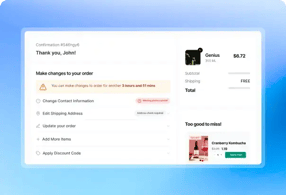
With Order Editing, shoppers fix an address, swap a size, add items, or cancel within a window you set, and see add-on offers while they edit.
Exchange-first returns instead of a returns add-on
The returns portal leads with size, color, and site-wide exchanges, and nudges shoppers toward store credit or a gift card before a refund.
Return policies set by customer segment
AI customer segmentation applies different return windows, fees, and refund methods based on each shopper’s purchase and return history.
Shopper-funded returns alongside shipment insurance
EasyPost Guard covers loss and damage. ClickPost’s Returns Protection lets shoppers buy free, unlimited returns at checkout for a fee you set.
ClickPost’s Pricing is usage-based: Order Editing has a free plan, with paid plans starting at $49 a month, and returns are priced by return volume and the modules you use. On the Shopify App Store, Returns & Exchanges is rated 5.0 from 19 reviews, and Order Editing & Upsell is rated 5.0.
ClickPost vs EasyPost: which one fits your business?
The two products overlap less than the “shipping software” label suggests. EasyPost is strongest at buying and rating labels from code, and it also leads on AI carrier selection and landed cost, which sit outside ClickPost’s US product line. ClickPost is strongest at everything the shopper does after checkout.
| Parameter | EasyPost | ClickPost | Edge |
| Core job | Shipping software for buying, rating, and tracking labels, built for developers | Post-purchase platform: order edits, branded tracking, returns and exchanges, plus label generation |
Depends on the job: labels (EasyPost) or the post-purchase journey (ClickPost)
|
| Getting started | Self-serve sign-up; free up to 3,000 labels a month | Shopify apps free to install; returns live in days for Shopify brands, with a dedicated onboarding contact | Even |
| Carrier coverage for labels | 100+ carriers | Shipping and return labels across 700+ carriers, single or bulk | ClickPost |
| Order changes after checkout | Not covered by EasyPost’s products | Self-serve edits to address, size, items, or cancellation within a window you set | ClickPost |
| Selling after checkout | Upsell placements on Advanced Tracking pages | Add-on upsells while shoppers edit orders, plus banners and AI product recommendations on the tracking page | ClickPost |
| Branded tracking and notifications | Advanced Tracking add-on with email and SMS, billed per shipment | Branded tracking page with real-time ETAs and AI-personalized email and SMS, in the same platform as returns | ClickPost |
| Returns and exchanges | Through WeSupply or a third-party returns app | Native, exchange-first portal with store credit and gift card options issued. | ClickPost |
| Return policies | Set in by merchant | AI customer segmentation with different windows, fees, and refund methods per segment | ClickPost |
| Protection | EasyPost Guard for loss and damage; insurance at 1% of value, $1 minimum | Returns Protection: shoppers buy free, unlimited returns at checkout for a fee you set |
ClickPost for return costs; EasyPost for loss and damage
|
| Pricing | Free to 3,000 labels, then $0.08 per label; BYOCA adds $20 a month | Usage-based: Order Editing free, then from $49 a month; returns priced on return volume and modules |
Depends on volume and modules
|
| Better fit when | Shipping logic lives in your codebase, and labels are the main job | CX, ops and retention teams want fewer order-change tickets, more exchanges and lower return costs |
ClickPost for post-purchase teams
|
How to choose?
Start with who will own shipping after the switch. If it stays with engineering, compare ShipStation’s API and Shippo against EasyPost on carrier list, call limits, and per-label cost at your real volume. If it moves to an operations team, ShipStation’s web app, Veeqo, and ShippingEasy remove most of the code.
Then look at where your orders go. A mostly domestic, USPS-heavy store may find Pirate Ship covers everything for free. A store with a growing international share should price Easyship against EasyPost plus Zonos. A warehouse moving hundreds of thousands of parcels a day belongs in a ProShip conversation.
Finally, look at the work that starts after checkout. If your team spends its week on order-change tickets, WISMO questions, and refunds that could have been exchanges, compare ClickPost with EasyPost’s own tracking and returns add-ons.
How this comparison was put together?
We pulled prices from each vendor’s pricing page or a dated third-party tracker, checked between June and October 2026. We read G2 ratings from G2 comparison pages in October 2026. We checked capabilities against vendor documentation where it was public. ClickPost publishes this guide; it is kept out of the ranked list, covers only its US product line, and notes where ClickPost doesn't fit.
Frequently asked questions
What is EasyPost used for?
EasyPost is shipping software, built around an API, that lets businesses rate, buy, and track labels across 100+ carriers from their own software. Most customers use it to build shipping into an order system, marketplace, or warehouse tool. It also sells add-ons for branded tracking, insurance, AI carrier selection, and landed cost.
Is EasyPost free?
Partly. Since February 2026, both EasyPost plans include 3,000 labels a month at no platform fee, with postage paid separately. After that, each label costs $0.08. The Bring Your Own Carrier Accounts plan adds $20 a month. Tracking, insurance, and Luma AI are priced separately.
What is the closest alternative to EasyPost for developers?
ShipStation’s API, formerly ShipEngine, is the closest like-for-like swap: REST endpoints for rating, labels, tracking, and address validation, with a free plan on discounted carrier rates. If shipping later moves to an ops team, the ShipStation web app runs on the same vendor. Shippo is the closest option for smaller teams that also want a usable dashboard.
Which EasyPost alternatives are free?
Pirate Ship and Veeqo charge nothing for software; you pay only for postage. Pirate Ship covers USPS and UPS. Veeqo adds FedEx, DHL, and Amazon Shipping. Shippo, Easyship, ShippingEasy, and ShipStation’s API also offer free tiers with volume or feature limits.
Does EasyPost handle returns and branded tracking?
Branded tracking pages and email or SMS notifications are available through EasyPost’s Advanced Tracking add-on, built on WeSupply’s technology. Returns and exchanges run through WeSupply’s returns product or a separate returns app connected to EasyPost labels.
Is ClickPost a replacement for EasyPost?
For the post-purchase side, yes: ClickPost covers order edits, branded tracking, returns and exchanges, and Returns Protection. ClickPost also generates shipping and return labels across 700+ carriers. Where EasyPost still has the edge is discounted postage through its wallet carrier rates and developer tooling for teams building shipping into their own code.
How hard is it to migrate away from EasyPost?
It depends on how deeply EasyPost sits in your stack. List every endpoint and webhook you use, including rates, labels, address validation, tracking, and returns, then map each one to the new platform. Run both systems in parallel on a slice of orders before cutting over, and keep EasyPost active until refunds on old labels are processed.
The bottom line
EasyPost remains a strong choice when shipping is a developer’s job, and the label is the product. Brands that look elsewhere are usually trying to fix one thing: platform fees at volume, an ops team without engineers, duties at checkout, or a post-purchase experience held together by add-ons. Pick the one that hurts most, and this list of eight gets short quickly.
If that one thing happens after checkout, see what ClickPost would do with your order-change tickets and refund volume. Book a demo and walk through order editing, exchange-first returns, and Returns Protection on your own store.
 4.8

 4.4

Looking for a Better
Alternative to Outvio?
We use cookies to keep the site working, understand usage, and improve your experience. Learn more
Always active for essential site performance and security.
Enables anonymous usage analysis to refine our services.
Used to present relevant promotions and advertising.