








ALTERNATIVES GUIDE
5 Best Pirate Ship Alternatives in 2026: Pricing & Features
Looking for Pirate Ship alternatives? Compare 5 post-purchase platforms for returns, warranties, repairs, tracking, and customer experience in 2026.
 Written by
 Reviewed by
-
Pirate Ship: Free software with discounted USPS and UPS rates, suited to small domestic sellers.
-
Veeqo: Also free, adding FedEx and DHL to USPS and UPS.
-
Shippo: 40+ carriers and branded tracking, free up to 30 labels a month.
-
ShipStation: Automation rules and multichannel order handling, from $14.99 a month.
-
Ordoro: Shipping with inventory and dropshipping, paid plans from $59 a month.
-
Easyship: 550+ courier services, with duties and taxes shown at checkout on Premier.
-
ClickPost: A post-purchase platform for order edits and returns, priced by quote.
Pirate Ship has earned its loyal following. The software is free, and you only pay for the postage you buy. Even a seller shipping a handful of parcels a week gets discounted USPS and UPS rates that usually take serious volume to negotiate. Pair that with friendly human support and a setup that takes minutes, and it’s easy to see why so few sellers leave over price.
The sellers who do move on usually leave because their business has changed. The most common reason is carrier coverage, since Pirate Ship ships only with USPS and UPS. Growth brings other needs too, and those tend to sit outside what a label tool is designed to handle.
This guide is built for sellers who have reached that point. It’s also for the operations lead who has just joined to bring order to a fast-growing setup. We’ll start with what Pirate Ship does well and where it stops fitting.
Pirate Ship at a glance
-
What it is: A web-based label tool that gets discounted labels printed in minutes.
-
Best for: Small sellers on Shopify, Etsy, or eBay who ship mostly domestic orders. Accounts are available to US-based sellers only.
-
Standout rates: USPS Cubic pricing suits small, heavy parcels. Simple Export Rate covers international parcels up to 20 lb.
-
Order handling: Orders arrive through store sync or spreadsheet upload. Batch printing works best when orders share a package size.
-
After the label: Customers receive tracking emails, and return labels are charged only when used. There’s no branded tracking page.
-
Ratings: 4.9 on Capterra from 1,006 reviews and 4.9 on the Shopify App Store from 185.
What Pirate Ship does well, and when to stay
Before you switch, it helps to know what you’d be giving up. Pirate Ship earns its revenue through its USPS and UPS partnerships, so it has no reason to split features into paid tiers. For a growing seller, that means every tool is available from the first label, and adding people or orders never triggers a plan upgrade.
-
No feature is locked behind a plan: Every account gets batch printing, store integrations, and international shipping from the first day. Competitors often gate key tools by tier, such as Shippo reserving branded tracking for its Pro plan.
-
Your whole team can join: Pirate Ship places no cap on users. ShipStation’s Starter plan allows 3 users and Ordoro’s free plan allows 1, so a growing packing team can hit a paywall elsewhere.
-
Support steps in when carriers get it wrong: The team helps sellers file insurance claims for lost or damaged parcels. Some reviewers also report disputing USPS adjustment charges through Pirate Ship and winning.
-
One international rate you can’t take with you: Simple Export Rate is exclusive to Pirate Ship. Sellers who ship many small parcels abroad will lose it when they switch, so it’s important to price those lanes elsewhere first.
Pirate Ship remains the right choice while USPS and UPS cover every lane you ship. It also holds up well when your orders come from a few channels, and a small team handles packing. If small international parcels make up a large share of your volume, Simple Export Rate alone may justify staying.
Where Pirate Ship reaches its limits
Pirate Ship works well until shipping labels stop being your biggest concern. As order volumes grow, carrier coverage and shipping automation start to matter more. The limitations become clearer when you look at how they affect day-to-day operations.
-
You're limited to two carriers and Pirate Ship's rates: Pirate Ship gives you access to discounted USPS and UPS shipping, but there's no FedEx option for customers or wholesale partners who require it. You also can't connect your own negotiated carrier accounts, even if those rates would work better for your business.
-
Batch printing has its limits: Printing labels in bulk is straightforward when orders use similar packages and shipping services. When your catalog mixes product sizes and packaging needs, assigning the right package and service becomes more manual. Pirate Ship doesn't have a rules engine to automate those decisions.
-
Marketplace integrations leave gaps: Shopify, Etsy, and eBay are supported, but Amazon and Walmart aren't. If you sell across these marketplaces, you'll need another tool to handle orders from the unsupported channels.
-
Inventory and custom integrations require other tools: Pirate Ship doesn't sync inventory across sales channels or offer an API. That leaves growing retailers to manage stock updates separately and find another way to connect shipping with custom storefronts or internal systems.
-
Post-purchase support is limited: Customers receive carrier tracking links with no branded tracking page around them. Returns are handled through prepaid labels, while address corrections and cancellation requests still require manual follow-up.
-
International shipping covers only the basics: Pirate Ship’s Simple Export Rate keeps costs low for small parcels, though it caps packages at 20 lb. Shoppers also don’t see duties and taxes at checkout, which can lead to surprise charges on delivery and refused parcels.
You can fill most of these gaps by adding separate tools to your setup. But each tool comes with its own subscription and management overhead. By the time you account for both, sticking with a free label tool may cost more than moving to a platform that covers most of your needs.
What you pay to fix each gap
| Gap | On Pirate Ship | Best fix | Monthly software cost |
| More carriers and your own rates | USPS and UPS only | Veeqo | $0 |
| Automation and multichannel orders | Batch printing, no rules | ShipStation | From $14.99 |
| Inventory sync | Not offered | Veeqo or Ordoro | From $19 (Veeqo) or $349 (Ordoro) |
| API access | Not offered | Shippo | Included on every plan |
| Duties and taxes at checkout | Not shown to shoppers | Easyship (on its Premier plan) | $69 |
| Branded tracking and returns | Tracking emails and return labels | Shippo Pro or ClickPost | From $17 (Shippo); custom quote (ClickPost) |
Pirate Ship alternatives compared
Here’s how the five alternatives compare side by side:
| Platform | Best for | Price | Carriers | G2 Rating |
| Shippo | More carriers, branded tracking, API | Free up to 30 labels; Pro from $17/mo | 40+ | 4.2 (77) |
| Veeqo | Free shipping with more carriers | Free; Inventory from $19/mo | USPS, UPS, FedEx, DHL, Amazon Shipping, OnTrac | 4.5 (47) |
| ShipStation | Automation, multichannel, freight | From $14.99/mo | 200+ parcel carriers, plus LTL freight | 4.3 (587) |
| Ordoro | Inventory, kitting and dropshipping | Free up to 100 labels; paid from $59/mo | USPS, UPS, FedEx, DHL and more | 4.8 (14) |
| Easyship | Cross-border shipping | Free up to 50 shipments; Plus from $29/mo | 550+ courier services | 4.4 (188) |
The 5 best Pirate Ship alternatives
1. Veeqo: Best free option with more carriers
Veeqo is the closest match to Pirate Ship’s model. Shipping is free because Veeqo earns a small commission on labels, and it adds the carriers and channels Pirate Ship lacks.
-
Free shipping plan with no cap on orders.
-
Discounted FedEx and DHL rates alongside USPS and UPS.
-
Shipping rules pick the right carrier and service automatically.
-
Bulk ship up to 100 orders in one click.
-
Up to 5% back in Veeqo Credits on labels.
Pricing: Shipping is free. The Inventory plan starts at $19 a month and scales with order volume. High Volume starts at $350 a month. (Veeqo pricing)
Pros:
-
Free like Pirate Ship, with far wider carrier and channel coverage.
-
Unlimited users on every plan, so a growing team never hits a seat limit.
Cons:
-
Priority support and an account manager require the $350 High Volume plan.
-
Linking your UPS or FedEx account removes Amazon’s rates for that carrier.
Verdict: Move here first if FedEx or multichannel orders are the reason you're leaving.
2. Shippo: Best for carrier choice and a shipping API
Shippo suits sellers who want to keep a simple label workflow while adding FedEx, DHL Express, and other carriers. Its free plan caps at 30 labels a month, so sellers who move from Pirate Ship will land on Pro from day one.
-
Discounted rates across 40+ carriers, including FedEx and DHL Express.
-
Negotiated carrier accounts connect on every plan, with no label fee on Pro.
-
Amazon and Walmart orders sync into the same dashboard as Shopify.
-
Pro brands your tracking pages, emails, and packing slips.
-
API access for custom storefronts, priced per label.
Pricing: Starter is free for up to 30 labels a month. Pro starts at $17 a month and scales with label volume. The API costs 7 cents per label after the first 30 each month (Shippo pricing).
Pros:
- Pro pricing scales by label tier, so costs stay predictable.
- 5 user logins with chat and phone support on Pro.
Cons:
- The free plan’s 30-label cap won’t cover a steady Pirate Ship volume.
- Non-US address validation and API tracking calls carry small fees.
Verdict: Choose Shippo if carrier choice is your main reason for leaving and you want branding or a custom integration within reach. Budget for Pro from the start.
3. ShipStation: Best for automation and multichannel workflows
ShipStation has grown from a label tool into a full fulfillment platform. Alongside shipping, it handles orders, inventory, and warehouse picking, so a growing brand can run most of its operation from one login.
-
Marketplaces like TikTok Shop, Temu, and Shein connect at no extra cost.
-
Automation rules batch, route, and print labels on every plan.
-
LTL freight quotes and bookings sit beside parcel shipping.
-
Prepaid duties and taxes for international orders come on every plan.
-
Standard syncs inventory across channels and supports bundles and lot tracking.
Pricing: Starter costs $14.99 a month for 50 shipments. Standard starts at $29.99 and Premium at $349.99. Prices increase with monthly shipment volume, and every plan includes a 30-day free trial. (ShipStation's pricing page).
Pros:
-
Wholesale pallets ship from the same screen as parcels.
-
A 90-day full refund promise lowers the risk of switching.
Cons:
-
Support response times vary widely.
-
Store orders and tracking updates sometimes fail to sync, more so since mid-2025.
Verdict: Pay for ShipStation when the hours spent on labels cost more than the plan. Most growing brands will need Standard to reach the features that matter.
4. Ordoro: Best when inventory is the problem
Ordoro suits brands whose complexity sits behind the order, in stock levels, bundles and suppliers. It sells its tools as separate apps, so a brand can start with shipping and add inventory or dropshipping as operations grow.
-
Barcode scanning checks each order before it ships, even on the free plan.
-
Automation rules and batch label processing arrive with Advanced.
-
Kitting tracks bundles built from several SKUs.
-
Bills of materials and manufacturing orders support brands that make their own products.
-
Dropship orders route to suppliers automatically, with vendor portals for tracking updates.
Pricing: Shipping is free for up to 100 labels a month. Advanced costs $59 and Premium $149. Inventory starts at $349 a month and dropshipping at $299, with a 15-day free trial on every app (Ordoro's pricing).
Pros:
- Support calls back quickly, and onboarding includes hands-on training.
- Multi-warehouse stock stays in sync.
Cons:
- The interface feels dated and takes time to learn.
- Reporting trails its other features in user ratings.
Verdict: Choose Ordoro when stock errors or supplier coordination cost more than the software. Brands that only need better shipping will find cheaper fixes elsewhere on this list.
5. Easyship: Best for international shipping
Easyship suits brands where international orders are a growing share of sales. Its strength lies at the border, from customs paperwork to the duties a shopper pays on arrival.
-
More than 550 courier services, spanning US carriers and international networks.
-
Import duties and taxes calculated for every international order.
-
Customs paperwork prepared within the shipment flow.
-
Duties, taxes, and live shipping rates shown to shoppers at checkout.
-
Smart box selection suggests the right package for each order.
Pricing: Free covers up to 50 shipments a month. Plus costs $29 for 500 shipments, Premier $69 for 2,500, and Scale starts at $99. Annual billing cuts each plan by about 20% (Easyship’s pricing).
Pros:
-
Duty estimates on the free plan let brands test international demand at no cost.
-
Crowdfunded brands can fulfill backer rewards without a separate tool.
Cons:
-
Refunds and insurance payouts draw frequent reviewer complaints.
-
Labels on your own courier account cost up to 5 cents extra each.
Verdict: Choose Easyship when international orders are growing, and surprise duties are costing you sales. For mostly domestic shipping, the other tools on this list fit better.
When brands using Pirate Ship need post-purchase tools: ClickPost
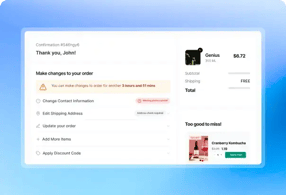
Most Pirate Ship sellers don’t need ClickPost yet. It handles the customer side of an order after checkout and gives the brand’s team a unified dashboard for shipping and post-purchase. It does not offer postage discounts, though brands can create shipments across 700+ integrated carriers.
What ClickPost does
-
Shoppers edit their own orders before fulfillment, including address changes and cancellations.
-
Branded tracking pages show live shipment status and delivery estimates.
-
Tracking pages carry product recommendations, style guides, and custom banners.
-
Email and SMS notifications go out at shipment milestones.
-
A self-serve returns portal offers exchange and store credit options.
-
Return policies can be set per customer segment, based on purchase and return history.
-
Returns protection can be sold at checkout, at a fee the brand sets.
When ClickPost is worth considering
-
Order status questions make up a large share of support tickets.
-
Customers regularly ask to change or cancel orders after checkout.
-
Returns are frequent enough to need set policies and a self-serve portal.
| What you are deciding | Pirate Ship | ClickPost |
| Main role | Buying and printing labels | Managing the order after checkout |
| Postage discounts | Built-in for USPS and UPS | Not offered |
| Pricing | Free | Custom quote |
| Carrier coverage | USPS and UPS | 700+ carrier integrations |
| Connects with | Stores and marketplaces | Storefronts, OMS and WMS, and messaging tools like Klaviyo |
| Setup | Self-serve | Guided onboarding |
Which Pirate Ship alternative fits you?
| Your trigger for leaving | Pick | Why |
| Need FedEx on a zero budget | Veeqo | Free with FedEx and DHL rates |
| Want more carriers plus branded tracking | Shippo | Pro-brand tracking, and a shipping API covers custom stores |
| Manual label work is slowing fulfillment | ShipStation | Automation rules on every plan |
| Overselling or kitting across channels | Ordoro | Stock stays in sync across every warehouse |
| International orders are growing | Easyship | Duties and taxes shown at checkout on Premier |
| WISMO tickets and returns are straining your team | ClickPost | Order edits, tracking and returns in one platform |
Keep your USPS savings when you switch
USPS charges two prices for the same service. Retail applies at the post office counter, and a lower commercial price applies to labels bought online through approved shipping software. Because that price comes from USPS, it stays with you when you change tools.
-
A typical 1 lb Ground Advantage label drops from $10.95 to $8.74 with commercial pricing, according to USPS Notice 123, effective April 26, 2026.
-
All five alternatives sell USPS labels at commercial pricing.
-
Pirate Ship goes below commercial pricing on some labels through cubic rates and USPS Connect eCommerce, so a few lanes may cost more elsewhere.
-
Priority Mail discounts change sharply by zone, so the same label can cost quite differently depending on where it ships.
How to switch from Pirate Ship: 6 steps
-
Export your shipment and cost reports, which give you a baseline for comparing rates on the new platform.
-
Request refunds on unused labels within the refund window, as they can take several weeks to clear.
-
Set up FedEx or other carrier accounts early, since approval can take time.
-
Recreate your package presets before building automation rules, since most rules assign a package or service.
-
Connect your stores and disconnect Pirate Ship on the same low-volume day, so no order gets labeled twice.
-
Keep your Pirate Ship account open until refunds and insurance claims on past shipments are settled.
Frequently asked questions
What is the best alternative to Pirate Ship?
It depends on which gap you need to fill. Veeqo is the closest free match and adds FedEx and DHL. Shippo suits sellers who want more carriers along with branded tracking. ShipStation fits stores where order volume calls for automation, and Ordoro suits brands managing inventory and suppliers. Easyship is the strongest option for growing international sales.
Is Pirate Ship really free?
Yes. Pirate Ship charges no subscription and adds no markup or label fees, so the only cost is postage.
How does Pirate Ship make money?
Its help center says it earns revenue through official partnerships with USPS and UPS. Veeqo runs on a similar model, earning a commission on labels bought through it.
Does Pirate Ship support FedEx?
No. Pirate Ship supports USPS and UPS only. Veeqo offers FedEx at no software cost, and Shippo and ShipStation support it as well.
Pirate Ship vs Shippo: which is better?
Pirate Ship has no software fees, while Shippo’s free plan stops at 30 labels a month and Pro starts at $17. In return, Shippo adds more than 40 carriers and a shipping API. Pirate Ship suits sellers focused on cost, and Shippo suits those who need wider carrier choice.
Will I lose USPS discounts if I leave Pirate Ship?
No. USPS commercial pricing comes from USPS and carries over to any approved platform. Pirate Ship does go below commercial pricing on some labels through cubic rates and USPS Connect eCommerce, so a few lanes may cost more elsewhere.
The bottom line
Pirate Ship remains hard to beat for small sellers who ship with USPS and UPS. The case for leaving grows as the business expands and needs more than two carriers or a way to manage inventory. At that point, a paid tool often costs less than the workarounds needed to keep a free one running.
 4.8

 4.4

Looking for a Better
Alternative to Outvio?
We use cookies to keep the site working, understand usage, and improve your experience. Learn more
Always active for essential site performance and security.
Enables anonymous usage analysis to refine our services.
Used to present relevant promotions and advertising.