









TL;DR Summary
The most-cited US benchmark, a 2020 Loqate survey of retailers, found that 8% of first-time deliveries failed, costing an average of $17.20 each, and no newer independent US benchmark has been found. Carrier pricing has clearly changed: in 2026, a single address correction costs $25.50 at FedEx and $25.25 at UPS, and both carriers have scheduled further increases.
-
8% of US first-time deliveries failed, as reported by retailers (Loqate, survey fielded December 2020)
-
$17.20 average cost per failed US delivery in the same survey
-
$25.50 FedEx and $25.25 UPS charge per address correction under 2026 fee schedules
-
71% of retailers in the US, UK, and Germany agree inaccurate addresses are a primary cause of failed delivery
-
47.7 million US adults estimated to have had a package stolen in the past year (Security.org, September 2026 survey)
Failed delivery statistics are easy to find and hard to trust. Many figures online trace back to a few studies, some more than five years old.
This article fixes two common problems:
-
Old data presented as new. Every statistic below shows when it was collected.
-
Different measures mixed. We keep failed attempts, delivery problems, returns, and theft separate.
Sources include Loqate, Descartes, the USPS Office of Inspector General (OIG), Security.org, SafeWise, and the 2026 fee schedules from FedEx and UPS.
What Is the First-Attempt Delivery Failure Rate in the US?
No current, independent US first-attempt failure rate is publicly available. The most cited benchmark is 8%, from Loqate's Fixing Failed Deliveries report, based on a December 2020 survey of 304 retail executives.
| Statistic | Value | Who or what was measured | Geography |
| First-time deliveries that failed | 8% | Retailers reporting on their own deliveries | US |
| Same measure in Loqate’s earlier poll | 5% | Retailers | US |
| Retailers with more than 1 in 10 orders failing the first time | 24% | 304 retail executives | US, UK, Germany |
| Shoppers who received every order on time | 13% | US online shoppers | US |
| Shoppers with more than five fulfillment failures | 12% | US online shoppers | US |
| Consumers reporting delivery problems | 66% (79% of ages 18 to 35) | 8,000 consumers | Europe and North America |
How to read these numbers
-
The 8% is retailer-reported, not carrier data. Loqate does not explain how responses were combined.
-
It is a 2020 figure. Use it as a historical reference point, not a 2026 rate.
-
Descartes' 2025 study measures any delivery problem a shopper reports, including late or damaged parcels.
-
Descartes covers Europe and North America, so it is not a US-only figure.
-
The Loqate and Descartes figures measure different things and should not be merged.
Failed Deliveries, RTO, Delivery Problems and Theft: What Each Statistic Measures
Published figures range from single digits to above 60% because they count different events. The table below defines each one.
| Term | What it means | Where it is usually recorded |
| Failed delivery attempt | The carrier cannot complete a stop: wrong or incomplete address, nobody available, access problem | Carrier exception scans and attempt notices |
| First-attempt failure rate | Share of shipments not delivered on the first attempt | Retailer or carrier performance data |
| Return to origin (RTO) | The carrier stops trying and returns the package to the shipper, also called return to sender | Carrier return scans; retailer returns logs |
| Consumer-reported delivery problem | Any issue a shopper reports, including late, damaged, or missing parcels | Consumer surveys |
| Delivered but not received | Tracking shows delivered, but the customer does not have the package | Customer claims and support tickets |
| Package theft | A delivered package is taken before the recipient collects it | Consumer surveys, police reports, retailer claims |
How Much Does a Failed Delivery Cost?
The most recent published US benchmark is $17.20 per failed delivery, from Loqate's 2020 retailer survey. No newer independent US average was found.
What the research shows
-
Loqate links the $17.20 to redelivery, refunds, and apology discounts.
-
The average US retailer in the sample shipped 140,792 orders a year and lost $193,730 to failed deliveries.
-
45% of US businesses said each failure also brought a $1 to $20 chargeback.
-
Live service contacts cost $8.01 each in Gartner's 2019 poll, against about $0.10 for self-service. This benchmark is older and not US-specific.
What has changed since 2020
-
FedEx raised its address correction charge from $24 (2025) to $25.50 (2026).
-
UPS raised its charge from $23.50 (2025) to $25.25 (2026).
-
Because carrier fees have risen, the 2020 cost should not be read as a 2026 cost.
Illustrative scenario: annual failed delivery cost using Loqate’s 2020 inputs
| Monthly orders | Annual orders | Failed deliveries at 8% | Cost at $17.20 each |
| 1,000 | 12,000 | 960 | $16,512 |
| 10,000 | 120,000 | 9,600 | $165,120 |
| 50,000 | 600,000 | 48,000 | $825,600 |
| 100,000 | 1,200,000 | 96,000 | $1,651,200 |
- This table uses a 2020 failure rate and a 2020 cost. It is a planning illustration, not a 2026 measurement.
- Your real cost depends on carriers, destinations, order values, and how often a failure becomes a refund or reshipment.
What Do FedEx and UPS Charge for Address Corrections in 2026?
FedEx charges $25.50 per address correction in 2026, per its 2026 surcharge and fee schedule. UPS charges $25.25 per package, capped at $175.25 per shipment, per its revised 2026 rates.
| Charge | FedEx 2026 | UPS 2026 | When it applies |
| Address correction | $25.50 per correction | $25.25 per package; max $175.25 per shipment | Carrier corrects or completes an address |
| Reroute or intercept | $25.50 per package (Reroute of Shipment) | $21 web request; $27 phone request (Delivery Intercept) | Shipper or recipient redirects a package in transit |
| Residential delivery | $6.45 per package (Ground, Home Delivery) | $6.50 per package (Ground) | Delivery to a residential address |
| Delivery area, residential | $6.60 per package | $6.55 per package | Residential delivery in a designated ZIP code |
| Delivery area, extended residential | $8.80 per package | $8.85 per package | Residential delivery in an extended-area ZIP code |
| Remote area, contiguous US | $16.75 per package | $16.50 per package | Delivery in a designated remote ZIP code |
| Effective from | Jan 5, 2026 | Dec 22, 2025 |
List prices; negotiated contracts may differ |
Illustrative example 1: stacked surcharges
-
A FedEx Home Delivery package to an extended residential ZIP code pays $6.45 (residential) plus $8.80 (delivery area) = $15.25.
-
If FedEx also corrects the address, add $25.50, for $40.75 in list-price surcharges.
-
This excludes the base rate and any fuel surcharge.
Illustrative example 2: annual correction fees
-
A brand ships 10,000 FedEx orders a month.
-
Assume 2% need an address correction. This is an assumption, not a benchmark.
-
That is 2,400 corrections a year, or $61,200 at $25.50 each.
Myth check: the "$18 FedEx reattempt fee"
-
FedEx's 2026 schedule lists Delivery Reattempt only for U.S. Express Freight, at the greater of $97 per shipment or $0.106 per pound.
-
The $18 line in the same document is FedEx Priority Alert, a separate premium service.
What Causes Most Failed Deliveries?
Inaccurate addresses are the most cited cause. In Loqate's 2020 survey, 71% of retail executives in the US, UK, and Germany said it is a primary cause of failed delivery.
No recent neutral US study ranks every cause by share. Here is what the evidence shows for each:
-
Address errors. 74% of retailers said bad address data causes up to a quarter of their failures. 34% did not verify customer addresses, though 83% of US retailers did.
-
Address entry problems. 13% of smartphone shoppers struggled to enter their address (US, UK, and Germany). 56% of US consumers call it a chore.
-
Recipient not available. Missed deliveries lead to reattempts, holds, and returns. No neutral source measures this cause's share.
-
Theft after a delivery scan. These usually show as completed deliveries in carrier data.
-
Carrier and network issues. Mis-sorts, damage, and peak-season strain. No public US breakdown was found.
A note on Loqate's 39% and 41% figures: Loqate reports that inaccurate addresses lead to 39% of deliveries failing and 41% being delayed. The report does not state the base, so treat these as directional.
Loqate's Matthew Furneaux put it: "Address verification plays a critical role in the digital shopping experience."
How Many Delivery Attempts Do Carriers Make?
UPS says it may make up to three delivery attempts at its discretion, then returns undeliverable packages to the sender, per its InfoNotice guidance.
-
FedEx: no single attempt limit appears in the 2026 fee schedule. Confirm in the FedEx Service Guide or with your account representative.
-
UPS intercept fee (2026): $21 by web, $27 by phone.
-
FedEx reroute fee (2026): $25.50 per package.
Package Theft Statistics: How Big Is the "Delivered but Not Received" Problem?
Package theft is large enough to distort delivery data. Security.org estimates 47.7 million US adults had a package stolen in the past year, and a USPS OIG white paper estimated losses at $5 billion to $16 billion per year.
| Source | What is counted | Value | Method | Period |
| Security.org 2026 report | US adults who had a package stolen | 47.7 million people; $7.7B in stolen goods | Online survey of 3,494 US adults, three-month rate annualized | Survey Sept 22 to 24, 2026 |
| SafeWise 2025 report | Packages stolen from US households | 104.3 million packages in about 91 million incidents | Survey-based estimate | 12 months before Nov 2025 |
| USPS OIG, citing Security.org | Packages stolen | At least 58 million packages | Third-party survey estimate compiled by the OIG | 2024 |
| USPS OIG, compiling third-party estimates | Annual financial losses | $5.2 billion to $16 billion | Range across Finder, Security.org, and SafeWise estimates | 2023 to 2024 |
Why these numbers differ
-
Security.org counts people. SafeWise counts packages. The OIG compiles other estimates.
-
The OIG notes that theft, misdelivery, and false claims are hard to separate.
-
Retailers often absorb replacement costs. One national retailer told the OIG it moved business away from carriers because lost package claims grew too high.
-
Practical step: track "delivered but not received" claims as their own metric, not just carrier failure data.
How Do Failed Deliveries Affect Customer Retention?
In a 2020 Loqate survey of 1,200 Americans, 57% said they would avoid a retailer after a negative delivery experience. This measures stated intent, not actual churn.
-
57% of consumers in the US, UK, and Germany would be reluctant to reuse a retailer after a fulfillment failure (Loqate, 2021).
-
60% of retailers say customers blame them, not the courier, for delivery issues (Loqate).
-
41% of consumers blamed the retailer for late orders; 32% blamed the courier (Loqate).
-
12% would post a negative review and 9% would complain on social media (Loqate).
-
63% of consumers with a delivery problem took action that hurt the retailer or carrier (Descartes 2024, Europe and North America).
What Changes in 2027?
Delivery volume and carrier prices are both rising. US retail e-commerce sales reached $340.2 billion in Q2 2026, according to the Census Bureau.
-
That was 17.1% of total retail sales.
-
It was 12.2% higher than in Q2 2025.
-
FedEx and UPS have both announced 5.9% average rate increases for 2027.
| Item | Figure | Effective date | Status | Source |
| UPS daily rate increase | 5.9% average net increase | Dec 21, 2026 | Announced by UPS | UPS Shipping Zones and Rates |
| UPS address correction | $27.50 per package, up from $25.25 | Dec 21, 2026 | Reported from UPS 2027 rate preview | TransImpact; PARCEL Industry |
| FedEx list rate increase | 5.9% average increase | Jan 4, 2027 | Announced by FedEx | Supply Chain Dive; FedEx 2027 Standard List Rates |
| FedEx address correction | $27.00 per correction, up from $25.50 | Jan 4, 2027 | Confirmed in FedEx 2027 surcharge and fee schedule | FedEx 2027 Changes to Surcharges & Fees |
| US e-commerce revenue projection | $1.88 trillion by 2029, from $1.22 trillion in 2024 | 2029 | Projection, not a current measurement | USPS OIG, Package Theft in the United States, citing Statista |
-
The UPS $27.50 figure comes from parcel audit firms reviewing UPS’s 2027 preview. UPS’s rates page links to that preview, but no official UPS document confirms the fee.
-
The Statista projection uses a different revenue definition than Census data, so you shouldn't compare the two directly.
Failed Delivery Trends to Watch
Address correction fees are rising faster than average rates
-
UPS’s address correction fee is scheduled to rise 8.91%, from $25.25 to $27.50 per package, on December 21, 2026, according to TransImpact’s review of the UPS 2027 preview.
-
That is 3.01 percentage points above UPS’s 5.9% average daily rate increase.
-
FedEx’s fee rises 5.88%, from $25.50 to $27, on January 4, 2027, per its 2027 surcharge schedule.
-
Takeaway: give address-related fees their own line in your shipping budget.
Younger shoppers report more delivery problems
-
79% of consumers aged 18 to 35 reported delivery problems, vs 66% overall (Descartes 2025, Europe and North America).
-
43% of under-35s increased online spending year on year.
Apartment residents face higher theft risk
-
10% of apartment residents had a package stolen in the past three months, vs. 3% in single-family homes (Security.org, 2026).
-
37% of all respondents hesitated to order online because of theft concerns.
Secure pickup options are expanding
-
USPS offered more than 500 Smart Locker locations as of summer 2024 (USPS OIG).
-
The OIG lists lockers, scheduled delivery, and pickup points as key defenses against porch theft.
How Can Ecommerce Brands Reduce Failed Deliveries?
Start with failures that appear on carrier invoices, since they are easiest to measure. These steps run from checkout to delivery:
-
Validate addresses at checkout, with separate fields for apartment and suite numbers.
-
Let customers correct their address before the label is created, when no carrier fee applies.
-
Send shipping and out-for-delivery notifications so recipients can prepare.
-
Offer lockers, access points, or store pickup in apartments and high-theft areas.
-
Review carrier invoices monthly for corrections, reroutes, and residential charges. Dispute corrections where the address was already right.
-
Track first-attempt failures, "delivered but not received" claims, and WISMO queries as separate metrics.
-
Compare carriers by destination, since area surcharges differ by carrier and service.
Where ClickPost fits
ClickPost's US post-purchase platform supports several of these steps.
Before the order ships
-
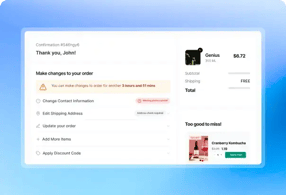
Order editing lets shoppers update details such as the shipping address themselves.
-
Address validation is built into the editing flow.
-
Merchants can set an editing window that matches their fulfilment cutoff.
After the label is created
-
An address change is no longer a simple edit and may trigger carrier correction or reroute charges.
-
Branded tracking pages and proactive delay and exception alerts keep customers informed.
-
AI-assisted NDR resolution helps teams act faster on delivery exceptions.
These tools won't prevent every failed delivery or stop theft. They help brands catch more preventable problems before carrier fees and refunds apply.
Failed Delivery Statistics at a Glance
| Statistic | Value | Measured | Geography | Period | Source |
| First-time deliveries that failed | 8% | Retailer-reported | US | Dec 2020 survey | Loqate |
| Average cost per failed delivery | 17 | Retailer-reported | US | Dec 2020 survey | Loqate |
| Retailers with more than 1 in 10 orders failing first time | 24% | Retail executives | US, UK, Germany | Dec 2020 | Loqate |
| Retailers agree bad addresses are a primary cause | 71% | Retail executives | US, UK, Germany | Dec 2020 | Loqate |
| US retailers verifying addresses at checkout | 83% | Retail executives | US | Dec 2020 | Loqate |
| Consumers who would avoid a retailer after a bad delivery | 57% | 1,200 consumers | US | 2020 | Loqate (GBG) |
| Consumers reporting delivery problems | 66% | 8,000 consumers | Europe and North America | Q1 2025 | Descartes |
| FedEx address correction charge | $25.50 | Published list price | US | 2026 | FedEx |
| UPS address correction charge | $25.25 | Published list price | US | 2026 | UPS |
| US adults who had a package stolen | 47.7 million | Annualized survey estimate | US | 12 months to Sept 2026 | Security.org |
| Packages stolen | 104.3 million | Survey-based estimate | US | 12 months to Nov 2025 | SafeWise |
| Annual package theft losses | $5.2B to $16B | Range of third-party estimates | US | 2023 to 2024 | USPS OIG |
| Cost per live service contact | $8.01 | Poll of service leaders | Not US-specific | 2019 | Gartner |
| Ecommerce share of US retail sales | 17.10% | Seasonally adjusted | US | Q2 2026 | US Census Bureau |
The Bottom Line
-
The best-known figures, 8% and $17.20, come from a survey fielded in December 2020. No independent US study has replaced them.
-
Carrier pricing is easier to measure: one address correction now costs more than Loqate's entire average cost per failure.
-
FedEx and UPS have both scheduled further increases for 2027.
Your next step: pull 90 days of carrier invoices, count address corrections, reroutes, and intercepts, then add "delivered but not received" refunds. Compare that total with your order volume to get your own baseline.
Failed Delivery Statistics FAQs
What is the first-attempt delivery failure rate in the US?
There is no current, independently measured US rate. The most cited benchmark is Loqate's December 2020 retailer survey, which found 8% of US first-attempt deliveries failed, up from 5% in its 2017 poll. Treat 8% as a historical, retailer-reported reference point rather than a 2026 rate.
What are the most common reasons deliveries fail?
Retailers most often cite inaccurate or incomplete addresses. In Loqate's 2020 survey, 71% of retail executives in the US, UK, and Germany said inaccurate addresses are a primary cause of failed deliveries. Other main causes include recipients not being available, theft after a delivery scan, and carrier errors such as damage or mis-sorting.
How much does a failed delivery cost?
The most recent published US benchmark is $17.20 per failed delivery, from Loqate's 2020 retailer survey, covering costs such as redelivery, refunds, and apology discounts. No newer independent US average was found. Carrier charges linked to failures, including address corrections, have increased since then, so the 2020 figure should not be read as a 2026 cost.
How much do FedEx and UPS charge for address corrections?
In 2026, FedEx charges $25.50 per address correction, and UPS charges $25.25 per package, capped at $175.25 per shipment. Both charge when they correct or complete an incorrect or incomplete address. FedEx’s fee rises to $27 per correction on January 4, 2027. UPS’s fee is scheduled to rise to $27.50 per package on December 21, 2026, according to parcel audit firms reviewing its 2027 rate preview.
How many delivery attempts do carriers make?
UPS states that it may make up to three delivery attempts at its discretion, after which it returns undeliverable packages to the sender. FedEx does not state a single-attempt limit in its 2026 fee schedule, so shippers should confirm the current FedEx policy in its service guide or with their account representative.
What is the difference between a failed delivery and an RTO?
A failed delivery is an unsuccessful attempt to deliver a package. Return to origin (RTO), also called return to sender, happens when the carrier stops attempting delivery and sends the package back to the shipper. An RTO usually follows one or more failed attempts, and the shipper typically absorbs the return and any reshipment or refund.
Is package theft counted as a failed delivery?
Usually not. When a package is stolen after the carrier scans it as delivered, carrier records typically show a completed delivery. The USPS Office of Inspector General notes that available data makes it hard to separate theft, loss, and misdelivery, so brands should track "delivered but not received" claims separately from carrier failure data.
How can ecommerce brands reduce failed deliveries?
Start with address quality. Loqate's 2020 survey found 34% of retailers in the US, UK, and Germany did not verify shipping addresses. Validate addresses at checkout, allow address edits before fulfillment, send shipping and delivery notifications, offer secure pickup options in high-theft areas, and review carrier invoices monthly for correction charges.