.png?width=193&height=27&name=ClickPost%20Logo%20(Blue).png)
.svg)
.svg)
.svg)
.svg)
.webp?width=286&height=206&name=ROI%20Calculator%20(2).webp)
.svg)
.svg)
.svg)
.svg)
.svg)
.svg)
.svg)
.svg)
.svg)
.webp?width=286&height=206&name=Frame%201171276203%20(11).webp)
.svg)
.svg)
.svg)
.svg)
.webp?width=286&height=206&name=ROI%20Calculator%20(3).webp)
.svg)

.svg)
.svg)
.svg)
.webp?width=286&height=206&name=ROI%20Calculator%20(4).webp)



In this blog
TL;DR Summary
- Narvar: Best for enterprise US retailers with stores and heavy returns volume
- AfterShip: Best for Shopify brands that want branded tracking live this week
- Loop Returns: Best for Shopify brands that want exchanges instead of refunds
- Redo: Best for Shopify brands that want returns funded by shopper-paid coverage
- Route: Best for brands fighting porch piracy and lost-package claims
- parcelLab: Best for enterprise brands shipping across the US and Europe
- WeSupply Labs: Best for omnichannel retailers running BOPIS and curbside
- LateShipment.com: Best for brands that want carrier billing audits alongside tracking
Most US DTC brands spend heavily to win the first order. Then the package ships, the customer lands on a carrier page, and the brand goes quiet until something breaks. That stretch between "order placed" and "order in hand" decides whether the second order ever happens.
The US numbers make the case on their own:
- Two-thirds of US online shoppers feel anxious after they click "buy," and 86% ran into at least one delivery issue in the past year, according to Narvar's 2025 State of Post-Purchase report, based on 3,461 US shoppers.
- 74% had a late delivery. After one bad experience, 60% of shoppers aged 18 to 29 say they won't shop with that retailer again.
- 73% say estimated delivery dates affect whether they buy, and 40% won't complete a purchase if no date is shown, as Chain Store Age reported.
- US shoppers were expected to return $849.9 billion in merchandise in 2025, and 19.3% of online sales, per the NRF and Happy Returns.
- 71% of shoppers say a poor returns experience makes them less likely to buy again, eMarketer reported.
A post-purchase experience platform is how you take that stretch back from the carrier. We reviewed the leading options for US DTC brands on tracking, notifications, returns, delivery exceptions, US carrier fit, and what they actually cost.
Quick Comparison: US Post-Purchase Platforms by Fit and Pricing (2026)
| Platform | Best for | Starting price | Pricing model | Free plan |
| Narvar | Enterprise omnichannel retail | Custom quote | Annual contract by volume and modules | No |
| AfterShip | SMB to mid-market Shopify brands | $29/month (Essentials, 6,000 shipments/year) | Tiered by shipment volume | Yes |
| Loop Returns | Returns-heavy Shopify brands | $155/month (Essential) | Annual subscription; tracking sold separately | Yes (Checkout+) |
| Redo | Shopify DTC, returns plus tracking | No fixed fee for returns | Shopper-paid coverage plus usage-priced modules | Yes (merchant side) |
| Route | Package protection and claims | Free to install | Shopper-paid protection; add-on modules | Yes (install) |
| parcelLab | Enterprise US and EU brands | Custom quote | Quote by module (Convert, Engage, Retain) | No |
| WeSupply Labs | Omnichannel mid-market | About $59/month | Tiered by shipments and returns | Yes (tracking) |
| LateShipment.com | Tracking plus carrier audit | $0.065 per shipment | Usage-based per module | 60-day trial |
Prices are list prices from vendor pricing pages and app listings checked in September 2026. Most vendors discount annual billing, and enterprise quotes vary by volume.
Why Post-Purchase Is the Biggest Retention Lever for US DTC Brands
Post-purchase is the one part of the journey your customer spends waiting. They have paid, they are excited, and they are checking their phone. Silence reads as a problem.
Where the money moves:
- Repeat purchases. In PwC's 2025 Customer Experience Survey, 52% of consumers said they stopped buying from a brand after a bad product or service experience. Late and lost packages are the most common version of that for DTC.
- Support cost. "Where is my order?" (WISMO) is the ticket type most DTC teams see first when tracking goes dark. Every one of those tickets is a question a tracking page or a proactive text could have answered.
- Returns margin. Returns are now a buying criterion, not an afterthought. 82% of shoppers call free returns a major consideration, and 76% are more likely to choose an option with an instant refund or exchange, per Chain Store Age's coverage of the NRF report.
- Fraud exposure. The NRF found 9% of all returns are fraudulent. Your returns flow needs rules, not just a form.
Shipping is most of what customers remember about ordering online. Nearly all (90%) US online shoppers say the shipping experience makes up at least half of their overall online shopping experience, according to UPS Capital research cited by eMarketer.
What Is a Post-Purchase Experience Platform?
A post-purchase experience platform (also called post-purchase software, a post-purchase experience management platform, or a post-purchase customer journey tool) is the layer that runs everything between checkout and a resolved delivery or return. It sits between your storefront and your carriers and replaces three things most brands live with: carrier tracking pages, generic shipped and delivered emails, and returns handled over email.
The six core functions:
- Order tracking: A branded tracking page on your domain that handles split shipments and multiple tracking numbers.
- Shipping notifications: Email and SMS alerts for shipped, out for delivery, and delivered, plus exception alerts.
- Delivery exception handling: Triggers for stalled scans, failed delivery attempts, address problems, and lost packages, with clear next steps for the customer.
- Returns and exchanges: A self-service portal with eligibility rules, label creation, drop-off options, and exchange or store credit offers.
- Analytics: Carrier on-time rates, exception rates, return reasons, and WISMO drivers by carrier and lane.
- Integrations: Shopify and other commerce platforms, helpdesks like Gorgias and Zendesk, email and SMS tools like Klaviyo and Attentive, 3PLs, and carriers.
Why US DTC Brands Choose ClickPost for Post-Purchase Experience
Disclosure: ClickPost publishes this guide, so we kept ourselves off the ranked list. The eight platforms below are scored on their own merits. This section explains where ClickPost fits next to them, and when it doesn't.
Most US DTC brands start with a stack of Shopify apps: one for tracking, one for returns, one for package protection. That works until volume, carrier mix, or reporting needs outgrow it. ClickPost is built for the stage after that, when a brand wants tracking, returns, and carrier data in one system its ops team controls.
What ClickPost covers for US brands:
- Branded tracking: A tracking page you control, with care notes, offers, and product recommendations based on the order. ClickPost reports its tracking cuts WISMO tickets by up to 60%.
- Returns and exchanges: A self-serve portal with AI segmentation that sets return policy by customer, so loyal buyers get instant refunds and serial returners get tighter rules.
- Returns protection: Coverage built into the returns flow.
- Shopify order editing: A window you define where shoppers can fix an address, swap a variant, or cancel before it becomes a ticket.
- Carrier depth: 700+ carrier integrations, including USPS, UPS, FedEx, and US regional carriers, with statuses normalized into one view.
- Ops reporting: Custom reports built from 120+ logistics parameters, scheduled daily to annually, and queryable through ClickPost's AI assistant, Felix.
- Security: SOC 2, ISO 27001, ISO 27701, and GDPR.
How ClickPost compares with each of the 8 leaders:
| Platform | Where it leads | Where ClickPost is different |
| Narvar | 200,000+ US drop-off locations, deep omnichannel returns | Goes live in about 4 weeks versus a typical multi-month enterprise rollout; ops-first reporting |
| AfterShip | Free plan, published pricing, fastest self-serve setup | Tracking, returns, and order editing in one contract, with account-managed onboarding |
| Loop Returns | Exchange-first returns and Shop Now flows | Returns and tracking in one platform instead of two products and two bills |
| Redo | Shopper-funded returns with no fixed merchant fee | Carrier-level analytics and exception reporting beyond Shopify-app scope |
| Route | Package protection and claims handling | Full tracking page and returns control stays on your brand's domain |
| parcelLab | Multilingual European communications | US carrier depth and about 4 weeks to live versus roughly 3 months (G2 averages) |
| WeSupply Labs | BOPIS, curbside, and store pickup flows | Deeper multi-carrier normalization and custom logistics reporting |
| LateShipment.com | Carrier invoice audit and refund recovery | Customer-facing tracking and returns are the core product, not an add-on to an audit tool |
When ClickPost is not the right pick:
- You need a nationwide box-free drop-off network today. Narvar or Happy Returns will serve you better.
- You ship under a few hundred orders a month and want a free plan. Start with AfterShip or WeSupply.
- You want zero fixed software cost, paid for by shopper opt-ins. Look at Redo or Route.
- Your core market is Europe and you need fully bespoke multilingual messaging. parcelLab is the stronger fit.
Want to see where your current stack leaks? Take the post-purchase fit assessment or book a demo.
How We Evaluated These Platforms
This list is for US brands shipping at volume and dealing with delivery exceptions every week. We scored each platform on:
- Coverage: Tracking, notifications, returns, and exception handling in one workflow
- US carrier fit: Event quality for USPS, UPS, FedEx, and regional carriers like OnTrac and LSO. USPS alone handled about 31% of US parcels in 2024, per the Pitney Bowes Parcel Shipping Index.
- Shopify and platform fit: Native Shopify and Shopify Plus support, plus BigCommerce, Salesforce Commerce Cloud, and Adobe Commerce
- Returns depth: Exchanges, store credit, fraud rules, and US drop-off options
- Pricing transparency: Whether a buyer can estimate cost before a sales call
- Time to live: Realistic setup time for a mid-market brand
The 8 Best Post-Purchase Experience Platforms for US DTC Brands in 2026
Narvar
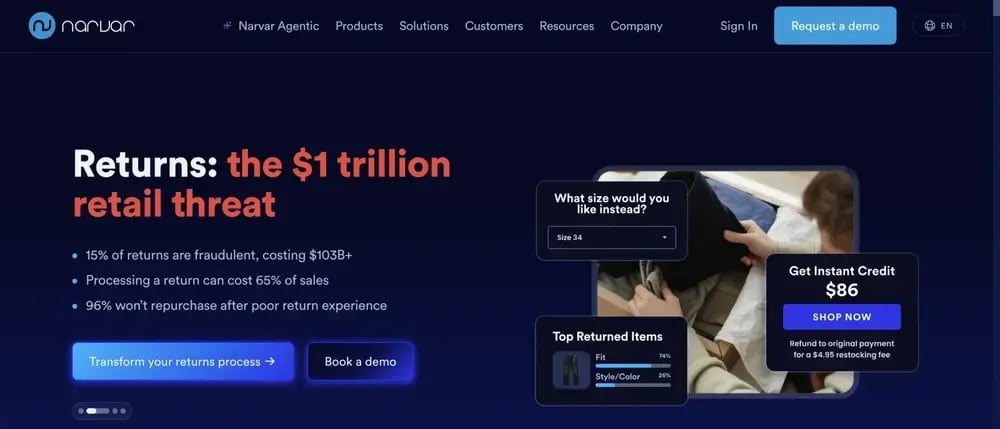
Narvar is the incumbent enterprise choice in US retail. It says it works with 1,500+ brands and runs the largest returns drop-off network in the US. In January 2026 it launched NAVI, an agentic assistant that resolves delivery issues, returns, and exchanges automatically.
Key features
- Branded tracking pages and proactive delivery notifications
- Returns with boxless, printerless, in-store, and home pickup options
- 200,000+ US drop-off locations, per Narvar
- Return policy rules and fees by customer or order attribute
- NAVI agentic assistant for delivery and returns resolution
Best for: Enterprise retailers with stores, high shipment volume, and complex returns.
Integrations: Shopify (dedicated returns app), Salesforce Commerce Cloud, Adobe Commerce, and other platforms; 1,000+ carrier partnerships.
Pricing: Custom enterprise quote, based on volume and modules.
Pros:
- The deepest US returns and drop-off network on this list
- Mature exception and fraud tooling at scale
Cons:
- Long, sales-led implementation
- Cost and complexity rule it out for most sub-enterprise brands
AfterShip
AfterShip is the default starting point for Shopify brands. The free plan is real, pricing is published, and most stores can get a branded tracking page live in days. The upgrade path runs from tracking to notifications to AI delivery dates and returns.
Key features
- Branded tracking page with automatic carrier detection
- Email and SMS alerts for every milestone and each revised delivery date
- AI-powered estimated delivery dates on Premium
- Order Edits so shoppers can fix address, size, or items (Premium)
- Apple Wallet order tracking and a separate returns product
Best for: SMB to mid-market Shopify brands that want to cut WISMO fast.
Integrations: Shopify, Salesforce Commerce Cloud, Magento 2, BigCommerce, Amazon; Klaviyo, Attentive, Gorgias, Yotpo, ShipBob; 1,900+ carriers.
Pricing: Free plan. On the tracking pricing page, Essentials is $29/month and Premium is $59/month at 6,000 shipments a year, with 18% off annual billing. Enterprise is custom. Returns starts at $16/month.
Pros:
- Fastest setup and clearest pricing on this list
- Broad carrier coverage, including USPS, UPS, and FedEx
Cons:
- Custom domain, AfterShip branding removal, and API access sit on Premium
- Costs climb with volume, SMS sends, and add-on products
Loop Returns
Loop treats returns as a revenue channel. Its whole design pushes shoppers toward exchanges and store credit before a refund. For Shopify apparel, footwear, and lifestyle brands with real return volume, it is the category benchmark.
Key features
- Shop Now, Instant Exchange, and Bonus Credit (Advanced tier)
- Automated return policies, workflows, and carrier rate shopping
- Fraud prevention on higher tiers
- Checkout+, a free plan funded by an optional shopper-paid fee at checkout
- Order tracking sold as a separate product
Best for: Shopify brands where returns are the biggest margin leak.
Integrations: Shopify and Shopify Plus natively, with custom implementations for other platforms; major helpdesks and 3PLs.
Pricing: Checkout+ is free. Essential starts at $155/month on an annual contract. Advanced adds the exchange features and is listed higher. Tracking starts around $99/month for 2,000 shipments.
Pros:
- The most mature exchange-first returns flows reviewed here
- Clear focus on keeping revenue in the store
Cons:
- The features that justify the price live on Advanced
- Paid tiers require annual contracts, and tracking is a second bill
Redo
Redo flips the pricing model. Instead of charging the merchant for returns, it offers shoppers optional coverage at checkout and uses that to fund free returns. In January 2026 Redo acquired Malomo, one of the best-known branded tracking tools on Shopify, which turns Redo into a returns-plus-tracking platform.
Key features
- AI-powered return flows with exchange-first logic and instant credit
- Package protection with claims handled by Redo
- Branded order tracking through Malomo
- Email and SMS tools plus support automation
Best for: Shopify DTC brands that want returns and tracking with little or no fixed software cost.
Integrations: Shopify-first; Klaviyo, Attentive, and Yotpo through Malomo.
Pricing: Returns are funded by shopper-paid coverage at checkout. Tracking, email, SMS, and other modules are priced by usage.
Pros:
- Very low fixed cost for the returns layer
- One vendor for returns, protection, and tracking
Cons:
- The economics depend on how many shoppers opt in at checkout
- The Redo and Malomo products are still being combined, so check the roadmap before a multi-year commitment
Route
Route started with package protection and built outward. Shoppers opt into coverage at checkout, and Route handles lost, stolen, and damaged claims so your support team doesn't have to. That matters in the US: Narvar found 41% of shoppers have had a package stolen, and 40% abandoned a purchase in the past year because they feared it would be.
Key features
- Opt-in package protection for lost, stolen, and damaged orders
- Fast claims resolution without merchant involvement
- Order tracking, returns, and exchanges
- Cash back loyalty discounts and product recommendations
Best for: Brands with high porch piracy exposure or high-value orders.
Integrations: Shopify through the Route app, plus other major commerce platforms.
Pricing: Free to install. Protection is paid by the shopper at checkout. Other modules carry separate charges.
Pros:
- Takes lost and stolen package claims off your support queue
- Protection revenue can offset other post-purchase costs
Cons:
- Some shoppers push back on checkout add-on fees
- Confirm how much of the tracking experience stays on your domain versus Route's own app
parcelLab
parcelLab is the most communications-led platform on this list. It is strongest for enterprise brands that already ship well but send scattered post-checkout messages. US customers named on its listings include Chico's, YETI, and Urban Outfitters.
Key features
- Convert: predictive delivery dates and order protection
- Engage: embeddable tracking pages and proactive, personalized messaging
- Retain: self-service returns portal with rules and workflows
- White-labeled experience on your own domain
Best for: Mid-market and enterprise brands shipping across the US and Europe.
Integrations: Shopify, Magento 2, Salesforce Commerce Cloud; Zendesk, Gorgias; Klaviyo; 550+ carriers.
Pricing: Quote-based by module. No public pricing page.
Pros:
- Strong brand control across tracking and notifications
- Mature multilingual messaging for cross-border shipping
Cons:
- Enterprise onboarding averages around three months on G2
- Carrier depth is weighted to Europe, so confirm USPS and regional carrier events in your pilot
WeSupply Labs
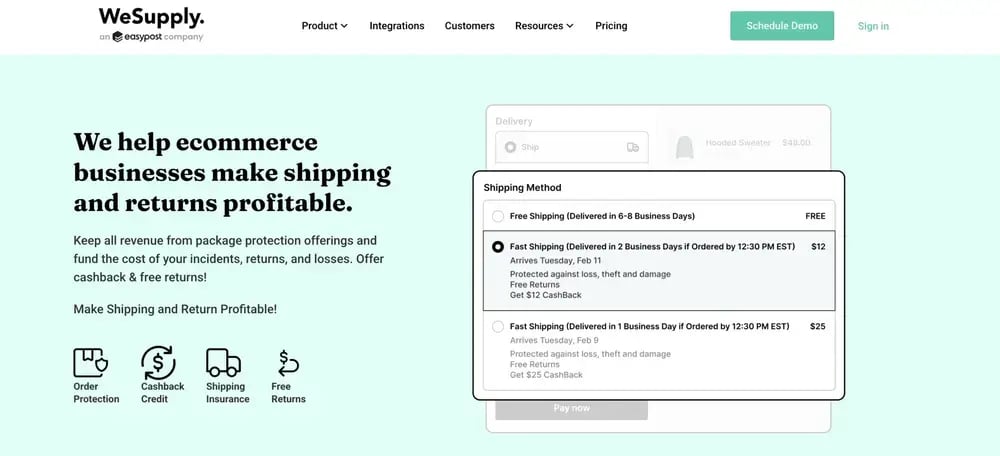
WeSupply bundles tracking, returns, delivery estimates, and store pickup in one product. Its edge is omnichannel: BOPIS, curbside, and buy online, return in store are part of the core product, not a custom build.
Key features
- Branded tracking pages with self-serve order lookup
- Proactive status and exception notifications
- Returns portal with exchange-first defaults and label automation
- BOPIS, curbside pickup, and store locator (some as add-ons)
- Carrier performance and return reason reports
Best for: Mid-market retailers running both stores and ecommerce.
Integrations: Shopify and Magento natively, BigCommerce through Zapier; Klaviyo, Attentive, Zendesk; direct FedEx, UPS, USPS, and DHL, with 100+ more through EasyPost and Shippo.
Pricing: Free Forever plan for tracking. Paid plans start around $59/month, with per-shipment and per-return overages. Enterprise is custom.
Pros:
- Real balance of customer experience and ops reporting
- Omnichannel flows that work without heavy customization
Cons:
- SMS, delivery estimates, and curbside can be add-ons, so price the full bundle
- BigCommerce support runs through Zapier rather than a native app
LateShipment.com
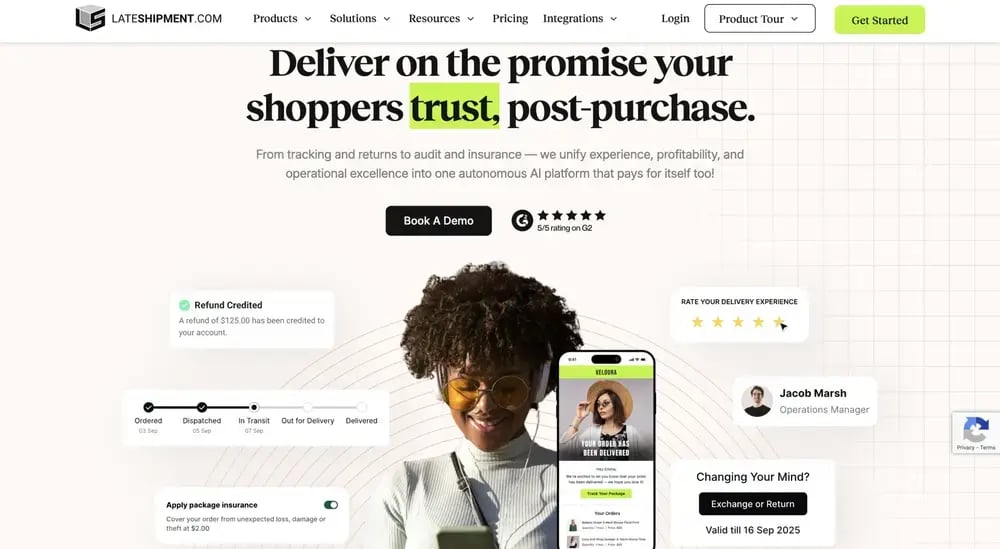
LateShipment pairs standard tracking and returns with a carrier invoice audit engine that files refund claims for billing errors and service failures. For brands with heavy UPS and FedEx spend, the audit can offset part of the platform cost.
Key features
- Branded tracking pages and milestone notifications
- Predictive delay and exception alerts
- Returns portal with exchange-first workflows
- OneAudit invoice audit and refund recovery
- OneProtect shipping insurance
Best for: Brands and 3PLs that want WISMO reduction plus shipping cost recovery.
Integrations: Shopify, Magento, BigCommerce, WooCommerce; Klaviyo, Gorgias, Freshdesk; UPS, FedEx, DHL, USPS, and other major carriers.
Pricing: Usage-based. Tracking at $0.065 per shipment, returns at $0.40 per return, audit at 35% of refunds recovered. 60-day free trial.
Pros:
- Audit recoveries can fund part of the platform
- Modular pricing lets you start with one product
Cons:
- FedEx and UPS guarantees on ground services remain suspended (FreightWaves covers the background), so late-delivery refunds are limited to guaranteed services. Billing error recovery is the bigger lever.
- Customer-facing tracking and returns are lighter than dedicated suites
Also Considered
- Happy Returns (a UPS company): Box-free, label-free drop-off for returns. Strong for returns only, not a full tracking platform.
- Parcel Perform: Enterprise delivery data and carrier analytics. Great for global ops teams, heavier than most US DTC brands need.
- Sendcloud, ZigZag Global, Outvio: Solid platforms built Europe-first. We left them out of this US edition because their carrier networks and drop-off options center on EU lanes.
Best Post-Purchase Solutions by Use Case
Most buyers are not shopping for "a post-purchase platform." They are trying to fix one problem after checkout. Here is where each tool fits.
| Use case | What to look for | Platforms to shortlist |
| Shipping and delivery issues after checkout | Exception alerts, revised delivery dates, self-serve order edits | Narvar, AfterShip, LateShipment.com, ClickPost |
| Order and delivery protection | Opt-in coverage at checkout, automated claims | Route, Redo, LateShipment.com, ClickPost |
| Engagement and monetization | Product recommendations and offers on the tracking page | AfterShip (Premium), Route, ClickPost |
| Win-back and nurturing journeys | Shipment and return events pushed into Klaviyo or Attentive flows | AfterShip, Redo (via Malomo), WeSupply Labs |
| Subscription churn | Delay alerts before renewal, exchanges instead of cancellations | Any shortlisted tool; confirm Recharge or Skio support in the demo |
| Customer satisfaction and feedback | Post-delivery surveys, CSAT on tracking and returns | WeSupply Labs (built-in surveys); others via helpdesk or email tools |
| Post-purchase customer support | Helpdesk integration so agents see tracking and returns in the ticket | AfterShip, parcelLab, WeSupply Labs, LateShipment.com |
| Branded tracking for retention | Custom domain and on-brand content blocks | AfterShip (Premium), parcelLab, Redo (via Malomo), ClickPost |
Tools to Manage Shipping Issues After Checkout
Most delivery problems surface after the order leaves the warehouse, when the brand has the least visibility. The right tools cover three moments:
- Before dispatch: Let shoppers fix a wrong address, size, or item themselves. AfterShip Order Edits and ClickPost order editing both do this on Shopify.
- In transit: Flag stalled scans and send a revised delivery date before the customer has to ask.
- At a failed delivery: Send clear next steps (reschedule, pickup point, address fix) and route unresolved cases to support automatically.
Post-Purchase Order Protection and Coverage Providers
Protection covers lost, stolen, and damaged packages. With 41% of US shoppers reporting a stolen package (Narvar), it is now a standard request from CX teams.
- Shopper-paid coverage at checkout: Route and Redo fund claims through an optional fee the shopper adds.
- Merchant-paid insurance: LateShipment.com's OneProtect is priced at $0.69 per $100 of coverage.
- Built into returns: ClickPost returns protection covers the return leg inside the same flow.
- What to check: Who pays, who files the claim, how fast replacements ship, and how it connects to your checkout.
Post-Purchase Engagement, Monetization, and Win-Back Journeys
Shoppers come back to the tracking page several times per order. Malomo says the average is 4.6 checks per shipment. That makes it one of the most-viewed pages a brand owns.
- Tracking page recommendations: AfterShip Premium adds AI product recommendations and Instant Checkout on the tracking page.
- Loyalty offers: Route offers cash back discounts toward the next purchase.
- Win-back and nurturing flows: Push "delivered" and "return received" events into Klaviyo or Attentive to trigger review requests, replenishment reminders, and win-back offers.
- Keep it light: One relevant recommendation block works better than a wall of banners on a page people open to check status.
Post-Purchase Tools for Subscription Brands
For subscription brands, a late or damaged box often turns into a cancellation.
- Send delay alerts before the next renewal date, not after the complaint.
- Offer an exchange or credit instead of a cancellation for damaged or wrong items.
- Confirm the platform reads orders from Recharge, Skio, or your subscription app, so renewals get the same tracking as one-time orders.
- Measure churn by delivery cohort: customers with a late or failed delivery versus on-time.
Post-Purchase Solutions That Improve Customer Satisfaction
- Measure CSAT and customer effort on tracking and returns separately, since they fail for different reasons.
- Send one short survey after delivery or after a return closes. WeSupply Labs includes surveys; most other tools connect through your helpdesk or email platform.
- Tie every score to carrier and lane, so ops can act on it instead of just reporting it.
How to Choose a Post-Purchase Platform That Builds Customer Trust: 7-Point Checklist
Demos all look good. The differences show up with real carrier data, real return volume, and real peak season. Use this checklist on every shortlisted vendor.
1. US carrier data quality
- Check: Event-level coverage for USPS, UPS, FedEx, and any regional carriers you use
- Check: Status normalization, so "in transit" means the same thing across carriers
- Ask: Can you show us a USPS shipment and a regional carrier shipment side by side?
- Red flag: Long carrier lists with no answer on scan quality or de-duplication
2. Notification control
- Check: Triggers for delays, failed delivery attempts, address issues, and ready for pickup
- Check: Frequency caps so a scan-heavy leg doesn't send five texts
- Check: SMS consent capture and quiet hours that support TCPA compliance
- Ask: Which events can we trigger on without engineering help?
- Red flag: "Omnichannel" that means email plus one SMS template
3. Branded tracking page
- Check: Tracking on your own domain, not a redirect
- Check: Clean handling of split shipments and partial fulfillment
- Check: Content blocks for FAQs, support options, and product recommendations
- Red flag: "Branded" means a logo swap and a color picker
4. Returns and exchanges
- Check: Rules by SKU, category, price, reason, and return window
- Check: Exchange-first options, store credit bonuses, and instant exchanges
- Check: US drop-off options and box-free returns if your shoppers expect them
- Check: Fraud controls, since 9% of returns are fraudulent per the NRF
- Red flag: Exchanges limited to same-variant swaps
5. Delivery promise and package protection
- Check: Estimated delivery dates on product, cart, and checkout pages
- Check: A clear claims path for lost and stolen packages
- Ask: How accurate are your delivery estimates on our lanes, and how do you measure it?
- Red flag: Delivery dates copied straight from the carrier with no adjustment
6. Analytics that drive decisions
- Check: Carrier scorecards for on-time rate, delay reasons, and exception frequency
- Check: WISMO contact rate by carrier, lane, and shipment stage
- Check: Export and API access for your BI team
- Red flag: Fixed dashboards you can't export or schedule
7. Integrations, scale, and total cost
- Check: Native Shopify and Shopify Plus apps, helpdesk integrations, and webhooks
- Check: Which features are included versus add-ons (custom domain, SMS, returns, API)
- Ask: What will we pay at 2x today's volume, and what breaks first?
- Red flag: "Custom pricing" with no reference range, or core features gated behind several upgrades
How to Measure Post-Purchase ROI
A post-purchase platform should pay for itself in two places: fewer support contacts and more repeat orders. Track both, or you will undercount the impact.
The 8 KPIs to track
- WISMO contact rate: WISMO tickets per 100 orders, by carrier and lane
- Cost to serve: Support cost per order, before and after rollout
- Repeat purchase rate: Share of customers reordering within 60, 90, or 180 days
- Customer lifetime value: Cohort-based CLV change after rollout
- Delivery exception rate: Delays, failed attempts, and lost or damaged claims per 100 shipments
- Return resolution mix: Refund versus exchange versus store credit, plus revenue retained
- Return cycle time: Days from return request to resolution
- CSAT and customer effort score: On tracking and returns specifically
A simple ROI model
Gains:
- WISMO tickets avoided x cost per ticket
- Extra repeat orders x contribution margin
- Refunds converted to exchanges x margin kept
- Carrier audit recoveries, where applicable
Costs:
- Subscription and per-transaction fees
- Implementation and integration time
- Ongoing admin time and SMS fees
Benchmark four weeks before launch, then compare 8 to 12 weeks after, by cohort rather than in aggregate. If the numbers don't move, check configuration before you blame the platform. You can plug your own numbers into ClickPost's tracking ROI calculator.
FAQs
What are the best post-purchase experience solutions for ecommerce?
For US DTC brands in 2026, the leading options are Narvar for enterprise retail, AfterShip for Shopify tracking, Loop Returns and Redo for returns and exchanges, Route for package protection, parcelLab for US and EU enterprise brands, WeSupply Labs for omnichannel, and LateShipment.com for carrier audits. ClickPost fits brands consolidating tracking, returns, and carrier data.
What tools improve the delivery experience after checkout?
Look for branded tracking, proactive delay alerts, revised delivery dates, and self-serve order edits. AfterShip, Narvar, LateShipment.com, and ClickPost cover these.
Which companies provide post-purchase order protection?
Route and Redo offer shopper-paid coverage at checkout. LateShipment.com sells OneProtect shipping insurance, and ClickPost offers returns protection inside its returns flow.
How do subscription brands reduce churn with post-purchase tools?
They send delay alerts before renewal dates, offer exchanges or credits instead of cancellations, and measure churn by delivery cohort. Confirm the platform supports your subscription app, such as Recharge or Skio.
How can brands monetize the post-purchase experience?
Add product recommendations and loyalty offers to the tracking page, and push delivery and return events into Klaviyo or Attentive to trigger review requests, replenishment reminders, and win-back flows.
What is a post-purchase experience platform?
It is software that runs everything after checkout: branded tracking, shipping notifications, delivery exception handling, returns and exchanges, and the analytics that connect them to repeat purchases.
Is an order tracking app the same as a post-purchase platform?
No. Tracking apps cover visibility and notifications. A full post-purchase platform adds returns, exception workflows, carrier analytics, and deeper integrations.
Which post-purchase platform is best for Shopify DTC brands?
It depends on your biggest leak. AfterShip is the fastest start for tracking. Loop Returns leads on exchanges. Redo and Route suit brands that want shopper-funded protection. Brands outgrowing a stack of separate Shopify apps often move to a single platform like ClickPost.
How much do post-purchase platforms cost in the US?
Entry tools start free or around $29 to $59 a month. Returns-focused tools like Loop start at $155 a month on annual contracts. Enterprise platforms like Narvar and parcelLab are quote-based.
How long does implementation take?
Shopify-native tools can go live in days. Mid-market platforms usually take two to six weeks. Enterprise rollouts with multiple warehouses and custom data mapping can take three months or more.
Do FedEx and UPS refund late deliveries?
Only for some guaranteed services. FedEx and UPS suspended their money-back guarantees in 2020 and have since reinstated them only for select air services. FedEx still lists its ground guarantee as suspended. Audit tools recover more from billing errors than from late deliveries.
What is the difference between a shipping platform and a post-purchase platform?
A shipping platform handles rates, labels, and carrier selection before dispatch. A post-purchase platform handles what happens after: tracking, notifications, exceptions, and returns. Many brands run both and connect them through the carrier data.
Which teams own the post-purchase stack?
CX and ecommerce operations usually share it. CX owns messaging and ticket deflection. Ops owns exceptions, carrier performance, and cost. See how ClickPost supports CX and support teams and ecommerce ops teams.
The Takeaway
Post-purchase is where US DTC retention compounds or leaks. Shoppers are anxious, deliveries run late more often than brands admit, and returns are a buying decision now. The right platform keeps customers informed without spamming them, catches exceptions before customers do, and steers returns toward exchanges without making refunds feel like a punishment.
How to act on this list:
- Map your post-checkout journey end to end, including every carrier you use
- Shortlist two or three platforms that match your real complexity: carrier mix, split shipments, return volume, and store footprint
- Pilot on a defined cohort and measure WISMO rate, exception rate, repeat purchase rate, return mix, and cycle time
- Expand if the numbers move; fix configuration if they don't
Related reading: [INTERNAL: Narvar alternatives] · [INTERNAL: AfterShip alternatives] · [INTERNAL: Loop Returns alternatives] · parcelLab alternatives for US teams
If your brand is outgrowing a patchwork of tracking, returns, and protection apps, and your carrier data is the real bottleneck, ClickPost is worth a look. See how GOPURE Beauty cut return processing time by 50%, or book a demo.