.png?width=193&height=27&name=ClickPost%20Logo%20(Blue).png)
.svg)
.svg)
.svg)
.svg)
.webp?width=286&height=206&name=ROI%20Calculator%20(2).webp)
.svg)
.svg)
.svg)
.svg)
.svg)
.svg)
.svg)
.svg)
.svg)
.webp?width=286&height=206&name=Frame%201171276203%20(11).webp)
.svg)
.svg)
.svg)
.svg)
.webp?width=286&height=206&name=ROI%20Calculator%20(3).webp)
.svg)

.svg)
.svg)
.svg)
.webp?width=286&height=206&name=ROI%20Calculator%20(4).webp)
How Prepaid Return Labels Work in 2026: A Complete Guide


Ready to delight customers after checkout?
Trusted by 600+ brands
In this blog
TL;DR – Summary
Free returns have shifted from a perk to a purchase prerequisite, with 82% of shoppers weighing return policies before buying. Merchants can control costs significantly through smart billing models, label delivery formats, and automated eligibility rules.
-
Scan-Based Billing – Charge only when customer actually ships
-
QR Code Labels – Eliminate printing friction at drop-off
-
Eligibility Validation – Screen fraud before labels are issued
-
USPS for Light Packages – Cheapest option under one pound
-
Refund-on-Scan – Release refunds only after carrier confirmation
-
Returns Portal Automation – Cuts most common returns support tickets
Why ecommerce brands increasingly rely on prepaid return labels
Free returns have moved from a perk to a purchase condition. In the NRF 2025 Retail Returns Landscape report, 82% of shoppers said free returns weigh on where they buy, up from 76% a year earlier.
A separate YouGov survey found that half of consumers say return policies directly influence their buying decisions, rising to 55% among women. As shoppers come to expect returns that are both free and effortless, prepaid return labels have become the standard way brands provide them.
This guide is written for the person configuring that program, not the shopper mailing a box. It explains how prepaid return labels work, what they really cost to operate, and the policy decisions that separate an efficient returns program from an expensive one.
UPS CEO Carol Tomé put the stakes bluntly on the company's Q1 2026 earnings call, calling returns "the nemesis of anybody who's in the e-commerce space." That makes every operational decision behind a prepaid return label matter, from billing models to fraud controls.
What Is a Prepaid Return Label?
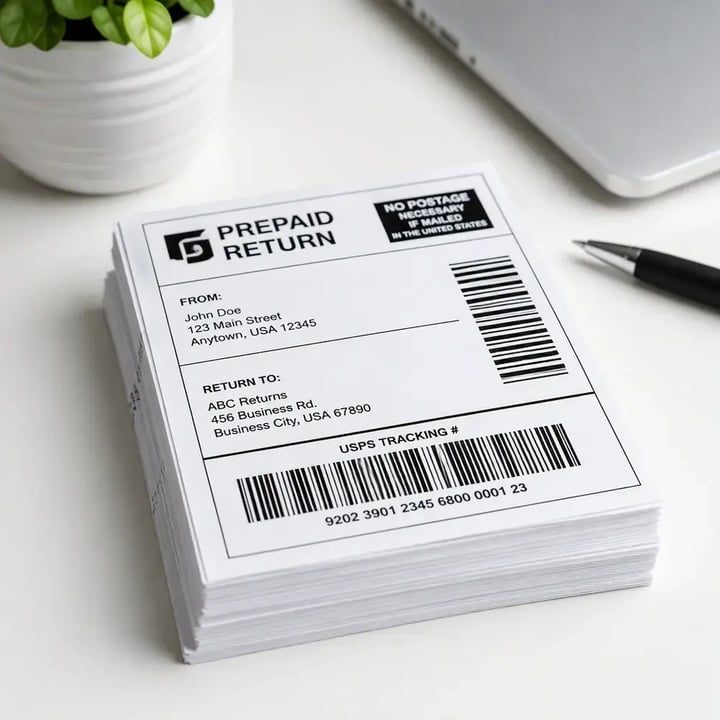
A prepaid return label is a shipping label where the merchant pays the postage in advance, letting customers return an item at no cost to them. The merchant chooses the carrier, the service level, and how the label reaches the customer: printed in the original box, emailed as a PDF, or sent as a scannable QR code that the carrier prints at drop-off.
It helps to separate three things people often lump together. An outbound prepaid label moves a product to the customer. A prepaid return label moves it back to the warehouse at the merchant's expense. A customer-paid return label shifts the return shipping cost to the shopper.
The delivery format matters too. In-box labels arrive inside the original shipment and suit high-return categories like apparel. Digital labels are generated only when requested, so merchants avoid creating labels for returns that never happen. QR code returns remove the need to print anything: customers present the code at drop-off and the carrier prints the label on-site.
How Prepaid Return Labels Work — Step by Step
The prepaid return process looks different for merchants and customers. Separating the two makes it easier to see where merchants control cost, speed, and fraud, and where automation has the biggest impact.
Merchant side
-
A customer initiates a return through a self-serve portal or by contacting support.
-
The merchant or an automation rule validates return eligibility and the stated return reason.
-
A label is generated through the carrier's API.
-
The customer receives the label as a PDF or QR code.
-
The carrier scans the package at drop-off.
-
The inbound scan triggers the refund workflow.
Customer side
-
Receives the label link or QR code.
-
Packs the item.
-
Attaches the label or presents the QR code at a drop-off point.
-
Gets tracking confirmation.
-
Receives the refund.
Step two is where much of the financial control sits. Validating eligibility before a label is issued lets brands screen return reasons, identify serial returners, and enforce policy before paying for return shipping.
The refund decision comes later. In many automated setups, brands release the refund once the inbound carrier scan confirms the return is in transit, using proof the package is moving before any money leaves the account.
USPS vs. UPS vs. FedEx: Prepaid Return Label Options Compared
The right carrier for prepaid returns depends on package weight, drop-off convenience, and total shipping cost. While all three major carriers support prepaid return labels, they differ in pricing, drop-off networks, and service options that affect return costs at scale.
| Feature | USPS | UPS | FedEx |
| Service name | Ground Advantage Return / Priority Mail Return | Electronic Return Label (ERL) | Ground Returns / Print Return Label |
| Cost <1 lb (Zone 3–5) | ~$3.50–$7 commercial; ~$7.90–$9.55 retail | $11.99 retail minimum; ~$7–$9 commercial | $11.99 retail minimum; ~$7–$9 commercial |
| Pay-on-use available | Yes (scan-based return labels) | Yes (scan-based) | Yes (scan-based) |
| QR / label-less drop-off | Yes (USPS Label Broker) | Limited (smart-barcode returns) | Yes (select locations) |
| Drop-off network | ~33,000+ post offices plus collection boxes | ~5,200 UPS Stores plus authorized agents | FedEx Office plus dropbox network |
| Label expiration | Scan-based return: ~1 year | ERL: commonly 30–90 days (verify by account) | Ground returns: account-dependent |
| Best for | Apparel, soft goods under 5 lb | Electronics, declared-value items | Mid-weight goods, suburban coverage |
Reading the table into decisions: USPS is the cheapest path for apparel brands shipping lightweight SKUs, since Ground Advantage carries no dimensional-weight penalty on most small parcels and no residential surcharge.
UPS often justifies its higher rate for high-value shipments that need declared-value coverage or signature confirmation. FedEx tends to fit mid-weight goods where suburban and rural residential coverage matters more than counter density.
Those rates also reflect several pricing changes introduced in 2026. USPS raised prices twice during the year and tightened its dimensional-weight rules, making bulky but lightweight returns more expensive.
UPS and FedEx each implemented a 5.9% General Rate Increase and continue to reserve their best pricing for commercial accounts, making negotiated rates essential for brands handling return volume.
Pay-on-Use vs. Charged-at-Creation: Which Billing Model Should You Choose?
The billing model determines when you pay for return shipping. For brands that issue labels proactively, that choice also determines whether unused labels become a real expense. Most carriers support two billing models: charged-at-creation and pay-on-use.
With charged-at-creation billing, the carrier charges the merchant as soon as a return label is generated, whether or not the customer ever ships the package. That works well for on-request labels, where customers have already decided to return an item and label utilization is typically high.
It becomes expensive when labels go out proactively, since you pay for every label issued, including those that sit in a box unused. With pay-on-use, also called scan-based billing, the carrier charges only when the package is scanned at drop-off, so you pay only for returns that actually enter the carrier network.
The cost difference becomes clearer with a simple example. Say your return rate is 15% and you tuck an in-box label into every order. Under charged-at-creation, you pay postage for the 15 customers who return an item while also paying for labels included with the 85 orders that never come back.
Unused labels can often be voided for a refund within a limited window, but that still requires reconciliation and temporarily ties up cash. Under pay-on-use, you pay only for the 15 labels that actually get used.
For brands including return labels in every shipment, pay-on-use is usually the more economical choice because postage is incurred only when a customer actually returns an item.
How Much Do Prepaid Return Labels Cost in 2026?
The price of a single return label looks small, but a few variables determine what it actually costs you at scale: the carrier, the service level, the package weight, the destination zone, and whether you pay retail counter rates or commercial rates. That last variable creates the largest difference in what you ultimately pay.
Labels generated through returns software or a shipping platform commonly run 15–40% below counter rates because commercial carrier agreements pass through volume discounts a single merchant account does not get. For a package under 1 lb in 2026, the approximate ranges look like this:
-
USPS Ground Advantage Return: Roughly $3.50–$7 at commercial rates, with higher prices at retail. Ground Advantage is USPS's lowest-cost return option for lightweight parcels and carries no residential surcharge or dimensional-weight penalty on most small packages.
-
USPS Merchandise Return Service permit: An annual permit fee plus a per-piece charge. The fixed cost only pencils out above roughly 800–1,000 returns a year. Since permit pricing can change, confirm the current fees with USPS before building your cost model.
-
UPS and FedEx Ground Returns: Both apply an $11.99 retail minimum on a 1 lb package, or about $7–$9 at commercial rates, following each carrier's 5.9% General Rate Increase for 2026. Accessorial surcharges can push the actual per-parcel cost higher.
Some brands choose to recover part or all of that cost by deducting the return label fee from the customer's refund. The NRF's 2025 Retail Returns Landscape reported that 72% of retailers charged a return fee on at least one item in the past year, up from 66% in 2024.
The catch is customer experience. If you deduct, say so in plain policy language at checkout and on the returns page, because unexpected deductions often lead to chargebacks, support tickets, and negative reviews.
Do Prepaid Return Labels Expire? (Policy by Carrier)
Yes, but the expiration window varies by carrier. What matters more is how those policies affect the way you distribute return labels. Expiration matters most for brands that include a return label inside every shipment, where a label can sit unused for months before a customer acts on it.
-
USPS scan-based return labels: Valid for about 365 days from creation, which comfortably covers seasonal return windows. USPS does not prominently document this timeframe, but it is widely reported for its commercial returns program.
-
UPS Electronic Return Labels: Reporting varies between 30 and 90 days depending on service and account terms, so verify your own contract. That is short enough for a label enclosed with a holiday order to expire before the shopper decides to return it.
-
FedEx Ground Returns: Account-dependent; email return labels stay retrievable far longer than the usable ship window, so confirm terms with your FedEx rep.
The operational takeaway: if you send labels proactively, favor digital or QR delivery generated only when the customer initiates a return, rather than a printed label sitting in the box for months. This approach sidesteps expiration entirely and, with pay-on-use billing, costs nothing until the carrier scans the package.
How to Prevent Return Fraud Without Killing the Customer Experience
Fraud hides inside legitimate return volume, and the volume is enormous. The NRF 2025 report pegs total US returns at $849.9 billion and finds 9% of all returns are fraudulent, roughly $76 billion.
Using a broader definition that also counts claims fraud, Appriss Retail and Deloitte put the 2024 loss at $103 billion. The two figures measure different things, but both point to losses large enough to justify additional checks, provided those checks target only high-risk requests.
Fraud gating starts before the label is issued. Instead of generating a prepaid label immediately, the portal first checks whether the return meets predefined validation rules. Three mechanisms do most of the work:
-
Return reason validation. Require a reason before the label generates, and route "changed mind" claims on high-value SKUs to manual review.
-
Photo proof. For items above a set threshold, say $150, require a photo of the defect before the portal issues a label. This helps filter fraudulent "defective" claims before return shipping costs are incurred.
-
Serial-returner flagging. Customers past a frequency threshold, for example three or more returns in 90 days, get routed to manual approval instead of instant issuance.
As AI-powered fraud detection becomes standard practice, the operational challenge shifts to applying those checks without slowing legitimate returns. ClickPost supports two of these controls directly. Brands can make photo proof mandatory in the returns portal before a request is accepted.
Its rules engine can also segment policy by customer behavior, routing high-return customers to exchange-only or store-credit outcomes or capping how many return requests they can raise. Together, these measures deter repeat abuse and weak claims without adding friction for first-time or low-risk returns.
How ClickPost Automates Prepaid Return Label Issuance for Shopify Brands
A prepaid return program is a chain of operational decisions: who qualifies for a label, which format it takes, when the refund releases, and how the customer is kept informed until it does. ClickPost manages that workflow from a single self-serve portal, applying the policy and fraud checks covered above before any label is generated.
For printer-free returns, ClickPost issues QR-code (digital) return labels, so a customer can return an item with nothing but a phone. Brands can also configure returnless (green) returns, approving a refund without requiring the customer to ship the item back when retrieval costs exceed its recovery value. That makes returnless refunds a configurable policy instead of a manual exception.
Once a return is moving, refunds can trigger early, including instant store-credit refunds, rather than waiting on warehouse receipt. Return, exchange, and refund updates are then tracked for both shoppers and brands, with status normalization and de-duplication across carriers. That visibility helps answer "Where is my return?" before it becomes a support ticket.
Before You Issue Your First Prepaid Return Label: An Operations Checklist
Several decisions shape the cost and reliability of a prepaid return program. It helps to work through them before labels go live at scale:
-
Set up carrier accounts and confirm commercial (not retail) rate access.
-
Choose a billing model: pay-on-use for anything shipped proactively, charged-at-creation only for on-request labels.
-
Decide label delivery: in-box, digital, or QR code.
-
Note each carrier's expiration window and align it with your return policy length.
-
Define return reason codes and map which ones auto-approve.
-
Configure fraud gating: reason validation, photo proof thresholds, serial-returner rules.
-
Set the refund trigger: inbound scan for speed, or warehouse receipt for control.
-
Turn on proactive tracking notifications to deflect status tickets.
-
Publish clear policy language for any label cost deducted from a refund.
The Bottom Line on Prepaid Return Labels
A prepaid return label is more than a shipping document. It is an operational decision that affects return costs, cash flow, fraud exposure, and the customer experience.
The strongest return programs make those decisions deliberately rather than by default: carrier selection, billing model, label issuance, and refund timing. Once those are set, the goal is to automate them wherever possible.
ClickPost brings those decisions into a single workflow. Brands can generate prepaid return labels, apply policy-based eligibility rules, and trigger refunds at the right point in the return journey. Customers get end-to-end visibility throughout, without the brand stitching together multiple systems.
If you want to see how those workflows apply to your own return volume, book a ClickPost demo and walk through the returns portal using your own policies and return scenarios.
Frequently Asked Questions About Prepaid Return Labels
What is a prepaid return label and how does it work?
A prepaid return label is a shipping label that lets customers return an item without paying for return shipping because the merchant covers the postage. The customer receives the label digitally, in the original package, or as a QR code, then drops the parcel at the carrier's drop-off location. The merchant is billed either when the label is generated or when the package is first scanned, depending on the billing model.
Who pays for a prepaid return label?
The merchant pays, not the customer. Depending on the billing model, the carrier charges the merchant either when the label is generated (charged-at-creation) or when the returned package receives its first carrier scan (pay-on-use).
What is the difference between a prepaid and a scan-based return label?
Both are prepaid return labels. The difference is when the merchant is charged. Charged-at-creation billing applies as soon as the label is generated, whether or not it is used. Scan-based (pay-on-use) billing applies only when the carrier scans the returned package.
Do prepaid return labels expire?
Yes, and the window varies by carrier. USPS scan-based return labels stay valid about a year from creation. UPS Electronic Return Labels commonly run 30 to 90 days depending on account terms. FedEx return windows are account-dependent, so confirm with your rep.
How do I create a prepaid return label?
You can create labels through a carrier portal (USPS.com, UPS.com, FedEx.com), a third-party multi-carrier shipping platform, or automatically through a returns management platform that generates a label when a customer submits a return request.
How much does a prepaid return label cost?
For a package weighing less than 1 lb in 2026, USPS Ground Advantage runs about $3.50 to $7 at commercial rates, while UPS and FedEx both start at an $11.99 retail minimum, or roughly $7 to $9 commercial. Generating labels through a returns or shipping platform typically costs 15 to 40% less than retail counter rates.
Can I use a USPS prepaid return label with FedEx or UPS?
No. Prepaid return labels are carrier-specific. A USPS label works only at USPS locations, and UPS or FedEx labels require their own networks. USPS Label Broker QR codes are USPS-exclusive.
What is USPS Label Broker and how does it work for returns?
USPS Label Broker lets a merchant send a customer a QR code instead of a printed label. The customer shows the code at a post office counter or self-service kiosk, and USPS prints the label on-site, so no home printer is needed.




We use cookies to keep the site working, understand usage, and improve your experience. Learn more
Always active for essential site performance and security.
Enables anonymous usage analysis to refine our services.
Used to present relevant promotions and advertising.