.png?width=193&height=27&name=ClickPost%20Logo%20(Blue).png)
.svg)
.svg)
.svg)
.svg)
.webp?width=286&height=206&name=ROI%20Calculator%20(2).webp)
.svg)
.svg)
.svg)
.svg)
.svg)
.svg)
.svg)
.svg)
.svg)
.webp?width=286&height=206&name=Frame%201171276203%20(11).webp)
.svg)
.svg)
.svg)
.svg)
.webp?width=286&height=206&name=ROI%20Calculator%20(3).webp)
.svg)

.svg)
.svg)
.svg)
.webp?width=286&height=206&name=ROI%20Calculator%20(4).webp)
Smart Product Recommendations to Boost Upsell Revenue


Ready to delight customers after checkout?
Trusted by 600+ brands
In this blog
TL;DR Summary
Most mid-market ecommerce brands run product recommendations but leave significant revenue on the table through poor placement timing and weak measurement. Shoppers who engage with recommendations drive ~25% of revenue despite being only 7% of visits, making execution the real differentiator.
-
Product Data Quality – Thin catalog data kills relevance before shopper sees anything
-
Placement Timing – Higher intent moments convert upsells far more reliably
-
Post-Purchase Offers – 14.6% acceptance rate after checkout commitment
-
One-Click Order Bumps – 37.8% conversion rate beats all other placements
-
Holdout Measurement – Control groups isolate true incremental revenue lift
-
AOV as a Metric – Seasonality and promos make AOV alone misleading
The revenue hiding in your recommendation strategy
Most mid-market ecommerce brands already run product recommendations across their storefront. "Frequently Bought Together" on product pages, personalized homepages, related products in the cart, and post-purchase offers have become standard ecommerce features. The harder question is whether those recommendations are actually increasing revenue or simply occupying page space.
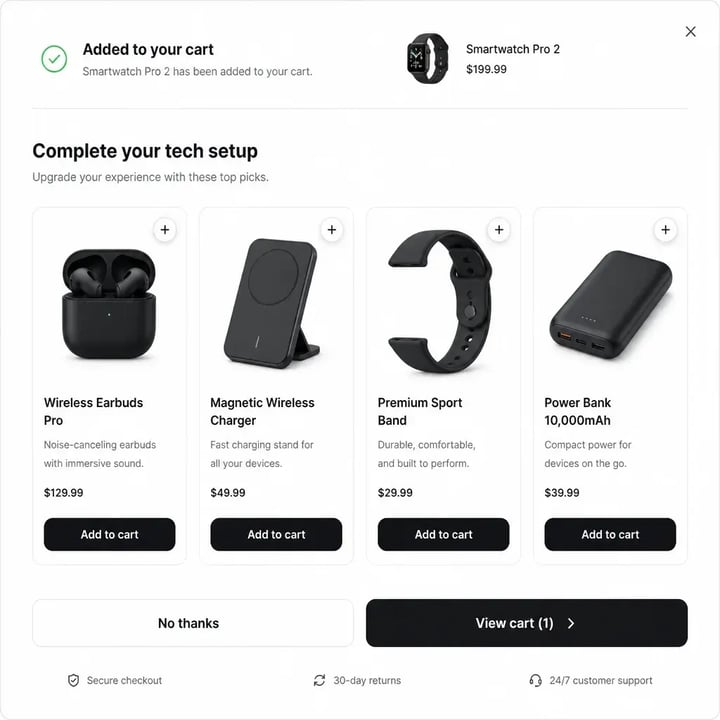
Ecommerce upsell product recommendations are dynamically generated product suggestions shown to shoppers during or after the buying journey to increase order value. They analyze behavioral signals, purchase history, and catalog relationships to surface a relevant higher-value or complementary item.
Recommendation-driven purchases account for a disproportionate share of ecommerce revenue. According to Salesforce, shoppers who interact with a product recommendation represent only about 7% of site visits, yet they generate roughly one-quarter of orders and revenue.
The opportunity is less about showing more recommendations and more about showing the right products at the right point in the buying journey.
For many retailers, underperformance has little to do with the recommendation platform itself. The usual causes sit elsewhere: product data that's too thin for the engine to work with, merchandising rules that treat every shopper the same, placements that surface offers at the wrong moment, and measurement too loose to tell what's working. This guide shows how to turn product recommendations into a measurable source of upsell revenue, starting with why most programs underperform.
Why Most Ecommerce Product Recommendations Fail to Increase Average Order Value
Many retailers invest in ecommerce upsell product recommendations expecting higher average order values and incremental revenue. When those gains fail to materialize, the recommendation engine often gets the blame. In practice, recommendation performance depends on three upstream decisions: product data quality, recommendation placement, and measurement.
Poor Product Data Limits Recommendation Quality
Recommendation engines, whether AI-powered or rule-based, can only work with the information available in the product catalog. Missing taxonomy tags, incomplete product attributes, inconsistent variant data, and out-of-stock items without fallback logic reduce recommendation relevance before a shopper sees a single recommendation.
For example, a recommendation engine cannot reliably suggest complementary accessories if products are missing category relationships or attribute data. In many cases, what appears to be a recommendation problem is actually a merchandising data problem.
Recommendation Placement Determines Revenue Potential
Recommendation quality alone does not determine results. Placement shapes when shoppers encounter an offer and how likely they are to act on it.
Many retailers begin with product detail pages because they are the simplest place to deploy recommendation widgets. While these placements can influence discovery, they are only one stage of the buying journey. Cart, checkout, post-purchase, and reorder experiences often create stronger upsell opportunities because the customer has already demonstrated purchase intent.
Rolling out recommendations based on implementation effort rather than expected commercial impact limits the revenue the program can generate.
Measuring the Wrong Metrics Hides Underperformance
Many teams evaluate recommendation performance by tracking changes in overall average order value. The problem is that AOV also changes with promotions, seasonality, traffic mix, pricing, and merchandising decisions. Those factors make it difficult to isolate the true impact of product recommendations.
A more reliable approach measures incremental revenue against a control group or holdout audience. Without that comparison, it is impossible to determine whether recommendations increased order value or whether customers would have made the same purchases anyway.
Upsell placement benchmarks: what the data suggests
Where an upsell appears influences how likely shoppers are to accept it because different placements reflect different levels of purchase intent. Product page recommendations target shoppers who are still evaluating their purchase, while post-purchase offers reach customers who have already completed checkout. As purchase intent increases, upsell acceptance generally improves.
Focus Digital's 2025 analysis of 1,847 businesses found post-purchase offers achieved a 14.6% acceptance rate, while one-click order bumps converted at 37.8%. These numbers illustrate the advantage of presenting relevant offers after purchase commitment, rather than treating every recommendation placement as equally valuable.
The table below summarizes typical performance ranges across common ecommerce touchpoints. Treat these as directional benchmarks rather than targets. Product mix, recommendation quality, pricing, and merchandising strategy have a greater influence on performance than placement alone.
| Placement | Typical acceptance | AOV lift range | Best for |
| Product page (Frequently Bought Together) | 1-3% | 2-5% | Discovery; complementary accessories and refills |
| Cart / cart drawer | 2-5% | 5-10% | Small add-ons; nudging toward a free-shipping threshold |
| Checkout (pre-submit) | 1-4% | 5-12% | One high-relevance add-on; keep the price modest |
| Post-purchase offer (one-click) | 3-8% | 8-15% | High-intent buyers; no cart-abandonment risk |
| Post-purchase email | 2-5% | 3-8% | Replenishment; introducing a new category |
Placement is only one part of the equation. The relevance of the recommendation and its price relative to the original purchase have a greater impact on whether shoppers accept an upsell.
The study alsol found that upsells priced at 10% to 25% of the original purchase converted at around 41%, with acceptance declining sharply as the add-on approached or exceeded the value of the primary item.
A modest accessory feels like a natural extension of the purchase. A second high-ticket product requires shoppers to reconsider the transaction.
Relevance has an even greater influence. Recommendations that complement products already in the cart consistently outperform generic "You might also like" suggestions because they solve an immediate need.
This is where AI-powered recommendation engines outperform static merchandising rules. They identify product relationships from browsing and purchase patterns that manual rules often overlook.
Five upsell placements, sequenced for mid-market execution
Not every upsell placement deserves equal priority. Some consistently generate stronger returns with lower implementation risk, while others are better suited for expanding product discovery. For most mid-market retailers, the sequence below maximizes commercial impact before adding complexity.
1. Post-purchase upsell page (start here)
A post-purchase offer displayed immediately after payment confirmation is the highest-priority placement for most retailers. Because the purchase is already complete, there is no risk of increasing checkout abandonment, making it the safest place to introduce an additional offer.
Limit the experience to a single, highly relevant recommendation based on the customer's purchase, and keep the upsell value modest, typically around 15% to 25% of the original order. Multiple offers or expensive upgrades create unnecessary friction, even after checkout.
2. Checkout Add-On (Expand Once Post-Purchase Is Performing)
Once your post-purchase offers are converting steadily, add a single recommendation during checkout. At this stage, shoppers are focused on completing their purchase, so the offer should complement the existing cart rather than compete with it.
Accessories, warranties, or low-cost consumables generally perform better than premium upgrades. Keeping the recommendation below roughly 30% of the cart value reduces the likelihood that shoppers reconsider the purchase.
Implementation note: Shopify retired checkout.liquid and additional scripts on the thank-you and order-status pages in 2025. New checkout and post-purchase experiences should be built using Checkout Extensibility rather than legacy script injections.
3. Cart Drawer Recommendations (Focus on Complementary Products)
The cart drawer works best for complementary products that naturally extend the customer's purchase. Someone adding a camera lens is more likely to buy a cleaning kit or protective filter than a more expensive lens competing with the item already selected.
Limit recommendations to two or three products to avoid overwhelming shoppers, and avoid suggesting alternatives from the same category that could replace the existing purchase instead of increasing basket size.
4. Product detail page (frequently bought together)
Product detail pages remain an important recommendation surface, but they are rarely the strongest driver of incremental revenue. Shoppers are still evaluating whether to purchase, so recommendation modules such as Frequently Bought Together or Complete the Look contribute more to product discovery than immediate upsells.
Performance at this stage depends heavily on recommendation quality. Complete product attributes, accurate merchandising data, and behavioral signals help recommendation engines surface complementary products that static rules often miss.
5. Post-purchase email (replenishment and cross-category)
Post-purchase emails extend upsell opportunities beyond the website and are particularly effective for replenishment reminders and cross-category recommendations. Their success depends less on placement than on timing and customer segmentation.
First-time buyers often respond well to complementary products that introduce a new category, while repeat customers are more likely to engage with replenishment offers timed to expected product usage.
Measure email-driven revenue separately from onsite recommendations to avoid attributing the same purchase to multiple touchpoints.
The return on every one of these placements is capped by the same thing: the quality of the product data feeding the recommendation engine.
Catalog Data Quality: The Foundation of Effective Product Recommendations
The quality of ecommerce product recommendations depends on the quality of the underlying catalog. Even the most sophisticated recommendation engine cannot consistently surface relevant products if attributes, taxonomy, and inventory data are incomplete or inconsistent.
Before optimizing recommendation placements or evaluating AI recommendation platforms, ensure your catalog is ready in these three areas.
Attribute Completeness
Recommendation engines rely on product attributes to identify complementary and similar products. Missing information such as size, color, material, style, compatibility, or category forces the engine to fall back on broader signals like purchase history or price similarity, producing weaker recommendations.
Audit attribute completeness by category before enabling AI-powered recommendations. Categories with substantial gaps in key attributes rarely produce recommendations that are more relevant than generic "popular products" suggestions. Improving attribute coverage in those categories usually has a greater impact than changing recommendation algorithms.
Taxonomy Consistency
Inconsistent taxonomy fragments product relationships across the catalog. Categories introduced through platform migrations, seasonal collections, or multi-brand imports often use different names for the same product type. For example, "Outerwear," "Jackets," and "Coats" may be treated as separate groups unless taxonomy rules standardize them.
A consistent taxonomy gives recommendation engines a reliable structure for identifying related products, improving both recommendation accuracy and product discovery.
Out-of-Stock Fallback Logic
Recommendation widgets should automatically replace unavailable products with relevant in-stock alternatives. Otherwise, shoppers encounter recommendations they cannot act on, creating friction at the moment the recommendation is supposed to drive another purchase.
The cost extends beyond a single missed sale. Once shoppers stop trusting the relevance of recommendation widgets, they are less likely to engage with future recommendations, reducing the effectiveness of the entire recommendation program. Configure fallback rules so every recommendation slot continues surfacing products customers can actually buy.
How ClickPost adds upsell revenue after the buy button
The highest-value upsell opportunities appear after checkout, when the purchase is complete and customers continue interacting with their order. ClickPost supports those moments across returns, branded tracking pages, and order editing.
During returns, ClickPost prioritizes exchanges and store credit before refunds. It then recommends relevant products using signals such as purchase history, wishlist activity, complementary products, similar customer behavior, new launches, and retailer-defined merchandising rules. Across ClickPost customers, 21% of returns are retained as exchanges or store credit, while exchanged orders deliver 39% higher average order values than the original purchase.
The same AI recommendation engine powers branded tracking pages, where customers revisit their order multiple times before delivery. Before fulfillment, ClickPost's order editing capability also lets shoppers add complementary products to an existing order instead of placing a second purchase.
The principle is the same across all three: recommend relevant products when customers are already engaged with their order. That allows retailers to increase upsell revenue without relying on additional traffic or creating friction during checkout.
Pre-launch upsell readiness checklist
Work through this audit before you launch your first upsell campaign. Each item is a concrete action a merchandising manager or ecommerce director can complete or delegate.
-
Audit catalog attribute fill rate by category, aiming to fill key attributes on at least 75% of products before enabling AI recommendation logic.
-
Harmonize product taxonomy across every source: historical imports, seasonal resets, and brand acquisitions.
-
Configure out-of-stock fallback rules so the engine never surfaces an unavailable product.
-
Establish AOV and order-volume baselines for 30 days before launch to enable incremental-lift measurement.
-
Define a holdout group of 10 to 15% of traffic for clean A/B measurement of true incremental revenue.
-
Map each offer to its placement: post-purchase uses single high-relevance items, PDP uses frequently bought together, email uses replenishment triggers.
-
Set price-delta guardrails per placement, using the ranges defined earlier, and flag any offer that exceeds them for review.
-
Confirm tracking-page branding and the recommendation module are live before the first post-purchase campaign.
The takeaway
Product recommendations generate incremental revenue when three elements work together: relevant products, the right placement, and disciplined measurement.
Recommendation engines can automate matching, but they cannot compensate for incomplete catalog data, weak merchandising decisions, or poor experimentation.
For most mid-market retailers, the highest-value starting point is post-purchase. It combines strong purchase intent with minimal implementation risk, allowing teams to validate recommendation quality before expanding to the cart, checkout, product pages, and email.
Platforms such as ClickPost support that approach by embedding AI-powered product recommendations across post-purchase touchpoints, including returns, branded tracking pages, and order editing. These touchpoints reach customers after the purchase is complete, making them a practical starting point for retailers looking to increase upsell revenue.
Frequently asked questions about ecommerce upsell recommendations
What is the difference between upselling and cross-selling in ecommerce?
Upselling encourages shoppers to buy a more expensive version of the product they are considering, while cross-selling recommends complementary products to increase basket size. For example, upgrading from a 128GB phone to a 256GB model is an upsell, whereas adding a phone case is a cross-sell.
Where should upsell recommendations be placed on an ecommerce site?
Retailers should prioritize upsell placements by purchase intent rather than implementation effort. Post-purchase offers generally provide the highest acceptance because the transaction is already complete, followed by checkout, cart, and product detail pages. Post-purchase email complements these onsite placements and should be measured separately to avoid attribution overlap.
What is a good upsell conversion rate for ecommerce?
Upsell acceptance rates vary by placement. Product pages typically convert between 1% and 3%, cart recommendations between 2% and 5%, checkout offers between 1% and 4%, and post-purchase offers between 3% and 8%. Dedicated post-purchase offers often perform best because they reach customers after purchase, when there is no checkout abandonment risk.
How do AI-powered product recommendations improve ecommerce upsells?
AI-powered recommendation engines improve upsells by combining customer behavior, purchase history, product attributes, and merchandising rules to generate more relevant recommendations than static rule-based systems. Their effectiveness depends on the quality of the underlying product catalog and the volume of behavioral data available, making accurate product attributes and taxonomy just as important as the recommendation engine itself.
What percentage of ecommerce revenue comes from product recommendations?
Among shoppers who interact with them, product recommendations account for a disproportionate share of ecommerce revenue. Salesforce found that recommendation clicks represented only 7% of site visits but generated 24% of orders and 26% of revenue. Frequently cited figures such as "35% of Amazon's revenue" come from older estimates and are not representative of most mid-market ecommerce brands.
How do you measure incremental revenue from upsell recommendations?
The most reliable way to measure incremental revenue is with a holdout test. Reserve a portion of traffic that does not see recommendations, then compare average order value and revenue per visitor against the treatment group over the same period. Measuring only changes in overall AOV can overstate impact because promotions, seasonality, pricing, and product mix also influence the metric.
When do upsell offers hurt conversion rates?
Upsell offers reduce conversion when they interrupt the buying journey or create unnecessary friction before checkout. Multiple offers, high-priced upgrades, or unexpected price increases can increase cart abandonment. Post-purchase recommendations avoid this risk because payment has already been completed, allowing retailers to introduce additional products without disrupting the original transaction.






We use cookies to keep the site working, understand usage, and improve your experience. Learn more
Always active for essential site performance and security.
Enables anonymous usage analysis to refine our services.
Used to present relevant promotions and advertising.