.png?width=193&height=27&name=ClickPost%20Logo%20(Blue).png)
.svg)
.svg)
.svg)
.svg)
.webp?width=286&height=206&name=ROI%20Calculator%20(2).webp)
.svg)
.svg)
.svg)
.svg)
.svg)
.svg)
.svg)
.svg)
.svg)
.webp?width=286&height=206&name=Frame%201171276203%20(11).webp)
.svg)
.svg)
.svg)
.svg)
.webp?width=286&height=206&name=ROI%20Calculator%20(3).webp)
.svg)

.svg)
.svg)
.svg)
.webp?width=286&height=206&name=ROI%20Calculator%20(4).webp)
Warranty Returns: How to Build a Process That Works


Ready to delight customers after checkout?
Trusted by 600+ brands
In this blog
TL;DR Summary
A warranty returns process is a structured workflow with six operational stages: claim intake, defect verification, triage, resolution, reverse logistics, and supplier cost recovery, all wrapped in a defect analytics loop. It differs from a standard return because it needs proof of defect and opens a supplier recovery loop.
Simple defect cases should close in 1 to 3 days; anything past 10 days signals a broken handoff. The right resolution, whether repair, replace, returnless refund, or write-off, is a cost calculation, not a policy default.
Brands that automate triage and instrument supplier chargebacks recover warranty costs that manual operations absorb silently, and fast resolution under three days doubles as a retention lever.
Introduction
Most ecommerce brands are running two systems, and neither one knows the other exists. The first is a return process designed for the everyday stuff: wrong size, changed my mind, didn't love it.
The second is a warranty policy that sits on a product page collecting dust until someone emails about a cracked hinge or a battery that won't hold a charge. What falls through the gap between them is the warranty returns process, and hardly anyone has bothered to build one.
US shoppers are on track to send back $849.9 billion in merchandise in 2025, and a poor returns experience makes 71% of them less likely to buy again. Warranty cases land at the sharp end of that number, because a defective product has already let the customer down once. Resolve it slowly, and you lose the second chance too.
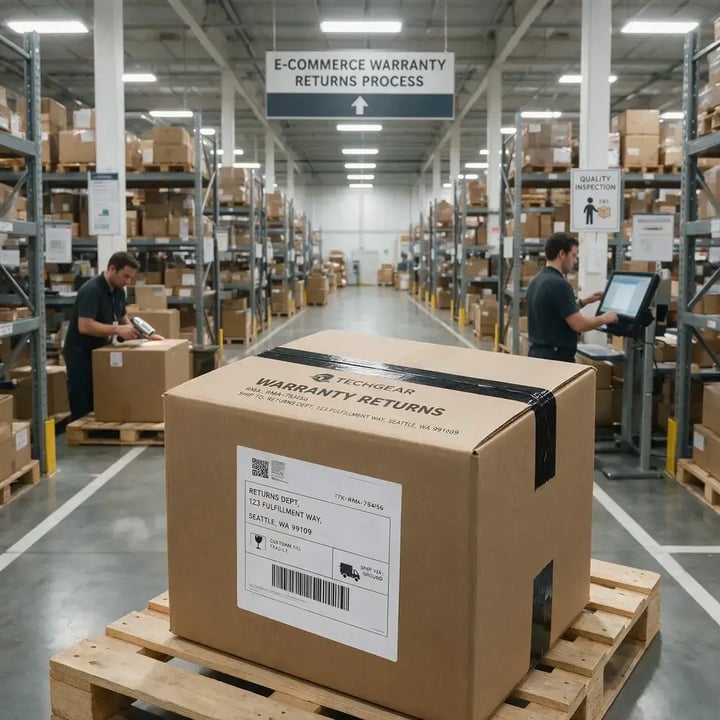
A warranty returns process is not a return policy applied to broken items. It is a distinct operational workflow that includes defect verification, resolution routing, reverse logistics, supplier cost recovery, and defect data feedback.
This guide covers the parts most articles skip: a decision framework for repair versus replace versus returnless resolution, a stage-by-stage workflow with named owners and SLAs, a supplier recovery playbook, and the KPIs to measure it all.
What is a warranty return?
A warranty return is the return of a product that failed or developed a defect inside its coverage window. Unlike a standard return, it requires proof of defect, can pull in the supplier who made the product, and opens a cost recovery path. The resolution may be a repair, a replacement, a returnless refund, or a write-off.
| Dimension | Warranty return | Standard return |
| Trigger | Product defect or failure inside the coverage window | Change of mind, wrong size, or transit damage |
| Eligibility window | Defined warranty period, 30 days to lifetime | Retailer return window, usually 30 to 60 days |
| Resolution options | Repair, replace, returnless refund, or write-off | Refund or exchange |
| Who bears cost | Supplier via chargeback, or brand, per contract | Brand absorbs shipping and restocking |
| Supplier involvement | Direct; defect data can trigger a chargeback or QC action | None |
| Customer intent | Resolution of a product failure | Reversal of a purchase decision |
In practical terms, the two flows shouldn't be governed by the same policy. What warranty coverage includes belongs in your returns policy design, but the handling behind a warranty claim needs its own routing, its own SLAs, and its own money trail.
Why most warranty returns processes fail
Warranty processes rarely fail because the policy is wrong. They fail in the handoffs, and three patterns show up again and again.
First, incomplete intake. A customer opens a claim with a vague description and no photo, so an agent emails back for details, waits a day, then emails again. The claim ages before anyone has verified anything.
Second, no triage logic. Every claim, simple or complex, lands in the same human queue. A trained agent spends 10 to 45 minutes on a manual warranty case, covering the conversation, policy lookup, photo check, and supplier handoff. At a few hundred claims a month, that is a full headcount doing work that clear rules could handle.
Third, no supplier recovery workflow. The brand eats the cost of a defective unit it is contractually entitled to charge back, because nobody captured the evidence to make the claim. Each of these has a fix, and none of them requires switching platforms.
Warranty returns benchmarks: what a healthy process looks like
You cannot fix what you do not measure. A healthy warranty returns process holds itself to a short list of numbers. Here is what good looks like in 2026.
| KPI | Formula | Healthy benchmark | Poor result signals |
| Claim resolution time | Days from intake to resolution | 1 to 3 days simple, 5 to 10 days complex | Manual triage bottleneck or missing supplier policy |
| Agent handling time per claim | Minutes from open to close | Under 15 min automated, 10 to 45 min manual | No structured intake form or triage rules |
| Warranty claim rate | Warranty claims/units sold | Typically 1 to 3%; over 3% in electronics warrants QC review | Systemic defect or mis-set warranty window |
| Supplier cost recovery rate | Costs recovered / total warranty costs | 20 to 40% for brands with chargeback programs | No documented defect intake or supplier SLA |
| Refund-to-exchange conversion | Exchanges chosen / claims resolved | 60%+ when an exchange is actively offered | Flow defaults to refund with no exchange prompt |
| Repurchase rate post-claim | Repeat purchase within 90 days | Rises with sub-3-day resolution | Slow resolution or poor status communication |
Two data points anchor the table. Claimlane's warranty operations benchmark puts typical claim rates at 1 to 3% of units sold, and manual handling at 10 to 45 minutes per case.
The category is large enough to take seriously, with the global extended warranty market worth about $187 billion in 2024 and the US market near $53 billion in 2025.
Warranty is not a rounding error, and the operations behind it reward measurement. Note that the repurchase lift and the 20 to 40% recovery range are directional planning benchmarks rather than figures from a single named study, so treat them as targets to validate against your own data.
The warranty returns process, stage by stage
A complete warranty returns process has six stages, and each one needs a defined owner, an SLA, and a trigger that hands the case to the next stage. Assign ownership, and the case stops stalling in the gaps between teams.
Stage 1. Claim intake (Owner: CS Tier 1 | SLA: same day)
A structured intake form captures the order number, product serial or SKU, defect description, photo evidence, and proof of purchase in one touchpoint. The goal is to collect everything needed for both automated triage and a future supplier chargeback before the claim is opened.
Incomplete intake is the single biggest failure point, and the fix is a required-field form, not a follow-up email. This is also where an RMA number gets issued so the incoming unit can be pre-logged.
Stage 2. Defect verification (Owner: CS Tier 1 or automated | SLA: under 4 hours)
AI-assisted image review or rule-based checks compare the photo evidence against known defect signatures. Clear, in-window, documented cases pass straight to resolution; ambiguous or under-documented cases escalate to Tier 2. This is where automation compresses the 10-to-45-minute manual case.
One Scandinavian retailer cut complex RMA resolution time by 77% after deploying an AI claims agent, because the software handled the photo review and policy layer.
Stage 3. Triage and resolution routing (Owner: Ops | SLA: same day)
The repair, replace, returnless refund, or write-off decision is a cost calculation, not a judgment call. Use this logic. If return shipping plus inspection cost exceeds the product value, issue a returnless refund and write off the unit. If the defect is repairable and repair costs less than 40% of replacement, route to repair. If neither holds, replace. Write-offs cover low-value accessories and recalled units.
Stage 4. Resolution execution and customer communication (Owner: CS and Ops | SLA: 24 hours after decision)
Fire automated messages at each milestone: claim received, decision made, replacement shipped with tracking, or repair dispatched. Proactive status updates are the difference between a customer who waits patiently and one who opens three follow-up tickets. Most top-ranking guides skip this entirely, even though it is standard platform capability now.
Stage 5. Reverse logistics and disposition (Owner: Ops or reverse logistics | SLA: receipt within 5 days)
Route returned units to inspection before disposition, then grade them for refurb, liquidation, supplier return for credit, or destruction. The inspection grade generated here is also the defect documentation that Stage 6 needs. For the mechanics of grading and routing, see your reverse logistics and disposition playbook.
Stage 6. Supplier cost recovery and defect feedback (Owner: Finance and Ops | SLA: monthly cycle)
Aggregate the defect data from intake and inspection into a supplier-ready evidence file, then submit a chargeback or debit memo per the supplier contract. Feed defect reason codes back to product and QC. This loop closes the process and, over time, lowers future claim volume by fixing the defects at the source.
Supplier cost recovery: the financial layer most warranty processes miss
If you manage returns and reverse logistics, you already suspect you are absorbing costs that belong to a supplier. Closing that gap comes down to three things.
Capture the right evidence at intake. A chargeback-ready file needs the serial number, a defect photo, the purchase date relative to the warranty window, and a standardized defect reason code. Miss any one of these and the claim is contestable.
Run recovery on a schedule, not a scramble. Aggregate defect data by supplier and submit chargebacks on a monthly cycle instead of a reactive quarterly cleanup. A predictable cadence keeps evidence fresh and makes disputes easier to win.
Set a realistic target. Brands with documented recovery programs commonly aim to recover a meaningful share of warranty costs, a range often cited at 20 to 40%, while brands without a structured workflow recover close to nothing. If you juggle 20 or more supplier contracts with different windows and terms, a supplier policy database is the prerequisite to running any of this at scale.
Warranty returns process audit: 10 questions to score your setup
Score each question Yes, Partial, or No. Mostly Yes means a mature process; a cluster of No answers points to where to start.
| # | Audit question | Dimension |
| 1 | Does intake require photo evidence, serial number, and proof of purchase before a claim opens? | Intake |
| 2 | Is every claim logged with an RMA number linked to the original order? | Intake |
| 3 | Do automated rules route simple claims to resolution without human review? | Triage |
| 4 | Is defect verification supported by image review or rule-based checks? | Triage |
| 5 | Is the repair vs replace vs returnless decision based on explicit cost thresholds? | Resolution |
| 6 | Are customers notified automatically at each resolution milestone? | Resolution |
| 7 | Do returned units pass through inspection and grading before disposition? | Logistics |
| 8 | Do you submit supplier chargebacks on a regular cycle with intake documentation? | Supplier recovery |
| 9 | Do defect reason codes flow back to product and QC teams? | Supplier recovery |
| 10 | Do you track resolution time, handling time, and refund-to-exchange conversion monthly? | Analytics |
Warranty returns as a connected process
The brands that carry structurally lower warranty costs into 2026 are the ones that treat warranty returns as one connected process, from intake through supplier recovery, rather than a customer service exception handled case by case. Three levers do most of the work: structured intake, resolution triage by cost, and a supplier chargeback program on a fixed cycle.
Treating warranty returns as a stage-by-stage operational process, instead of a policy applied inconsistently by individual agents, is the single most impactful change an operations team can make to cut per-claim cost and lift retention.
Frequently asked questions
What is the warranty returns process?
A warranty returns process is a structured workflow, claim intake, defect verification, triage, resolution, reverse logistics, and supplier recovery, that handles product failures inside a warranty window. It differs from a standard return because it requires proof of defect and may trigger supplier cost recovery.
How long does a warranty return take to process?
Simple defect cases with complete intake documentation should resolve in 1 to 3 days. Complex cases needing supplier approval or carrier investigation usually take 5 to 10 days. Anything beyond 10 business days points to a stalled handoff between CS, ops, or the supplier, not a legitimate delay.
What is the difference between a warranty return and a regular return?
A warranty return is triggered by product failure inside a coverage window and may involve supplier chargebacks and defect documentation. A standard return is a customer preference reversal with no supplier accountability component. Resolution options and cost allocation differ significantly between the two.
How do I automate warranty returns?
Map your current process first to find where claims stall. Then configure a required-field intake form, set triage routing rules by defect type and product value, and automate customer updates at each milestone. Automation works best on top of a documented process, not as a substitute for one.
What happens to products returned under warranty?
Returned products go through inspection and grading before disposition. Depending on condition and defect type, they are refurbished for resale, liquidated, returned to the supplier for credit, or disposed of. The inspection step also generates the defect documentation used for supplier chargebacks.
How do I prevent warranty fraud in e-commerce?
Require photo evidence and serial number validation at intake. Flag claims where the serial does not match your records, the defect is inconsistent with the product, or the claim lands days after purchase. AI image analysis can now verify defect photos at scale, which matters given that roughly 9% of retail returns are fraudulent.
What is an RMA and how does it work for warranty returns?
An RMA, or Return Merchandise Authorization, is a number issued before a defective product ships back. It lets ops pre-log the incoming return, assign it to the right disposition path, and link it to the warranty claim record. RMAs are standard in B2B and increasingly used by high-volume ecommerce brands.
How do I recover supplier costs from warranty claims?
Document defect type, serial number, and purchase date at intake, and keep the photo evidence. Aggregate this by supplier on a monthly cycle and submit a chargeback or debit memo per your contract terms. Brands with formal chargeback programs commonly target recovery in the 20 to 40% range.





We use cookies to keep the site working, understand usage, and improve your experience. Learn more
Always active for essential site performance and security.
Enables anonymous usage analysis to refine our services.
Used to present relevant promotions and advertising.