.png?width=193&height=27&name=ClickPost%20Logo%20(Blue).png)
.svg)
.svg)
.svg)
.svg)
.webp?width=286&height=206&name=ROI%20Calculator%20(2).webp)
.svg)
.svg)
.svg)
.svg)
.svg)
.svg)
.svg)
.svg)
.svg)
.webp?width=286&height=206&name=Frame%201171276203%20(11).webp)
.svg)
.svg)
.svg)
.svg)
.webp?width=286&height=206&name=ROI%20Calculator%20(3).webp)
.svg)

.svg)
.svg)
.svg)
.webp?width=286&height=206&name=ROI%20Calculator%20(4).webp)
FedEx vs UPS 2026: Which Carrier is Cheaper? [Rate Comparison]


Ready to delight customers after checkout?
Trusted by 600+ brands
In this blog
FedEx vs UPS: Quick Summary
TL;DR: When comparing FedEx vs. UPS in 2026, UPS typically wins on domestic ground shipments for business addresses and heavier parcels, while FedEx excels at express delivery, residential routes with weekend coverage, and international air shipments. The carrier that saves you the most depends on package weight, dimensional size, destination type, and how surcharges stack up beyond the base rate—making shipment-level analysis essential before committing to either carrier.
Key Differences Between FedEx and UPS for Business Shipping
If you are comparing FedEx vs UPS, the answer depends on what you ship and where it is going. UPS usually makes more sense for domestic ground shipments, especially when the package is larger or heavier, or when it's headed to a business address. FedEx tends to stay strong in express shipping, residential delivery options, and international air-heavy routes.
Key Points: FedEx vs UPS — Speed, Cost & Service Differences
-
UPS remains very strong in domestic ground shipping and heavier parcel movement.
-
FedEx has a stronger identity around express delivery and global air networks.
-
Dimensional weight rules can change the winner even when the box looks small.
-
Published base rates do not tell the full story because surcharges often decide the final bill.
-
The smartest way to compare FedEx vs UPS is to match the carrier to the shipment type, not to pick one carrier for everything.
This article breaks down the real differences of FedEx vs UPS, where each carrier is more cost-effective, and how to choose without getting lost in base-rate comparisons.
How FedEx and UPS Approach Domestic and International Shipping Differently
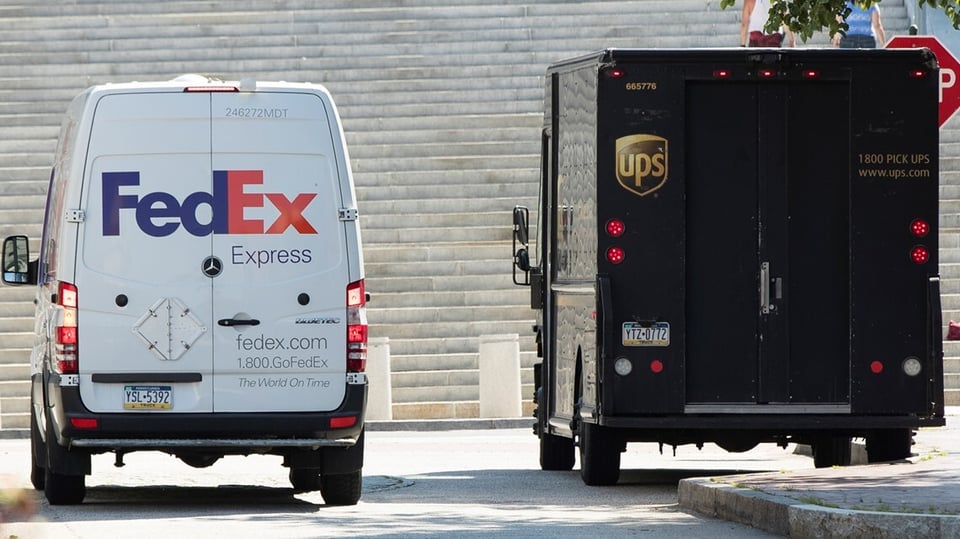
At a distance, FedEx and UPS can look like the same machine in different colors. Both move parcels fast, both offer ground and express services, and both serve businesses that care about price, reliability, and delivery speed. But once you get past the surface, the split becomes clearer.
UPS has long been a ground-shipping workhorse inside the U.S. At the same time, FedEx still carries more weight in the minds of shippers who care about express movement, residential reach, and international air capability.
That does not make one universally better than the other. It just means the right answer depends on the package, the lane, the urgency, and the fees hiding behind the quote. Businesses using multi-carrier software can route shipments intelligently rather than forcing every parcel through a single network.
What Makes FedEx and UPS Different: Core Service Strengths Compared
FedEx and UPS overlap in many ways, but they do not approach the shipping market from the same place.
UPS has a stronger domestic ground identity and positions UPS Ground as a core value play for U.S. shipping. FedEx, by contrast, still carries a stronger express and air-oriented profile, even though its ground network is also mature and widely used.
That difference shows up in how businesses compare services, build carrier mixes, and think about where each provider fits best. For companies managing ecommerce shipping across multiple channels, understanding these differences is critical to controlling costs.
| Area | UPS | FedEx |
| Core strength | Domestic ground parcel delivery | Express delivery and a global air-heavy network |
| Ground package limit | Up to 150 lbs | Up to 150 lbs |
| Typical ground transit | 1 to 5 business days | 1 to 5 business days in the contiguous U.S. |
| Residential model | Strong, but surcharges matter | Stronger residential positioning with Home Delivery |
| Dimensional weight | Domestic divisor 166, international divisor 139 | Divisor 139 for most parcel services |
| International positioning | Broad international coverage, strong for heavier freight and business shipping | Strong international express orientation |
| Weekend angle | Weekend options available on select services and ZIPs | FedEx Home Delivery includes weekend residential delivery |
The practical takeaway is simple. UPS often looks better when you want predictable domestic ground coverage for standard business shipping. FedEx becomes more attractive when you need more express-oriented options, weekend-friendly residential delivery, or a robust international air-parcel setup. Neither carrier wins every route, and that is why a one-size-fits-all carrier strategy usually costs more than it saves. Smart carrier allocation based on shipment profile can significantly reduce total shipping spend.
Sources: UPS Domestic Services | FedEx Ground | FedEx Home Delivery
How Dimensional Weight Rules Impact FedEx vs. UPS Pricing
That is where many shipping comparisons go wrong. Shippers often compare carriers based on actual package weight, but the carrier may not care much about that if the box takes up too much space. Practically, dimensional weight can shift the cost comparison before the package even leaves the dock.
That is where many shipping comparisons go wrong. Shippers often compare carriers based on actual package weight, but the carrier may not care much about that if the box takes up too much space.
-
UPS uses two different dimensional formulas: domestic (L × W × H ÷ 166) and international (L × W × H ÷ 139).
-
FedEx applies a tighter dimensional rule across its parcel services: L × W × H ÷ 139.
Why this matters: if you ship a lightweight product in a slightly oversized box, FedEx can rate it more aggressively on dimensional weight than UPS on domestic routes.
The clean takeaway is that UPS often has an edge on domestic parcels packed in medium-sized cartons. At the same time, FedEx's stricter dimensional framework can narrow or erase that advantage once the box gets bulkier. That is why packaging discipline matters as much as carrier choice. Businesses looking to reduce shipping delays and costs should optimize packaging alongside carrier selection.
Sources: UPS 2026 Small Business Rate Guide | FedEx 2026 Service Guide
FedEx Ground vs. UPS Ground: Which Ground Service is Cheaper in 2026?
Ground shipping is where many real-world business decisions are made. Not every order needs to fly, and not every brand can afford to pay for speed it does not need. That makes the FedEx Ground vs UPS Ground comparison one of the most important parts of the whole FedEx vs UPS debate.
| Feature | UPS Ground | FedEx Ground / Home Delivery |
| Transit time | 1 to 5 business days | 1 to 5 business days contiguous U.S.; 3 to 7 for Alaska and Hawaii |
| Package weight limit | Up to 150 lbs | Up to 150 lbs |
| Length limit | Up to 108 inches | Up to 108 inches |
| Tracking | Included | Included |
| Base liability | Included up to $100 | Included up to $100 declared value coverage baseline |
| Residential angle | Strong, but a residential surcharge applies | Home Delivery is built for residences and delivers every day of the week in the contiguous U.S. |
| Weekend delivery | Available in select situations | Saturday and Sunday residential delivery through Home Delivery |
If your volume is mostly business shipments or heavier parcels, UPS often feels like the more natural fit. If your volume is home-delivery heavy, FedEx deserves a closer look. Companies shipping both B2B and direct-to-consumer should consider using courier aggregators to route shipments to the optimal carrier automatically.
Sources: UPS Domestic Services | FedEx Ground | FedEx Home Delivery
FedEx vs. UPS Rates: Long-Distance Shipping from San Francisco to New York
To keep this comparison useful, let us use a representative cross-country shipment: a 3 lb package measuring 13 in x 12 in x 2 in, shipped on a Monday from San Francisco, CA, to New York, NY. Since this is a long domestic route, the package typically falls within the far-distance zone for both carriers.
The table below uses the current 2026 published rate materials and service structures as a directional comparison, not a live cart quote.
| Service | Estimated delivery time | Representative published 2026 rate |
| UPS Ground | 3 business days | $13.17 |
| FedEx Ground | 3 business days | $27.33 plus residential surcharge if applicable |
| UPS 3 Day Select | 3 business days | $18.53 |
| FedEx Express Saver | 3 business days | $27.33 |
| UPS 2nd Day Air | 2 business days | $39.34 |
| FedEx 2Day | 2 business days | $22.59 |
| UPS Next Day Air | 1 business day | $44.65 |
| FedEx Standard Overnight | 1 business day | $30.66 |
| FedEx Priority Overnight | 1 business day | $34.41 |
| UPS Next Day Air Early | Early next business day | $74.65 |
For this kind of long-haul domestic lane, UPS looks notably stronger on ground pricing, while FedEx becomes more competitive once you move into two-day and overnight services. That does not mean FedEx is always cheaper for express service, or that UPS always wins for ground service, but the pattern is clear enough to matter. Understanding expedited shipping options from both carriers helps businesses optimize for both cost and speed.
If your goal is low-cost cross-country ground transportation, UPS has the better published track record here. If speed matters, FedEx starts to close the gap quickly. For businesses comparing UPS Ground shipping against express alternatives, the transit time difference may justify the premium.
Disclaimer: These are representative published-rate comparisons based on current carrier guides and zone-based long-distance assumptions. Live quotes can move once fuel, pickup fees, residential classification, negotiated discounts, and route-specific service availability are added.
Disclaimer: Representative published-rate comparisons based on current carrier guides and zone-based assumptions. Live quotes can change with fuel, pickup fees, residential classification, and negotiated discounts.
Sources: UPS 2026 Small Business Rate Guide | FedEx 2026 Service Guide | UPS Calculate Time and Cost
FedEx vs. UPS for Rural Delivery: St. Helena, CA to Shirley Mills, ME
Now, let us shift the same 3 lb package to a longer rural lane, such as St. Helena, CA, to Shirley Mills, ME. The distance remains long, but rural delivery adds another layer because access, residential treatment, and service availability can all change the final cost.
| Service | Estimated delivery time | Representative published 2026 rate |
| UPS Ground | 5 business days | $13.17 plus applicable residential or area fees |
| FedEx Ground/Home Delivery | 5 to 7 business days | $27.33 plus $6.45 residential surcharge |
| UPS 3 Day Select | 3 business days | $18.53 |
| FedEx Express Saver | 3 business days | $27.33 |
| UPS 2nd Day Air | 2 business days | $39.34 |
| FedEx 2Day | 2 business days | $22.59 |
| UPS Next Day Air | 1 business day | $44.65 |
| FedEx Standard Overnight | 1 business day | $30.66 |
Sources: UPS Domestic Services | FedEx 2026 Service Guide | FedEx Home Delivery
Short-Distance Shipping Rates: Los Angeles to Las Vegas Comparison
Short-haul shipping changes the equation. When the package is not traveling across the country, the rate gap often narrows, and service preference starts to matter as much as raw price. For a shipment from Los Angeles, CA, to Las Vegas, NV, both carriers compete in a shorter domestic zone.
| Service | Estimated delivery time | Representative published 2026 rate |
| UPS Ground | 1 to 3 business days | $11.10 |
| FedEx Ground/Home Delivery | 1 to 3 business days | about $14.64 plus residential surcharge if Home Delivery applies |
| UPS 3 Day Select | 3 business days | $18.53 |
| FedEx Express Saver | 3 business days | about $14.64 |
| UPS 2nd Day Air | 2 business days | $22.23 |
| FedEx 2Day | 2 business days | about $22.59 |
Sources: UPS 2026 Small Business Rate Guide | FedEx 2026 Service Guide
International Shipping Rates: San Francisco to London Comparison
International shipping is where the FedEx vs UPS question starts to split more clearly. FedEx has long been associated with air-heavy international express movement, while UPS tends to appeal to businesses that want breadth, control, and strength across larger international shipping programs.
For a representative example, consider a 3 lb package from San Francisco, CA, to London, UK.
| Service | Estimated delivery time | Tentative Costing | Representative published 2026 rate basis |
| UPS Worldwide Saver | 2 to 3 business days | $50.66 | Zone-based export pricing; often competitive for urgent documents and parcels |
| UPS Worldwide Expedited | 2 to 5 business days | $47.51 | Lower-cost UPS international option |
| FedEx International Express | 1 to 2 business days | $80.82 | Strong express option for fast international parcel shipping |
| FedEx International Economy | 2 to 8 business days | $69.78 | Usually, the lower-cost FedEx international alternative |
The honest answer is that FedEx often looks sharper for fast international express parcel movement. At the same time, UPS can be more attractive once the shipment becomes heavier, more operationally complex, or part of a broader business shipping setup. Companies managing international logistics at scale typically benefit from using both carriers strategically.
There is no universal winner here, but if speed is the priority, FedEx usually deserves the first quote. If flexibility, freight-adjacent scale, or commercial shipping depth matters more, UPS often becomes the better long-term partner. Businesses shipping internationally should also consider shipping insurance to protect high-value cross-border shipments.
Disclaimer: International rates vary heavily by destination, duties, service option, export lane, account pricing, and package characteristics.
Sources: UPS International Shipping Services | FedEx Rate Sheets Tool | FedEx 2026 Service Guide
Which Shipping Carrier Should You Choose: FedEx or UPS?
There is no clean knockout here, and that is exactly why the comparison matters. FedEx and UPS are close enough in capability that the best choice depends less on brand loyalty and more on shipment profile.
- Choose UPS when domestic ground shipping is your center of gravity. It is usually the stronger fit for routine U.S. ground movement, heavier packages, and business shipping programs. Companies with strong B2B logistics operations typically find UPS Ground to be the most reliable and cost-effective option.
- Choose FedEx when time-sensitive shipping matters more. FedEx remains very compelling for overnight, two-day, and international express movements. For brands focused on post-purchase experience, FedEx's express capabilities can differentiate the delivery experience.
- Choose UPS when dimensional rules help you. On some domestic cartons, UPS’s dimensional framework can keep a package closer to actual-weight pricing.
- Choose FedEx for residential and weekend-friendly delivery needs. FedEx Home Delivery gives it a practical edge for home-focused shipping strategies.
- Do not compare only base rates. Both carriers add surcharges, and those fees can change the real winner faster than any headline price table. Using courier software to track actual landed costs across carriers reveals the true cost difference.
The best carrier is the one that fits the shipment in front of you. Businesses that ship enough volume usually get the best results by using both and routing intelligently, rather than forcing every parcel through a single network. Implementing smart automated shipping rules based on destination, package profile, and service level can reduce total shipping costs by 15-30%.
Methodology and Editorial Note
This article was researched using official 2026 carrier documents from UPS and FedEx, including current service guides, published rate guides, dimensional-weight rules, and service descriptions. Rate tables are directional comparisons from current public materials, not account-specific live-cart outputs.
Final Thoughts on FedEx vs. UPS in 2026
When you take away the branding, the FedEx vs UPS decision comes down to route, package profile, and urgency. UPS usually makes more sense for domestic ground and heavier parcel work, while FedEx stays very strong in express shipping and certain residential or international use cases.
The smartest way to settle the question is to use a reliable shipping calculator from both carriers and compare the actual shipment details, including all applicable surcharges, before you buy the label. For businesses managing shipping at scale, implementing a parcel management system that compares rates in real-time and routes shipments to the optimal carrier can generate significant savings while improving delivery performance.
FedEx vs UPS FAQ
Is FedEx or UPS cheaper for domestic ground shipping in 2026?
For many domestic ground shipments, UPS is often cheaper on published base rates, especially for business addresses and heavier everyday parcels. But base rates do not tell the whole story, because surcharges can swing the final total sharply, so the only dependable comparison is a live quote with all fees included. Companies should also evaluate single-carrier vs multi-carrier strategies to understand which approach delivers better overall economics.
Which carrier delivers faster: FedEx or UPS?
Both carriers are fast, but FedEx usually feels stronger when the shipment is time-sensitive, and speed is the priority. UPS is highly competitive on standard ground performance, while FedEx has a stronger express identity across overnight and urgent parcel services. For businesses where delivery speed directly impacts customer satisfaction, understanding each carrier's estimated delivery date accuracy is critical.
Which carrier is better for international shipping: UPS or FedEx?
FedEx is often the better fit for fast international express parcel shipping, especially when air speed matters most. UPS becomes very compelling when the shipment is heavier, more complex, or part of a broader international business shipping program. Companies managing cross-border ecommerce should also evaluate how each carrier handles international shipping documentation and customs.
Does FedEx or UPS charge extra for Saturday delivery?
FedEx Home Delivery includes Saturday delivery at no extra cost. UPS charges $16.00 for Saturday delivery, and UPS Ground only delivers Monday through Friday as standard. FedEx's built-in Saturday coverage removes a recurring surcharge that compounds significantly at volume. For residential-heavy shippers, this difference can represent substantial annual savings.
Which carrier has better package tracking: UPS or FedEx?
UPS gives real-time tracking with reliable updates, making it easier to keep customers informed. UPS My Choice is considered an excellent delivery management tool for recipients. FedEx Ground has faced more complaints about tracking consistency, partly because its shipments are often handled by independent contractors, which can lead to inconsistent service quality across regions. Businesses prioritizing customer communication should consider implementing package tracking software that normalizes tracking data across multiple carriers and provides proactive delivery notifications.
Related reading: Shipping Cost Guide | Shipping Label Guide | Shipping Delays Guide | How to Ship a Package




We use cookies to keep the site working, understand usage, and improve your experience. Learn more
Always active for essential site performance and security.
Enables anonymous usage analysis to refine our services.
Used to present relevant promotions and advertising.