









Best Last-Mile Delivery Software in 2026: 7 Tools Compared



Ready to delight customers after checkout?
Trusted by 600+ brands
In this blog
TL;DR: Best Last-Mile Delivery Software in 2026
- Last-mile delivery absorbs about 53% of total shipping cost, and a failed first attempt costs US retailers about $17.20 per order, so this purchase moves margin.
- Routific is the cheapest serious planner for small planned-route fleets: free up to 100 orders a month, then $150 a month up to 1,000.
- Onfleet leads same-day and on-demand dispatch, starting at $619 a month for 2,500 tasks.
- Track-POD suits Shopify and WooCommerce stores that run their own drivers and need airtight proof of delivery.
- Shipday is the micro-fleet pick, with a free plan and DoorDash and Uber overflow from $99 a month.
- OptimoRoute fits fleets that mix deliveries with service calls, from $35.10 per driver.
- DispatchTrack (big-and-bulky) and Locus (multi-carrier enterprise) are custom-priced and earn their cost above roughly 500 stops a day.
- Year-one cost lands above the sticker price once SMS, onboarding, and integration hours are counted. The TCO table below shows by how much.
Last-mile delivery eats roughly 53% of total shipping cost, per Business Insider Intelligence's last-mile logistics analysis. Loqate's Fixing Failed Deliveries study adds that 8% of first-time US deliveries fail, at $17.20 per order.
That makes finding the best last-mile delivery software in the USA a margin decision. The right tier pays for itself quickly. The wrong one means overpaying, or outgrowing the tool within months.
What this guide gives you:
- A disclosed scoring method across six dimensions.
- Prices checked against vendor pages in October 2026.
- Year-one cost estimates that include SMS, onboarding, and integration.
Use the comparison table below to jump to the platform that fits your operation, or read through the full breakdown for the buying framework your logistics team can take into an RFP.
Why the Best Last-Mile Delivery Software Pays for Itself in 2026
Three pressures make 2026 the year to act:
- Tighter per-stop margins: Surcharges, wages, and fuel all land on the final leg. IKEA's largest retailer expects about $100 million a year in routing savings, Supply Chain Digital reported.
- Customers expect live tracking: When the tracking link is missing, they call support. Every WISMO ("where is my order") ticket is avoidable labor.
- Automation now divides the tiers: Top platforms re-sequence routes, shift overflow to other carriers, and update customers without a dispatcher stepping in.
DispatchTrack COO Peter Elmgren summed it up for Furniture Today: "The more information you provide within it, the smarter it gets." Persistence Market Research sizes the global market at $13.6 billion in 2026.
How We Evaluated the Best Last-Mile Delivery Software in the USA
We scored each platform 1 to 5 on route optimization, ecommerce integration, tracking and customer comms, pricing transparency, driver app usability, and enterprise readiness.
How we verified:
- Prices checked on vendor pricing pages, October 28 to 29, 2026.
- Ratings and review counts from G2's public product pages on the same dates.
- Features confirmed against named 2025 to 2026 releases. Unconfirmed claims were left out.
- Custom-priced tools get a clearly labeled planning estimate.
ClickPost does not sell route planning or dispatch, and none of the seven tools is a ClickPost product.
| Platform | Route optimization | Ecommerce integration | Tracking and comms | Pricing transparency | Driver app | Enterprise readiness |
|---|---|---|---|---|---|---|
| Routific | 5 | 3 | 3 | 5 | 4 | 2 |
| Onfleet | 4 | 4 | 5 | 3 | 5 | 4 |
| Track-POD | 3 | 4 | 4 | 4 | 4 | 3 |
| OptimoRoute | 5 | 2 | 3 | 4 | 4 | 3 |
| DispatchTrack | 4 | 2 | 5 | 1 | 4 | 5 |
| Locus | 5 | 2 | 4 | 1 | 4 | 5 |
| Shipday | 3 | 4 | 4 | 3 | 3 | 2 |
These are editorial judgments. Weight each column by what hurts most in your operation.
Last-Mile Delivery Management Software Comparison: 7 Tools at a Glance
Prices checked October 2026. Select a platform name to jump to its review.
| Platform | Best for | Starting price (Oct 2026) | Delivery model | Key integrations | G2 rating |
|---|---|---|---|---|---|
| Routific | Planned multi-stop routes, small fleets | Free to 100 orders/mo; $150/mo to 1,000 orders | Own fleet, planned routes | Shopify (native), CSV, API | 4.8 (46 reviews) |
| Onfleet | Same-day and on-demand dispatch | $619/mo for 2,500 tasks | Own fleet plus courier partners | Shopify app, API, Zapier | 4.6 (140) |
| Track-POD | Shopify and WooCommerce stores with own drivers | $49/driver/mo (annual, 3-driver min) or $285/mo for 1,500 orders | Own fleet, planned routes | Shopify, WooCommerce, Zapier, REST API | 4.5 (35) |
| OptimoRoute | Mixed delivery and field service | $35.10/driver/mo (annual) | Own fleet, deliveries plus appointments | Web service API, Excel import | 4.8 (51) |
| DispatchTrack | Scheduled big-and-bulky delivery | Custom (est. $2,000 to $5,000/mo) | Own and contracted fleets, booked windows | ERP and OMS via project | 4.5 (13) |
| Locus | Enterprise multi-carrier orchestration | Custom (est. $3,000 to $8,000+/mo) | Own fleet, 3PL, and gig networks | Enterprise API | 4.5 (57) |
| Shipday | Micro-fleets with gig overflow | Free to 300 orders/mo; paid from $29/mo | Own drivers plus DoorDash and Uber | Shopify, Wix, API and webhooks | Too few G2 reviews; 4.7 on Capterra (29) |
DispatchTrack and Locus figures are our planning estimates. Neither publishes prices.
What Features Should Last-Mile Delivery Software Have?
Every evaluation should cover seven features: route optimization, real-time GPS tracking with ETAs, electronic proof of delivery, a dependable driver app, automated customer notifications, ecommerce and WMS/ERP integrations, and failed-delivery analytics. Here is what to look for in each.
- Route optimization engine: Test it on your real addresses and time windows, including what happens when an order arrives at 11 a.m.
- Real-time GPS tracking and ETA updates: Dispatchers need live positions, and customers need an ETA that updates by itself when the route changes.
- Electronic proof of delivery (ePOD): Photo, signature, barcode, and timestamp capture settles "it never arrived" disputes in minutes.
- Driver mobile app: Check offline mode, Spanish-language support, and performance on older Android phones, since drivers quietly abandon apps that freeze.
- Customer notification automation: Look for SMS and email triggers at dispatch, approach, delivery, and exception, and ask whether texts are included or metered.
- Ecommerce and WMS/ERP integrations: Native Shopify or WooCommerce connectors save weeks of setup, while API-only platforms need developer time.
- Analytics and failed-delivery reporting: You want failure reasons by driver, zone, and time slot so the same failure does not repeat next week.
The 7 Best Last-Mile Delivery Software Platforms, Reviewed
Ordered from small planned-route fleets to enterprise, with the micro-fleet pick last.
1. Routific: Best for Planned Multi-Stop Routes on a Flat Budget
Routific sequences hundreds of planned stops around time windows and vehicle capacity in seconds. You pay by monthly order volume, with unlimited drivers on every plan.
What's new: Native Shopify connector (April 2026), flexible time windows, and an insert-only mode for adding orders to live routes.
Pricing: Free to 100 orders a month; $150 for 101 to 1,000; per-order fees of $0.15 down to $0.03 above that; custom past 50,000.
AI: Constraint-based optimization. Traffic prediction and smart driver assignment are still in development, so treat them as roadmap.
G2 rating: 4.8 out of 5 (46 reviews).
Pros:
- Unlimited drivers, so seasonal vans cost nothing extra.
- New dispatchers learn the planner in an afternoon.
Cons:
- No overflow to gig or courier networks.
- SMS is a paid add-on.
Skip it if: Same-day, on-demand jobs make up most of your volume.
Verdict: For a small fleet running predictable routes, Routific is the lowest-risk first platform on this list.
2. Onfleet: Best for Same-Day and On-Demand Dispatch
Onfleet is the dispatcher's tool here, with a top-rated driver app and live dispatch console. It handles job insertion, auto-dispatch, and customer ETAs better than planner-first products.
What's new: Command Center, rebuilt analytics, and a Courier Suite that links shippers to couriers through Onfleet Connect (2025).
Pricing: Launch $619 a month (2,500 tasks), Scale $1,349 (5,000), Enterprise from $3,099; Courier Suite add-on $299; telephony metered. TechRadar's Onfleet review confirms the entry tier.
AI: AI route optimization, smart auto-dispatch, and predictive ETAs (ETA-based alerts need Scale).
G2 rating: 4.6 out of 5 (140 reviews).
Pros:
- Best-in-class driver app and dispatch console.
- Courier network access for peak-day overflow.
Cons:
- Metered telephony makes bills hard to forecast.
- Auto-dispatch is locked to Scale and above.
Skip it if: You run fixed weekly routes with no same-day component.
Verdict: If same-day promises drive your revenue, Onfleet is the safest bet, as long as you budget from the Scale tier.
3. Track-POD: Best for Shopify and WooCommerce Stores Running Their Own Drivers
Track-POD started as a proof-of-delivery app, so photos, signatures, barcodes, and PDF notes come standard. Shopify and WooCommerce orders sync straight into route planning.
What's new: Vehicle-specific routing, toll avoidance, and a "Ready" status for scheduled routes.
Pricing: Advanced $49 per driver a month annually ($59 monthly), Advanced Plus $69, Ultimate $89; per-order plans from $285 a month for 1,500 orders.
AI: No branded AI module; algorithmic route and load planning.
G2 rating: 4.5 out of 5 (35 reviews).
Pros:
- The fullest ePOD toolkit in the SMB tier.
- Native Shopify and WooCommerce order sync.
Cons:
- Three-driver minimum on per-driver plans.
- Weaker on complex multi-stop days.
Skip it if: You need multi-depot enterprise controls or AI dispatch.
Verdict: This is the pick for an online store that delivers with its own vans and keeps getting "it never arrived" emails.
4. OptimoRoute: Best for Mixed Delivery and Field Service Fleets
OptimoRoute schedules deliveries and service appointments in one plan. Weekly planning spreads orders up to five weeks ahead.
Good to know: Plans cap orders optimized at once (700 on Lite, 1,000 on Pro), but daily volume is unlimited.
Pricing: Lite $35.10 per driver a month annually ($39 monthly); Pro $44.10 ($49 monthly); Custom by quote.
AI: No branded AI layer; constraint-based optimization with live ETAs.
G2 rating: 4.8 out of 5 (51 reviews).
Pros:
- Service calls and deliveries in one route.
- Weekly planning picks the best day automatically.
Cons:
- Lite tier lacks proof of delivery.
- No courier or gig overflow.
Skip it if: You run pure same-day parcel delivery or need an API-first enterprise build.
Verdict: For HVAC, appliance, and water-delivery businesses juggling installs and drops, OptimoRoute is the most practical scheduler here.
5. DispatchTrack: Best for Scheduled Big-and-Bulky Delivery
DispatchTrack leads appointment-based delivery of furniture, appliances, and building materials. It handles narrow windows, two-person crews, and access quirks like gated communities.
What's new: Driver AI voice briefings (June 2026). DT Agent, its AI customer chat agent, has been live since March 2025.
Pricing: Custom, billed annually. Our planning estimate: $2,000 to $5,000 a month plus implementation (not vendor-published).
AI: Machine-learning routing trained on its delivery history, plus the two 2026 agents above.
G2 rating: 4.5 out of 5 (13 reviews).
Pros:
- Built for booked windows and two-person crews.
- AI features that actually shipped in 2026.
Cons:
- No published pricing.
- Small G2 sample (13 reviews).
Skip it if: You run same-day parcel or food delivery under a few hundred stops a day.
Verdict: If a missed four-hour window means rebooking a two-person crew, DispatchTrack is worth the enterprise price.
6. Locus: Best for Enterprise Multi-Carrier Orchestration
Locus orchestrates own fleets, 3PLs, and gig networks from one control tower and calls itself an agentic TMS. Ingka Group acquired Locus in October 2025 and kept it independent.
Good to know: Ingka's Tolga Öncü described the deal as "taking control of a crucial element in our fulfilment chain."
Pricing: Custom. Our planning estimate: $3,000 to $8,000+ a month plus implementation (not vendor-published).
AI: Agentic dispatch, an AI co-pilot that flags SLA risks, and multi-carrier allocation.
G2 rating: 4.5 out of 5 (57 reviews).
Pros:
- Deepest multi-carrier orchestration here.
- Long-term backing from Ingka Group.
Cons:
- No public pricing.
- Hard to justify below 500 deliveries a day.
Skip it if: You run fewer than 500 deliveries a day.
Verdict: Locus is a serious option for enterprise shippers juggling several carrier types, provided your RFP demands proof behind the AI claims.
7. Shipday: Best for Micro-Fleets That Overflow to DoorDash and Uber
Shipday's free plan covers 300 orders a month, 10 drivers, live tracking, and photo proof of delivery. From $99, orders can overflow to DoorDash Drive and Uber couriers in the US.
Good to know: Prices move often. PricingSaaS's change log shows Business AI and Enterprise increases in September and October 2026.
Pricing: Free to 300 orders a month; Professional Lite $29; Professional $49; Branded Elite $99 (300 orders, then $0.20 each); Business AI Lite $199; Business AI $399; Enterprise from $3,499. Courier deliveries billed separately.
AI: AI Operations Manager, AI Growth Manager, AI Receptionist, and Agentflow agents.
G2 rating: Not enough G2 reviews for a score yet; 4.7 out of 5 on Capterra (29 reviews).
Pros:
- Real free tier, low paid entry.
- DoorDash and Uber overflow from $99.
Cons:
- Frequent 2026 price changes.
- AI features lean toward restaurants.
Skip it if: Route optimization is your top criterion or you run enterprise volume.
Verdict: For a florist, grocer, or Shopify brand with two to ten drivers and spiky demand, Shipday delivers the most capacity per dollar.
AI Capabilities Compared: Shipped Features Versus Roadmap
Only features with a named 2025 or 2026 release are listed.
| Platform | Named AI features | What it automates | Our read |
|---|---|---|---|
| Routific | Constraint optimization; traffic prediction and smart driver assignment in development | Stop sequencing | Strong math, light AI. Fine for planned routes. |
| Onfleet | AI route optimization, smart auto-dispatch, predictive ETAs | Job assignment, customer ETAs | Mature and proven, but auto-dispatch needs the Scale plan. |
| Track-POD | None branded; algorithmic route and load planning | Route and load building | Honest tooling with no AI layer to evaluate. |
| OptimoRoute | None branded; constraint optimization and weekly planning | Multi-day scheduling | Excellent scheduler, not an AI play. |
| DispatchTrack | Driver AI (June 2026), DT Agent (March 2025) | Driver briefings, customer questions | Shipped and in use. Ask for reference customers. |
| Locus | Agentic dispatch, AI co-pilot, multi-carrier allocation | Dispatch decisions across carriers | Most ambitious. Demand benchmarks on your own data. |
| Shipday | AI Operations Manager, Growth Manager, Receptionist, Agentflow | Ops monitoring, reviews, phone orders | Broad, but tuned for restaurants. |
Trial test: remove a driver mid-route and time how fast the platform rebalances stops and updates customers.
How Much Does Last-Mile Delivery Software Cost? Pricing and Year-One TCO
Last-mile delivery software costs from $0 to about $3,500 a month on published plans in 2026, and enterprise contracts run higher. Shipday and Routific offer free tiers for low volume, per-driver planners charge $35 to $59 per driver, Onfleet starts at $619, and Locus and DispatchTrack quote custom contracts.
The table models year one at 2,000 deliveries a month with five drivers.
| Platform | Plan modeled | Annual subscription | Onboarding | SMS and notifications | API access | Est. year-one TCO |
|---|---|---|---|---|---|---|
| Routific | $150 base + 1,000 orders at $0.15 | $3,600 | Self-serve | Email free; SMS paid add-on | Included | $4,000 to $6,000 |
| Onfleet | Launch (Scale if you need auto-dispatch) | $7,428 ($16,188 on Scale) | Self-serve; basic onboarding on Scale | Metered per segment | Included | $8,500 to $11,000 ($17,500+ on Scale) |
| Track-POD | Advanced, 5 drivers, annual | $2,940 | Self-serve; enterprise quoted | Email and push included; SMS billed separately | REST API | $3,500 to $5,500 |
| OptimoRoute | Pro, 5 drivers, annual | $2,646 | Self-serve; 30-day trial | Notifications on Pro; confirm SMS | Web service API | $3,200 to $5,000 |
| DispatchTrack | Custom (estimate) | $24,000 to $60,000 | $5,000 to $20,000 (est.) | Quoted | Quoted | $29,000 to $80,000 |
| Locus | Custom (estimate) | $36,000 to $96,000 | $5,000 to $20,000 (est.) | Quoted | Quoted | $41,000 to $116,000 |
| Shipday | Branded Elite, 1,700 extra orders at $0.20 | $5,268 | Self-serve | SMS included | API and webhooks | $5,300 to $6,500 + courier fees |
Model assumptions:
- Two texts per delivery at $0.01 to $0.05 each where SMS is metered.
- 10 to 40 hours of internal setup and training.
- Result: SMB tools land at about 1.1 to 1.7 times the subscription. Enterprise runs higher.
Watch for bill shock:
- Onfleet meters SMS and voice; Routific sells SMS as an add-on; Shipday includes texts.
- Switching costs: data export, driver retraining, and weeks of running two systems.
- Year-two price escalation clauses.
- Quotes that bundle license, onboarding, and integration hours. Ask for them separated.
Which Platform Fits Your Team? Picks by Role and Fleet Size
| Your situation | Start with | Why |
|---|---|---|
| Small business, under 10 drivers, planned routes | Routific | Free to 100 orders and unlimited drivers keep early costs near zero. |
| Local business with spiky demand, under 10 drivers | Shipday | DoorDash and Uber overflow from $99 covers peaks without hiring. |
| Shopify or WooCommerce brand with its own vans | Track-POD | Native order sync and full ePOD cut disputes. |
| Same-day courier or 3PL running last-mile logistics for clients | Onfleet | Live dispatch plus courier partner access. |
| Field service plus delivery (HVAC, appliances, water) | OptimoRoute | Weekly planning handles installs and drops together. |
| Furniture, appliance, or building supply retailer | DispatchTrack | Booked windows and crew scheduling are its home turf. |
| Enterprise shipper, 500+ stops a day across carrier types | Locus | Orchestrates own fleet, 3PL, and gig capacity together. |
| Brand shipping mostly through UPS, FedEx, and USPS | A post-purchase platform | Routing tools add little here. See the next section and our guide to ecommerce shipping software in the USA. |
How to Choose Last-Mile Delivery Management Software
Choosing last-mile delivery management software takes five steps: define your volume and fleet model, map your tech stack, calculate the true first-year budget, score platforms against weighted criteria, and get SLA commitments in writing before you sign.
- Define your daily delivery volume and fleet model. Note whether you run your own drivers, a 3PL, a hybrid fleet, or gig overflow, because each points to a different tier.
- Map your tech stack before scheduling demos. List your ecommerce platform (Shopify, WooCommerce), WMS, and ERP, then confirm native integrations exist for each.
- Establish the true budget. Include onboarding, SMS overages, API integration hours, and any year-two price escalation clauses.
- Score finalists on the six evaluation dimensions. Weight route optimization, ecommerce integration, tracking, pricing transparency, driver app, and enterprise readiness by your own priorities.
- Get SLAs in writing. Ask for uptime guarantees, breach penalties, and support response times before signing.
If your operation manages over 500 stops per day across multiple depots or carrier types, add a sixth step: map the migration cost from your current platform, including data export, driver retraining, and expected go-live timeline.
Implementation Checklist for the First 60 Days
- Export 90 days of order history and clean addresses before the first import.
- Configure depots, vehicle capacities, service times, and time windows in week one.
- Connect Shopify, your WMS, or your ERP in a sandbox and test order sync in both directions.
- Pilot with two drivers on real routes and compare miles and on-time rate against manual plans.
- Turn on customer notifications only after checking message wording, timing, and opt-out handling.
- Roll out depot by depot, and review failed-delivery reasons with dispatchers every week.
Where Last-Mile Software Stops: Adding a Post-Purchase Experience Layer
The seven platforms above optimize your driver's route. But what optimizes your customer's experience between "order placed" and "delivered"?
Most last-mile tools are built for dispatchers, and customers get a generic tracking link. A brand running its own vans plus UPS, FedEx, and USPS ends up with three tracking experiences and no single returns flow.
A post-purchase platform sits above delivery execution. ClickPost fills that layer for US brands, with 700+ carrier integrations and 600+ brands on the platform:
- Branded tracking pages on your own domain, consistent across carriers.
- Proactive email and SMS alerts for delays and deliveries, which cut WISMO tickets.
- A self-serve returns and exchanges portal that keeps revenue in the business.
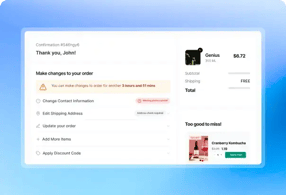
- Order editing for Shopify, so customers fix an address before the order ships.
Your routing tool keeps drivers efficient; this layer keeps customers informed. If you're evaluating last-mile delivery software and want to understand how a post-purchase experience layer integrates with your shortlist, explore ClickPost's integrations or book a platform walkthrough.
Last-Mile Delivery Software: Frequently Asked Questions
What is the best last-mile delivery software for small businesses in 2026?
Routific and Shipday are the strongest small-business picks in 2026. Routific suits planned routes and is free up to 100 orders a month, then $150 up to 1,000 orders. Shipday is free up to 300 orders and adds DoorDash and Uber overflow from $99 a month, making it the lowest-risk entry point for micro-fleets.
How much does last-mile delivery software cost?
Last-mile delivery software ranges from free to roughly $3,500 a month on published plans in 2026. Shipday and Routific have free tiers for low volume, per-driver tools cost $35 to $59 per driver, Onfleet starts at $619 a month, and enterprise platforms quote custom contracts above that. Add SMS, onboarding, and integration costs to build a realistic year-one budget.
What features should I look for in last-mile delivery software?
Look for seven core features: route optimization, real-time GPS tracking, electronic proof of delivery, a reliable driver app, automated customer notifications, ecommerce and ERP integrations, and failed-delivery analytics. For most operations the non-negotiables are route optimization, real-time tracking, and ePOD, because they drive cost per stop and settle delivery disputes.
What is the difference between last-mile delivery software and a TMS?
A TMS manages carrier selection, load planning, freight contracts, and multimodal transportation across the whole shipping network. Last-mile delivery software covers only the final leg: driver dispatch, route optimization, customer notifications, and proof of delivery. Many enterprise shippers run both, using the TMS for carrier procurement and the last-mile platform for dispatch execution.
Which last-mile delivery platform is best for ecommerce businesses?
It depends on who drives. Track-POD fits ecommerce brands with their own vans that need Shopify or WooCommerce sync and strong proof of delivery. Shipday fits hybrid fleets that overflow to DoorDash Drive or Uber. Onfleet fits same-day operations that need polished customer tracking. Brands shipping mainly through national carriers need a post-purchase platform.
How do I choose last-mile delivery management software?
Start with your daily delivery volume and fleet model, then confirm native integrations with your ecommerce platform, WMS, and ERP before booking demos. Compare pricing on year-one cost rather than the monthly fee. Finally, score finalists on weighted criteria and get uptime and support SLAs in writing before you sign.
What is the best last-mile delivery software with route optimization?
Routific leads planned multi-stop route optimization for small and mid-size fleets. OptimoRoute is the strongest choice when routes mix deliveries with service appointments, thanks to weekly planning. Locus leads at enterprise scale, where AI re-optimizes routes across your own fleet and carrier partners. Whichever you shortlist, test it on your own address data.
Does last-mile delivery software integrate with Shopify or WooCommerce?
Yes, most SMB platforms do. Track-POD connects natively to Shopify and WooCommerce, Onfleet and Shipday offer Shopify apps, and Routific added a native Shopify connector in April 2026. Enterprise platforms such as Locus and DispatchTrack usually integrate through APIs, so build developer time into your implementation budget.
The Bottom Line on Choosing Last-Mile Delivery Software
Three variables decide this purchase:
- How many deliveries you run each day.
- Who drives: your staff, contracted couriers, gig networks, or a mix.
- Which systems the platform must connect to.
Routific and Shipday cover most small fleets. Onfleet owns same-day dispatch. Track-POD and OptimoRoute fill specific mid-market needs, and DispatchTrack and Locus pay off only at enterprise volume.
Test every finalist on your own addresses before signing. If your evaluation includes the customer experience layer, model the impact with our tracking ROI calculator.





We use cookies to keep the site working, understand usage, and improve your experience. Learn more
Always active for essential site performance and security.
Enables anonymous usage analysis to refine our services.
Used to present relevant promotions and advertising.