.png?width=193&height=27&name=ClickPost%20Logo%20(Blue).png)
.svg)
.svg)
.svg)
.svg)
.webp?width=286&height=206&name=ROI%20Calculator%20(2).webp)
.svg)
.svg)
.svg)
.svg)
.svg)
.svg)
.svg)
.svg)
.svg)
.webp?width=286&height=206&name=Frame%201171276203%20(11).webp)
.svg)
.svg)
.svg)
.svg)
.webp?width=286&height=206&name=ROI%20Calculator%20(3).webp)
.svg)

.svg)
.svg)
.svg)
.webp?width=286&height=206&name=ROI%20Calculator%20(4).webp)
How Proactive Shipping Notifications Reduce WISMO


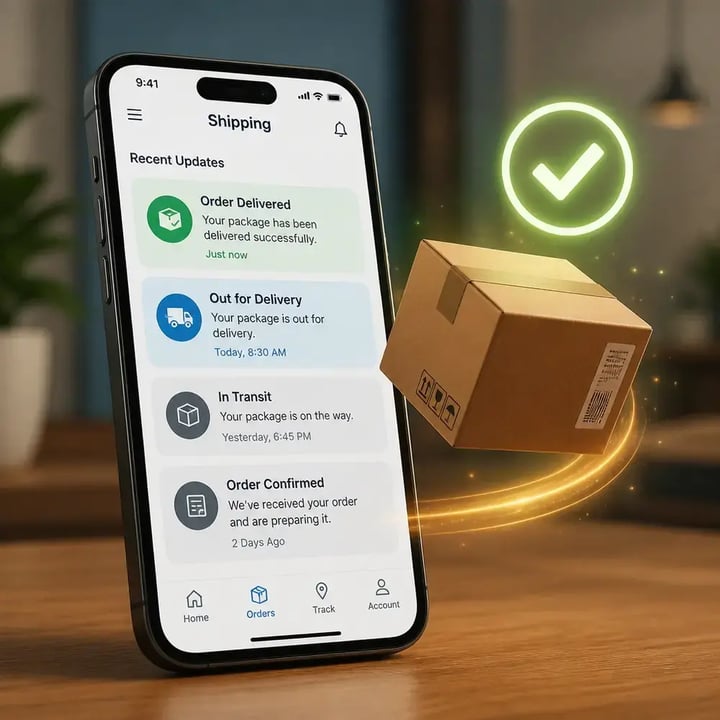
Ready to delight customers after checkout?
Trusted by 600+ brands
In this blog
TL;DR Summary
WISMO tickets — customers asking where their order is — consume 30–50% of ecommerce support volume and cost far more than brands realize. Fixing it is a budget decision, not a logistics one, and the savings are measurable against your own numbers.
-
WISMO Volume – eats 30–50% of all support tickets
-
Processing Gap – 12–48hr silence triggers most anxiety
-
Channel Cost Gap – phone costs 4x more than self-service
-
Proactive Updates – eliminate the reason customers contact you
-
Agent Opportunity Cost – hidden drain beyond the per-ticket fee
-
Budget Framing – model savings against your own order volume
Introduction
Support tickets regarding perfectly normal orders currently make up roughly a third to a half of your volume. Where is my order is the biggest question in ecommerce support, and it accounts for 30 to 50 percent of everything your team handles. The order itself is usually fine. It's moving, it's on schedule, and the customer simply has no way to see that from where they're standing.
So they wait through the quiet stretch after the shipping email, the day or two before the carrier logs its first scan. The longer the quiet runs, the more certain they become that something has gone wrong, until they open a ticket to find out. Every one of those contacts runs about $13.50 on an assisted channel, by Gartner's benchmark, while the same answer through self-service costs $1.84. Every one of those is money spent telling someone what your systems already knew.
The Real Reason WISMO Happens, and It Is Not Your Carrier
The Processing Gap: Where WISMO Anxiety Begins
Most WISMOs do not start with a late delivery. It starts in the processing gap, the 12 to 48 hour silence between label creation and the first carrier scan.
Here's the part many brands miss: the processing gap is usually a problem with fulfillment timing. Usually. There are three mechanics driving it:
-
Batch label printing: Warehouses print labels in waves, often hours ahead of the truck. The tracking number goes live the moment the label prints, so the customer sees a number while the box still sits on the dock.
-
Carrier pickup cutoffs: Every carrier has a daily collection window. Miss it by ten minutes and the order waits for the next pull, adding a full day before any scan lands. Order spikes near your cutoff make this worse.
-
Bulk handoffs: High-volume shippers tender batches under one master barcode, so individual parcels stay pre-shipment until they clear intake. A package can physically move for a day before a single scan appears.
While so much goes on in the background, the customer sees none of it. They only wait for a number, a change in milestone, or a revised estimated delivery date. McKinsey's survey of more than 1,000 US consumers found that half of them track an order specifically to confirm it is progressing and on time. Each time a tracking page sits unchanged or a notification is skipped, they believe their order is stalled, or worse, won't reach them at all.
Diagnostic tip: Pull a week of orders and compare label-print time to first-scan time. A gap that swings wildly, or routinely runs past your carrier cutoff, usually means the delay is in your warehouse, not the carrier network.
What WISMO Is Actually Costing Your Brand
Per-Ticket Cost by Channel (2025/26)
WISMO tickets are cheap individually and expensive in aggregate. The cost turns almost entirely on which channel the customer uses to ask, and the brand rarely gets to choose.
The visible cost is the ticket fee. ContactBabel's 2025 report, puts the average inbound phone contact at $7.16, about 18 percent higher than email and 42 percent higher than web chat. A call ties up one agent for its full length; a chat agent handles several at once. Self-service and automated resolution, however, sit in a different tier. Gartner's 2024 benchmark puts the median self-service contact at $1.84.
To turn that into an annual figure, here is a worked example. Take a brand shipping 2,000 orders a month. WISMO volume commonly runs 5 to 10 percent of orders; we use 8 percent, roughly 160 tickets a month. Depending on your WISMO volume, the prices can increase or decrease.
| Support channel | Cost per WISMO ticket | Annual cost (800 tickets/mo, 8% WISMO) |
| Phone / voice | $7.16 | $68.7K |
| $6.07 | $58.3K | |
| Live chat | $5.04 | $48.4K |
| AI-resolved/self-service | $1.84 | $17.7K |
The table above tells half the story. The per-ticket fee counts what each channel charges you, but not what the agent's time is worth while they handle it. That second cost is a heavy add-on, and it's where WISMO does its real damage.
The Opportunity Cost Brands Underprice
The hidden cost: agent time. The ticket fee understates the real drain, because it prices the contact, not the capacity it consumes. A retail WISMO voice contact runs about 5 minutes of handle time (Kayako's 2026 benchmark puts retail AHT at 3 to 5 minutes).
At 800 phone tickets a month, that is roughly 67 agent-hours monthly, or 800 hours a year. At a fully loaded support wage near $25 an hour, about $20K a year in labor, on top of the ticket fee.
So the figure to weigh against automation is not $68.7K. It is closer to $89K once labor is counted. And WISMO scales with order volume, not with complexity, so those hours grow in your peak months, exactly when your team has the least slack to absorb them.
That changes the objective. The win is not resolving WISMO tickets more cheaply. It is stopping them from being opened. Which raises a fair question: don't carriers already send tracking updates?
Carrier Notifications vs Brand-Owned Proactive Notifications
It's easy to assume carrier updates have WISMO covered. Understandable, but it leaves a gap, because a carrier update and a brand-owned one do very different jobs.
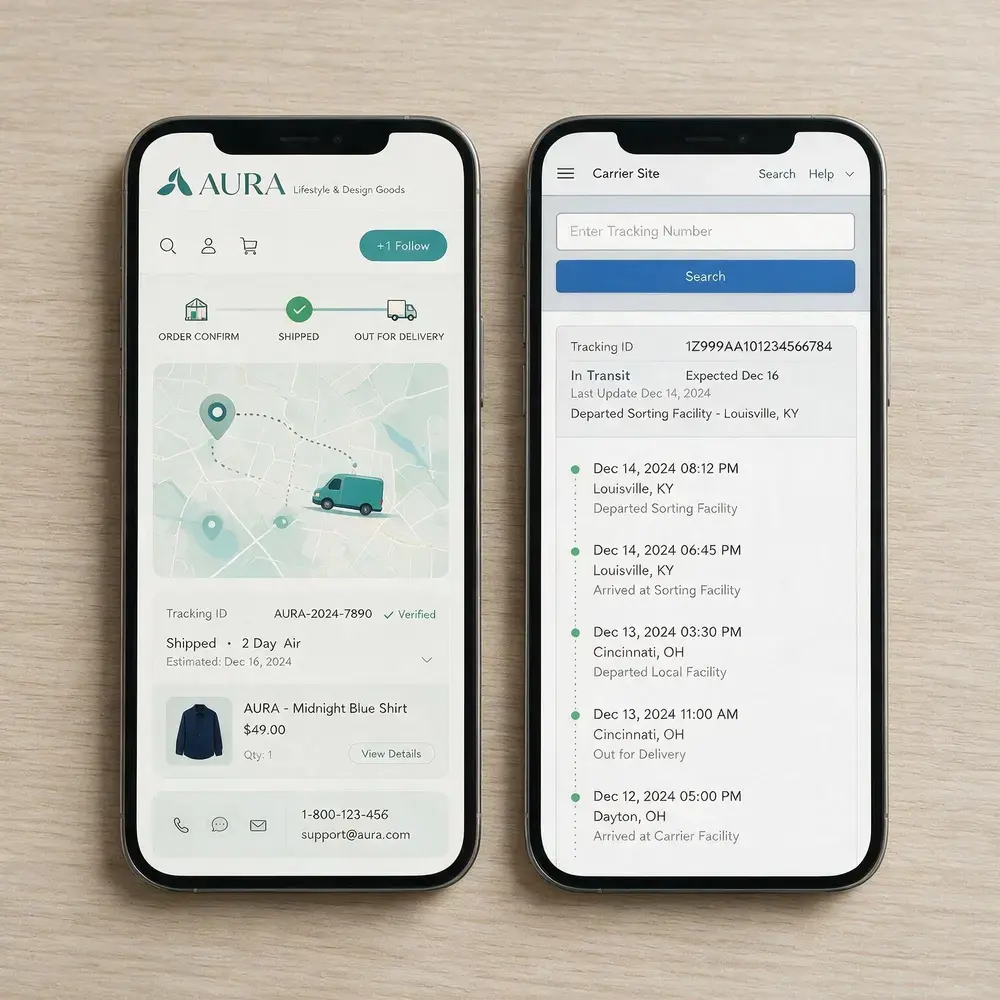
A carrier update fires on a scan event you do not control and lands under the carrier's name. A brand-owned update fires on your order logic, including the pre-scan dispatch moment inside the processing gap, and lands under yours. That gap in control is what separates a notification that prevents a ticket from one that arrives too late to matter.
| Dimension | Carrier notifications | Brand-owned proactive notifications |
| Opt-in required | Often yes (carrier app) | No, sent via your channel |
| Branding control | None, carrier-branded | Full, drives loyalty |
| Timing control | Carrier scans only | Any event, including processing gap |
| Exception handling | Generic status codes | Custom delay messaging by type |
| Multi-carrier normalization | No, incompatible codes | Yes, normalized across carriers |
| Channel support | Email / push (limited) | Email, SMS, WhatsApp |
Brands shipping across several carriers shouldn't underestimate how differently each one talks to customers. DHL, USPS, and FedEx use different status vocabularies for the same physical event, so raw carrier messages can confuse customers and generate more tickets instead of preventing them.
Only the brand layer can standardize those codes into a common set and de-duplicate the scans, turning a messy multi-carrier feed into one consistent status the customer can actually follow.
Five Ways Proactive Notifications Eliminate WISMO Before It Starts
Proactive notifications can effectively eliminate WISMOs. The harder question is which ones to send, and when. The following five triggers do most of the work. Each one shuts down a specific kind of WISMO, and placed end to end they cover the whole journey from warehouse to doorstep, closing the gaps where questions start before the customer can ask.
1. The Dispatch Notification: Close the Processing Gap
Send a brand-triggered message the moment the order leaves the warehouse, before the carrier's first scan. It tells the customer their order is physically moving even while tracking still shows nothing. Fire it off the WMS or OMS dispatch event and send email and SMS together. Done well, this drives processing-gap WISMO, the most common type, close to zero.
A line like "your order is packed and headed to the carrier, tracking goes live within 24 hours and we'll text you when it does" does the job. Route the customer to a branded tracking page so they can self-serve between updates.
2. In-Transit Milestone Notifications: Replace Anxiety With Anticipation
Trigger short updates at the key scan events, accepted, in transit, and out for delivery. Because 87 percent of merchants go silent after the confirmation email, each of those silences is its own WISMO trigger. Map the messages to normalized carrier events rather than raw carrier codes so the language stays consistent no matter which carrier moves the parcel. This removes the is-it-still-moving category of inquiry entirely.
3. Proactive Delay Alerts: Own the Bad News First
The moment an exception is detected, a weather hold, an address problem, a customs delay, reach the customer before they check tracking themselves. Include a revised delivery date and a resolution path.
The damage from a delay is rarely the delay itself; it's the silence around it. And that silence now lands on you: a 2025 UPS Capital report found only 39 percent of US consumers still blame the carrier for delivery problems, down from 83 percent in 2022.
The customer holds the brand responsible, so the brand is better off delivering the news on its own terms. Owning the delay early also curbs item-not-received disputes, since unresolved delay anxiety is a common trigger for them, which ties this trigger directly to recovered revenue.
4. Delivery Confirmation and What-Happens-Next
A delivered notification closes the "did it arrive" question and opens a revenue window. Pair it with a review prompt, an exchange path, and a soft product recommendation, so the message that confirms delivery also invites the next order. You deflect last-mile WISMO and earn incremental revenue in a single send.
5. AI-Driven Segmentation: Right Message, Right Customer
Notification fatigue is real, and over-messaging drives the opt-outs that quietly erode your deflection rate. A first-time buyer needs more touchpoints than a repeat buyer with a clean delivery history. High-anxiety segments, prior WISMO contacts, high-value orders, and Q4 gift shipments each deserve their own sequence.
This is where ClickPost's AI customer segmentation earns its place: it identifies segment membership at order creation and routes each shipment to the right cadence, holding opt-outs down while lifting CSAT on delayed shipments for the customers who matter most.
Key point: Five triggers, dispatch, in-transit milestones, delay alerts, delivery confirmation, and AI-segmented sequences, cover the full post-purchase arc. Together they hand customers the information they would otherwise have to ask for, which is what turns WISMO from a standing queue into a rare exception.
Peak Season WISMO: Why Q4 Is a Different Problem
WISMO already runs a significant support volume in a normal month, and passes half the queue during BFCM. Volume itself rises about 42 percent from Q3 to Q4 (Zendesk benchmark data), so WISMO grows as a share and against a bigger base.
Three things drive the Q4 spike: carrier networks run at capacity, so scans lag; warehouse backlogs widen the processing gap; and gift deadlines shorten the customer's fuse, turning a quiet tracking page into an escalation in hours instead of days.
Here is a preparation timeline that absorbs the surge without adding headcount:
-
By end of Q2: audit carrier integrations and normalize status codes across every holiday carrier.
-
By end of Q3: configure exception-specific delay templates for weather, peak-volume, and customs delays.
-
Six weeks before BFCM: run notification-sequence tests across email, SMS, and WhatsApp.
-
BFCM week: activate high-frequency sequences for VIP and gift orders.
Key point: By the time BFCM arrives, the work is done or it isn't. Brands that prepare from Q2 on, normalizing carriers, building delay templates, testing sequences, absorb the surge without adding a single agent.
Role-Specific Action Plan: Who Does What
If You Are Head of Customer Experience
Your metrics are CSAT on delayed shipments, repeat contact rate, and NPS lift from proactive communication. When you take this to leadership, frame it as CX infrastructure, and tie the budget to the metric that moves most: exception shipments. Gartner has found that proactive service lifts CSAT, NPS, and Customer Effort Score by a full point each, and delayed orders are where that lift is easiest to show.
If You Are Head of Customer Support
The metric to track is your deflection rate, and behind it, how your agent mix changes as volume drops. With most WISMO deflected, what remains is complex and high-value: disputed claims, damaged goods, escalations. Your agents move up into work that develops them, and the headcount stays intact.
If You Are an Ecommerce Operations Manager
You own the plumbing. Your job is to confirm the dispatch event actually reaches the notification platform, and that status codes are normalized across your carrier mix before BFCM. The carrier integration layer is where this quietly works or quietly breaks.
Key point: For Support Heads, the real value is not fewer tickets. It is the shift from low-value where-is-it inquiries to high-value cases where agent judgment drives retention.
How ClickPost Operationalizes This Without a Six-Month Integration
WISMO originates at different points in the fulfillment journey, and each one needs its own trigger. ClickPost listens to your OMS or WMS dispatch events, so coverage starts at the processing gap, before the carrier's first scan, with no custom engineering.
-
Pre-shipment: Order editing catches address and SKU errors before dispatch, removing that WISMO at the source.
-
Processing gap: Notifications fire on the dispatch event, so the first update reaches the customer before the carrier's first scan.
-
In transit: Proactive notifications follow the customer across carriers and channels.
-
Message personalization: AI tailors each message, adjusting subject lines, destination details, and content to the individual order, keeping customers engaged in the journey rather than just informed of it.
-
Between updates: Branded tracking pages do more than show status. Weather widgets, style guides, care tips, and relevant upsells turn the page into part of the customer experience, so customers stay and self-serve instead of opening a ticket.
-
After delivery: Returns and exchanges extend the same coverage into the Where Is My Refund gap most brands leave open.
For the tickets that still arrive, ClickPost pushes notification history and live shipment status into Gorgias, Zendesk, or Freshdesk, so agents resolve them in one touch with full context.
Key point: When notifications feed the helpdesk, pushing shipment history and exception context into the agent's ticket view, the remaining WISMO contacts become single-touch resolutions.
WISMO Reduction Quick-Start Checklist
Most mid-market brands can get this operational in under two weeks. Work the steps in order.
-
Calculate your current WISMO rate: (WISMO tickets divided by total orders) times 100.
-
Identify your processing-gap window: the time between label creation and first carrier scan.
-
Map your current notification triggers: what fires today, and where nothing fires.
-
Configure a dispatch notification tied to the WMS or OMS event, not the carrier scan.
-
Normalize carrier status codes across your full carrier mix before enabling in-transit alerts.
-
Build exception-specific delay templates for your three most common exception types.
-
Define your segments (VIP, first-time, gift-order) and assign each a notification frequency.
-
Connect the notification platform to your helpdesk so agents see shipment history on every ticket.
Conclusion
Every WISMO inquiry is a missed opportunity to answer a customer's question before they feel the need to ask it. Proactive shipping notifications give brands control over that conversation, replacing uncertainty with timely updates at the moments customers care about most.
Managing those touchpoints consistently is difficult with native carrier notifications alone, which is why many growing brands adopt a dedicated post-purchase platform. If you'd like to see how ClickPost uses AI-powered notifications, branded tracking, and post-purchase automation to reduce WISMO inquiries, explore the platform.
Frequently Asked Questions About Proactive Shipping Notifications and WISMO
What is WISMO and why does it happen?
WISMO (Where Is My Order?) describes inbound customer questions about shipment status. It happens when brands stop communicating after order confirmation, creating an anxiety gap that customers fill by contacting support. The most common trigger is the processing gap: label created and tracking link sent, but no carrier scan for 12 to 48 hours.
What percentage of customer service calls are WISMO?
WISMO makes up 30 to 50 percent of all inbound ecommerce support tickets, which makes it the single largest avoidable support category for most brands. During peak season it can climb past half of total volume.
How much does a WISMO call cost to resolve?
Cost depends heavily on the channel. Phone is the most expensive: ContactBabel's 2025 US data puts the average inbound call at $7.16, with email and chat lower. Self-service resolution sits far below, around $1.84 per contact on Gartner's 2024 benchmark. That spread is why channel mix drives your total cost.
How do I calculate my WISMO rate?
Divide order-status inquiries by total orders shipped in the same period, then multiply by 100. As a rough guide, a best-in-class rate sits below 5 percent, the industry average runs around 8 to 10 percent, and brands without proactive notifications often sit higher around 12 to 18 percent.
What is the difference between carrier and brand-owned proactive notifications?
Carrier notifications fire on carrier scan events and carry carrier branding, so you control nothing. Brand-owned notifications fire on your order logic, including pre-scan dispatch, carry your branding, and go out on your channel mix. Carrier notifications cut WISMO 15 to 30 percent; brand-owned reach 70 to 90 percent.
How do proactive shipping notifications reduce support tickets specifically?
They remove the customer's reason to make contact. When a dispatch notice, in-transit updates, and a delay alert all arrive before the customer notices a problem, there is no information gap left to drive a WISMO inquiry.
How do I reduce WISMO during Black Friday and peak season?
Configure carrier normalization and exception-specific delay templates by end of Q3. Activate high-frequency sequences for gift orders and VIP customers six weeks before BFCM. WISMO surges 3 to 5 times in Q4, and brands that prepare in Q3 absorb it without adding headcount.
What tools reduce WISMO most effectively?
Post-purchase platforms with multi-carrier normalization, AI segmentation, and direct helpdesk integration into Gorgias or Zendesk, such as ClickPost, cut WISMO by 70 to 90 percent. Standalone carrier tracking apps and transactional email tools reach 15 to 40 percent at best.



We use cookies to keep the site working, understand usage, and improve your experience. Learn more
Always active for essential site performance and security.
Enables anonymous usage analysis to refine our services.
Used to present relevant promotions and advertising.