.png?width=193&height=27&name=ClickPost%20Logo%20(Blue).png)
.svg)
.svg)
.svg)
.svg)
.webp?width=286&height=206&name=ROI%20Calculator%20(2).webp)
.svg)
.svg)
.svg)
.svg)
.svg)
.svg)
.svg)
.svg)
.svg)
.webp?width=286&height=206&name=Frame%201171276203%20(11).webp)
.svg)
.svg)
.svg)
.svg)
.webp?width=286&height=206&name=ROI%20Calculator%20(3).webp)
.svg)

.svg)
.svg)
.svg)
.webp?width=286&height=206&name=ROI%20Calculator%20(4).webp)
Shipping Notifications vs. Branded Tracking: Which Reduces WISMO?


Ready to delight customers after checkout?
Trusted by 600+ brands
In this blog
TL;DR Summay
WISMO queries consume 30–50% of ecommerce support volume, costing $5–$22 per ticket — far above the retail baseline. Two tools dominate the fix, but they work differently and suit different ticket types.
-
Proactive Notifications – stops informational WISMO before tickets open
-
Branded Tracking Page – reduces repeat contacts and adds upsell revenue
-
Informational WISMO – notifications resolve this largest ticket category fastest
-
Exception-Driven WISMO – notifications control narrative better than passive pages
-
Reassurance-Seeking WISMO – neither tool helps — needs AI or policy changes
-
Combined Deployment – 70%+ deflection reported when both tools run together
Introduction
WISMO or “where is my order,” queries make up 30 to 40 percent of ecommerce support volume in a normal week, and that share climbs past 50 percent during peak seasons. Faced with that volume, most CX teams reach for the same two fixes: send more proactive shipping notifications, or build a branded tracking page. Few teams have the budget or engineering time to deploy both at once.
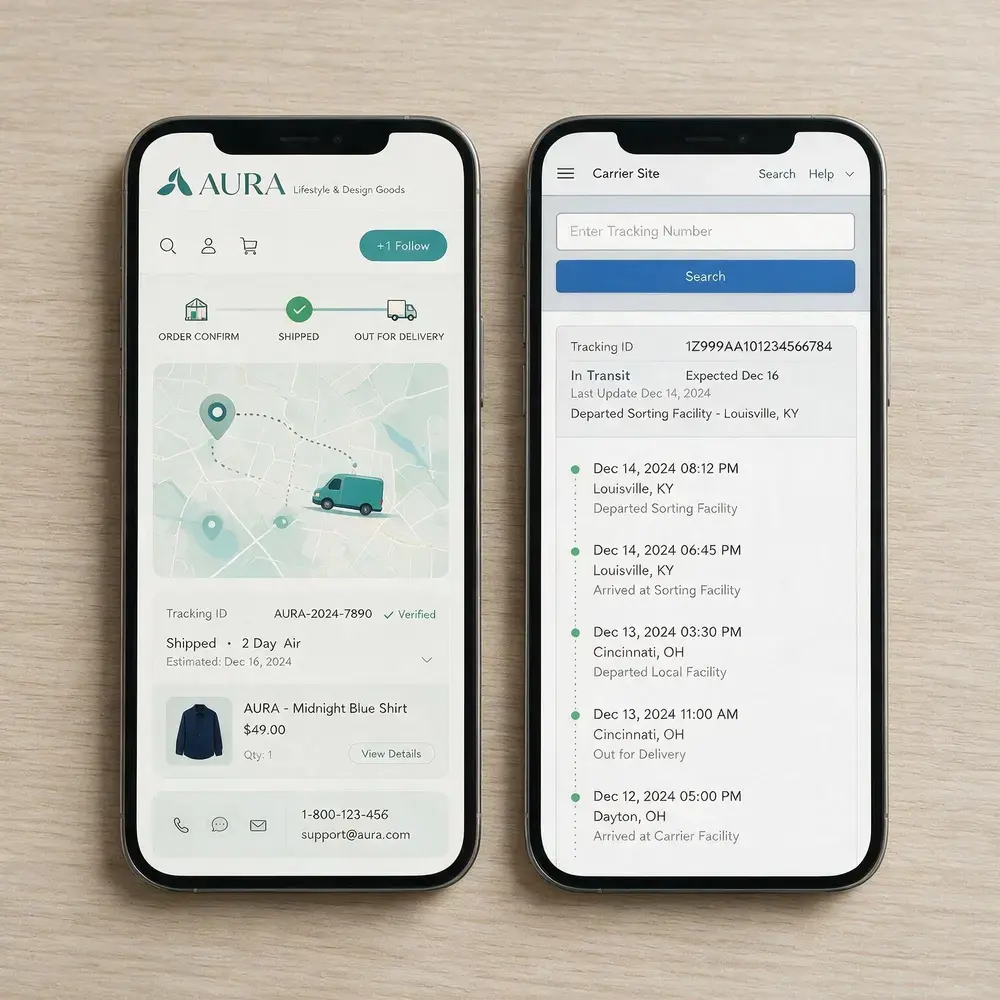
Proactive shipping notifications are typically brand-initiated. They are push-based messages (email, SMS, WhatsApp) triggered by a carrier scan event and sent before the customer has to ask. A branded tracking page, on the other hand, is a brand-hosted, pull-based destination where customers check status on their own terms. Both tools address the same customer anxiety, but they intervene at different moments, and that difference decides which one cuts WISMO more.
A crucial question often asked is, does a branded tracking page actually reduce WISMO tickets? The answer is Yes. A branded tracking page mainly reduces repeat contacts and self-service anxiety, while proactive notifications close the anxiety window before a ticket ever opens. This makes notifications the tool most likely to produce the largest single reduction
Why “just use both” doesn't answer the question CX teams actually face
The three WISMO sub-types below determine the specific tool you need to counter WISMOs. Not every WISMO ticket has the same cause, and that distinction matters to the solution you implement. The following three sub-types determine which tool actually moves the needle:
-
Informational WISMO (an estimated 60 to 70 percent of tickets): the customer received no proactive update and is simply asking for status. Notifications resolve almost all of this; a tracking page is a secondary fallback for customers who prefer to look rather than be told.
-
Exception-driven WISMO (an estimated 15 to 25 percent): a carrier exception occurred, a delay, a scan gap, a failed delivery attempt. Neither tool removes the exception, but notifications shape how the customer experiences it, while a tracking page only displays it after the fact.
-
Reassurance-seeking WISMO (an estimated 10 to 20 percent): the customer already has notifications and tracking page access and contacts support anyway. Neither tool reduces this category; it responds to AI deflection or policy-level changes, not more information.
Another common question often arises here, why do customers still contact support after receiving shipping notifications? This is because a share of WISMO tickets are not information problems at all. My AskAI's guide to reducing WISMO makes a related point: a tracking page deflects the orders that are already on track, but does little for customers who ask even when the answer sits one click away.
Not all WISMO tickets share a cause. Informational, exception-driven, and reassurance-seeking tickets respond to proactive notifications and branded tracking pages in meaningfully different ways.
The head-to-head numbers: what the data actually shows
Human-handled WISMO tickets cost roughly $5 to $22 to resolve, against a broader retail support baseline of $2.70 to $5.60 per contact, based on Ringly's ecommerce customer service cost analysis and Opensend's ecommerce support cost benchmarks. At 25 to 40 percent of total ticket volume, that adds up fast for a mid-market brand. Below is a table that compares proactive SMS notifications against passive tracking portals across key performance metrics like WISMO deflection, implementation speed, and revenue potential.
| Dimension | Proactive notifications | Branded tracking page |
| Primary WISMO type addressed | Informational (largest single category) | Informational plus repeat contacts |
| Reported deflection range | 50-70% within 60 days once tuned | 20-40% standalone; combined deployments report 70%+ |
| Time to first measurable impact | Days to two weeks | Two to four weeks, traffic-dependent |
| Peak season (BFCM) effectiveness | High, reaches the customer first | Medium, requires the customer to seek it out |
| Exception handling | Strong, controls the narrative | Weak, passive display only |
| Revenue and upsell potential | Low | High, 6-12% additional revenue reported |
| Works without opt-in | No, SMS needs consent | Yes |
| Implementation speed (Shopify) | 1-2 weeks | 2-4 weeks |
A transparency note is worth stating plainly: independently audited, tool-isolated deflection figures do not exist in public research. Industry data from Forrester and macro-level customer experience benchmarks from Gartner indicate that proactive communication can prevent up to 73% of standard WISMO inquirie. But every one of those real-world metrics describes a bundled deployment of automated notifications and a dedicated self-service tracking page together, not either tool in isolation. It's best to treat the notification-only and page-only split above as directional, not definitive.
In a head-to-head read of the available data, proactive notifications show the larger standalone deflection number, while branded tracking pages show the larger revenue and repeat-contact number, and no public source cleanly isolates one tool from the other.
How each tool performs against each WISMO type
Informational WISMO: notifications win, tracking pages catch the overflow
The anxiety window sits in the 48 to 72 hours between order confirmation and the first carrier scan, and that is when informational WISMO spikes. A proactive notification fires the moment a scan event happens, closing that window before the customer decides to open a ticket. A tracking page only helps customers who already know to look for it. It is a pull mechanism placed inside a push-behavior moment.
Exception-driven WISMO: notifications control the narrative, tracking pages supply the evidence
When a delivery exception happens due to a weather delay, a failed attempt, or an address problem, the customer's experience depends entirely on who explains it first. Notifications let a brand frame the exception before the customer discovers it alone.
According to e-commerce consumer research by McKinsey, roughly 50 percent of modern consumers closely track their transaction status, demanding high transparency throughout the post-purchase cycle. However, relying purely on passive channels presents a major operational challenge.
Several operational research indicate that while proactive outreach has the power to protect customer value, passive self-service frameworks that fail to resolve the user's underlying anxiety backfire, driving up to two-thirds of notified customers to contact customer support directly to confirm details.
When fulfillment issues or delivery windows drift under heavy seasonal volumes, an unguided customer defaults to anxiety. A brand running high shipping volume carries a heavier exception load than a passive tracking page alone will explain, making highly precise, proactive notifications critical to managing the narrative before support channels are overwhelmed.
Reassurance-seeking WISMO: neither tool is the answer
Some customers contact support even after receiving every notification and seeing a tracking page marked "on time." Industry guidance on WISMO reduction indicates that tracking pages reduce straightforward inquiries, while exceptions and higher-friction cases still require additional support. This segment sets the floor a CX team cannot automate below with notifications or a nicer tracking page alone.
Proactive notifications control the customer's first experience of a delivery exception, while a branded tracking page can only respond to the curiosity of a customer who already knows to look.
The irreducible WISMO floor: what neither tool can eliminate
Even with both proactive notifications and tracking pages fully deployed, a residual share of customer service tickets inevitably survives. This "floor" is sustained by reassurance-seeking behavior and genuine carrier disruptions that no amount of status data can resolve.
Understanding this limitation is essential for accurate resource and workforce planning. Customer experience managers who build budget forecasts on the premise that automation will entirely eliminate delivery inquiries are frequently blindsided when contact volume levels off well above zero.
Rather than expecting perfection from basic digital tracking, enterprise strategies must treat the residual floor as a permanent baseline. Managing this remaining volume requires subsequent investments in front-line automation, checkout-level delivery promise accuracy, and streamlined returns orchestration.
Operational research from Gartner indicates that while the vast majority of consumers engage with digital self-service tools at some stage in their post-purchase journey, the average success rate for fully resolving customer inquiries through these standalone digital channels rests at 14 percent. Because a significant subset of users will always require direct human validation or complex exception handling, a zero-percent inquiry rate remains functionally impossible for any modern merchant.
A residual WISMO floor persists for most ecommerce brands even after full notification and tracking page deployment, driven by reassurance-seeking behavior and carrier exceptions that neither tool resolves.
How ClickPost turns WISMO into a post-purchase revenue lever
A brand that solves the sequencing problem correctly does not have to choose between the two tools forever. It deploys notifications first for speed, then layers a tracking page for compounding and revenue. ClickPost's AI-powered tracking and notifications platform addresses the US carrier scan-gap problem directly, normalizing events across carriers so notifications fire on reliable data rather than noisy webhooks.
The tracking page session is the highest-intent moment in the post-purchase journey. Customers who visit a tracking page multiple times per order before delivery represent a concentrated window for product recommendations, loyalty touchpoints, and review requests. ClickPost's D2C post-purchase solution embeds those directly in the tracking experience, turning the page into more than a status lookup.
When it comes to returns-related WISMOs, ClickPost's returns and exchange platform applies different return windows and exchange-first flows by customer segment. Customer-specific return policies help reduce avoidable inquiries, while returns protection lowers the spike in exceptions caused by lost or damaged packages.
The WISMO resolution implementation sequence decision
Start with proactive notifications if:
-
WISMO sits above 30 percent of total support volume
-
A high-volume season is approaching (BFCM prep, Q4)
-
Current carrier notifications are generic or carrier-branded
-
A custom tracking page destination is not yet feasible
Start with a branded tracking page if:
-
A notification tool, even basic Shopify notifications, is already live
-
WISMO tickets cluster around “where do I track my order,” signaling no self-service destination exists
-
The revenue and upsell benefit matters as much as the ticket reduction
Deploy both for ceiling performance:
Once informational WISMO is under control and the compounding repeat-contact and revenue effects become the priority.
Bottom Line
For most US ecommerce brands, proactive shipping notifications are the higher-impact lever to pull first. They address the largest WISMO category, reach the customer before anxiety turns into a ticket, and show measurable deflection within weeks.
A branded tracking page is the essential second layer. It compounds the notification effect, catches customers who prefer to self-serve, and turns the tracking session into a revenue opportunity through recommendations, reviews, and a return entry point.
Together, the two tools produce the ceiling result. But sequencing still matters, and “deploy both simultaneously” is not a real answer for a CX manager working with a single implementation window and one engineering sprint to spend.
FAQs
Does a branded tracking page actually reduce WISMO tickets?
Yes. A branded tracking page reduces WISMO mainly by eliminating repeat “where is my order” contacts from customers who already have a self-service destination, though vendor case studies bundling it with notifications report considerably higher combined reductions.
What is the difference between proactive shipping notifications and carrier notifications?
Carrier notifications come from the carrier's own system, use its branding, and need no opt-in, but they are inconsistent and dilute brand presence. Brand-owned notifications come from your domain, carry your branding, and fire from normalized carrier events you control.
How much does a WISMO ticket cost an ecommerce brand?
Human-handled WISMO tickets cost roughly $5 to $22 each, against a broader retail support baseline of $2.70 to $5.60 per contact, per Ringly's ecommerce customer service cost analysis. A brand handling 1,000 WISMO tickets a month faces $60,000 to well over $250,000 a year in direct support cost.
What percentage of ecommerce support tickets are WISMO?
WISMO typically runs 25 to 40 percent of total support volume in a normal week and climbs past 50 percent during peak season, per Ringly's WISMO tracking analysis.
Should I implement proactive notifications or a branded tracking page first?
Deploy notifications first once WISMO exceeds 30 percent of support volume. They reach the largest ticket category fastest, days to two weeks, versus two to four weeks for a tracking page to build traffic and habit.
Can proactive notifications eliminate WISMO entirely, or is there an irreducible floor?
No. A residual floor persists even with full notification and tracking deployment, driven by reassurance-seeking customers and genuine carrier exceptions. Reducing it further requires AI deflection, delivery-promise accuracy improvements at checkout, and exception-specific messaging rather than more of the same two tools.
Should I implement proactive notifications or a branded tracking page first?
Deploy notifications first if WISMO exceeds 30 percent of support volume. They address the largest WISMO category with the fastest time to impact, days to two weeks, against two to four weeks for a tracking page to build traffic.




We use cookies to keep the site working, understand usage, and improve your experience. Learn more
Always active for essential site performance and security.
Enables anonymous usage analysis to refine our services.
Used to present relevant promotions and advertising.