.png?width=193&height=27&name=ClickPost%20Logo%20(Blue).png)
.svg)
.svg)
.svg)
.svg)
.webp?width=286&height=206&name=ROI%20Calculator%20(2).webp)
.svg)
.svg)
.svg)
.svg)
.svg)
.svg)
.svg)
.svg)
.svg)
.webp?width=286&height=206&name=Frame%201171276203%20(11).webp)
.svg)
.svg)
.svg)
.svg)
.webp?width=286&height=206&name=ROI%20Calculator%20(3).webp)
.svg)

.svg)
.svg)
.svg)
.webp?width=286&height=206&name=ROI%20Calculator%20(4).webp)
Returns Reason Codes: Best Practices for Ecommerce in 2026


Ready to delight customers after checkout?
Trusted by 600+ brands
In this blog
TL;DR – Summary
Ecommerce returns hit $849.9B in 2025, with fraud and abuse accounting for a growing share of that loss. Structured reason codes give ops teams the data consistency needed to automate routing, catch fraud, and fix root causes at scale.
-
Structured Reason Codes – enable automated routing and consistent reporting at scale
-
Six Parent Categories – cover nearly every return type across all verticals
-
Sub-codes and Follow-ups – capture root cause behind broad vague selections
-
Disposition Codes – decide item fate separately from return reason
-
Category Ownership – assign teams accountability to reduce repeat returns
-
Fraud and Abuse Flags – 12% loss from abuse demands automated second review
Introduction
The National Retail Federation estimated that retailers would absorb around $849.9 billion in returned merchandise in 2025, equivalent to roughly 15.8% of annual sales.
For ecommerce operations teams, however, the return volume is only part of the problem. The bigger challenge is understanding why products came back and using that to decide what happens to each returned item.
A vague reason from a customer such as "didn't like it" gives your warehouse little direction. It does not tell your team whether the item should be restocked, inspected for damage, routed elsewhere, or held for further review.
Across thousands of returns, these unclear responses also make it harder to spot recurring sizing issues, inaccurate product descriptions, fulfillment errors, or patterns that may indicate returns abuse.
That lack of visibility becomes more costly when abuse and fraud enter the picture. Appriss Retail's 2026 Total Retail Loss Benchmark attributed about 12% of returns-related loss to abuse and another 2% to outright fraud. Signifyd also reported that abusive returns increased by 64% between January 2024 and May 2025.
Structured returns reason codes give operations teams a consistent way to route each return automatically and flag the refunds worth a second look. This guide explains how to build a practical reason-code taxonomy and connect it with disposition codes, Shopify's 2026 returns setup, and fraud checks.
What are returns reason codes?
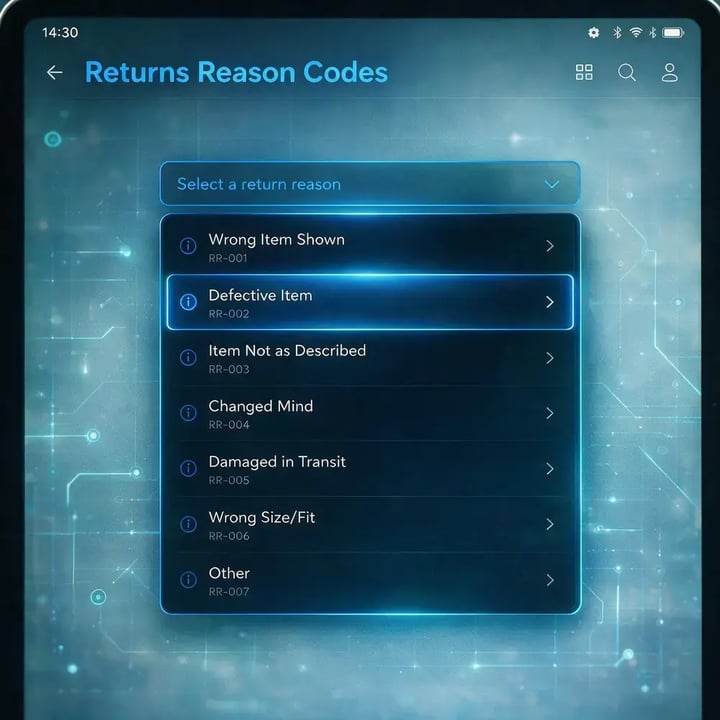
A returns reason code is a standardized label that records why a customer is returning an item. Unlike a free-text explanation, the code gives your systems a consistent value that can be grouped in reports, connected to workflow rules, and compared across products and over time.
The reason code captures why the return was initiated; a separate disposition code decides what happens to the item next (covered in its own section below). What matters here is that a consistent code can drive a workflow.
When your returns platform, OMS, or WMS is configured around these codes, a reason such as DEFECT_DAMAGE can place the item on quality-control hold and keep it out of sellable inventory until it has been inspected.
Free text still plays an important role. A comment such as "the item arrived with a scuff on the side" gives your team useful context, but it usually needs to be reviewed or classified before it can be included in reporting. The structured code makes the return easier to process at scale, while the written explanation helps your team understand the individual case.
Why broad return reasons need more context
A customer-selected reason may be accurate but still too broad to reveal the root cause. A broad option like "changed my mind" could mean several different things: an unexpected fit, a color that looked different online, a product that disappointed, or an item no longer needed. Some brands may not offer this option at all, but the same issue can arise with broad labels such as "not as expected" or "other."
Grouped under one label, those returns look identical in your dashboard even though each needs a different fix. That does not mean the customer picked the wrong reason. It usually means the form did not ask for enough detail.
You can improve the quality of your returns data by pairing the main reason code with a short, conditional follow-up. A sizing return could ask whether the item was too small or too large. A damaged-item return could request a photo. An "other" selection could open an optional text field.
This gives your systems the consistency they need while capturing enough context for your teams to act on the return.
The 6 standard return reason code categories
Most ecommerce brands can group their return reasons into a small set of parent categories. Returns platforms may use different labels, but these six categories offer a practical starting point:
-
Size/Fit — the item did not fit as expected (apparel, footwear, accessories).
-
Product Mismatch — not as described; color, material, or feature differs from the listing.
-
Fulfillment Error — wrong item or wrong quantity shipped.
-
Shipping/Transit — late arrival or damage that happened in transit.
-
Defect/Damage — the product itself is faulty or broken on arrival.
-
Buyer's Remorse — the customer changed their mind or no longer needed the item.
You can use these as parent categories and add more specific sub-codes underneath them. This keeps high-level reporting clean while still giving your team enough detail to understand what is driving each return. For example, Size/Fit could include sub-codes such as “runs small,” “runs large,” and “wrong size sent.”
Assign each category to an owner
Return reason data only becomes useful when someone is responsible for acting on it. Once you have defined your parent categories, assign each one to the team best placed to investigate the issue and reduce how often it occurs.
| Parent code | Team that owns it | Apparel sub-code examples |
| Size/Fit | Merchandising or Product | Runs small · Runs large · Wrong size sent |
| Product Mismatch | Product / Content | Color off · Materials differ · Feature missing |
| Fulfillment Error | Ops / 3PL | Wrong item · Wrong quantity |
| Shipping/Transit | Ops / Logistics | Late arrival · Damaged in transit |
| Defect/Damage | Supplier Relations / QC | Faulty on arrival · Stopped working |
| Buyer's Remorse | CX / Marketing | Changed mind · Gift return · No longer needed |
The goal of using the return reason is not simply to report how many returns fall into each category. It is to give the right team a clear signal they can investigate, prioritize, and improve over time.
Return reason codes vs. disposition codes: the operational bridge
Reason codes explain why a customer returned an item. Disposition codes record what happens to that item after inspection, such as restocking it, quarantining it, scrapping it, or returning it to the supplier. Together, they connect the customer-facing reason for the return with its inventory and financial outcome.
This is the distinction we set aside earlier, and it's worth getting right.
| Return reason code (why) | Typical disposition code (what happens) | Inventory outcome |
| Size/Fit | Inspect, restock if sellable | Returns to sellable stock |
| Buyer's Remorse | Restock if unopened; refurbish if opened | Sellable, or moved to open-box |
| Fulfillment Error | Inspect the returned unit; restock if sellable | Returns to stock; replacement ships separately |
| Product Mismatch | Restock, and flag the listing for review | Sellable; listing corrected to prevent repeats |
| Defect/Damage | Quarantine for QC, then scrap or return to supplier | Removed from sellable stock |
The pairing is what makes the data actionable. Log a Defect/Damage return without its disposition and you know a faulty unit came back, but not whether anyone recovered the cost from the supplier. The disposition is the record your finance team needs to pursue a chargeback, and the check on units quietly going back to sellable stock when they shouldn't.
How to build a return reason code taxonomy for your store
A taxonomy earns its keep when it is small enough to stay consistent and specific enough to drive action. Four steps get you there.
Step 1 — Start with a small set of parent codes
Resist the urge to enumerate every conceivable reason on day one. Thirty top-level codes fragment your data so badly that no single code carries enough volume to justify a fix. A short parent list keeps each bucket meaningful; you add depth underneath the parents, not beside them.
Step 2 — Add sub-codes by vertical
Depth belongs at the sub-code level, tuned to your category. Apparel might carry several Size/Fit sub-codes (runs small, runs large, wrong size sent). Electronics often rely on Defect sub-codes (dead on arrival, intermittent fault, missing component). Beauty typically needs only a couple of Product Mismatch sub-codes (shade mismatch, texture or scent). Start narrow and split a sub-code only when it appears often enough to reveal a recurring pattern or justify a different operational response.
Step 3 — Map each code to a disposition and an owner
Every code needs a downstream action and a named team. This is where a taxonomy stops being a survey and becomes an operating system. A Defect sub-code routes the returned unit to QC while surfacing recurring defects for Supplier Relations to investigate. A Fulfillment Error can trigger a replacement workflow for Operations. A Size/Fit code sends the returned unit back to restockable inventory, while the return data itself goes to Merchandising to analyze.
Step 4 — Add a fraud-signal flag
Structured return data makes irregular activity easier to spot. Sudden spikes in "item not received" claims, clusters of "wrong item sent" on high-value SKUs, or a surge of Buyer's Remorse returns just before a policy window closes are all patterns worth a closer look.
You do not need to treat every anomaly as fraud, but flagging these patterns for additional review before a refund is finalized creates a structured review point that free-text reasons alone cannot. Fraud detection builds on this, and it gets its own section later.
Done in order, these four steps turn a list of return reasons into a system your warehouse, merchandising, and finance teams can all act on. The next question is what to do with the patterns that system surfaces, starting with the returns you can actually prevent.
Shopify 2026: setting up return reason codes with the new API
Shopify's 2026-01 GraphQL Admin API introduced the ReturnReasonDefinition type, replacing the older ReturnReason enum with a richer library of standardized return reasons.
Instead of relying on a short fixed list such as DEFECTIVE, WRONG_ITEM, or SIZE_TOO_SMALL, merchants can now assign more granular, category-specific reasons from Shopify's expanded library. Shopify also suggests a curated subset of reasons for each product category, while still allowing any reason from the full library when creating a return.
For operations teams, the change is less about the API itself and more about data quality. More granular return reasons produce cleaner reporting, more accurate routing, and a taxonomy that scales across different product categories. Migrating to the new model generally involves three steps:
-
Upgrade to the 2026-01 Admin API (or later) so the new return reason definitions are available. This is typically a task for your dev team or returns platform.
-
Retrieve the return reason library and align your taxonomy with Shopify's standardized definitions, using the category-specific suggestions where they fit your catalog.
-
Map each return reason to downstream workflows, including disposition decisions, ownership, and OMS or WMS routing rules, so every captured reason leads to a consistent operational outcome.
Returns platforms that support Shopify's newer return reason definitions can surface the same standardized reasons in the customer returns portal and pass them into downstream workflows. That reduces manual mapping between customer selections and internal routing logic, while keeping reporting consistent across systems.
Turning reason code data into return reduction actions
Coded data only pays off when it changes something upstream. Return reason codes become useful when you group them into recurring patterns, because each pattern points to a different team and a different corrective action.
Pre-purchase and product experience
These are the largest lever in most catalogs. Independent benchmarks put fit and sizing at roughly half of apparel returns, so a rising Size/Fit code is a direct instruction to fix a size chart, add measured dimensions, or deploy AI size recommendations.
Expectation Gap codes send you back to the product page: sharper photos, accurate color, honest material descriptions. Feeding this data back into PDP optimization is where a returns tool earns its place in the merchandising workflow.
These often represent the biggest opportunity to reduce avoidable returns. Size/Fit and Product Mismatch codes usually point to something the customer could not judge before buying. A size chart that runs off, inconsistent manufacturing, or a listing that oversells the color or material.
Fulfillment failures (Fulfillment Error codes)
A sustained increase in Fulfillment Error codes is an operations problem, not a product one. It should trigger a 3PL SLA review and pick-and-pack QC checks.
Fulfillment-related codes can also drive faster resolution. When a customer initiates a return for a wrong or mis-sized item, an exchange-first workflow can offer a replacement before a refund, often shipping the correct unit before the original comes back. That turns a lost sale into a retained one.
Product quality
Defect codes are your supplier-quality early-warning system. Rolled up by vendor and SKU, they become a supplier scorecard, the basis for chargeback claims, and a routing rule that sends suspect units to QC inspection instead of back onto the shelf.
Over a quarter, that scorecard is what lets you push defect costs back onto the supplier or renegotiate terms with a vendor whose units keep coming back. A single SKU spiking on Defect codes is a conversation with a manufacturer, not a customer-service ticket.
How ClickPost turns reason code data into a returns intelligence system
Capturing a reason code is only the beginning. The real value comes from using that data to automate decisions, personalize the return experience, and route each return the right way. That is where a returns platform like ClickPost fits.
-
Capture structured return data. The self-service portal records a standardized reason at the start of the return, giving your team consistent data for reporting, sizing analysis, and quality investigations instead of free-text guesswork.
-
Apply different policies to different customers. ClickPost can read the return reason alongside a customer's history, order value, and risk signals, then automatically apply the right return window, fee, or refund method. A first-time customer returning for Size/Fit might get a free exchange, while a repeat returner follows a stricter policy.
-
Encourage exchanges before refunds. When a customer selects a Size/Fit reason, the portal can offer a size or color swap instead of defaulting to a refund, and ship the replacement before the original comes back. That recovers revenue and resolves the issue faster. ClickPost reports 21% of returns retained as exchanges or store credit.
-
Review higher-risk returns. Patterns such as frequent returns, repeated high-value claims, or unusual activity can trigger extra review before a refund is approved, while straightforward returns move through the standard process.
In practice, the return reason becomes the starting point for every decision that follows. Combined with customer history and your return policies, it determines whether a customer is offered an exchange, store credit, a refund, or a closer look, which cuts down the returns your team has to handle by hand.
The 10-point return reason code audit
Use this checklist to review your current return reason code setup. Every "No" highlights an opportunity to make your taxonomy more actionable.
-
Are all return reasons captured as structured codes rather than free text alone?
-
Do you have six or fewer parent codes, with sub-codes underneath?
-
Does every code map to a disposition action?
-
Does every code have a clearly assigned owner?
-
Are unusual or high-risk return patterns flagged for additional review?
-
If you use Shopify, have you adopted the 2026-01 ReturnReasonDefinition library and mapped your taxonomy to its category-specific recommendations?
-
Is there an open-text field alongside the structured return reason?
-
Do your return reason codes trigger routing rules in your OMS or WMS?
-
Is your "Other" or "Unknown" category reviewed regularly and kept intentionally small?
-
Do you review return trends by product, supplier, and sales channel every month?
Conclusion
Return reason codes are not just labels for returned orders. They are the operating language of an effective returns process. When every return is captured with a structured reason, mapped to a disposition, and reviewed by the right team, return data stops being historical reporting and starts driving operational decisions.
The goal is not to collect more return reasons. It is to collect reasons that lead to consistent action. Start with a simple parent taxonomy, expand with sub-codes only where they reveal meaningful patterns, and connect every code to a workflow someone owns.
Over time, that turns return reason codes from historical reporting into a practical system for reducing avoidable returns, improving inventory decisions, and strengthening supplier accountability.
Frequently asked questions about return reason codes
What are return reason codes in ecommerce?
Return reason codes are structured labels that record why a customer returned an item. Unlike free-text explanations, they support automated workflows, reporting, and trend analysis. Combined with other return data, they can also help identify unusual patterns that warrant further review.
What is the most common return reason in ecommerce?
Size and fit are the most common return reason in apparel. Coresight Research estimates it drives around 70% of online apparel returns, with an earlier survey putting it at 53%. Across other categories, the mix shifts toward defects, fulfillment errors, and items not matching their description.
What percentage of ecommerce returns are due to sizing issues?
In apparel, sizing and fit drive a large share of returns, with Coresight Research estimating up to 70%. The share is much smaller outside apparel and footwear, where defects and fulfillment errors lead instead.
What is the difference between a return reason code and a disposition code?
A return reason code records why an item came back, captured at customer intake. A disposition code records what happens to the item at the warehouse: restock, scrap, quarantine, or return to supplier. A complete return record needs both, one for the customer-facing cause and one for the inventory and financial outcome.
How do you set up return reason codes in Shopify?
On Shopify, move your integration to the 2026-01 Admin API or later, then use the ReturnReasonDefinition library to assign category-specific reasons. Align your taxonomy with Shopify's suggested reasons per product category, and map each reason to a disposition and routing rule so every return triggers a consistent action.
How many return reason codes should an ecommerce store have?
Most stores do best with a small set of parent categories, around six, and more detailed sub-codes underneath. A short parent list keeps reporting meaningful, since each category holds enough volume to act on, while sub-codes capture detail where recurring patterns justify it. Too many top-level codes fragment the data and make trends hard to spot.
What return reason codes should I use for my online store?
A practical starting set is Size/Fit, Product Mismatch (item not as described), Fulfillment Error (wrong item shipped), Shipping/Transit (late or damaged in transit), Defect/Damage, and Buyer's Remorse, plus Other for edge cases. Add category-specific sub-codes, like "runs small" under Size/Fit, as recurring patterns emerge.
Should customers choose from predefined return reasons or type their own?
Use predefined codes with an optional free-text field. Structured codes make reporting and workflow automation possible, while the free-text box captures context a code alone cannot. Broad options like "changed my mind" can hide the real cause, so a short conditional follow-up, such as asking whether an item ran small or large, improves data quality without adding friction.
How do return reason codes reduce ecommerce returns?
They reduce returns indirectly by exposing recurring problems you can fix. Size/Fit trends point to better sizing guidance, Product Mismatch codes flag inaccurate product pages, Fulfillment Error codes surface warehouse issues, and Defect codes reveal supplier quality problems. The reduction comes from acting on these patterns over time, not from the codes themselves.
How do return reason codes help detect return fraud?
Return reason codes help identify potentially abusive returns when combined with other signals. Patterns worth flagging include spikes in "item not received" claims, clusters of "wrong item sent" on high-value SKUs, and repeat returners filing claims just before policy deadlines. Flagging these for review before a refund catches abuse that free-text reasons tend to hide.
How do return reason codes integrate with warehouse management systems?
Many warehouse management systems let return reason codes trigger routing rules. For example, Defect/Damage returns can route to quality inspection, Fulfillment Error returns can initiate a replacement workflow, and Size/Fit returns can go to restockable inventory when the item is fit for resale. This removes manual disposition decisions at volume.





We use cookies to keep the site working, understand usage, and improve your experience. Learn more
Always active for essential site performance and security.
Enables anonymous usage analysis to refine our services.
Used to present relevant promotions and advertising.