









TL;DR: Tariff and De Minimis Statistics 2026
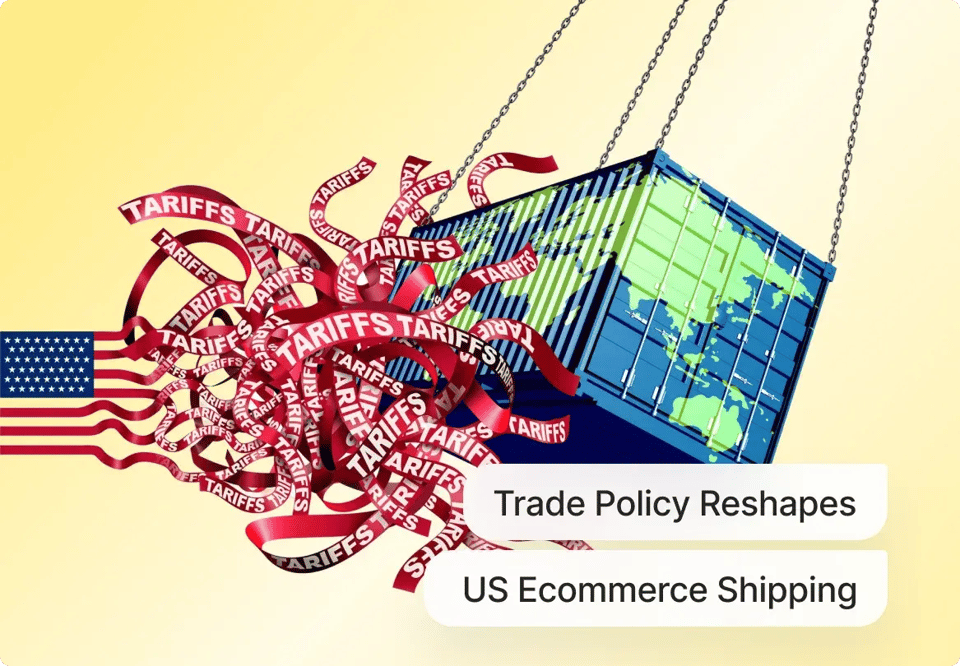
US de minimis volume peaked at 1.36 billion duty-free parcels in FY2024, then fell 30.7% once the exemption was suspended. Every low-value parcel you import now pays duty, and the $800 exemption is repealed for good on July 1, 2027.
-
1.36 billion de minimis shipments entered the US in FY2024. That is about 3.7 million a day.
-
30.7% decline in FY2025, down to 942.5 million shipments.
-
81% drop in US-bound postal traffic on August 29, 2025, the first day of the global suspension.
-
$194.9 billion in US customs duties in FY2025, up 153% in one year.
-
12.5% extra Section 301 duty on China-origin goods since July 24, 2026.
Introduction
In fiscal 2025, 942.5 million parcels entered the US under de minimis rules, carrying $48.1 billion in declared value. That was 30.7% fewer parcels than the year before, as the rules that once made low-value imports easier and cheaper began to change.
For ecommerce businesses shipping to US customers, the shift was significant. China and Hong Kong lost the exemption on May 2, 2025. The rest of the world followed on August 29. Between May and December, US Customs and Border Protection (CBP) collected more than $1 billion in duties on 246 million parcels that had previously entered duty-free.
The change reaches beyond the cost of a shipment. Businesses now have to account for duties, entry filings and additional fees when planning cross-border deliveries. That affects landed costs, pricing decisions and what customers may pay at checkout. And the transition is not over: on July 1, 2027, the $800 de minimis exemption is scheduled to be removed from law.
This report brings together the latest figures from CBP, the US Treasury, the Office of the US Trade Representative and the Federal Register to explain what changed, what it means for ecommerce shipping, and what businesses should prepare for next.
What was the de minimis exemption, and how high did the threshold go?
The de minimis exemption let one person import up to $800 of goods a day, duty-free. It came from Section 321 of the Tariff Act of 1930. CBP's June 2026 rule in the Federal Register traces the cap's history. It started at $1 in 1938. It reached $200 in 1993 and $800 in 2016.
| Year | Threshold | Legal basis |
| 1938 | $1 | Customs Administrative Act of 1938 (added Section 321) |
| 1978 | $5 | Customs Procedural Reform and Simplification Act |
| 1993 | $200 | North American Free Trade Agreement Implementation Act |
| 2016 | $800 | Trade Facilitation and Trade Enforcement Act of 2015 (P.L. 114-125) |
| July 1, 2027 | Repealed | One Big Beautiful Bill Act (P.L. 119-21), Section 70531 |
The 2016 jump quadrupled the cap. It landed just as cross-border marketplaces were scaling. In 2019, CBP added Entry Type 86, a fast electronic filing lane. A higher cap plus less paperwork made bulk use cheap. The volume table below shows what followed.
How many packages entered the US under de minimis each year?
CBP's e-commerce statistics show volume peaking at 1.36 billion shipments in FY2024. Their declared value was $64.6 billion. In FY2025, volume fell 30.7% to 942.5 million shipments, worth $48.1 billion. The FY2024 peak was nearly ten times the 139 million shipments of 2015.
| Fiscal year | Shipments | Declared value | YoY volume change | Avg value per shipment |
| FY2020 | 636.7 million | $67.0 billion* | n/a | $105* |
| FY2021 | 771.5 million | $43.5 billion | +21.2% | $56 |
| FY2022 | 685.4 million | $46.5 billion |
-11.2% |
$68 |
| FY2023 | 1.0 billion | $54.5 billion | +45.9% | $55 |
| FY2024 | 1.36 billion | $64.6 billion | +36.0% | $47.50 |
| FY2025 | 942.5 million | $48.1 billion |
-30.7% |
$51 |
-
Air carried roughly 795 million de minimis shipments in FY2025, about 84% of the total. Truck carried about 142 million, per The Export Practitioner's summary of CBP data.
-
Entry Type 86 filings dropped 33% in FY2025, from nearly 948 million to about 635 million. CBP was shutting the program down.
-
Non-China shipments hit 309 million in FY2025 through June 30. All of FY2024 saw 115 million, says the White House fact sheet on the global suspension.
-
China's ecommerce exports to the US fell from $22.9 billion in 2024 to $16 billion in 2025, the Congressional Research Service reports.
At an average declared value of $47.50 per parcel, a flat entry fee can significantly increase the cost of low-value shipments. Add brokerage charges, and sellers face further pressure on margins or retail prices. This makes ultra-low-price sellers particularly vulnerable. The 309 million figure points to another shift. After China lost the exemption, some shipments were rerouted through other countries. The August 29 policy change closed that option.
When did the US de minimis exemption end?
The exemption ended in two stages. China and Hong Kong lost it on May 2, 2025, under Executive Order 14256. Every other country lost it on August 29, 2025, under Executive Order 14324. CBP made the suspension permanent in June 2026. The statute itself is repealed on July 1, 2027.
| Date | What happened | Reference |
| Feb 1, 2025 | Suspension for China ordered, effective Feb 4, then paused days later | EO 14195 |
| May 2, 2025 | China and Hong Kong lose de minimis treatment | EO 14256 |
| July 4, 2025 | Statutory repeal enacted, effective July 1, 2027 | P.L. 119-21, Sec. 70531 |
| August 29, 2025 | Suspension extended to all countries | EO 14324 (signed July 30, 2025) |
| Feb 20, 2026 | Supreme Court strikes down IEEPA tariffs; suspension continued the same day | Learning Resources v. Trump; EO 14388 |
| Feb 24 to July 23, 2026 | 10% global Section 122 surcharge replaces IEEPA duties | Trade Act of 1974, Sec. 122 |
| June 24, 2026 | CBP codifies an indefinite suspension for all non-postal modes | CBP Dec. 26-12, 91 FR 37789 |
| July 24, 2026 | Section 301 forced-labor duties take effect; new postal informal entry process begins | USTR final action; 19 CFR 145 |
| Sept 22, 2026 | Voluntary electronic mail entry test (Entry Type 13) starts | CBP test notice, June 24, 2026 |
| July 1, 2027 | Statutory $800 exemption repealed | P.L. 119-21 |
The February 2026 ruling created uncertainty for sellers. The Court struck down the emergency tariff powers behind the original suspension, but the White House reissued the suspension the same day. CBP then reinstated it under its own Section 321 authority. This means a future ruling on tariffs may not restore duty-free treatment. Businesses should plan on the basis that de minimis is no longer available.
What happened to parcel volume and enforcement after de minimis ended?
On August 29, 2025, US-bound postal traffic fell 81% from the prior Friday, the Universal Postal Union recorded. In all, 88 postal operators suspended some or all US service. Meanwhile, CBP collected over $1 billion in duties. That came from more than 246 million low-value shipments between May and December 2025.
-
Inbound US mail made up 15% of global postal traffic in the prior 12 months, per the UPU. The shutdown pulled a large slice of the world's mail offline overnight.
-
$1 billion across 246 million shipments is about $4 of duty per parcel. That is a ClickPost calculation. It shows how small the duty is next to the cost of filing for it.
-
Seizures of unsafe and noncompliant low-value goods rose 82% once China and Hong Kong lost the exemption.
-
De minimis shipments made up 90% of all US cargo seizures in FY2024, the White House said.
-
Shein's observed US sales fell about 8% year over year in September 2025. That was the first full month of the global suspension, according to Bloomberg Second Measure data.
CBP Commissioner Rodney Scott said the collections showed just how much revenue was slipping away under the old rules. For you, the $4 average says something else. The duty was never the real threat; the per-parcel filing, bonding and broker cost was. On a $20 item, that cost can beat the duty. It is what knocked postal operators offline overnight.
How much tariff revenue does the US collect now?
US customs duties hit a record $194.9 billion in FY2025, Treasury data shows. That is up 153% from $77 billion in FY2024. In FY2026, net receipts fell to about $172 billion, the Congressional Budget Office estimates. Roughly $130 billion in IEEPA tariff refunds explain the drop.
-
Monthly customs receipts rose from $7 billion in January 2025 to $30 billion by September 2025, the Committee for a Responsible Federal Budget found.
-
Most of the roughly $166 billion collected under IEEPA gets refunded within FY2026, CBO projects.
-
The average effective tariff rate reached 18.0% in October 2025, the highest since 1934, per the Yale Budget Lab. That was before the Supreme Court ruling.
-
By July 24, 2026, the average statutory rate stood at 11.1%, Yale's latest tracker shows.
-
Current-law tariffs cost the average US household about $1,100 a year, Yale estimates.
Do not misread the falling revenue line. Refunds covered IEEPA tariffs only. Duties on low-value parcels never paused. Nothing in the refund process brings back duty-free entry for your $800 parcel.
What does a former de minimis shipment cost to import in 2026?
Your sub-$800 parcel now pays three layers. First, its regular MFN duty. Second, any Section 301 or 232 duty. Third, a processing fee. Under USTR's July 2026 forced-labor action, goods from China and Vietnam add 12.5%. Goods from Canada, Mexico and the UK add 10%.
| Cost layer | 2026 rate | Applies to |
| MFN (Column 1) duty | Varies by 10-digit HTS code | All imports without a trade preference |
| Section 301 forced-labor duty | 10% or 12.5% by country; EU, Japan, Korea, Switzerland and Taiwan capped net of MFN | Imports from 60 economies since July 24, 2026; goods under Section 232 tariffs are exempt |
| Legacy China Section 301 duties | Product-specific, from 7.5% on List 4A goods upward | Listed China-origin products |
| MPF, informal entry | $2.77 per automated entry (FY2027) | Entries valued at $2,500 or less |
| MPF, formal entry | 0.3464% of value, minimum $34.58, maximum $670.86 (FY2027) | Entries above $2,500, or where CBP requires formal entry |
| Broker and bond costs | Market rate | Varies by provider, volume and entry type |
Run that stack on a $40 China-origin apparel order, entered informally. Assume a 12% MFN rate. Add 12.5% forced-labor duty and 7.5% legacy Section 301 duty. That is $12.80 in duty. The automated MPF adds $2.77. Your landed cost just rose about 39%, before any broker fee. This is illustrative ClickPost math, and real rates depend on the HTS code. The gap is still clear. A sub-$50 order feels every dollar. A $400 order barely notices. Fee amounts come from CBP's FY2027 user fee notice.
How does the US compare with other countries' de minimis thresholds in 2026?
For commercial parcels, the US threshold is now effectively zero. The EU followed on July 1, 2026. It charges a flat €3 per item category on parcels under €150. About 4.6 billion small parcels entered the EU in 2024, the Council of the EU says. Roughly 91% came from China.
| Market | Duty threshold | Tax treatment | Status, October 2026 |
| United States | $0 in practice (statutory $800 repealed July 1, 2027) | No federal VAT; duties and fees apply | Suspended for all countries since Aug 29, 2025 |
| European Union | €150 relief abolished; interim €3 per item category | VAT due from the first euro | €3 duty runs July 1, 2026 to July 1, 2028, then normal tariffs |
| United Kingdom | £135 | VAT collected at point of sale | Relief to be removed by March 2029 at the latest |
| Canada | CAD 20; CAD 150 duty and CAD 40 tax for CUSMA courier shipments from the US or Mexico | GST/HST above the tax threshold | Active under CBSA rules |
| Australia | AUD 1,000 | 10% GST collected at checkout since July 2018 | Active under ATO rules |
Study Australia. It kept a high duty threshold but collects tax at checkout. That is a middle path between duty-free entry and full border clearance. Selling abroad yourself? Canada's CUSMA courier lane is still the friendliest nearby market for low-value orders. EU orders now carry a per-category charge. Price it into your order value.
How does the end of de minimis affect each ecommerce business model?
If you ship one overseas parcel at a time, your costs rose the most. If you import in bulk or source domestically, they rose the least. Cross-border ecommerce survived: CBP still counted 942.5 million low-value shipments in FY2025. But the economics moved toward inventory held inside the US.
| Business model | What changed | ClickPost verdict |
| China-direct dropship, orders under $50 | Every parcel pays MFN plus 12.5% and any legacy Section 301 duty, plus entry fees | Hardest hit. Works only for higher-margin SKUs or after a move to bulk import. |
| Bulk import into a US 3PL or marketplace warehouse | Duty is paid once per container entry; formal MPF is capped at $670.86 per entry | Strongest position. Per-unit fees shrink as entry value grows. You pay for it in working capital. |
| Nearshore sourcing (Mexico, Canada) | 10% Section 301 tier; USMCA preference can remove MFN duty on qualifying goods | Attractive. Your origin paperwork decides whether the savings are real. |
| US-sourced D2C | No change in import cost; overseas rivals lost a price edge | Relative winner. Speed and delivery experience now win more sales than price. |
| US brands shipping abroad | EU €3 per category duty since July 2026; UK reform due by 2029 | Price destination duties into AOV. Show them at checkout. |
Bloomberg Intelligence analyst Poonam Goyal summed it up: the playing field has been levelled. Price was the one lever domestic sellers could not match. Now it is close to even.
VERDICT
For 2026, holding inventory in the US and fulfilling orders domestically offers a stronger option for many sellers. You will need more working capital and pay for storage, but you can manage import duties in bulk and reduce the risk of customs delays at your customers’ doorsteps. Shipping individual parcels from overseas can still work, particularly if your margins can absorb a 30% to 40% increase in landed costs without hurting conversions.