.png?width=193&height=27&name=ClickPost%20Logo%20(Blue).png)
.svg)
.svg)
.svg)
.svg)
.webp?width=286&height=206&name=ROI%20Calculator%20(2).webp)
.svg)
.svg)
.svg)
.svg)
.svg)
.svg)
.svg)
.svg)
.svg)
.webp?width=286&height=206&name=Frame%201171276203%20(11).webp)
.svg)
.svg)
.svg)
.svg)
.webp?width=286&height=206&name=ROI%20Calculator%20(3).webp)
.svg)

.svg)
.svg)
.svg)
.webp?width=286&height=206&name=ROI%20Calculator%20(4).webp)
Warranty Fraud: Types, Costs & Prevention | 2026 Guide


Ready to delight customers after checkout?
Trusted by 600+ brands
In this blog
TL;DR Summary
Warranty fraud is the deliberate misrepresentation of a product claim, by customers, employees, dealers, or suppliers, to obtain a replacement, refund, or service the claimant is not entitled to.
It affects an estimated 3 to 15% of warranty claim volume across ecommerce categories and can drain 2 to 4% of annual revenue for mid-market brands. The six core fraud types are false damage claims, claim padding, serial number fraud, return swaps, advance replacement abuse, and supplier-side inflation.
Detection needs both behavioral signals (claim velocity, address clustering, cross-account serial reuse) and technical controls (image metadata checks, purchase validation, AI anomaly scoring).
The cost no one models: over-aggressive filters deny legitimate claims, and those denials generate chargebacks, CSAT damage, and lost lifetime value that can exceed the fraud itself.
What is Warranty Fraud?
Warranty fraud happens when someone knowingly provides false information in a warranty claim. This could be a customer, employee, dealer, or supplier. The false claim leads the brand to approve a repair, replacement, refund, or other benefit that the person was not entitled to receive.
That remedy is usually a replacement unit, a refund, or a paid repair. The defining element is intent: the claimant knows the representation is false and submits it anyway.
Warranty fraud is not the same as an honest mistake. A customer who gets the purchase date wrong or misunderstands what the warranty covers is not committing fraud. The same applies when a customer raises a genuine service issue, even if the brand eventually denies the claim.
Treating good-faith disagreements as fraud is exactly the false-positive problem covered later in this article.
In the US, the Magnuson-Moss Warranty Act sets the rules for consumer product warranties. It also gives the FTC power to act against deceptive warranty practices.
That framework protects both sides. Brands must honor valid claims, while people who submit fraudulent claims can face federal criminal charges.
The Six Types of Warranty Fraud Ecommerce Brands Face
The six most common types of warranty fraud each involve a different actor and leave a different detection signature:
-
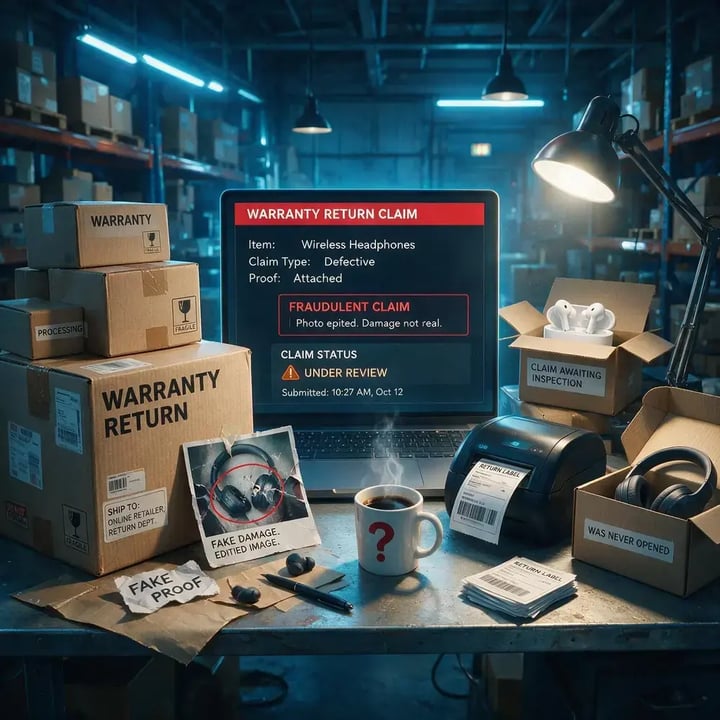
False damage claims: A customer fabricates or exaggerates a defect, increasingly using edited or AI-generated damage photos that look convincing to a rushed reviewer.
-
Claim padding: A legitimate defect gets inflated to justify a higher-value remedy, extra accessories, or a full unit replacement instead of a repair.
-
Serial number fraud: Reusing, spoofing, or transferring serial numbers from out-of-warranty, grey-market, or already-claimed units to make an ineligible product look covered.
-
Return swap (switcheroo): Returning a broken, counterfeit, or different-model unit under a warranty claim in exchange for a working replacement.
-
Advance replacement abuse: Accepting an advance replacement, then never returning the original unit the program was built to recover.
-
Supplier-side and dealer fraud: Authorized service partners inflating repair counts, billing for parts never used, or filing ghost claims for work that never happened.
One key difference is how the fraud happens. An individual might add a little extra to one claim, leaving very few clues. Fraud rings create clearer patterns by reusing serial numbers across multiple accounts, sending orders to the same addresses, and filing many claims within a short period. You can spot these patterns only when you look at claims together.
The Real Cost of Warranty Fraud: A P&L Framework
Warranty fraud costs more than the claim itself. Brands also deal with replacement, shipping, investigation, and operational costs. The broader fraud problem is significant, with the FTC reporting $15.9 billion in consumer fraud losses in 2025. For a $1 billion brand, even a hypothetical 1% loss would mean $10 million in direct exposure before those added costs. Here is a model any finance lead can run:
| Input | Example value | Your estimate |
| Annual warranty claims volume | 10,000 claims | ___ |
| Average claim resolution cost | $45 / claim | ___ |
| Estimated fraud rate (category) | 8% | ___ |
| Annual fraud exposure | $36,000 | ___ |
| Agent review cost (15 min / claim) | $12 / claim reviewed | ___ |
| Total annual ops + fraud cost | ~$48,000 | ___ |
Fraud rates vary sharply by category. Electronics and tech RMA fraud tends to run 3 to 5%; apparel and home goods sit closer to 6 to 12%; and high-value consumer electronics can reach 10 to 15%.
Channel matters too: marketplace listings (such as third-party Amazon) usually carry higher fraud rates than a brand's own DTC storefront, because identity and purchase verification are weaker on marketplace transactions.
How to Detect Warranty Fraud?
Detection works on two levels. Behavioral signals are patterns in how and when claims arrive. Technical signals are anomalies inside the claim record itself. The strongest programs watch both.
Behavioral detection signals
1. Claim velocity anomaly: A customer or household files multiple warranty claims within a short period.
2. Address clustering: Multiple unrelated customer accounts use the same shipping address for warranty claims.
3. First-claim timing spikes: Fraudulent claims often increase during the first 30 days after purchase, especially as the return window approaches its end.
4. Cross-account serial reuse: The same product serial number appears in warranty claims linked to different customer accounts.
5. Photo metadata inconsistencies: EXIF data may show that a damage photo was created before the reported incident, or the image may contain signs of AI generation or manipulation.
Technical detection signals
1. Purchase validation failure: A serial number does not match the brand’s registration database or the manufacturer’s records.
2. Grey-market detection: A serial number linked to an unauthorized sales channel or region appears in a domestic warranty claim.
3. Claim language similarity scoring: NLP models identify repeated, templated, or copied claim language across different accounts, helping teams spot patterns that manual reviews cannot catch at scale.
The single most reliable early indicator is cross-account serial reuse. If the same serial number appears in claims from unrelated accounts, it could signal organized fraud or grey-market activity. Flag the claims for review automatically.
The False-Positive Problem: What Over-Aggressive Filters Actually Cost You?
Catching fraud is only half the equation. Every legitimate claim your filters wrongly deny carries its own bill, and it often lands higher than the fraud you avoided.
-
Chargeback risk: A customer denied a valid claim has documented grounds to dispute the charge, and a chargeback usually costs more than simply resolving the claim would have.
-
CSAT and lifetime-value erosion: A wrongly denied claim is a loyalty-destroying event. Brands routinely see steep retention drops among customers whose valid claims were refused and later reversed.
-
Agent escalation cost: A wrongly flagged claim triggers supervisor review, longer handle time, and manual work that costs more than an auto-resolution ever would.
A first-time buyer with a purchase-validated serial and a consistent shipping history is a fundamentally different risk than an account filing three claims in 60 days. Scrutiny should scale with risk, so honest customers move fast, and suspicious claims get the attention they warrant.
How to Prevent Warranty Fraud: Controls That Scale
Durable prevention stacks four layers. Skip any one and fraudsters route around the gap.
Policy controls
-
Define what a valid claim requires and what it excludes, so grey-zone abuse has nowhere to hide.
-
Exclude grey-market units, unauthorized modifications, and third-party repairs in writing.
-
Require a date-stamped photo with the serial number visible, plus proof of purchase, at submission.
Verification controls
-
Validate serial numbers against the purchase database at intake, not after review.
-
Use product registration as a fraud-reduction layer; pre-established ownership lowers fraud rates.
-
Flag claims on units sold through unauthorized third-party marketplaces.
Technology controls
-
Run image metadata and AI-artifact detection on every submitted damage photo.
-
Score claim patterns for velocity, address, and cross-account anomalies with machine learning.
-
Route by risk tier: auto-approve low-risk claims, send medium-risk claims to soft verification, and reserve manual review for high-risk claims. This protects CSAT for good customers while concentrating scrutiny where it pays off.
Governance controls
-
Separate claims approval duties to prevent one agent from approving and closing a high-value claim alone.
-
Add audit rights to service-partner contracts and regularly sample completed repair claims to catch supplier fraud.
Is Warranty Fraud Illegal? US Legal Exposure Explained
Yes. When a fraudulent warranty claim travels by email, a claims portal, or postal mail, it can constitute federal wire fraud (18 USC 1343) or mail fraud (18 USC 1341), each a felony carrying up to 20 years in prison per count.
The scale of enforcement is real: in one of the largest counterfeit-trafficking prosecutions on record, a reseller who trafficked fake Cisco hardware and defrauded the company's support and warranty channels pleaded guilty to conspiracy, mail fraud, and wire fraud and was sentenced to 78 months, with $15 million in forfeiture.
The FTC also enforces against deceptive warranty practices under Magnuson-Moss, and that authority cuts both ways: brands must honor valid warranties or face their own exposure. If you confirm fraud, document it with specificity, preserve claim records, consult counsel before denying to avoid wrongful-denial liability, and report organized schemes to the FBI's IC3.
Warranty Fraud Detection Checklist
A practitioner checklist ops and support leads can apply to every claim:
-
Validate the serial number against the purchase database at claim intake.
-
Check claim frequency and flag any account with two or more claims in 90 days.
-
Verify the shipping address against the purchase address; flag new addresses on repeat claims.
-
Inspect photo metadata and confirm the EXIF timestamp matches the reported incident date.
-
Cross-reference the serial number across all accounts for reuse.
-
Verify the purchase channel and flag units from unauthorized marketplace listings.
-
Score claim language for templated or AI-generated text patterns.
-
Route claims above your risk threshold to manual review; auto-approve low-risk claims.
Conclusion
Warranty fraud is a two-sided problem: it drains real money, and over-prevention drives away real customers. Three priorities keep both in check. Build the four-layer prevention framework so no gap goes uncovered.
Calibrate fraud scoring to minimize false positives, because a wrongly denied claim can cost more than the fraud you stopped. And use customer segmentation to match policy to risk rather than applying one blunt rule to everyone.
The next wave of fraud (AI-generated evidence, synthetic identities, and organized rings) will not yield to static rule engines. It calls for an intelligence layer that learns.
FAQS
What is warranty fraud?
Warranty fraud is the deliberate submission of false or exaggerated claims by customers, employees, dealers, or suppliers to obtain a replacement, refund, or service not covered under valid warranty terms. It affects an estimated 3 to 15% of claim volume across ecommerce categories.
What are the most common types of warranty fraud?
The most common types are false damage claims, claim padding, serial number fraud, return swaps, advance replacement abuse, and supplier-side inflation. Each involves a different actor and requires its own detection signals and prevention controls.
How much does warranty fraud cost businesses?
Warranty fraud costs businesses an estimated 2 to 4% of annual revenue in affected categories. For a brand processing 10,000 claims a year at an 8% fraud rate and $45 average resolution cost, direct exposure exceeds $36,000 before agent review time or chargeback costs.
How do you detect warranty fraud?
Key signals include cross-account serial reuse, claim velocity anomalies, address clustering across unrelated accounts, photo metadata inconsistencies, purchase validation failures, and NLP scoring of claim text for templated or synthetic language.
Is warranty fraud illegal in the US?
Yes. Warranty fraud submitted electronically or by mail can constitute federal wire fraud (18 USC 1343) or mail fraud (18 USC 1341), each carrying up to 20 years in prison. Organized schemes involving counterfeit products have led to federal prosecution and multi-year sentences.
How can ecommerce businesses prevent warranty fraud?
Prevention takes four layers: policy controls that define valid claims, verification controls like serial and purchase validation, technology controls such as image analysis and risk-tiered routing, and governance controls covering internal segregation of duties and supplier audit rights.
What is the difference between warranty fraud and return fraud?
Return fraud misrepresents a product to obtain a refund or exchange inside a return window. Warranty fraud misrepresents a defect or ownership to obtain a remedy under a warranty program. They overlap: a return swap is a common tactic in both. Return fraud alone cost US retailers $101 billion in 2023.
Can AI detect warranty fraud?
Yes. AI detection identifies claim velocity anomalies, cross-account serial reuse, AI-generated photo artifacts, and NLP-based text similarities that manual review misses at scale. Trained on enough historical data, it also reduces false positives compared with rigid rule-based systems.





We use cookies to keep the site working, understand usage, and improve your experience. Learn more
Always active for essential site performance and security.
Enables anonymous usage analysis to refine our services.
Used to present relevant promotions and advertising.