






TL;DR: India Logistics Cost Statistics 2026
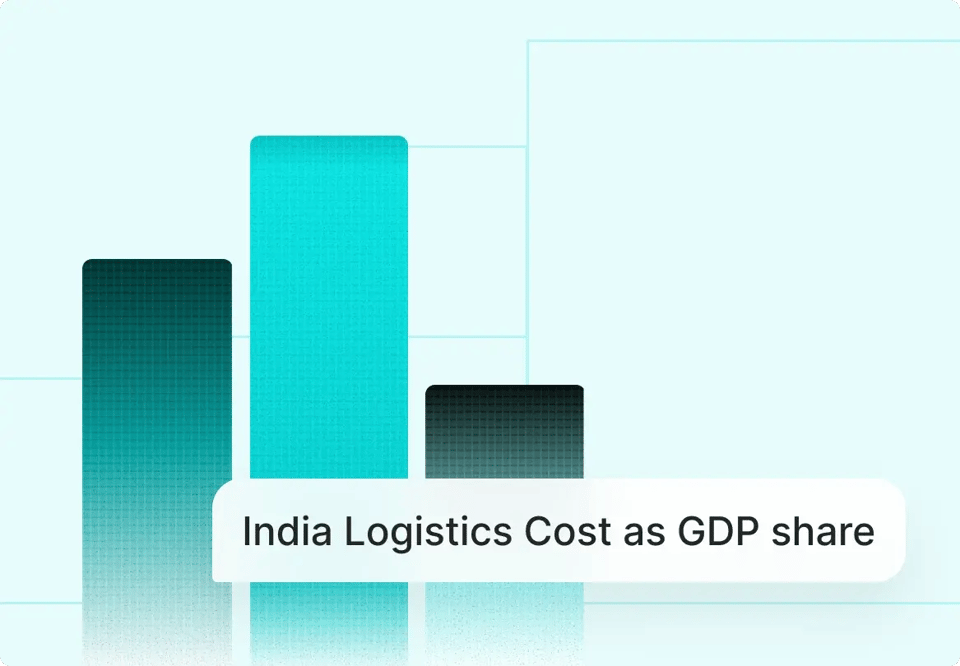
India spent 7.97% of its GDP on logistics in FY2023-24, or ₹24.01 lakh crore (about $290 billion). That is close to the US (7.8%) and far below China (13.9%), but small businesses still pay more than double what large companies pay.
-
India's logistics costs stood at 7.97% of GDP in FY24.
-
Moving one tonne over one kilometre costs ₹1.96 by rail, compared with ₹3.78 by road.
-
The same movement costs ₹72 by air, about 37 times the rail cost.
-
Small firms spend 16.9% of revenue on logistics, compared with 7.6% for large firms.
-
25% to 30% of truck return trips run empty.
Introduction
India has long been associated with high logistics costs, often quoted at 13–14% of GDP. But the latest government-backed estimate puts the figure at 7.97% for FY24. That is only part of the story. Rail freight costs significantly less than road or air; smaller businesses spend a much larger share of revenue on logistics, and empty truck returns add avoidable costs. These India logistics cost statistics for 2026 break down what the numbers actually mean for businesses moving goods across the country.
What is India's logistics cost as a percentage of GDP?
India's logistics cost was 7.97% of GDP in FY2023-24. In money terms, that is ₹24.01 lakh crore, or about $290 billion. The figure comes from the NCAER-DPIIT study, the first official measurement, and it replaces the 13 to 14% figure quoted for years.
| Figure | Source | What it is |
| 7.97% | NCAER-DPIIT, Sep 2025 | Official measurement for FY24. |
| 10% to 10.7% | CII-Knight Frank, May 2026 | Industry estimate for FY26, built from the old figure |
| 13% to 14% | Older studies | Rough estimate from partial data. Now outdated. |
The old number came from outside studies and partial data, not direct measurement, and the government says it caused confusion at home and abroad.
Is India's logistics cost going down?
Yes. India's logistics cost fell from 8.84% of GDP in FY23 to 7.97% in FY24, the lowest of the three years measured. It had risen slightly the year before, from 8.79% in FY22. FY24 is still the latest official year, and no newer figure has been released.
| Year | Logistics cost (% of GDP) |
| FY2021-22 | 8.79% |
| FY2022-23 | 8.84% |
| FY2023-24 | 7.97% |
-
The government aims to bring logistics cost in line with global benchmarks by 2030.
-
India ranked 38th in the World Bank's 2023 Logistics Performance Index, up from 54th in 2014.
-
On the Eastern Dedicated Freight Corridor, a rail line built only for goods, freight wagons now finish a round trip in 2 to 3 days instead of 15 to 16.
The Economic Survey 2025-26 repeated these figures in January 2026. One good year is not yet a trend, so the next release will matter.
How much does it cost to move freight by rail, road and air in India?
Rail is one of the cheapest ways to move bulk goods over land in India, at ₹1.96 per tonne-km. Road costs ₹3.78 on average. Ships along the coast cost even less, at ₹1.80. Air costs ₹72, about 37 times more than rail.
Tonne-km means the cost of moving one tonne of goods for one kilometre.
| Transport mode | Cost per tonne-km (₹) | In US cents |
| Big truck (55 tonnes) | 1.51 | 1.8 |
| Coastal ship | 1.8 | 2.2 |
| Rail (bulk goods) | 1.96 | 2.4 |
| River and canal boats | 3.3 | 4 |
| Road (all trucks, average) | 3.78 | 4.6 |
| Small truck | 11.03 | 13.3 |
| Air | 72 | 87 |
-
A 55-tonne truck costs ₹1.51 per tonne-km, while a small truck costs ₹11.03, more than seven times as much for the same distance.
-
On a trip of about 600 km, improving the first and last 50 km can significantly lower the total cost of a rail and road journey.
The key lesson: load size matters as much as the mode. A small truck costs more per tonne-km than every option except air.
What makes up India's ₹24 lakh crore logistics bill?
Trucking is the biggest part of India's logistics bill, at ₹10.01 lakh crore, or 41.7% of the total. Warehousing comes next at ₹5.95 lakh crore (24.8%). Loading, handling and paperwork add ₹3.84 lakh crore (16.0%).
| Where the money goes | Amount (₹ lakh crore) | Share |
| Road transport | 10.01 | 41.70% |
| Warehousing and storage | 5.95 | 24.80% |
| Loading, handling and admin | 3.84 | 16.00% |
| Shipping and waterways | 1.82 | 7.60% |
| Rail | 1.61 | 6.70% |
| Air | 0.75 | 3.10% |
-
Warehouse space costs about ₹30 per square foot per month on average.
-
Rail carries 27.4% of India's freight, while road carries 70.1%, measured by tonne-km.
Two-thirds of the bill is trucking and warehousing. That is where any cost review should start.
Do small businesses pay more for logistics in India?
Yes, more than twice as much. Businesses with turnover up to ₹5 crore spend 16.9% of their output on logistics, while companies above ₹250 crore spend 7.6%. Output means the value of the goods a business produces.
| Business size | Logistics cost (% of output) |
| Small (turnover up to ₹5 crore) | 16.90% |
| Large (turnover ₹250 crore or more) | 7.60% |
| Industry | Logistics cost (% of output) |
| Transport equipment (vehicles and parts) | 21.40% |
| Textiles and apparel | About 15% |
| Food | 9.57% |
| Aluminium | 8.57% |
The reason is load size. A small firm shipping a few tonnes pays small-truck rates of ₹11.03 per tonne-km instead of big-truck rates of ₹1.51. Sharing loads with other shippers closes more of this gap than haggling with carriers.
How does India's logistics cost compare with the US and China?
India's logistics cost of 7.97% of GDP is close to the US, at 7.8% in 2025, and well below China, at 13.9% in 2025. Countries measure this differently, so treat the comparison as a rough guide rather than an exact match.
| Country | Logistics cost (% of GDP) | Year |
| India | 7.97% | FY2023-24 |
| United States | 7.80% | 2025 |
| China | 13.90% | 2025 |
-
US business logistics costs totalled $2.4 trillion in the latest report, down from 8.7% of GDP the year before.
-
China aims to bring its figure down to about 13.5% by 2027.
-
The NCAER-DPIIT report also cites South Korea at about 8% and Indonesia at 24%.
-
An Indian truck covers 250 to 300 km a day, compared with 700 to 800 km in the US.
India's overall number now looks like the US. Its trucks do not, and that gap in daily distance is where India still loses the most money.
How can businesses cut logistics costs in India?
Here are five moves backed by the numbers above. Test each one on your own routes first.
1. Move long-distance bulk to rail. Rail costs about half as much as road per tonne-km. Plan the first and last few km by road carefully, because that is where rail's savings are won or lost.
2. Ship port to port by sea. Coastal shipping, at ₹1.80 per tonne-km, is the cheapest option measured. River transport costs more, at ₹3.30.
3. Fill bigger trucks. Small trucks cost over seven times more per tonne-km than 55-tonne trucks, so sharing loads or using a 3PL cuts your rate fast.
4. Stop running trucks empty. KPMG estimates that using trucks 10% more lowers long-distance freight rates by 6% to 7%.
5. Use air only when speed is worth it. At ₹72 per tonne-km, air makes sense for perishables or urgent parts, and little else.
Verdict
For most mid-sized shippers, fill your trucks first. It needs no new infrastructure and cuts costs right away. Move to rail once your volumes are big enough to book full trains.
What is next for India's logistics cost?
CII and Knight Frank estimate India's logistics cost at 10% to 10.7% of GDP for FY2026. Their method starts from the old 13 to 14% figure and counts only savings from better transport, so it is not directly comparable with the official 7.97%. They expect India's freight volume to reach nearly 28 billion tonnes by 2047.
-
Projection: India will need about 215 multimodal logistics parks by 2047. These are hubs where goods switch between trucks, trains and ships.
-
Target: The National Rail Plan aims for rail to carry 45% of freight, up from about 27% today. The plan sets 2030 as the target date.
-
Projection: freight demand will grow 7% to 8% a year, and KPMG warns costs could rise again unless trucks and terminals are used better.
Today, these hubs handle about 129 million tonnes a year, only 2% of India's freight.
CII's Ashwani Gupta says the problem is "no longer an infrastructure deficit, but a lack of connective nodes." Put simply, India has built roads and rail lines but not enough hubs to link them. KPMG's Chintan Patel adds that India "must now defend its gains".
Four logistics cost trends to watch in India in 2026
Empty trucks are the easiest cost to cut
25% to 30% of truck return trips in India run empty. KPMG estimates that freight-matching platforms filling those trips could remove ₹1.5 to 2 lakh crore in wasted cost.
Freight hubs decide whether rail pays off
Knight Frank estimates that with logistics parks at both ends of a dedicated freight corridor, rail can be 43% cheaper than road door to door. Without them, most of rail's savings get lost on the trucks at either end.
Waiting at ports costs real money
Goods sit at Indian ports for three to four days, compared with one to two days globally. Delay charges add ₹20,000 to 40,000 per container.
India logistics cost: key statistics at a glance
| Statistic | Figure |
| Logistics cost, % of GDP (FY24) | 7.97% |
| Total logistics cost (FY24) | ₹24.01 lakh crore |
| Logistics cost, % of GDP (FY23) | 8.84% |
| Logistics cost, % of GDP (FY22) | 8.79% |
| Rail cost per tonne-km | ₹1.96 |
| Road cost per tonne-km (average) | ₹3.78 |
| Coastal shipping cost per tonne-km | ₹1.80 |
| Air cost per tonne-km | ₹72 |
| Road share of logistics bill | 41.70% |
| Warehousing share of logistics bill | 24.80% |
| Small firms' logistics cost | 16.9% of output |
| Large firms' logistics cost | 7.6% of output |
| FY26 industry estimate | 10% to 10.7% of GDP |
| US logistics cost (2025) | 7.8% of GDP |
| China logistics cost (2025) | 13.9% of GDP |
| Truck return trips running empty | 25% to 30% |
| India LPI rank (2023) | 38th of 139 |
Conclusion: India's logistics cost is lower than people think
At 7.97% of GDP, India's logistics cost is close to the US and far below China. But the average hides real problems. Small firms pay 16.9% of their output, small trucks cost seven times more than big ones, and a quarter of return trips run empty. Compare your own routes against these rates before your next freight review.
FAQs: logistics cost in India
What is India's logistics cost as a percentage of GDP in 2024?
7.97% of GDP was India's logistics cost in FY2023-24, or ₹24.01 lakh crore. This comes from the NCAER-DPIIT study released in September 2025, the first official measurement. It is still the latest official figure, and it replaces the older 13 to 14% estimate.
Why is India's logistics cost often quoted at 13 to 14%?
13 to 14% of GDP was a rough estimate from outside studies and partial data, not a real measurement. When the government measured it properly using surveys of over 3,500 businesses, the figure came out at 7.97% for FY24. The older number is now outdated.
What is the cheapest way to move freight in India?
₹1.80 per tonne-km makes coastal shipping the cheapest option measured in India, followed by rail at ₹1.96. Road averages ₹3.78, though a full 55-tonne truck costs just ₹1.51. Air is the most expensive at ₹72 per tonne-km.
What does road transport cost per tonne-km in India?
₹3.78 per tonne-km is the average cost of moving goods by road in India. Truck size makes a big difference: a 55-tonne truck costs ₹1.51 per tonne-km, while a small truck costs ₹11.03. Road transport makes up 41.7% of India's total logistics bill.
What is the National Logistics Policy target?
2030 is the deadline the National Logistics Policy sets to bring India's logistics cost in line with global benchmarks. The policy also aims to put India in the top 25 of the World Bank's Logistics Performance Index by 2030. India ranked 38th in 2023.
How does India's logistics cost compare with China and the US?
7.97% of GDP puts India close to the US, at 7.8% in 2025, and well below China, at 13.9%. Countries measure this differently, so the comparison is a rough guide. India's bigger gap is truck use: 250 to 300 km a day, versus 700 to 800 km in the US.
How much do small businesses in India spend on logistics?
16.9% of their output goes to logistics for businesses with turnover up to ₹5 crore. Large companies above ₹250 crore spend 7.6%. The gap comes mainly from load size, since small shipments travel on small trucks that cost far more per tonne-km.
How do dedicated freight corridors help reduce logistics costs?
2 to 3 days is how long a freight wagon now takes for a round trip on the Eastern Dedicated Freight Corridor, down from 15 to 16 days. KPMG estimates that moving 5 to 7% of freight from road to rail could protect savings worth 0.5 to 0.8% of GDP.