






TL;DR Summary
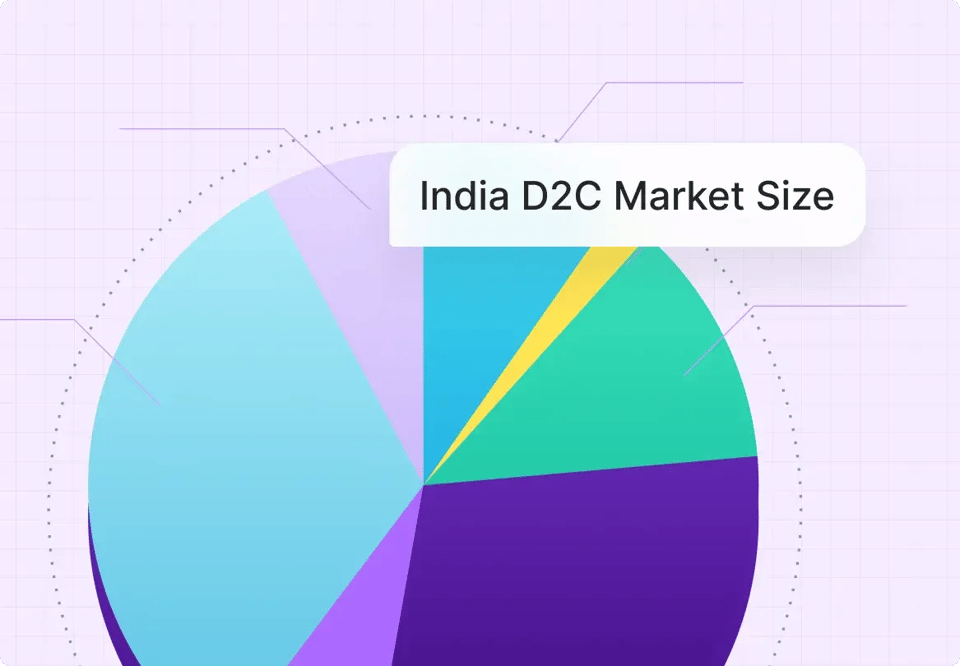
India's D2C market is worth $65 billion in 2026 by Inc42 and $108.8 billion, according to Mordor Intelligence, a gap driven by how each firm measures. Funding has cooled to $398 million in 2026 through August 20, yet 15 IPOs and 105 acquisitions since 2021 show the exit route now runs mostly through strategic buyers.
-
$65 billion to $108.8 billion: India D2C market size in 2026, depending on the source and its definition.
-
$6 billion: equity raised by Indian D2C startups across nearly 2,000 rounds from 2021 to August 2026, per Tracxn.
-
37.51% vs 5.28%: RTO rate for cash-on-delivery vs prepaid orders on ClickPost's FY2026 D2C network.
-
19 million: online shoppers who account for more than half of India's e-commerce and D2C spend, per Inc42.
-
About 50%: share of India's incremental e-retail orders that came from Tier 2+ cities in 2025, per Bain.
Ask two research firms how big India's direct-to-consumer economy is, and you will get answers $43.8 billion apart. Inc42 Datalabs' D2C 3.0 report puts 2026 D2C GMV at $65 billion, while Mordor Intelligence's India D2C e-commerce report sizes brand-owned online sales at $108.8 billion. Both are defensible, and they measure different things.
This roundup of India D2C statistics reconciles those estimates, then works through funding, categories, sales channels, unit economics, and the forecasts investors keep quoting.
We checked each figure against its primary source in November 2026, corrected several numbers that circulate in the wrong form, and added order data from ClickPost's D2C shipping network. Rupee figures convert at roughly ₹94 to the dollar, the market rate in early November 2026. For readers outside India, ₹1 lakh crore equals ₹1 trillion.
Why Do India D2C Market Size Estimates Differ So Much?
India D2C market size estimates for 2026 range from $65 billion (Inc42 Datalabs) to $108.8 billion (Mordor Intelligence) because the two firms count different transactions. Mordor sizes online sales through brand-owned websites and apps only, while Inc42 sizes D2C GMV within a $165 billion e-commerce market it defines more broadly than Bain.
| Source | Headline figure | What it measures | Growth rate | Best used for |
| Inc42 Datalabs | $65B D2C GMV (2026) | D2C segment GMV within Inc42's $165B ecommerce estimate | About 37% CAGR to 2031 (projection) | Benchmarking against the D2C startup ecosystem |
| Mordor Intelligence | $108.8B (2026) | Online sales by brands through their own websites and apps; marketplace sales excluded | 23.3% CAGR, 2027 to 2032 (projection) | Upper-bound TAM sizing |
| Bain & Company with Flipkart | $65B to $66B (2025) | All e-retail GMV across retailers and marketplaces, excluding travel | 19% to 21% in 2025 | Sanity check for any D2C figure |
| Tracxn | $6B raised, 2021 to Aug 2026 | Equity funding into D2C startups, not market size | Not applicable | Investment analysis |
-
Mordor's 2026 base of $108.8 billion exceeds Bain's estimate for all of India's e-retail in 2025($65 billion to $66 billion), even though Mordor excludes marketplace sales.
-
Inc42 sizes India's total ecommerce market at $165 billion in 2026, roughly 2.5 times Bain's 2025 e-retail figure, suggesting a broader category scope.
Our read
Use Inc42's $65 billion to benchmark against the D2C startup ecosystem, since its growth and funding data share one tracker. Treat Mordor's $108.8 billion as an upper bound: a brand-owned-channel figure larger than Bain's entire e-retail estimate needs a caveat in any pitch deck.
How Big Is the India D2C Market in 2026?
India's D2C market is worth about $65 billion (roughly ₹6.1 lakh crore) in 2026, per Inc42 Datalabs' estimate, or $108.8 billion (about ₹10.2 lakh crore) per Mordor Intelligence's brand-owned-channel count. Inc42's figure equals about 39% of the $165 billion e-commerce market it tracks for the same year.
| Measure | USD | INR (at about ₹94/$) | Source |
| D2C GMV, 2026 | $65B | ₹6.1 lakh crore (₹6,11,000 crore) | Inc42 Datalabs |
| Brand-owned online D2C sales, 2026 | $108.8B | ₹10.2 lakh crore | Mordor Intelligence |
| India e-retail GMV, 2025 | $65B to $66B | ₹6.1 lakh crore to ₹6.2 lakh crore | Bain & Company |
| India e-commerce market, 2026 | $165B | ₹15.5 lakh crore | Inc42 Datalabs |
-
Apparel and footwear held a 24.94% share of Mordor's India D2C e-commerce market in 2026, the largest of its six end-user segments.
-
Delhi NCR accounted for 20.44% of the same market in 2026, the largest single-city share in Mordor's model.
-
India's e-retail sector accounted for about 1.6% of GDP in 2025, compared with 13% to 14% in China, according to Bain figures reported by Business Standard.
Bain managing partner Shyam Unnikrishnan framed the shift plainly in the report's launch coverage: "Five years ago, India's e-retail story was about potential; today, it is a reality."
Our read
US readers should watch the exchange rate as closely as the growth rate. Bain's report converted at roughly ₹87 per dollar, and the rupee traded near ₹94 in November 2026, so a 20% growth rate in rupees grows noticeably slower in dollar terms.
How Are Tier 2 and Tier 3 Cities Changing India D2C Statistics?
Tier 2+ cities contributed about 50% of India's incremental e-retail orders in 2025 and roughly 65% of new online shoppers, according to Bain & Company's How India Shops Online 2026. Shopper penetration there is still 25% to 30% of internet users, compared with 45% to 50% in metro and Tier 1 cities.
-
Tier 3 cities took 45% of shipments, and Tier 2 another 22%, across a fixed cohort of 200 D2C brands in the opening phase of the 2026 festive sales, per ClickPost's network data.
-
Across 35.8 million ClickPost-shipped orders in October and November 2025, 12.0% of Tier 3 orders ended as return to origin (RTO), against 6.6% from metros.
-
In ClickPost's 635 million-order India Unboxed dataset, prepaid orders made up 34.5% of Tier 3 orders in 2025, compared with 46% in metros.
Our read
Growth and cost now come from the same pincodes. A brand that doubles its Tier 3 mix should plan for nearly double the metro RTO rate, so COD confirmation and address checks should be in the expansion budget.
How Much Funding Have Indian D2C Brands Raised?
Indian D2C startups raised nearly $6 billion in equity across about 2,000 rounds between 2021 and August 20, 2026, according to Tracxn. Annual funding peaked at $1.6 billion in 2022, bottomed at $824 million in 2024, rose 9% to $898 million in 2025, then slowed to $398 million to date in 2026.
| Year | Equity funding | Rounds | What changed |
| 2021 | $1.4B | 307 | Late-stage money dominates, at $849M |
| 2022 | $1.6B | 379 | Peak year for D2C funding |
| 2023 | $921M | 359 | Late-stage funding falls to $516M |
| 2024 | $824M | 380 | Lowest full-year value, highest round count |
| 2025 | $898M | 374 | Seed funding reaches a window high of $190M |
| 2026 (to Aug 20) | $398M | 152 | Lowest year-to-date total in the series |
Source: Tracxn data reported by Business Standard, August 2026.
-
Seed and early-stage rounds made up about 70% of 2025 D2C funding value, up from 38% in 2021, while late-stage funding fell 69% from its 2022 level to $271 million, Tracxn reported.
-
Tracxn counted 15 D2C IPOs and 105 acquisitions in India between 2021 and 2026 year to date, including Lenskart's November 2025 listing after $981 million in private funding.
-
Hindustan Unilever's $350 million purchase of Minimalist on January 22, 2025, was the largest disclosed D2C acquisition in Tracxn's report; USV India's $175 million deal for Wellbeing Nutrition followed in February 2026.
-
India ranked second globally for D2C startup funding in 2024, behind only the United States, in Tracxn's April 2025 report.
-
Inc42's separate tracker counts $10 billion+ across 1,400+ deals from 2015 to Q1 2026, which is why "$10 billion" headlines also circulate.
Our read
Tracxn's own summary is blunt: "The capital moved, the deal-making did not." Round counts held steady while cheque sizes shrank, and late-stage money hasn't returned in 2026. For a profitable brand, a sale to an FMCG or retail group such as Hindustan Unilever, Wipro Consumer Care or Reliance Retail now looks more reachable than an IPO. The trade-off: founders swap a public-market valuation for distribution they could not build alone.
How Many D2C Brands Are There in India, and Which Categories Lead?
India had about 9,000 D2C brands in June 2023, the most recent published count, from Redseer Strategy Consultants. No firm has released a verified 2026 count. By value, apparel and footwear lead with a 24.94% share of Mordor's 2026 market, while personal care grows fastest.
-
Food and beverages is the largest D2C segment by funded startups, at roughly one-third of them and nearly $3 billion in funding since 2015, according to Inc42's D2C 3.0 analysis.
-
Personal care is Mordor's fastest-growing D2C segment, with a projected 24.1% CAGR from 2027 to 2032.
-
Lenskart ($981 million), Licious ($490 million), FreshToHome ($320 million), BlueStone ($255 million), and Country Delight ($214 million) were the five most-funded Indian D2C companies in Tracxn's data as of August 2026.
-
Grocery, beauty and general merchandise drove more than 75% of India's incremental e-retail GMV growth between 2020 and 2025, according to Bain.
-
About 60% to 65% of Indian D2C brands remain in the ₹1 crore to ₹50 crore revenue band, in a DSG Consumer Partners survey of 100+ founders.
Investor appetite follows repeat purchase. Kannan Sitaram, cofounder of Fireside Ventures, told Inc42 the most interesting openings come from brands "solving highly specific behavioural or lifestyle problems for consumers." For a fuller list of the names behind these categories, see ClickPost's roundup of top D2C brands in India.
Where Do Indian D2C Brands Sell in 2026?
Indian D2C brands sell through their own websites, marketplaces, quick commerce and, increasingly, ONDC, usually all at once. Quick commerce already carries 16% to 17% of India's e-commerce GMV, according to Bain, and is projected to supply 45% to 50% of incremental e-retail GMV over the next five years.
| Channel | 2026 data point | Source | What brands use it for |
| Own website and app | Libas, an apparel brand, earns 25% of its sales from its own website (July 2026) | Mordor Intelligence | Margin, first-party data, retention |
| Branded sites (survey) | 34% of fashion purchases by surveyed challenger-brand buyers happened on branded sites (April to May 2026) | Google and Kantar, via Mordor | Turning discovery into checkout |
| Marketplaces | Libas attributes nearly 50% of its sales to marketplaces | Mordor Intelligence | Scale and discovery |
| Quick commerce | $10B to $11B GMV in 2025; 16% to 17% of e-commerce GMV | Bain & Company | Purchase frequency |
| ONDC | 500 million cumulative network transactions by July 25, 2026, across retail and other domains | ONDC | Reach beyond metros |
-
Quick commerce GMV in India has doubled each year for two years and is projected to reach $65 billion to $70 billion by 2030, per Bain's How India Shops Online 2026.
-
India's Ministry of Commerce links ONDC's open protocol to lower acquisition costs for sellers, though orders placed through buyer apps still count as intermediated sales, Mordor notes.
Our read
Be wary of tidy national "channel share" splits for D2C; we could not trace one to a primary dataset. Libas, a scaled brand, still books half its sales on marketplaces, and platform dependency is the risk Inc42 flags most for this cycle.
What Do India D2C Statistics Show About RTO, COD and Acquisition Costs?
Cash-on-delivery orders ended as return to origin 37.51% of the time on ClickPost's FY2026 D2C network, against 5.28% for prepaid orders, a 7.1x gap. Payment mix is moving the right way: prepaid orders rose from 32% of ClickPost-tracked orders in 2024 to 41% in 2025.
| Category | Typical COD RTO band | Top-quartile benchmark |
| Fashion and apparel | 21% to 32% | Below 21% |
| Health, wellness and nutraceuticals | 18% to 29% | Below 18% |
| Beauty and personal care | 18% to 27% | Below 18% |
Source: ClickPost FY2026 network data, COD orders, brands with 1,000+ COD shipments.
-
Prepaid orders made up 52% of shipments across 200 D2C brands in the opening phase of the 2026 festive sales, up from 46% a year earlier.
-
One RTO costs a brand about ₹350 (roughly $3.70) on a ₹1,200 order in ClickPost's loaded-cost model, within a ₹285 to ₹490 range.
-
Orders that hit three or more failed delivery attempts end as RTO 88.5% of the time on ClickPost's network; its NDR statistics report for India covers reattempt outcomes in more detail.
-
Founders cited rising CAC and unstable return on ad spend as the top growth blockers in the DSG Consumer Partners survey, ahead of funding.
Our read
At a 60% COD mix, these network rates imply a blended RTO near 24.6%, so every acquired customer whose parcel comes back costs the brand twice. We found no primary, channel-level CAC benchmark for India worth publishing; the rupee-per-channel figures online come from agency client samples. Model CAC from your own blended spend, and treat prepaid conversion as a CAC lever too.
How Concentrated Is D2C Spending in India?
About 19 million shoppers, out of roughly 350 million online shoppers, account for more than half of the spending recorded by India's ecommerce and D2C platforms, according to Inc42 Datalabs. Put another way, 2% of India's 958 million internet users generate 60% of ecommerce GMV.
-
India had 290 million to 300 million e-retail shoppers in 2025, double the base of five years earlier, according to Bain.
-
Bain's 2026 report found that Gen Z accounts for 40% to 45% of India's e-retail shoppers.
Yash Dholakia, partner at Sauce.vc, told Inc42 that "Discovery of new brands now happens largely through digital content," which is pushing ecommerce beyond its top categories.
Our read
A new D2C brand pitches the same 19 million buyers incumbents already target, inflating CAC for everyone. The larger opportunity is the other 330 million online shoppers, mostly in Tier 2+ cities, where attention is cheaper, but COD and RTO risk run higher.
What Is the India D2C Market Forecast Through 2032?
Inc42 Datalabs projects India's D2C GMV will grow from $65 billion in 2026 to $310 billion by 2031, a CAGR of about 37%. Mordor Intelligence projects brand-owned D2C sales will reach $385.3 billion by 2032, growing 23.3% per year from 2027. Both figures are projections, not reported sales.
| Forecaster | Base | Projection | Implied growth | Scope |
| Inc42 Datalabs | $65B (2026) | $310B (2031) | About 37% CAGR | D2C GMV |
| Mordor Intelligence | $108.8B (2026) | $135.2B (2027); $385.3B (2032) | 23.3% CAGR, 2027 to 2032 | Brand-owned websites and apps |
| Bain & Company | $65B to $66B (2025) | $170B to $180B (2030) | Above 20% CAGR | All e-retail (context) |
| Bain & Company | $10B to $11B (2025) | $65B to $70B (2030) | Doubled yearly in the past two years | Quick commerce (context) |
All forward figures are projections published by the named firms in 2026.
-
Inc42 expects D2C channels to supply about $245 billion of the $285 billion in new ecommerce GMV it projects between 2026 and 2031, or 85% to 86% of the total.
-
On Inc42's numbers, D2C would rise from about 39% of its ecommerce base in 2026 to roughly 69% by 2031.
Our read
Inc42's path assumes D2C grows about 15 percentage points a year faster than ecommerce for five straight years. That is a bull case. Bain's 20%-plus e-retail growth is the safer anchor; a plan that only works at 37% has no room for a weak festive season.
Which Trends Will Shape India D2C Statistics in 2027?
Quick commerce becomes the repeat-purchase channel
Bain projects that between 45% and 50% of India's incremental e-retail GMV over the next five years will come from quick commerce. The channel leans less on cash on delivery, which suits food, beauty and wellness brands chasing frequency, but the platform keeps the customer.
Prepaid crosses half of D2C festive orders
Prepaid shipments reached 52% of orders across 200 D2C brands in the opening phase of the 2026 festive sales, up from 46% in 2025, according to ClickPost's network data. Because COD orders fail at roughly seven times the prepaid rate, each point of payment-mix shift lowers blended RTO without any change of carrier.
Strategic buyers replace late-stage venture capital
Acquisitions outnumbered D2C IPOs seven to one between 2021 and 2026, at 105 deals against 15 listings, by Tracxn's count. Global groups are joining the queue: L'Oréal agreed in June 2026 to take a majority stake in skincare brand Innovist, and Senco Gold's board approved a proposal in January 2026 to buy 68% of August Jewelry, the company behind jewelry brand Melorra, per Mordor's industry tracker.
Open networks and stricter e-commerce rules
ONDC crossed 500 million cumulative transactions on July 25, 2026, according to the network. Separately, India's amended Consumer Protection (E-Commerce) Rules, notified in September 2026, take effect on January 1, 2027, adding sponsored-listing disclosure and dark-pattern self-audit duties for every e-commerce entity, which Mordor reads as covering brands that sell through their own websites.
India D2C Statistics 2026: Master Data Table
| Statistic | Figure | Source | Published |
| India D2C GMV, 2026 | $65B | Inc42 Datalabs | May 2026 |
| Brand-owned D2C online sales, 2026 | $108.8B | Mordor Intelligence | Oct 2026 |
| D2C GMV projection, 2031 | $310B (about 37% CAGR) | Inc42 Datalabs | May 2026 |
| Brand-owned D2C sales projection, 2032 | $385.3B (23.3% CAGR) | Mordor Intelligence | Oct 2026 |
| India e-retail GMV, 2025 | $65B to $66B | Bain & Company | Apr 2026 |
| D2C equity funding, 2021 to Aug 2026 | About $6B, about 2,000 rounds | Tracxn via Business Standard | Aug 2026 |
| D2C equity funding, 2026 to Aug 20 | $398M | Tracxn via Business Standard | Aug 2026 |
| D2C IPOs and acquisitions, 2021 to 2026 YTD | 15 IPOs, 105 acquisitions | Tracxn via TNGlobal | August 2026 |
| D2C funding, 2015 to Q1 2026 | $10B+, 1,400+ deals | Inc42 Datalabs | May 2026 |
| D2C brands operating in India | About 9,000 (June 2023) | Redseer via IndiaRetailing | June 2023 |
| Apparel and footwear share of D2C market | 24.94% | Mordor Intelligence | October 2026 |
| Tier 2+ share of incremental e-retail orders, 2025 | About 50% | Bain & Company | April 2026 |
| Quick commerce share of e-commerce GMV, 2025 | 16% to 17% | Bain & Company | April 2026 |
| Power shoppers driving over half of spend | 19 million of 350 million | Inc42 Datalabs | May 2026 |
| COD vs prepaid RTO, FY2026 | 37.51% vs 5.28% | ClickPost | November 2026 |
| Prepaid share of orders, 2025 | 41% (32% in 2024) | ClickPost India Unboxed | 2026 |
What India D2C Statistics Mean for Brands and Investors
For founders, the numbers favour retention over reach. With 19 million shoppers driving more than half of online spend and acquisition costs rising, a second order from an existing customer is worth more than a cheaper first order.
Investors should read 2026's $398 million year-to-date total as a reset, and price exits around strategic M&A, which has run at seven deals for every D2C IPO since 2021.
Operations teams hold the fastest lever: moving COD buyers to prepaid cuts RTO more than any carrier switch, and prepaid already passed half of festive D2C shipments in 2026. We will update this page when Tracxn and Inc42 publish full-year 2026 data. To act on RTO now, ClickPost's 90-day RTO reduction playbook outlines the sequence.
Frequently Asked Questions
What is the market size of D2C in India in 2026?
Inc42 Datalabs estimates India's D2C GMV at $65 billion in 2026, or about ₹6.1 lakh crore. Mordor Intelligence puts brand-owned online D2C sales higher, at $108.8 billion (about ₹10.2 lakh crore). The gap reflects different definitions, so always cite the source and its scope alongside the number.
How many D2C brands are there in India in 2026?
About 9,000 D2C brands operated in India in June 2023, according to Redseer, the most recent published count. No research firm has released a verified 2026 figure. Claims of 100,000 or more brands circulate online, but we could not trace them to a named, dated dataset, so treat them with caution.
What is the CAGR of the Indian D2C market?
Inc42 projects about 37% CAGR for India's D2C GMV, from $65 billion in 2026 to $310 billion by 2031. Mordor Intelligence projects 23.3% a year for brand-owned D2C sales between 2027 and 2032. Both are forecasts, and Inc42's assumes D2C grows far faster than ecommerce overall.
Which D2C category is growing fastest in India?
Mordor Intelligence projects personal care will grow 24.1% per year from 2027 to 2032, the fastest of its D2C segments. Apparel and footwear remain the largest, with a 24.94% share in 2026. By number of funded startups, food and beverages lead, accounting for roughly one-third, per Inc42.
How much funding has the Indian D2C sector raised?
Indian D2C startups raised nearly $6 billion across about 2,000 equity rounds from 2021 to August 2026, according to Tracxn. Funding peaked at $1.6 billion in 2022, reached $898 million in 2025, and stood at $398 million in 2026 through August 20. Inc42's longer series counts $10 billion or more since 2015.
What are the RTO rates for D2C brands in India?
37.51% of cash-on-delivery orders ended as RTO on ClickPost's FY2026 D2C network, compared with 5.28% of prepaid orders. Fashion runs highest, at 21% to 32% on COD. India has no official national RTO rate, so compare your numbers with datasets that share your payment mix and city-tier spread.
What is the customer acquisition cost for Indian D2C brands?
60% to 65% of Indian D2C brands stay in the ₹1 crore to ₹50 crore revenue band, and founders surveyed by DSG Consumer Partners name rising CAC as their biggest growth blocker. No primary dataset publishes a national CAC benchmark by channel, so calculate blended CAC from your own total acquisition spend.
How are Tier 2 and Tier 3 cities driving D2C growth in India?
About 50% of India's incremental e-retail orders came from Tier 2+ cities in 2025, and those cities supplied roughly 65% of new online shoppers, according to Bain. The trade-off is fulfilment cost: Tier 3 RTO ran at 12.0% against 6.6% in metros across ClickPost's festive 2025 orders.