.png?width=193&height=27&name=ClickPost%20Logo%20(Blue).png)
.svg)
.svg)
.svg)
.svg)
.webp?width=286&height=206&name=ROI%20Calculator%20(2).webp)
.svg)
.svg)
.svg)
.svg)
.svg)
.svg)
.svg)
.svg)
.svg)
.webp?width=286&height=206&name=Frame%201171276203%20(11).webp)
.svg)
.svg)
.svg)
.svg)
.webp?width=286&height=206&name=ROI%20Calculator%20(3).webp)
.svg)

.svg)
.svg)
.svg)
.webp?width=286&height=206&name=ROI%20Calculator%20(4).webp)
How to improve CSAT during the holidays



Ready to delight customers after checkout?
Trusted by 600+ brands
In this blog
TL;DR Summary
The fastest way to improve CSAT during the holidays is to remove the reasons customers contact you at all, then make the contacts you do get quick to resolve. Four moves carry most of the result.
Publish proactive, branded order tracking so shoppers stop asking where their order is. Set a CSAT baseline in October so you can see peak damage as it happens.
Automate the repetitive tier of contacts so agents keep response times low. And make returns self-serve so the January wave does not drag your scores down. Everything below supports those four.
Introduction
The last holiday season pushed US retail spending past $1 trillion for the first time, and volume at that scale changes what your support team is up against. More orders mean more shipments in transit, more delivery exceptions, more returns, and more anxious customers refreshing a tracking page.
That mix is what quietly pulls CSAT down between Black Friday and mid-January. To improve CSAT during the holidays, treat satisfaction as an operational outcome you engineer before peak, while you still have room to plan and build in slack.
The moves below are the ones that keep your CSAT steady while order volume, delivery exceptions, and returns all climb at once.
Why does CSAT drop during the holidays?
CSAT drops during the holidays because contact volume rises faster than support capacity while customer patience falls. Order surges create more delivery delays, exceptions, and returns, and each one is a reason to contact support. Seasonal staffing is stretched thin at the same time, so response times climb right when expectations peak.
Several pressures stack at once.
1. Volume outruns staffing
Order-status questions dominate the queue. Where-is-my-order (WISMO) questions sit at the top of ecommerce support volume, and they multiply when more parcels are moving and delivery windows tighten.
2. Capacity is capped
NRF expected retailers to hire 265,000 to 365,000 seasonal workers, yet even fully staffed teams face spikes that outpace hiring. When a queue swells past what your headcount can clear, wait times grow and scores fall with them.
3. Delivery promises break
Carrier networks run near capacity in December, so estimated delivery dates that held in October start slipping. Every slipped date tends to land in your queue, because a worried customer will contact support to chase it down.
4. Returns arrive in waves
Retailers expect 17% of holiday sales to be returned, and most of that lands in January, stretching the CSAT-risk window well past the gifting rush.
5. Expectations keep climbing
88% of customers now expect faster responses than a year earlier, so the bar rises even as your team gets busier.
How do you measure CSAT before peak season?
Measure CSAT by sending a short post-interaction survey that asks customers to rate their satisfaction, usually on a 1 to 5 scale, then dividing positive responses by total responses. Run it in October so you hold a clean pre-peak baseline to compare against once holiday volume distorts everything.
A score in the low-to-mid 80s is a common ecommerce benchmark, though your own trend line matters more than any external number. Three habits make the metric useful going into peak.
Baseline early: Lock in a September or October reading before volume moves it.
Segment by journey stage: Tag CSAT responses by contact reason, such as tracking, delivery issue, return, or product question, so you can see which pressure costs you the most.
Pair it with a driver metric: CSAT tells you satisfaction falls. First response time, resolution time, and contact volume tell you why. Watch them together.
The peak-season pressure map
Use this to decide where to spend effort first.
| Peak-season pressure | What it does to CSAT | The fix |
| Order-status questions | Floods the queue, slows every other reply |
Proactive notifications and branded tracking
|
| Broken delivery promises | Turns a shipment into a complaint |
Conservative EDDs and early exception alerts
|
| Thin seasonal staffing | Response times climb, quality dips |
Automate the repetitive tier, prep macros
|
| January returns wave | Extends dissatisfaction past the rush |
Self-serve returns, instant exchanges
|
| Rising expectations | The bar moves even if you do not |
Round-the-clock self-service coverage
|
How to cut order-status tickets before they flood your queue
Cut order-status tickets by giving customers the answer before they ask. Proactive shipping notifications at each milestone, plus a branded tracking page written in plain language, remove most of the reason to contact support. Deflecting these routine questions is the single biggest CSAT lever available during peak.
The information the customer wants already exists in carrier scan data. The gap is that it has not surfaced clearly. Here’s how you can close that gap and shrink the queue.
Send milestone notifications: Confirmed, shipped, out for delivery, delivered, and, most important, delayed. A proactive delay message with a revised date prevents far more contacts than a fast reply ever will.
Brand the tracking page: Keep customers on your domain with a status page that translates carrier jargon into a clear delivery window.
Surface tracking everywhere: Order confirmation email, account page, and SMS. If the tracking link is easy to find, the ticket never gets created.
This is the layer where a post-purchase platform earns its place. ClickPost sits here as the system brands graduate to once carrier-email tracking stops scaling, unifying multi-carrier tracking, proactive notifications, and NDR workflows so status questions resolve on their own.
How to keep delivery promises that hold up under peak volume
Keep delivery promises credible by showing realistic estimated delivery dates that already price in peak-season carrier delays, then communicating the moment one slips. Accurate, slightly conservative promises protect CSAT better than optimistic dates that break, because a missed promise is what turns a shipment into a complaint.
On-time delivery against the promise made at checkout is one of the strongest drivers of post-purchase satisfaction. During peak, the risk comes less from slower networks than from the gap between what you promised and what actually happened.
Set realistic cutoffs: Publish shipping cutoff dates for holiday delivery and hold to them.
Build buffer into EDDs: A promise you can beat generates delight. One you miss generates a ticket.
Detect exceptions early: Flag stuck or delayed shipments automatically and reach out before the customer notices, ideally with a resolution already in motion.
How to scale holiday support without adding headcount
Scale holiday support by automating the repetitive tier of contacts so human agents are reserved for real problems.
AI agents and self-service handle order-status and policy questions instantly, macros speed up common replies, and smart routing sends complex issues to the right person the first time.
You cannot hire your way out of a December spike, and 74% of customers now expect service around the clock. Automation is how a small team covers that expectation.
Automate the repetitive tier: Order status, return initiation, and policy questions resolve well without a human, freeing agents for exceptions.
Extend self-service: A well-built help center deflects contacts before they enter the queue.
Route intelligently: 81% of customers want the conversation to pick up where it left off, so preserve context and stop making people repeat themselves across channels.
Prepare macros and playbooks: Editable responses for the season's top issues keep quality consistent when the queue is deep.
How to make holiday returns effortless
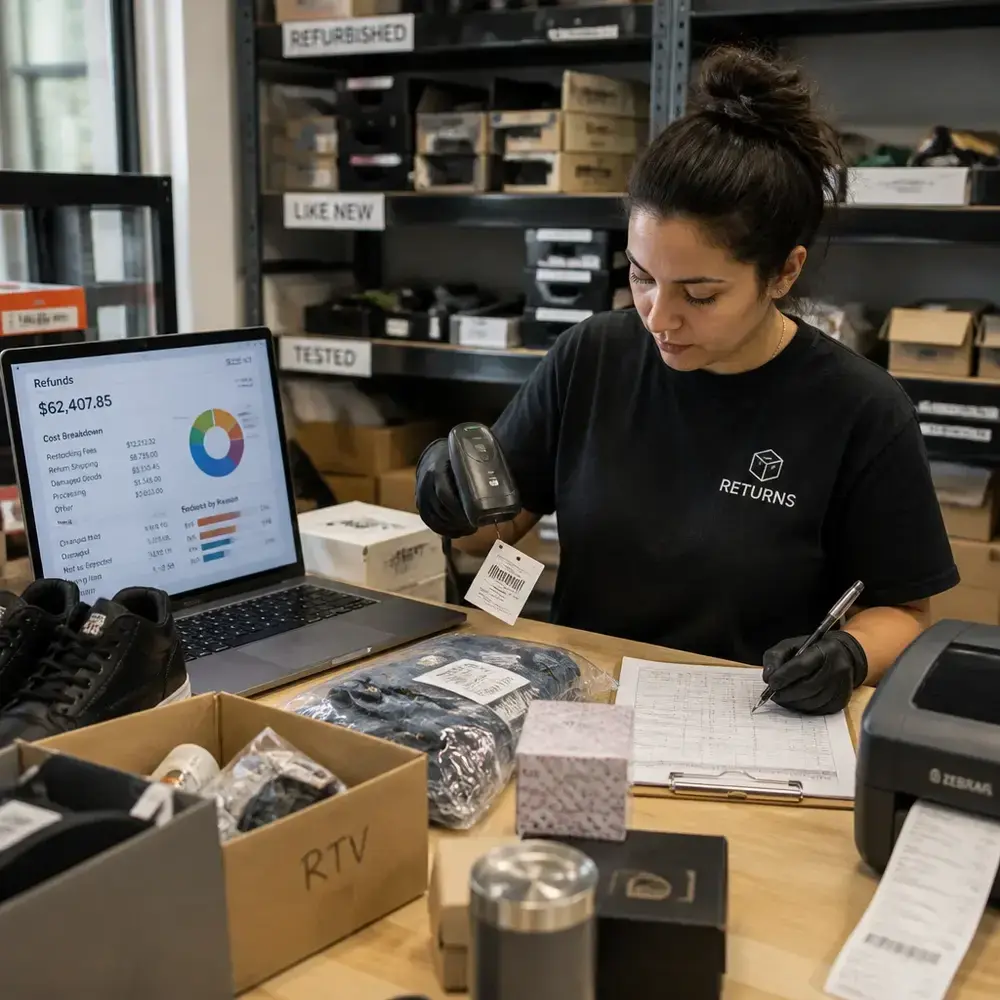
Make holiday returns effortless with a self-serve returns portal, clearly extended holiday return windows, and instant exchange or store-credit options. Because most holiday returns land in January, a smooth returns experience protects CSAT well after the gifting rush and often turns a return into another sale.
Returns now function as a loyalty moment rather than an afterthought. 82% of consumers weigh free returns before they buy, and a poor returns experience makes them less likely to come back at all.
Offer self-serve returns: A portal that generates labels and QR codes removes both contact and frustration.
Extend and clarify the window: Gift buyers purchase in December for recipients who may not open until later. State the holiday policy plainly.
Push exchanges and store credit: Keeping the value in-house beats a refund, and instant options improve the experience.
How to close the loop after delivery
Close the loop by surveying customers right after delivery or resolution, then acting on low scores fast. A quick post-delivery prompt catches problems while they are still fixable, and service recovery on a detractor often rebuilds more loyalty than a smooth order ever would.
Trigger surveys at the right moment: Right after delivery for the fulfillment experience, right after a support resolution for the service experience.
Act on detractors within hours: A fast, human recovery message can reverse a low score. PwC found 52% of consumers have walked away from a brand after a bad experience, so recovery is retention.
Feed insight back into operations: If tracking questions spiked one weekend, fix the notification flow before the next one, not next year.
A checklist to improve CSAT during the holidays
Work through this in the weeks before peak.
1. Lock a CSAT baseline in October, segmented by contact reason.
2. Audit and switch on proactive milestone notifications, including delay alerts.
3. Brand and stress-test your tracking page on mobile.
4. Add buffers to estimated delivery dates and publish shipping cutoffs.
5. Stand up AI and self-service for the top order-status and policy questions.
6. Write macros for the season's ten most common issues.
7. Extend return windows and confirm the self-serve returns portal works.
8. Set up automatic exception detection for stuck shipments.
9. Schedule post-delivery and post-resolution surveys.
10. Assign a daily owner to watch CSAT, response time, and contact volume through January.
Where ClickPost fits in your holiday CSAT plan
Almost every holiday CSAT drop traces back to information that already exists in your systems but is not in front of the customer or agent when it is needed: the carrier scan, the revised delivery date, the returns eligibility. ClickPost closes that gap by running tracking, notifications, exception handling, and returns on one layer.
ClickPost is where brands graduate once carrier-email tracking and manual returns stop holding up at volume, unifying tracking across 600+ carrier integrations, proactive milestone alerts, automatic exception detection, and a self-serve returns portal that converts 54% of returns into exchanges. It removes the manual work that makes the discipline in this playbook hard to sustain through the busiest weeks of the year.
The takeaway
Holiday CSAT is won in October, not December. The teams that hold their scores steady are the ones that remove predictable contacts ahead of the surge, keep delivery promises honest, automate the repetitive tier, and make returns painless.
Build the baseline, close the visibility gaps, and treat every peak-season survey as an operational signal you act on the same week. Do that, and the season that breaks most support queues becomes the one that earns you repeat buyers.
FAQs
What is a good CSAT score during the holidays?
A CSAT score in the low-to-mid 80s is a common ecommerce benchmark, and holding near your own pre-peak baseline is the real goal. Expect some seasonal dip. A drop of more than a few points signals that volume is outrunning your capacity to respond and resolve.
Why does customer satisfaction drop during peak season?
Satisfaction falls because contacts rise faster than staffing while patience shrinks. More orders create more delivery exceptions and returns, each a reason to reach out. Seasonal hires cannot fully close the gap, so response times climb exactly when customer expectations are at their highest.
How do you calculate CSAT?
Divide the number of satisfied responses, usually the top two boxes on a five-point scale, by the total number of responses, then multiply by 100. Send the survey right after an interaction, and segment results by contact reason so the score points you toward a specific fix.
How can I reduce order-status tickets during the holidays?
Answer the question before it is asked. Send proactive milestone notifications, including delay alerts with a revised date, and publish a branded tracking page in plain language. Surfacing status in the confirmation email, account page, and SMS removes most of the reason customers ever contact support.
When should I start preparing support for the holidays?
Begin in early October. That gives you time to baseline CSAT, turn on proactive notifications, extend return windows, prepare macros, and stand up self-service before volume arrives. Teams that wait until November end up reacting to the queue instead of shaping it.
Does proactive shipping notification improve CSAT?
Yes. Proactive notifications remove the uncertainty that drives order-status contacts, and a well-timed delay alert prevents the frustration a missed promise creates. Fewer inbound tickets keeps response times low for everyone, so proactive communication lifts satisfaction across the whole queue, not only for the notified order.





We use cookies to keep the site working, understand usage, and improve your experience. Learn more
Always active for essential site performance and security.
Enables anonymous usage analysis to refine our services.
Used to present relevant promotions and advertising.