.png?width=193&height=27&name=ClickPost%20Logo%20(Blue).png)
.svg)
.svg)
.svg)
.svg)
.webp?width=286&height=206&name=ROI%20Calculator%20(2).webp)
.svg)
.svg)
.svg)
.svg)
.svg)
.svg)
.svg)
.svg)
.svg)
.webp?width=286&height=206&name=Frame%201171276203%20(11).webp)
.svg)
.svg)
.svg)
.svg)
.webp?width=286&height=206&name=ROI%20Calculator%20(3).webp)
.svg)

.svg)
.svg)

.svg)
.webp?width=286&height=206&name=ROI%20Calculator%20(4).webp)

Ready to delight customers after checkout?
Trusted by 600+ brands
In this blog
TL;DR summary
ClickPost just got named a G2 Leader in Returns Management for Summer 2026. The numbers behind it are a 4.8/5 rating across 135 verified reviews, six G2 badges, and 28% of refund-marked revenue recovered through AI-driven customer segmentation.
We never set out to build a returns management company.
What we wanted to fix was that weird in-between moment right after checkout. The customer has paid. The thing is not there yet. The brand is not really paying attention. The platform stack is doing background work nobody is looking at.
That is the moment we wanted to live in.
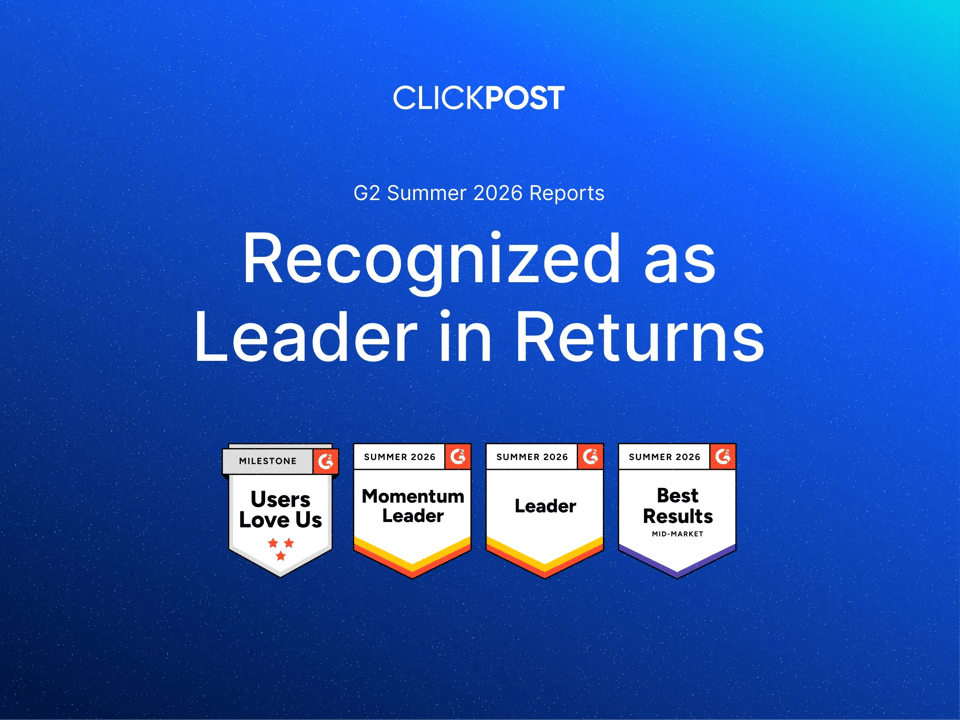
So when G2 named us a Leader on the Summer 2026 Grid Report for Returns Management, with six badges in one quarter and 4.8/5 across 135 verified reviews, it felt like confirmation. Real customers, running real Shopify brands, were telling us this works.
G2 Grid for Returns Management Software
What our customers are saying about ClickPost's returns
The Leader badge is not a marketing claim. It is literally based on what verified ClickPost users wrote on G2. Here is what real reviewers said about our returns management module, pulled straight from our G2 profile.
Then there is OneBone. They saw a demo on a Tuesday afternoon. Live by Wednesday morning. No IT team. No multi-month implementation project. No six-figure deal cycle. Just a working post-purchase experience the next day.
When we caught up with them a few weeks later, they were already planning Phase 2. Loyalty tier data on the tracking page. Product vote surveys embedded into the post-purchase flow. Countdown timers for new drops. The tracking page had gone from a dead end to the most engaged surface in their customer journey.
Read more ClickPost customer stories
The most expensive mistake in post-purchase is treating every customer the same
Picture two people. The first has been bought from you eleven times. Returned twice. Love your brand. The second has returned six of their last eight orders. Costs you money on every shipment.
They get the same tracking page. Same returns portal. Same email cadence. Same offer when they hit your portal.
This is not a small thing. It is where revenue walks out the door. And for a long time, nobody in the returns management category was talking about it.
Most tools in the market were solving one slice of the problem.
-
Narvar built strength in tracking and returns for enterprises.
-
AfterShip went deep on shipment tracking.
-
Loop Returns focused on Shopify returns workflows.
-
Returnly specialized in returns financing before being absorbed into a payments platform.
-
Redo built a membership-style returns experience for Shopify brands, charging shoppers for the return experience itself.
-
parcelLab went deep on operational delivery tracking and post-purchase engagement, especially for European brands moving into the US.
Each one doing its job in isolation. Nobody is talking to anybody else. None of them give a brand the full picture of what is actually happening after the sale.
That gap is what we wanted to fix.
How ClickPost's AI-powered revenue retention layer works with four products on one data model
We built four things. They run on one data layer underneath. Not four separate tools stitched up to look like a stack.
1. AI customer segmentation for returns
Before anything else, the system needs to know who is returning. That is the first job. No manual rules. No spreadsheet logic written by an ops manager three job changes ago. The system just sorts out who is who.
ClickPost reads who is returning. A high-LTV customer with a low return rate gets one treatment. Someone returning six of eight orders gets a different one. Your team does not have to lift a finger.
For your loyal customers, here is what shows up.
-
Free returns
-
Extended return windows
-
Automatic approval, no review queue
-
Just better treatment overall
For high returners, the picture flips.
-
Return fees applied
-
Tighter return windows
-
Manual review on every request
-
Friction that is proportional to the behavior
The result is that 28% of revenue that was about to be refunded gets recovered instead. Understanding how AI is reshaping ecommerce returns makes it clear why rule-based systems simply cannot keep up.
Finance and ops leaders can stop treating returns as a cost center, because ClickPost's AI segmentation recovers 28% of revenue marked for refund with no manual rules, no new headcount, and no spreadsheet policies your ops team is silently dreading.
2. Personalized branded tracking
Think about your tracking page for a second. Most brands send people to a courier page. UPS, FedEx, generic. That is a missed beat.
Customers check their tracking page 4.6 times on average before the order shows up. Four point six. That is more attention than your homepage gets most days.
ClickPost turns that page into a personalized revenue surface. It shows real-time delivery updates, but it does more than that. It serves AI care tips for the product they just bought, pairing suggestions if they are a loyalist, and social proof if they are a first-time buyer. The page does work. You can see exactly how a branded tracking page transforms a passive shipping update into an active customer touchpoint.
The result is 8% additional upsell revenue from a page customers were already visiting anyway.
Marketing and growth teams should know that the tracking page gets 4.6 views per order, more attention than most homepages get during peak, and ClickPost turns that surface into 8% incremental upsell revenue with zero paid acquisition.
3. Segment-specific returns policies
The moment a customer initiates a return is one of the most underrated moments in DTC. They are frustrated. But they are still engaged. They came to your portal. They did not dispute the charge. That is a real window. Most brands treat it like a routine workflow. We treat it like a decision point.
The rules and offers we serve at that moment depend entirely on who the customer is and what they have done.
ClickPost serves the right nudge to the right customer. An exchange offer. A store credit bonus. A personalized alternative based on what they have bought before. Not a generic pop-up. A behavior-based intervention. This is the difference between brands that treat every return as a refund and those that treat it as a retention opportunity.
Look, returns are not a logistics problem. They are a retention decision.
The result is that 54% of return requests turn into exchanges, and revenue climbs 3% from moments that used to be pure cost on the P&L.
Product and retention teams should treat returns as a retention decision rather than a logistics problem, because ClickPost converts 54% of return requests into exchanges and lifts revenue 3% from moments most brands write off as pure cost.
4. Post-purchase order editing
Customers fix their own orders before they ship. Size changes, address corrections, color swaps. The kind of thing that usually creates a support ticket, then a return, then a refund.
The top three support tickets at almost every Shopify brand we work with sound like this. "Can I change my size?" "Wrong address." "I ordered the wrong color."
Every one of these tickets exists because the customer cannot fix the thing themselves. So they email. Then your team scrambles to catch the order before it ships. Sometimes they make it. Sometimes they do not, and the return cycle starts.
What if the customer just did it themselves? No ticket. No return. No refund. And in the moment they are editing, a one-click upsell appears. Brands that have improved their Shopify customer service experience through self-service tools consistently report lower ticket volume and higher satisfaction scores.
The result is 40% lower support cost and 5% higher AOV.
CS and CX teams get one feature that kills the top three inbound ticket types, namely size, address, and color or variant changes, and brands using ClickPost report 40% lower support costs and 5% higher AOV inside the first 60 days.
Book a demo of the ClickPost post-purchase platform
What the G2 Summer 2026 recognition means to us
Six badges in one quarter. Leader. Best Results. Best Usability. Highest User Adoption. Users Most Likely to Recommend. Users Love Us. All in the Mid-Market category. 4.8/5 average across 135 verified reviews.
We are proud of all of them. But the one that means the most to me, personally, is Highest User Adoption.
Because adoption means teams are actually using the product. Not just buying it and moving on to the next vendor. Using it. Daily. Which usually means the product is doing what we promised, the onboarding worked, and there is enough value sitting inside the platform for someone to come back to it every single day.
That is the thing we have always cared about most. Not the contract. The outcome. And it is worth saying out loud that customers chose ClickPost not just because we covered more of the post-purchase journey.
They chose us because of how AI is woven into every layer. Segmentation logic without a rules engine. Predictive exchange nudges that learn from purchase history. The product gets smarter the more it gets used.
How ClickPost compares to other returns management software
So you are evaluating ClickPost against alternatives. Here is the short version, from someone who has spent a lot of time looking at all of these. If you want to go deeper on the evaluation criteria, our guide on questions to ask before choosing returns management software is a good starting point.
| Feature | ClickPost | Narvar | AfterShip | Loop Returns |
| Primary Focus | Full Post-Purchase Stack | Enterprise Logistics | Shipment Tracking | Shopify Returns |
| AI Segmentation | Native & Automated | Limited/Manual | Limited | Rule-based |
| Order Editing | Integrated Self-Service | No | No | No native |
| Best For | Mid-Market Growth & ROI | Global Enterprise | High-Volume Tracking | Small-to-Mid Shopify |
What we are building next?
Three things are coming in the next two quarters.
We are 450+ brands and 50 million orders in. Enough volume to see where this category is going. Honestly, the next wave of post-purchase is not about adding more tools. It is about smarter intelligence layered on the same data you already have.
That is why we launched Returns Protection in June 2026.
US shoppers expect cheap or free return shipping. Fast refunds. Easy exchanges. Meanwhile, reverse logistics costs keep rising, tariffs are squeezing margins, and wardrobing fraud is eating into profit. Something has to give.
Related read. How to Prevent Return Fraud Without Damaging Customer Experience
Returns Protection is how brands plug that leak. At checkout, customers opt into a small fee that unlocks benefits later. Those benefits include the following.
-
Free return shipping
-
Longer return windows
-
Instant refunds
-
No restocking fees
When a customer actually returns, the fee fund covers the cost. When they do not, which is most orders, the fee becomes margin. Brands that want to understand the full financial picture should read our breakdown of returns protection cost and ROI for ecommerce.
What makes ClickPost's version different is AI-driven dynamic pricing. Most existing programs in the market charge a flat fee at checkout. We use customer data, SKU history, zip-code return patterns, and historical claims to price the protection per shopper. Lower-risk customers see lower fees. The brand keeps 100% of the fees collected and manages claims directly inside the same dashboard they already use for returns. If you are evaluating vendors in this space, our guide on choosing a returns protection solution walks through the key differentiators.
If you are a DTC brand planning your returns economics for H2 2026, Returns Protection is the lever you have been waiting for.
FAQ about ClickPost and G2 returns management
What is ClickPost?
ClickPost is an AI-powered post-purchase platform. We pull order tracking, returns management, exchanges, and post-purchase order editing into one Shopify-native product. Over 450 global brands use it, processing more than 50 million orders monthly.
What does it mean to be a G2 Leader for Returns Management?
G2's Leader badge goes to products that score highly on both customer satisfaction (based on verified user reviews) and market presence in their category. ClickPost earned Leader status in the Summer 2026 Grid Report for Returns Management with a 4.8/5 rating across 135 verified reviews.
How long does ClickPost take to implement?
Most ClickPost customers go live within days, not months. OneBone, for example, saw a demo on a Tuesday and was live by Wednesday. You can learn more about typical Shopify post-purchase integration timelines and what to expect during onboarding.
How does ClickPost compare to Narvar, AfterShip, or Loop Returns?
ClickPost is a single platform covering tracking, returns, exchanges, and order editing, built specifically for mid-market DTC brands. Most competitors specialize in one slice of the post-purchase journey. See full comparisons across the category in our returns module vs. post-purchase platform breakdown.
How many brands use ClickPost?
Over 450 global brands process more than 50 million orders monthly through ClickPost.
Is ClickPost Shopify-native?
Yes. ClickPost is built natively for Shopify and integrates with Shopify Plus stores in days, not months. Our guide on automating Shopify returns covers how the integration works in practice.
What's the best returns management software for Shopify mid-market brands?
Mid-market Shopify brands ($50M to $500M revenue, 100 to 1,000 employees) consistently choose ClickPost for its full post-purchase coverage across tracking, returns, exchanges, and order editing, all in a single Shopify-native product. ClickPost earned G2 Leader status in the Mid-Market segment for Returns Management in Summer 2026. For a deeper look at how these tools are evaluated, our post on evaluating a post-purchase platform for WISMO reduction covers the criteria that matter most.
Which return management software has the highest exchange conversion rate?
ClickPost reports 54% of return requests converted into exchanges through its segment-specific returns policy engine. That is one of the highest documented exchange conversion rates in the returns management category.






We use cookies to keep the site working, understand usage, and improve your experience. Learn more
Always active for essential site performance and security.
Enables anonymous usage analysis to refine our services.
Used to present relevant promotions and advertising.