.png?width=193&height=27&name=ClickPost%20Logo%20(Blue).png)
.svg)
.svg)
.svg)
.svg)
.svg)
.svg)
.svg)
.svg)
.svg)


.svg)
.svg)
.svg)
.svg)
.svg)
.svg)


.svg)
.svg)
.webp?width=286&height=206&name=ROI%20Calculator%20(1).webp)
.svg)
.svg)

.svg)

.webp?width=286&height=206&name=RTO%20Playbook%20(1).webp)


In this blog
TL;DR – The Best Reverse logistics Companies in 2026
ClickPost leads in AI-powered returns automation for high-volume retailers, but businesses differ on scale, geography, and circular economy goals.
-
ShipBob – Best for small to mid-sized eCommerce scalability
-
XPO Logistics – Best for global enterprise-scale reverse logistics
-
Optoro – Best for maximizing returns value via circular economy
-
WeSupply Labs – Best for automation-first eCommerce with deep insights
-
Bowman Logistics – Best for specialized reverse logistics and inventory experts
-
Mercury Logistics – Best for cost-effective tech-enabled returns management
-
ODW Logistics – Best for mid-sized eCommerce scalable returns processing
-
Ecom Express – Best for fast reliable reverse logistics in India
What Is Reverse Logistics? Definition, Process, and Key Components
Reverse logistics refers to the movement of goods from the end customer back to the retailer, manufacturer, or designated logistics centers for return, exchange, refurbishment, recycling, or disposal. Unlike traditional eCommerce logistics, which focuses on forward supply chain movement, reverse logistics solutions handle returns, repairs, product recovery, and warranty services.
At their core, reverse logistics services aim to recapture product value or ensure responsible disposal of returned goods. They encompass managing product returns, tracking defective items, processing customer returns, and optimizing recycling and resale strategies. Effective reverse logistics management helps reduce costs, lower environmental impact, and streamline operations.
Key Components of a Reverse Logistics System
-
Returns management: Processing customer returns efficiently to reduce operational delays.
-
Product recovery and refurbishment: Salvaging returned items for resale, repackaging, or refurbishing.
-
Recycling and disposal: Ensuring eco-friendly disposal of returned products to minimize waste.
-
Inventory optimization: Managing excess inventory and reintegrating returned goods into stock.
-
Warranty and repair services: Handling warranty claims and offering repair solutions to customers.
With the growing demand for seamless returns, supply chain management software is becoming crucial to business operations. Leading reverse logistics providers leverage real-time visibility, data-driven insights, and eCommerce automation to enhance efficiency and control in the returns process.
Why Reverse Logistics Is Critical to eCommerce Success in 2026
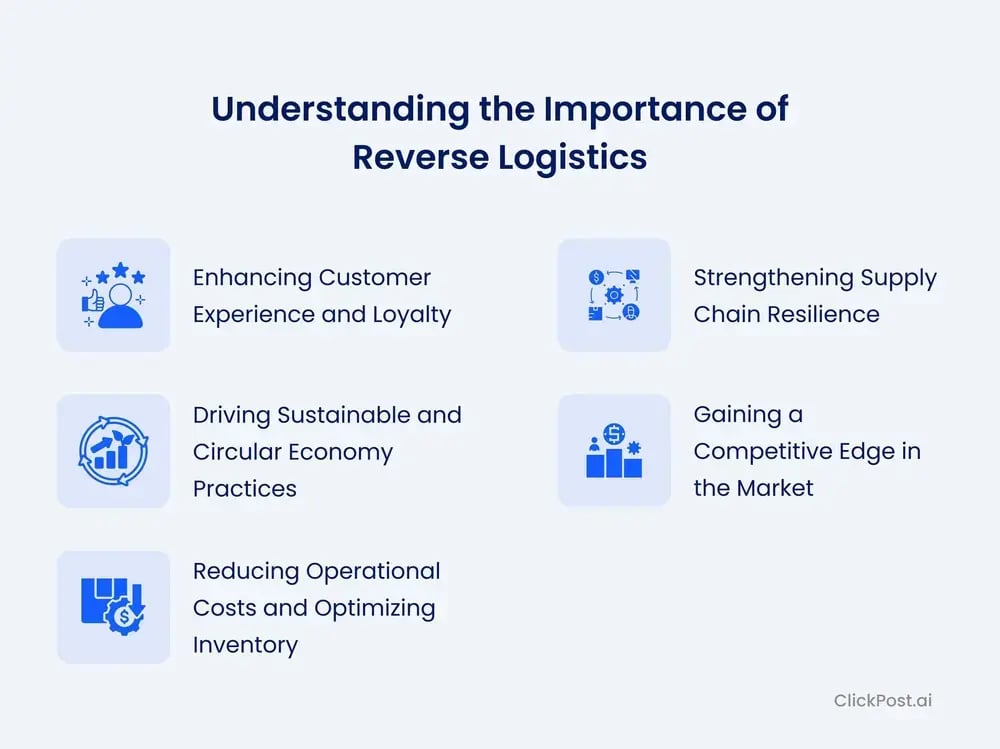
Reverse logistics is a critical business function that drives customer satisfaction, sustainability, and profitability. Without a robust reverse logistics strategy, companies risk losing customers, incurring unnecessary costs, and facing inventory mismanagement issues.
1. How Reverse Logistics Improves Customer Experience and Retention
Efficient returns management is crucial to shaping customer loyalty. A smooth, transparent returns process increases trust, leading to higher repurchase rates and improved customer retention. Businesses offering easy, hassle-free returns enjoy greater consumer confidence and repeat purchases. A strong post-purchase experience is increasingly what separates leading brands from the rest.
2. How Reverse Logistics Drives Sustainability and Circular Economy Practices
With rising concerns over waste, reverse logistics companies are focusing on sustainability initiatives by enabling recycling, refurbishment, and resale of returned items. Adopting eco-friendly reverse logistics solutions helps businesses reduce waste and carbon footprint while aligning with global sustainability goals.
3. How Reverse Logistics Reduces Operational Costs and Optimizes Inventory
Reverse logistics providers help businesses minimize return-related expenses by optimizing the reverse flow of goods and ensuring cost-effective product recovery. Companies leveraging reverse logistics experts can reduce logistics costs associated with restocking, refurbishing, and reselling.
4. How a Strong Reverse Logistics Strategy Strengthens Supply Chain Resilience
A well-managed reverse logistics supply chain enhances supply chain resilience by reducing product return delays and ensuring quicker restocking of returned goods. Real-time visibility and data management enable companies to anticipate return trends and proactively adjust logistics strategies.
5. Why Efficient Reverse Logistics Gives eCommerce Businesses a Competitive Edge
With consumer expectations evolving, efficient reverse logistics management is now a key competitive advantage. Companies investing in top reverse logistics partners gain an edge by providing superior return experiences, reducing operational inefficiencies, and increasing profitability.
How We Selected and Evaluated the Best Reverse Logistics Companies for 2026
This list was compiled based on a structured evaluation across six dimensions: returns automation capabilities, carrier and platform integrations, analytics and real-time visibility, fraud prevention controls, scalability across business sizes, and suitability for different operational models (eCommerce, enterprise retail, cross-border, Shopify-native, etc.).
We reviewed each provider's publicly available product documentation, feature sets, integration ecosystems, and positioning in the market. Companies were included based on their demonstrated ability to handle reverse logistics at scale, from return authorization and pickup scheduling through to disposition management, refurbishment, and resale.
National and global providers (XPO Logistics, Optoro, ShipBob) were evaluated for infrastructure breadth and enterprise-readiness. Specialized platforms (ClickPost, WeSupply Labs, Mercury Logistics) were evaluated for automation depth, AI capabilities, and integration flexibility. Regional providers (Ecom Express) were included for their strength in specific geographies.
Reverse Logistics Companies vs Reverse Logistics Software: What Is the Difference?
Before selecting a provider, it helps to understand the distinction between reverse logistics companies and reverse logistics software, since the two categories overlap but serve different operational roles.
Reverse logistics companies are service providers that physically handle the movement of returned goods. This includes pickup scheduling, warehousing, sorting, refurbishment, recycling, and disposal. Companies like XPO Logistics, ShipBob, and Bowman Logistics fall into this category. They are typically 3PL providers or specialized logistics operators that manage the physical reverse supply chain on your behalf.
Reverse logistics software refers to platforms that orchestrate and automate the returns process including, return authorization, label generation, carrier allocation, tracking, analytics, and fraud prevention, without necessarily owning the physical logistics infrastructure. ClickPost, WeSupply Labs, Optoro, and Mercury Logistics operate primarily in this space. They integrate with your existing carriers and warehouses to streamline the reverse flow digitally.
Hybrid providers combine both: they offer software-layer automation alongside physical fulfillment or carrier networks. ShipBob and Ecom Express are examples of providers that bridge both sides.
For most eCommerce businesses, the choice depends on whether you need a partner to physically handle returns (3PL reverse logistics) or a platform to orchestrate returns across existing logistics partners (reverse logistics software). High-volume retailers often use both, a software platform like ClickPost layered over one or more 3PL providers for physical execution.
Top 9 Reverse Logistics Companies Transforming eCommerce Returns in 2026
Selecting the right reverse logistics provider is crucial for eCommerce businesses and retailers looking to enhance their returns process while optimizing costs and ensuring customer satisfaction. The best reverse logistics companies offer technology-driven solutions, seamless integrations, and scalable services tailored to businesses of all sizes.
Below, we explore the top 9 reverse logistics companies, highlighting their key offerings, strengths, and who they are best suited for.
| Company Name | Key Offerings | Best For |
| ClickPost | AI-powered returns management, real-time tracking, automated pickups, customizable returns portal, fraud prevention logic. | Large-scale retailers with high-volume returns, looking for automation and scalability. |
| ShipBob | Automated return approvals, inventory optimization, customer-facing portal, carrier/platform integration, disposition management (restock, repair, recycle). | Small to mid-sized eCommerce businesses needing scalable reverse logistics solutions. |
| XPO Logistics | End-to-end returns handling, repair & refurbishment, customizable solutions, sustainability initiatives, real-time analytics & reporting. | Enterprises and retailers with large-scale reverse logistics needs and global reach. |
| Optoro | AI-driven return routing, bulk liquidation & resale, sustainability & recycling, integrated returns management, customer-centric returns portal. | Retailers and eCommerce businesses looking to maximize value from returns while supporting a circular economy. |
| WeSupply Labs | Automated returns & exchanges, inventory reconciliation, real-time tracking & notifications, carrier & platform integration, data-driven insights. | eCommerce businesses prioritizing automation, insights, and seamless returns handling. |
| Bowman Logistics | Comprehensive returns processing, repair & refurbishment, multi-channel returns integration, sustainability focus, advanced warehousing & inventory control. | Businesses requiring specialized reverse logistics and inventory management experts. |
| Mercury Logistics | End-to-end returns management, automated return approvals, product recovery & disposal, customizable reverse flow solutions, data insights & analytics. | Retailers and manufacturers seeking cost-effective, tech-enabled reverse logistics solutions. |
| ShipWizard | Efficient returns processing, eCommerce & carrier integration, product sorting & condition assessment, customer service & support, advanced tracking & reporting. | Mid-sized eCommerce businesses looking for efficient and scalable reverse logistics solutions. |
| Ecom Express | Nationwide reverse logistics network, AI-powered quality checks, flexible return options, technology-driven return tracking, seamless integration with eCommerce platforms. | eCommerce businesses in India seeking reliable and fast reverse logistics services. |
1. ClickPost – Best AI-Powered Reverse Logistics Platform for High-Volume Retailers in 2026
ClickPost stands out as a robust, AI-powered returns management system designed to simplify reverse logistics for high-volume retailers. The platform automates returns authorisation, generates return labels, and schedules pickups with over 500 integrated carrier partners. Brands can create a fully white-labelled portal tailored to their policies and SKUs. It provides real-time status tracking, customisable communications, and built-in fraud prevention logic.
Key Features
-
It offers a branded, fully customisable returns portal that is aligned with your return policies.
-
Automates reverse logistics, including pickup scheduling, return label generation, and carrier allocation.
-
Provides real-time updates via APIs and multi-channel notifications to keep customers informed.
-
Built-in fraud detection flags high-risk returns based on behaviour and history.
-
Allows exchanges, store credit incentives, or automated refunds with milestone triggers.
ClickPost's pricing is customisable based on business scale, with enterprise-grade plans that include extensive onboarding and support. It is ideal for large-scale retailers looking to streamline operations and reduce return-related costs. Businesses exploring the best returns management software options will find ClickPost consistently ranked among the top choices for high-volume automation.
2. ShipBob – Scalable Reverse Logistics and 3PL Returns Management for Growing eCommerce Brands
ShipBob is a technology-driven third-party logistics (3PL) provider that specializes in eCommerce fulfillment and reverse logistics solutions. It integrates with leading eCommerce platforms like Shopify, Amazon, and WooCommerce, offering a seamless experience for managing product returns and returns processing across multiple channels.
Key Features
-
Returns processing: Automated return approvals, label generation, and streamlined handling.
-
Inventory optimization: Tracks returned items for restocking or refurbishing.
-
Customer-facing portal: Allows customers to initiate and track returns easily.
-
Carrier & platform integration: Works with major carriers and online marketplaces.
-
Disposition management: Determines whether products should be restocked, repaired, or recycled.
3. XPO Logistics – Enterprise-Grade Reverse Logistics Solutions for Retail, eCommerce, and Manufacturing
XPO Logistics is a global leader in supply chain management. It provides reverse logistics solutions tailored for industries such as retail, e-commerce, and automotive. Its returns management solutions help businesses reduce costs and increase operational efficiency.
Key Features
-
End-to-end returns handling: From pickup to final product disposition.
-
Repair & refurbishment: Extends product lifespan and enables resale.
-
Customizable solutions: Tailored reverse logistics services for various industries.
-
Sustainability initiatives: Focuses on environmentally responsible disposal and recycling.
-
Data insights & reporting: Provides real-time analytics on return trends.
4. Optoro – AI-Driven Returns Management and Resale Platform for Circular Commerce
Optoro is a returns management and resale technology company that leverages AI and real-time visibility tools to optimize the reverse logistics process. It helps businesses reduce waste, resell returned products, and maximize recovery value. This makes it a strong fit for retailers focused on reducing eCommerce return rates while recapturing maximum product value.
Key Features
-
AI-driven return routing: Directs returned goods to the most profitable resale channels.
-
Bulk liquidation & resale: Maximizes value from excess or returned inventory.
-
Sustainability & recycling focus: Reduces waste by promoting refurbishment.
-
Integrated returns management: Works with warehouses and logistics providers.
-
Customer-centric returns portal: Enhances the customer experience with self-service returns.
5. WeSupply Labs – Automated eCommerce Returns and Exchange Management Software for DTC and Shopify Brands
WeSupply Labs specializes in reverse logistics automation, helping eCommerce stores streamline returns and improve operational efficiency. Its self-service portal enables hassle-free returns while integrating seamlessly with major logistics solutions. Businesses using automated Shopify returns workflows will find its platform particularly compatible.
Key Features
-
Automated returns & exchanges: Enables customers to initiate returns and select exchange options in a seamless manner.
-
Inventory reconciliation: Ensures accurate stock updates by identifying products eligible for restocking or resale.
-
Real-time tracking & notifications: Provides visibility into the returns journey, keeping both customers and businesses informed.
-
Integration with carriers & platforms: Works with multiple logistics partners for efficient return handling.
-
Data-driven insights: Offers analytics to identify return trends and reduce future return rates.
6. Bowman Logistics – Specialized Reverse Logistics with Advanced Warehousing and Inventory Control
Bowman Logistics offers customized reverse logistics solutions focused on inventory management, return processing, and product refurbishment. The company is known for its scalable solutions, which help businesses optimize their reverse flow and minimize waste.
Key Features
-
Comprehensive returns processing: Handles returns from pickup to final resolution, ensuring quality checks at every step.
-
Repair & refurbishment: Extends the lifecycle of returned goods through reconditioning and repackaging.
-
Multi-channel returns integration: Supports returns across physical stores, online marketplaces, and warehouses.
-
Sustainability initiatives: Focuses on recycling returned products, promoting a circular economy.
-
Advanced warehousing & inventory control: Ensures accurate inventory tracking to prevent overstocking.
7. Mercury Logistics – Cost-Effective, Tech-Enabled Returns Management for Retailers and Manufacturers
Mercury Logistics provides comprehensive returns management services, ensuring businesses can process returns efficiently while maintaining cost-effectiveness. The company supports multiple industries, from consumer electronics to retail, making it a versatile option for businesses seeking reliable reverse logistics software capabilities.
Key Features
-
End-to-end returns management: Handles returns from authorization to final disposition.
-
Automated return approvals: Uses AI-powered solutions to validate and process returns efficiently.
-
Product recovery & disposal: Maximizes value from returned products through resale, recycling, or repurposing.
-
Customizable reverse flow solutions: Tailored solutions to meet business-specific reverse logistics needs.
-
Data insights & analytics: Provides real-time visibility into return trends, fraud detection, and cost control.
8. ShipWizard – Full-Service 3PL with eCommerce Returns Processing and Real-Time Tracking
ShipWizard is a full-service 3PL company that offers reverse logistics services, eCommerce fulfillment, and returns processing. It integrates with eCommerce platforms to help businesses manage returns efficiently.
Key Features
-
Efficient returns processing: Seamless handling of product returns, exchanges, and restocking.
-
ECommerce & carrier integration: Works with leading online stores and shipping partners.
-
Product sorting & condition assessment: Determines whether items should be refurbished, recycled, or disposed of.
-
Customer service & support: Enhances the customer experience by simplifying return requests.
-
Advanced tracking & reporting: Provides businesses with real-time return visibility.
9. Ecom Express – Nationwide Reverse Logistics Provider for eCommerce Companies in India
Ecom Express specializes in reverse logistics for eCommerce companies operating in India. It offers fast return processing, multi-parcel handling, and nationwide coverage, making it one of India's leading courier and logistics service providers.
Key Features
-
Nationwide reverse logistics network: Provides rapid return pickups across India.
-
AI-powered quality checks: Reduces fraudulent returns with automated inspections.
-
Flexible return options: Offers multi-parcel handling, bulk returns, and customized return windows.
-
Technology-driven return tracking: Ensures full real-time visibility over return shipments.
-
Seamless integration with eCommerce platforms: Supports all major online stores and marketplaces.
Best Reverse Logistics Companies by Business Type: Which Provider Is Right for You?
Best for enterprise retail: XPO Logistics and ClickPost. XPO provides end-to-end physical reverse logistics with global infrastructure, repair, and refurbishment capabilities. ClickPost layers AI-powered returns orchestration, carrier allocation, and analytics on top of existing logistics networks, making it ideal for large retailers managing high return volumes across multiple carriers.
Best for Shopify and DTC brands: WeSupply Labs and ShipBob. WeSupply Labs integrates natively with Shopify and offers automated returns and exchange workflows built for DTC operations. ShipBob combines 3PL fulfillment with returns processing, making it a practical choice for growing Shopify brands that want fulfillment and reverse logistics under one roof. If you are evaluating dedicated Shopify returns apps, both platforms are worth comparing against native app alternatives.
Best for circular commerce and resale: Optoro. Its AI-driven return routing directs goods to the most profitable resale, liquidation, or recycling channels, making it the strongest fit for retailers prioritizing sustainability and product value recovery.
Best for India-focused eCommerce: Ecom Express. With nationwide reverse logistics coverage, AI-powered quality checks, and deep integration with Indian eCommerce platforms, Ecom Express is the leading choice for businesses operating primarily in the Indian market.
Best for multi-carrier orchestration and returns automation: ClickPost. For businesses that work with multiple 3PL providers and carriers, ClickPost serves as the orchestration layer, automating return authorization, carrier allocation, tracking, fraud detection, and customer communications across 600+ integrated partners.
Best for cost-sensitive mid-market businesses: ShipWizard and Mercury Logistics. Both offer practical returns processing with carrier integration and real-time tracking at price points suited to mid-sized operations that need reliable reverse logistics without enterprise-scale commitments.
How to Choose the Right Reverse Logistics Provider: 5 Key Factors to Evaluate in 2026
Selecting the right reverse logistics partner is essential for businesses looking to enhance operational efficiency, minimize costs, and improve the returns process. A well-structured reverse logistics strategy can significantly impact customer satisfaction and profitability. Below are the critical factors to consider when choosing a reverse logistics provider.
1. What Automation and Technology Features Should a Reverse Logistics Provider Offer?
The efficiency of a reverse logistics process heavily depends on automation and technology-driven solutions. Providers leveraging AI, machine learning, and data-driven analytics can streamline operations, reduce manual errors, and optimize return flows. Look for platforms that also offer supply chain automation capabilities to keep pace with growing return volumes.
Key things to consider:
-
AI-powered return approvals for faster processing.
-
Automated return tracking and self-serve return portals.
-
Data analytics to identify return trends and optimize reverse logistics workflows.
-
Integration with warehouse management systems and order fulfillment platforms.
2. How Important Are Carrier and Platform Integrations When Selecting a Reverse Logistics Partner?
A reverse logistics provider should offer seamless integration with major shipping carriers and eCommerce platforms. It ensures an effortless returns process, providing businesses with better control and real-time tracking. Evaluating multi-carrier shipping software capabilities is especially important for businesses managing high return volumes across multiple channels.
Key things to consider:
-
Compatibility with leading carriers such as FedEx, UPS, and DHL.
-
API-based integration with eCommerce platforms like Shopify, WooCommerce, and Magento.
-
Automated return label generation for customer convenience.
-
Multi-channel return handling, including physical stores and warehouses.
3. How to Assess the Cost-Effectiveness of a Reverse Logistics Provider
Managing returns can be costly, from transportation expenses to inventory holding costs. Businesses must assess a provider's pricing structure and how well it aligns with their budget while maintaining service quality. Understanding total shipping costs and reverse logistics fees upfront can prevent expensive surprises at scale.
Key things to consider:
-
Transparent pricing models with no hidden fees.
-
Cost-effective restocking, refurbishment, and disposal solutions.
-
Network reach and bulk shipping discounts for returns management.
-
Scalability of services to accommodate peak return seasons.
4. Why Fraud Prevention and Security Matter When Choosing a Reverse Logistics Company
Return fraud is a growing concern, with some businesses losing millions annually due to unauthorized or false return claims. Robust security measures ensure businesses minimize fraud-related losses while maintaining a positive customer experience. Pairing your reverse logistics provider with dedicated eCommerce fraud prevention software adds an extra layer of protection.
Key things to consider:
-
AI-based fraud detection systems to flag suspicious returns.
-
QR-coded return labels for verification and tracking.
-
Multi-step return authentication processes.
-
Real-time monitoring to prevent policy abuse.
5. How Does Reverse Logistics Provider Quality Impact the Customer Returns Experience?
A seamless returns process directly influences customer satisfaction and retention. A provider that prioritizes customer convenience can help businesses build long-term loyalty. Businesses focused on improving the post-purchase experience for eCommerce brands should treat returns quality as a core differentiator.
Key things to consider:
-
Self-service return portals for customer convenience.
-
Hassle-free refund processing and exchange management.
-
Transparent return status tracking with real-time updates.
-
Multiple return options, including store drop-offs, carrier pickups, and mail-in returns.
Streamline Returns & Exchanges with ClickPost – Get Started Today
Managing product returns does not have to be a logistical nightmare. ClickPost offers a fully automated reverse logistics solution that ensures efficiency, cost savings, and customer convenience.
Whether you are looking to reduce your eCommerce return rate or simply handle returns more cost-effectively, ClickPost has tools built to scale with your business. For brands evaluating a broader post-purchase platform, ClickPost's returns module integrates seamlessly with its full suite of tracking and customer communication tools.
Key features of ClickPost reverse logistics
- Automated returns management: Automates return approvals via a self service portal, reducing processing delays.
- Multi-carrier & multi-platform integration: Works with leading logistics carriers and eCommerce platforms for seamless operations.
- Real-time tracking & notifications: Ensures businesses and customers stay informed at every stage of the returns process.
- Advanced exchange solutions: Supports catalog-wide exchanges, ensuring optimal revenue retention.
- Fraud prevention & return policy optimization: Reduces fraudulent returns and enhances return compliance.
From Returns Problem to Returns Advantage: The Future of Reverse Logistics
The reverse logistics landscape is evolving rapidly. What was once a cost center is now a competitive differentiator. Businesses that invest in the right combination of reverse logistics technology and operational partners will reduce costs, retain more customers, recover more product value, and build more resilient supply chains.
Whether you are a growing Shopify brand processing a few hundred returns per month or an enterprise retailer managing millions, the providers in this list represent the strongest options available in 2026. For a deeper look at optimizing the full returns workflow, explore our guide on streamlining the eCommerce returns process from end to end.
Frequently Asked Questions About Reverse Logistics Companies
How Can a Reverse Logistics Company Help Reduce Return Processing Costs?
A reverse logistics company helps businesses reduce costs by optimizing return workflows, automating approval processes, and minimizing manual interventions. With AI-powered automation, bulk return shipments, and optimized warehouse management, businesses can cut down on storage fees, transportation expenses, and overall operational costs.
Can Reverse Logistics Companies Help Prevent Return Fraud?
Yes, many reverse logistics providers implement advanced fraud detection mechanisms, including AI-based return validation, multi-step authentication, and QR-coded return labels. These measures help businesses identify fraudulent return claims, prevent policy abuse, and ensure only legitimate returns are processed. The NRF estimated $101 billion in fraudulent returns in 2023 alone, making fraud prevention a critical capability.
How Do Reverse Logistics Providers Integrate with eCommerce Platforms and Shipping Carriers?
Leading reverse logistics providers offer API-based integrations with eCommerce platforms like Shopify, WooCommerce, and Magento. They also connect with major shipping carriers such as FedEx, DHL, and UPS, allowing businesses to automate return label generation, streamline return pickups, and enhance visibility throughout the reverse logistics process. Businesses looking for a broad set of shipping carrier options should verify that their reverse logistics provider supports their preferred carrier network.
What Industries Benefit the Most from Reverse Logistics Services?
Industries that deal with high return volumes benefit the most from reverse logistics services. These include fashion, electronics, consumer goods, automotive, and home appliances. Businesses in these sectors rely on efficient returns management software, product recovery strategies, and optimized inventory control to maintain profitability while enhancing the customer experience.
What Is the Difference Between Reverse Logistics and Returns Management?
Reverse logistics is the broader discipline covering the entire backward flow of goods — from customer returns and product recalls to recycling, refurbishment, warranty repairs, and disposal. Returns management is a subset of reverse logistics focused specifically on processing customer-initiated returns: authorization, pickup, inspection, restocking, and refund or exchange. A reverse logistics provider typically handles the full spectrum, while returns management software may focus on the customer-facing return workflow.
Which Reverse Logistics Company Is Best for Shopify Stores?
For Shopify-native operations, WeSupply Labs and ShipBob are strong choices. WeSupply Labs offers direct Shopify integration with automated returns and exchange workflows designed for DTC brands. ShipBob combines Shopify-integrated fulfillment with built-in returns processing. For Shopify brands that also need multi-carrier orchestration and AI-driven automation at higher volumes, ClickPost integrates with Shopify and adds carrier allocation, fraud prevention, and advanced analytics. You can also explore dedicated Shopify returns apps for fashion stores if apparel returns are your primary challenge.
How Much Do Reverse Logistics Companies Typically Charge?
Pricing varies significantly by provider type and business scale. 3PL-based reverse logistics providers like ShipBob and ShipWizard typically charge per-shipment or volume-based fees that include physical handling. Software platforms like ClickPost and WeSupply Labs use SaaS subscription models, often tiered by return volume or feature access. Enterprise providers like XPO Logistics and Optoro offer custom contract pricing. It is advisable to request detailed quotes and compare the total cost of ownership, including integration, onboarding, and per-return fees.
Do Reverse Logistics Companies Support Cross-Border Returns?
Some do, but cross-border reverse logistics adds complexity around customs, duties, and international shipping costs. Providers like DHL (through its eCommerce logistics services), XPO Logistics, and ClickPost (via its 500+ carrier integrations including international partners) can support cross-border return flows. Businesses with significant international return volumes should evaluate carrier coverage, customs documentation support, and landed-cost visibility when selecting a provider. Our guide on international logistics covers additional considerations for managing cross-border shipments.
What Should I Look for in Reverse Logistics Software vs a 3PL Reverse Logistics Provider?
If you already have carriers and warehouses in place but need to automate and orchestrate the returns process, reverse logistics software (like ClickPost, WeSupply Labs, or Optoro) is the better fit. If you need a partner to physically handle returned goods — warehousing, sorting, refurbishment, disposal — a 3PL reverse logistics provider (like ShipBob, XPO, or Bowman Logistics) is more appropriate. Many high-volume retailers use both: a software layer for orchestration and a 3PL for physical execution. For a broader comparison of third-party logistics options, see our overview of 3PL advantages and disadvantages.
How Do Reverse Logistics Companies Help with Sustainability and Circular Commerce?
Reverse logistics companies contribute to sustainability by routing returned products to the most appropriate next destination — resale, refurbishment, recycling, or responsible disposal — rather than sending everything to landfill. Optoro specializes in this with AI-driven routing to resale and liquidation channels. XPO and Bowman Logistics offer refurbishment and recycling programs.
ClickPost's analytics help businesses identify the root causes of returns, enabling upstream improvements that reduce return volumes altogether. According to the EPA, circular economy practices in product recovery and reuse are critical to reducing the environmental impact of consumer goods.