





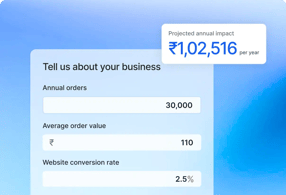



Ecommerce Shipping Cost Statistics India 2026: Cost per Order


Ready to ship smarter? Talk to our logistics experts.
Trusted by 600+ brands
In this blog
TL;DR Summary
Shipping cost in India e-commerce looks cheap on paper. Delhivery earned about ₹60 per express parcel last quarter, and India Post now charges ₹70 to send a 500g parcel to a metro. Then a share of your COD orders comes back unopened, and the math changes.
This report separates three numbers that teams tend to blur. Cost per shipment is the rate card price for moving one parcel. True cost per delivered order spreads every logistics rupee (forward freight, packaging, COD fees, RTO freight and handling) across only the orders that reached a customer. Shipping cost as a share of AOV divides that true cost by order value, and it is the figure your CFO actually cares about.
What is the average ecommerce shipping cost per order in India in 2026?
On the rate card, a 500g ecommerce parcel in India costs roughly ₹32 to ₹90 in 2026. Indicative Delhivery Surface rates start at ₹32 within a city, Delhivery earned about ₹60 per express parcel in Q2 FY27, and India Post's revised Speed Post Parcel tariff tops out at ₹90 interstate.
-
Delhivery booked ₹1,961 crore of express parcel revenue on 325 million shipments in Q2 FY27 (July to September 2026), per Inc42's coverage of Delhivery's Q2 FY27 results. That is about ₹60 a parcel, down from about ₹65 a year earlier.
-
India Post's retail parcel tariff, revised on August 1, 2026, charges ₹28 locally, ₹65 within a state, ₹70 to zone or metro destinations and ₹72 to other states for a 500g parcel, with GST extra, according to UNI's report on the Post Office (Sixth Amendment) Regulations, 2026.
-
Indicative Delhivery Surface rates for 500g run from ₹32 within a city to ₹110 for J&K and the Northeast, before fuel and GST, per ClickPost's compiled rate reference.
-
At the national level, NCAER's Assessment of Logistics Cost in India for DPIIT put total logistics cost at 7.97% of GDP, or ₹24.01 lakh crore, in 2023-24.
A brand that tells its board shipping costs "about ₹40" is usually quoting its best lane on its best plan. Treat the rate card as the floor of your cost.
Why does the courier rate card understate true shipping cost?
In ClickPost's cost model, true cost per delivered order runs 1.5x the rate card for a metro, prepaid brand and 3.1x for a COD-heavy brand shipping deep into Tier-3 India. RTO freight, COD fees, packaging and handling get spread across fewer delivered orders, and the per-order number climbs fast.
The RTO amortisation error
Most teams book an RTO as the cost of that one failed order. That undercounts it. Take 100 dispatched orders at a 20% RTO rate, a ₹55 forward rate, a matching ₹55 return charge and ₹20 to inspect and restock each returned unit. The 20 failures burn ₹2,600 (₹130 each), and only 80 orders produce revenue. Every delivered order therefore carries ₹32.50 of RTO cost, including the ones that arrived on time.
COD fees and the float nobody books
COD adds two costs. The visible one is the carrier fee, which Delhivery's rate card commonly sets at ₹35 or 1.5% of order value, whichever is higher. The quieter one is float. A brand collecting ₹30 lakh a month in COD on T+7 remittance has about ₹7 lakh outstanding at any moment, or roughly ₹11 lakh once four days of transit are added.
At a 14% to 18% annual cost of working capital, that is ₹8,200 to ₹16,500 a month. Real money, though small next to RTO, and rising: the RBI raised the repo rate to 5.50% in October 2026, so each day of remittance lag now costs more.
What is the true cost per delivered order in India?
ClickPost's model puts the true cost per delivered order in India between roughly ₹70 and ₹235 in 2026. A metro-focused prepaid brand lands near ₹69. A brand with 65% COD and a 22% RTO rate lands near ₹155, and Tier-3-heavy COD operations pass ₹230.
The seven components of true shipping cost per delivered order in India:
-
Forward freight: ₹32 to ₹90 for a 500g parcel, depending on carrier, contract and zone.
-
Packaging: ₹12 to ₹35 per order, varying by category and box size (ClickPost assumption).
-
COD fee: nothing on prepaid orders; about ₹35 or 1.5% of order value on COD.
-
RTO return freight: usually billed at or near the forward rate, so ₹32 to ₹90 per returned parcel.
-
RTO handling and restocking: ₹15 to ₹40 per returned unit (ClickPost assumption).
-
Weight disputes and billing leakage: ₹2 to ₹5 per dispatched order (directional estimate).
-
COD float: ₹3 to ₹6 per COD order at a 14% to 18% cost of capital (derived above).
The formula behind the table: true cost per delivered order equals forward freight plus packaging plus disputes plus the RTO rate times (return freight plus handling), all divided by (1 minus the RTO rate), plus COD share times the COD fee.
True cost per delivered order by operating profile (ClickPost model, November 2026)
| Operating profile | Forward rate (500g) | COD share | RTO rate | True cost per delivered order | Multiple of rate card |
| A. Metro, prepaid-first | ₹45 | 0% | 5% | ₹69 | 1.5x |
| B. National, mixed payments | ₹55 | 40% | 12% | ₹113 | 2.1x |
| C. COD-heavy, Tier-2 mix | ₹62 | 65% | 22% | ₹155 | 2.5x |
| D. Tier-3-heavy, COD-led | ₹75 | 75% | 35% | ₹233 | 3.1x |
If finance budgets ₹62 a parcel and you look like profile C, the P&L is short about ₹93 per delivered order. Most of that gap is RTO, which is the component you can actually move.
What percentage of AOV should shipping cost be for D2C brands in India?
Keep true shipping cost under 10% of AOV, and treat anything above 15% as a margin problem. On ClickPost's modeled numbers, a ₹1,800 order costs 4% to 13% of its value to deliver, while a ₹400 order costs 17% to 58% depending on COD share and RTO rate.
Shipping cost as a percentage of AOV by AOV band and operating profile (ClickPost model)
| AOV band (modelled at) | A. Metro prepaid (₹69) | B. National mixed (₹113) |
| Below ₹600 (₹400) | 17% | 28% |
| ₹600 to ₹1,200 (₹900) | 8% | 13% |
| ₹1,200 to ₹2,500 (₹1,800) | 4% | 6% |
| Above ₹2,500 (₹3,500) | 2% | 3% |
Category shapes which profile you resemble. The guide below is directional: it reflects product traits, and ClickPost has not measured these as category averages.
What drives shipping cost by category (directional guide)
| Category | Main cost driver | Profile it usually resembles |
| Apparel and fashion | Light items, but over-boxing inflates volumetric weight; high size-exchange returns | B to C |
| Beauty and personal care | Low AOV relative to fixed per-parcel cost | B to C |
| Electronics accessories | Small, dense parcels with higher prepaid share | A to B |
| Footwear | Shoe boxes push parcels into higher weight slabs | B to C |
| Home decor | Heavy, fragile items and damage-related returns | B to D |
| Nutraceuticals | Dense parcels; repeat buyers lean prepaid over time | B |
| Jewelry | Tiny parcels against a high AOV | A |
| FMCG and daily essentials | Heavy for their value, low AOV, COD-heavy | C to D |
How much more does shipping cost in Tier-2 and Tier-3 India?
Indicative Delhivery Surface rates rise from ₹55 for a 500g metro-to-metro parcel to ₹72 for the rest of India and ₹110 for J&K and the Northeast. Lower delivery success widens the gap, so a delivered order outside the metros works out about 56% more expensive in our model.
Zone escalation: same 500g parcel, 50% COD (ClickPost model)
| Delivery zone | Indicative 500g Surface rate | Delivery success used | Modelled true cost per delivered order | vs metro |
| Metro to metro | ₹55 | 73% | ₹152 | Baseline |
| Rest of India (Tier-2, Tier-3) | ₹72 | 60% | ₹237 | 0.56 |
| J&K, Northeast, special zones | ₹110 | 60% (assumed) | ₹326 | 1.14 |
-
Markets outside the metros account for more than 67% of total shipments but only about 60% are successfully delivered, against 73% in metros, according to Business Standard's April 2026 report on D2C delivery completion.
-
Flipkart supply chain head Hemant Badri expects most of the company's next 100 million customers to come from smaller cities, telling Business Today in October 2026: "Possibly, 60-70% of that could be Tier 2, Tier 3."
-
Badri also said a warehouse that takes about 18 months to build in a metro can take close to three years in a Tier-2 or Tier-3 market.
The freight gap between metro and rest-of-India lanes is 31%. The delivered-order gap is 56%. Failed deliveries, not distance, do most of the damage, and a uniform ₹499 free-shipping threshold quietly subsidizes your hardest pin codes.
How can D2C brands reduce shipping cost as a share of revenue?
Five levers move true cost per delivered order the most: COD-to-prepaid conversion, failed-delivery (NDR) automation, right-sized packaging, multi-carrier routing by pin code and zone-aware free-shipping thresholds. For a COD-heavy brand, cutting RTO from 22% to 18% alone saves about ₹10 on every delivered order.
1. Shift COD to prepaid, gradually
What: A small prepaid discount, a UPI-first checkout or prepaid-only drops.
Impact: moving 10 points of volume from COD to prepaid trims about ₹10 per delivered order (6%), assuming 30% RTO on COD and 7% on prepaid.
Trade-off: push too hard and conversion drops outside metros. A ₹20 to ₹50 incentive usually pays for itself; forcing prepaid rarely does.
2. Automate failed-delivery (NDR) follow-up
What: reach the customer within hours of a failed attempt to confirm address, slot or payment.
Impact: Business Standard reported an 11% improvement in delivery completion for D2C brands using AI calls, address checks and COD-to-prepaid conversion, and Arvind Fashions reports a 23% RTO reduction on ClickPost (vendor-reported). On profile C, a four-point RTO cut saves about ₹10.50 per delivered order, roughly ₹1 lakh a month at 10,000 orders.
Trade-off: automation fixes customer-side failures; fake courier attempts need a carrier escalation backed by scan data.
Size it for your volume with ClickPost's NDR ROI calculator or see how automated NDR management works.
3. Right-size packaging for volumetric weight
What: couriers bill the higher of actual and volumetric weight, commonly length x width x height in centimeters divided by 5,000, so a 400g item in a 30 x 25 x 10 cm box bills as 1.5 kg.
Impact: at indicative metro-to-metro rates, that parcel costs about ₹111 instead of ₹55.
Trade-off: poly mailers cut weight but raise damage on fragile goods. Start with your top 10 SKUs.
4. Route each pin code to the right carrier
What: send each order to the carrier with the best cost and delivery record for that lane. India Post's flat ₹72 interstate rate can beat private rates on remote lanes, while private carriers usually win on metro speed.
Impact: ClickPost reports 8% to 14% extra savings from AI carrier allocation on top of negotiated rates (vendor-reported).
Trade-off: below a few hundred orders a day, integration and reconciliation overhead can eat the savings.
5. Set free-shipping thresholds by zone
What: price free shipping against each zone's true cost.
Impact: at a 10% cost-to-AOV target, profile B justifies free shipping from about ₹1,130; in the zone table, metro orders break even near ₹1,520 and rest-of-India orders near ₹2,370.
Trade-off: pin-code-specific thresholds can confuse shoppers, so show them on the product page well before checkout.
Shipping cost health audit: 8 questions for ops leaders
-
Do you report cost per delivered order alongside cost per dispatched shipment?
-
Is your blended RTO rate under 15% if you are prepaid-led, or under 25% if you are COD-led?
-
Is true shipping cost under 10% of AOV for your main category?
-
Do you route orders by PIN code across more than one carrier?
-
Is your COD share trending down, with a prepaid incentive live at checkout?
-
Does a failed delivery trigger customer contact within four hours?
-
Have you checked volumetric weight on your top 10 SKUs in the last 90 days?
-
Do your free-shipping thresholds differ by zone?
Score one point per yes. Six or more means you are measuring the right things. Three or fewer usually means the rate card is shaping decisions that the delivered-order math would overturn.
What is the forecast for e-commerce shipping volumes in India?
Redseer projects Indian e-commerce shipments to grow from 4.8 to 5.5 billion in FY25 to 15 to 16 billion by FY30, a 23% to 24% annual pace, according to IBEF's summary of Redseer's express logistics report. These are projections. They point to heavier price competition per parcel as carriers chase volume.
India e-commerce logistics forecasts
| Forecast | Figure | Source | Type |
| E-commerce shipments by FY30 | 15 to 16 billion | Redseer via IBEF | Projection |
| Total express parcel market by FY30 | 24 to 29 billion shipments | Redseer via IBEF | Projection |
| India e-commerce market by 2030 | $180 to $200 billion, up from $70 to $80 billion in 2024 | Business Standard, April 2026 | Projection |
Delhivery's Q2 FY27 numbers already show it: shipments up 32%, express revenue up 22%. Rate cards may keep easing for brands with volume, but RTO and failed attempts will not shrink on their own.
Ecommerce shipping cost trends in India for 2026 and 2027
1. Carrier consolidation raises the risk of single-carrier contracts
₹1,369 crore bought Delhivery 99.87% of Ecom Express in a deal that closed on July 18, 2025, and CEO Sahil Barua said it lifted Delhivery's market share by 25%, according to Inc42's report on the Ecom Express buyout. Fewer large carriers means fewer competing quotes on some lanes, so pre-merger rate cards are worth re-bidding.
2. India Post is repricing for e-commerce parcels
₹90 is India Post's new Speed Post Parcel price for a 500g parcel to another state, effective August 1, 2026, with ₹82 for zone or metro destinations. A new last-mile parcel service lets bulk shippers book parcels up to 2 kg at ₹20 through a parcel hub. Slower than private express, but its reach earns it a lane in your routing table.
3. COD charges face regulatory scrutiny
₹7 to ₹10 per order is what marketplaces including Amazon, Flipkart and Myntra had been adding for COD when the Consumer Affairs Ministry opened a probe into the practice in October 2025, as Medianama reported. Recovering COD costs through surprise checkout fees now carries compliance risk; a prepaid discount stated upfront gets most of the economics with less exposure.
4. Money is getting more expensive
5.50% is the RBI repo rate after a 25 basis point hike on October 7, 2026, which ended a long pause, and the committee signalled that near-term cuts are off the table. Slow COD remittance now costs more to carry. Compare settlement cycles in our COD courier guide.
Master statistics table: e-commerce shipping cost in India
| Statistic | Figure | Source | Published |
| India logistics cost as share of GDP, 2023-24 | 7.97% (₹24.01 lakh crore) | NCAER for DPIIT | Sep 2025 |
| Delhivery express parcel shipments, Q2 FY27 | 325 million (+32% YoY) | Delhivery results via Inc42 | Nov 2026 |
| Delhivery express parcel revenue, Q2 FY27 | ₹1,961 crore (+21.7% YoY) | Delhivery results via Inc42 | Nov 2026 |
| Delhivery revenue per express parcel (derived) | About ₹60 (about ₹65 a year earlier) | ClickPost calculation | Nov 2026 |
| India Post Parcel retail tariff, 500g | ₹28 local to ₹72 other states | UNI on DoP regulations | Aug 2026 |
| Speed Post Parcel retail tariff, 500g | ₹28 local to ₹90 other states | UNI on DoP regulations | Aug 2026 |
| Indicative Delhivery Surface rate, 500g | ₹32 to ₹110 by zone | ClickPost rate reference | 2026 |
| Delivery success, metro vs smaller markets | 73% vs about 60% | Business Standard (Velocity data) | Apr 2026 |
| Smaller markets' share of shipments | More than 67% | Business Standard | Apr 2026 |
| E-commerce shipments, FY25 | 4.8 to 5.5 billion | Redseer via IBEF | Apr 2025 |
| E-commerce shipments, FY30 (projection) | 15 to 16 billion | Redseer via IBEF | Apr 2025 |
| India e-commerce market, 2030 (projection) | $180 to $200 billion | Business Standard | Apr 2026 |
| Delhivery acquisition of Ecom Express | ₹1,369 crore for 99.87% | Inc42 | Aug 2025 |
| RBI repo rate | 5.50% | Business Standard | Oct 2026 |
| Marketplace COD fee per order | ₹7 to ₹10 | Medianama | Oct 2025 |
| Modeled true cost per delivered order | ₹69 to ₹233 | ClickPost model | Nov 2026 |
The bottom line on shipping cost in India ecommerce
A rate card tells you what it costs to move a parcel. In India, delivering an order costs 1.5x to 3.1x that figure once failures are counted. Two habits fix most of the confusion. Report cost per delivered order every month, and benchmark it against your own AOV band and payment mix rather than an industry average that lumps jewelry in with groceries.
The market is shifting under that math. Delhivery now owns Ecom Express and India Post has repriced parcels, so a brand tied to one carrier contract carries more pricing risk than it did a year ago.
ClickPost is the platform brands graduate to when single-carrier rate cards stop telling the whole story, with AI carrier allocation and failed-delivery automation running on the same lane-level cost data. Book a demo to see your true cost per delivered order, lane by lane.
Frequently asked questions about ecommerce shipping cost in India
What is the average shipping cost per order for ecommerce in India?
₹32 to ₹90 is the 2026 rate card range for a 500g parcel, from indicative within-city Delhivery Surface rates to India Post's interstate Speed Post Parcel tariff, with Delhivery realizing about ₹60 per parcel. The true cost per delivered order is higher, about ₹70 to ₹235 in ClickPost's model, once RTO, COD fees, packaging and failed attempts are included.
What percentage of AOV should shipping cost be for D2C brands in India?
10% of AOV is a sensible ceiling for true shipping cost, and margins usually start to hurt above 15%. ClickPost's 2026 modeling shows a ₹1,800 order costing 4% to 13% of its value to deliver, while a ₹400 order runs 17% to 58% depending on COD share and RTO rate.
How much does COD add to shipping costs in Indian ecommerce?
About ₹35 per order, or 1.5% of order value, is the typical courier COD fee, but RTO is the bigger cost. By ClickPost's estimate, moving from a prepaid metro profile to a 65% COD profile lifts true cost from about ₹69 to about ₹155 per delivered order, and most of that gap is RTO and failed attempts.
What is the true cost of an RTO order in India?
₹130 is a realistic direct cost for one RTO on a ₹55 lane: the forward freight already paid, a matching return charge and about ₹20 of handling. Spread across delivered orders at a 20% RTO rate, that adds ₹32.50 to every order that reaches a customer, before lost product or wasted ad spend.
How does shipping cost differ between Tier-1 and Tier-3 cities in India?
31% is the freight gap between indicative metro-to-metro (₹55) and rest-of-India (₹72) 500g Surface rates. Lower delivery success outside metros, about 60% against 73% per Business Standard, widens it further. ClickPost estimates a delivered non-metro order costs about 56% more than a metro one.
Which courier is cheapest for ecommerce in India in 2026?
₹72 is India Post's flat retail rate for a 500g parcel to any other state, which is hard to beat on remote lanes, though delivery is slower than private express carriers. No single courier is cheapest everywhere. Brands shipping several hundred orders a day usually save more by routing each pin code to its best carrier.
What is the blended logistics cost per delivered order in India?
₹113 is ClickPost's modeled blended cost per delivered order for a national D2C brand with 40% COD and a 12% RTO rate on a ₹55 forward lane. It covers forward and return freight, packaging, COD fees and handling, and it excludes GST, COD float and lost inventory.
How do I reduce shipping cost for my D2C brand in India?
₹10 per delivered order is roughly what a four-point RTO cut saves on ClickPost's numbers, so start with failed-delivery automation. Then shift COD to prepaid with small incentives, right-size packaging for volumetric weight, route each pin code to its best carrier and set free-shipping thresholds by zone.




We use cookies to keep the site working, understand usage, and improve your experience. Learn more
Always active for essential site performance and security.
Enables anonymous usage analysis to refine our services.
Used to present relevant promotions and advertising.