.png?width=193&height=27&name=ClickPost%20Logo%20(Blue).png)
.svg)
.svg)
.svg)
.svg)
.svg)
.svg)
.svg)
.svg)
.svg)


.svg)
.svg)
.svg)
.svg)
.svg)
.svg)


.svg)
.svg)
.webp?width=286&height=206&name=ROI%20Calculator%20(1).webp)
.svg)
.svg)

.svg)

.webp?width=286&height=206&name=RTO%20Playbook%20(1).webp)
Prepaid Shipping Labels in 2026: Costs, and Best Practices


Ready to ship smarter? Talk to our logistics experts.
Trusted by 600+ brands
In this blog
TL;DR: Know About Prepaid Shipping Labels in 2026
A prepaid shipping label is a postage-paid routing document generated before package handoff, enabling direct carrier network entry without additional payment at drop-off.
-
Global ecommerce revenue is projected to reach $3.88 trillion in 2026, requiring at least one label per order and often a second for returns.
-
Thermal printers deliver the lowest per-label cost at scale because they eliminate ink, reduce scan failures, and apply 4–5x faster than laser-printed sticker sheets.
-
Online-generated labels through shipping platforms cost 20–40% less than retail counter rates, because pre-validated labels reduce carrier processing overhead.
-
QR-code-based label-less returns grew 9 percentage points year-over-year, leading to higher conversion rates for merchants offering box-free drop-off options.
-
Address Validation Services prevent $15–$30 per-incident correction surcharges by catching undeliverable destinations before labels are printed.
What Is a Prepaid Shipping Label and How Does It Work?
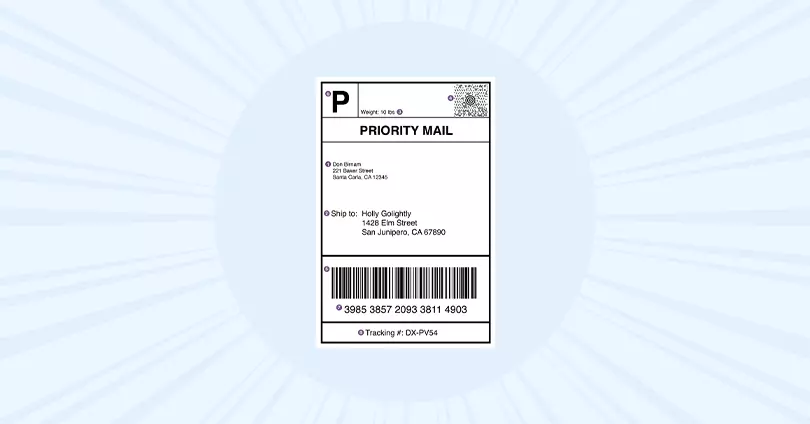
A prepaid shipping label is a shipping document where the postage is paid at the time the label is generated, rather than at the post office counter. It contains all the information a carrier needs to route a package from origin to destination: sender address, recipient address, weight, service tier, tracking barcode, and routing data.
The prepaid element matters operationally. When postage is paid upfront, the package can move directly into the carrier's network at pickup or drop-off, with no additional payment step required. This is what enables efficient outbound dispatch for ecommerce operations and label-less return workflows for customers.
Prepaid labels show up in three operational contexts. Merchants use them for outbound shipments. Retailers use them for return shipments sent to customers. 3PLs and shipping platforms generate high volumes of them through carrier APIs. The mechanics differ across each use case, but the underlying document structure is the same.
What's Inside a Shipping Label? The Anatomy of a Modern Prepaid Label
A shipping label looks like a simple sticker, but it functions as a data-encoded routing instruction for high-speed sorting equipment. Five components carry most of the operational weight.
The shipping barcode and why it matters for carrier sorting
This is the primary scan target for carrier sorters. The most common standard is GS1-128 (a linear barcode), but carriers increasingly use 2D barcodes for richer data encoding. The barcode contains the tracking number that connects the physical package to its digital record.
The MaxiCode (or equivalent 2D symbol) used by UPS
Used primarily by UPS, the MaxiCode is a honeycomb-shaped 2D symbol that contains routing data, including destination zip code and service class. It's designed to be scanned by overhead cameras as packages move along high-speed conveyors, regardless of orientation.
The routing code and how sortation centers use it
A series of numbers and letters that tells the carrier's sorting system exactly which hub or facility the package needs to flow through. This is what determines which conveyor branch the package gets diverted to at the sortation center.
The service indicator: Priority, Express, or Ground
A bold letter or short code (P for Priority, E for Express, G for Ground) that serves as a fallback for human sorters if automated systems fail. It also signals handling priority.
The tracking number: why each label must be single-use
A unique identifier that the customer uses to track the package and that the carrier uses to update package status across the network. Each tracking number is single-use; reusing one creates routing conflicts.
The reason this anatomy matters: carriers increasingly operate high-speed, automated sorting facilities where labels must be scanned in fractions of a second. Labels with smudged barcodes, compromised quiet zones (the white space surrounding the barcode), or off-spec routing codes get shunted to manual exception handling. That adds delay and processing fees to the shipment.
Why Prepaid Shipping Labels Are a Bigger Operational Decision in 2026
Three forces have made prepaid labels a higher-stakes operational decision in 2026 than they were even three years ago.
-
Ecommerce volume is still growing: Global ecommerce logistics revenue is projected to reach $3.88 trillion in 2026, with a compound annual growth rate of 6.84% expected to push the market to $5.05 trillion by 2030. User penetration is forecast to hit 58.1% globally by 2030. Each of those orders requires at least one shipping label, and many require a second for returns.
-
Returns now drive purchase decisions: 72% of shoppers say they're more likely to shop with retailers that don't require a box or label for returns, and 82% say free returns are an important consideration when shopping online. Retailers offering box-free, label-free returns have grown 8 percentage points year-over-year. The label experience is now part of the post-purchase experience.
-
Return fraud is rising: 9% of all returns are now fraudulent, including schemes involving false tracking IDs, label manipulation, and price switching. Strong label workflows, including address validation and unique-per-shipment tracking numbers, are part of how merchants protect against this. Platforms offering ecommerce fraud prevention increasingly integrate label-level controls as a first line of defense.
These pressures mean the choice of how labels are generated, printed, and managed is no longer a peripheral operational detail. For merchants moving more than a few hundred shipments per month, label strategy directly impacts shipping costs, customer experience, and fraud exposure.
Thermal vs. Inkjet vs. Laser: Which Printer Is Best for Shipping Labels?
The printer choice for shipping labels comes down to scannability, durability, and unit economics. Each technology has a clear use case.
| Printer Type | Initial Cost | Cost Per Label | Best For | Why |
| Inkjet | Low | Higher (ink + paper + tape) | Sub-50 shipments per month | Ink can smudge or fade; barcodes lose scannability if exposed to moisture |
| Laser | Medium | Medium | 50-500 shipments per month | Sharper output than inkjet, but requires sticker sheet labels and cutting |
| Thermal (direct thermal) | Higher upfront | Lowest at scale | 500+ shipments per month | Carrier-preferred standard; waterproof, smudge-proof, no ink required |
Why thermal printers win for high-volume label printing
Thermal printers use heat-sensitive paper rather than ink. The result is a high-contrast, smudge-proof print that meets carrier scannability requirements consistently. There's no ink to run out of, no toner to replace. The labels are 4x6 adhesive rolls that apply directly to packages, eliminating the cut-and-tape step that paper labels require. For any operation serious about printing shipping labels at scale, thermal is the standard.
Why inkjet printers struggle for ecommerce shipping
Inkjet ink is water-soluble. A package sitting on a porch in the rain (or moving through a humid sortation center) can develop bleeding around the barcode. Carriers' automated scanners interpret this as an unscannable label. The package then gets diverted to manual processing, which adds time and often a manual handling surcharge to the bill.
Where does a laser printer fit in your shipping workflow
Laser is a reasonable middle ground for merchants doing 50-500 shipments per month. The output quality is better than inkjet, and standard 8.5×11 sticker sheets work fine. The drawback is the cut-and-tape labor cost; thermal labels apply 4-5x faster than laser-printed sticker sheets.
For ecommerce fulfillment operations crossing roughly 500 shipments per month, the math typically tips clearly in favor of thermal. The upfront printer cost (₹15,000 to ₹40,000 in India, $200-$500 in the US) pays back within a few months through lower per-label costs and faster operational throughput.
Commercial Base Pricing: Why Generating Labels Online Saves 20–40% vs. Retail Counter Rates
The single biggest cost lever in prepaid label strategy is where the labels are generated. Buying postage at the retail counter (post office, courier branch) gets you retail rates. Generating labels through a shipping aggregator, software, or carrier business account unlocks Commercial Base Pricing, which is materially cheaper.
The savings vary by carrier and weight bracket, but the gap is real. For USPS, FedEx, and UPS, online-generated labels typically run 20-40% below retail counter rates for equivalent service tiers [VERIFY against current carrier rate cards]. The gap widens for high-volume merchants who can negotiate further.
The mechanism is straightforward: carriers reward prepaid, pre-printed, address-validated labels because they reduce their processing costs. A pre-validated label moving through automated sorting costs the carrier far less than a hand-written counter shipment that requires manual entry. The rate difference reflects that processing efficiency.
For ecommerce merchants, buying labels through a multi-carrier shipping platform rather than at retail is among the most reliable ways to reduce logistics costs. Understanding single-carrier vs. multi-carrier strategy is also worth evaluating at this stage.
The Rise of Label-less Returns: How QR Codes Are Replacing Printed Return Labels
Label-less returns are reshaping reverse logistics. Instead of emailing a PDF return label for the customer to print at home, the merchant sends a QR code to the customer's phone or email. The customer brings the package to a drop-off location (such as a UPS Store, FedEx Office, USPS counter, or designated retail partner) and shows the QR code. The carrier scans it and prints the label at the counter.
The customer experience is materially better: no printer required, no packaging required if dropping off at certain partners, and no risk of losing the printed label between order and drop-off. The merchant economics are also strong: lower processing costs, faster return cycles, and reduced risk of missing or misaddressed return labels.
Adoption is accelerating. Mail returns using QR codes for carrier label printing grew 9 percentage points year-over-year, while traditional self-printed mail returns grew only 5 percentage points. The directional shift is clear: customers prefer it, and merchants who offer it are winning on product-page conversion.
For merchants evaluating return programs, label-less options should now be table stakes for any category with material return volume (apparel, footwear, consumer electronics, home goods). Brands without label-less return capability are at a structural disadvantage when shoppers compare return policies before buying. The broader data on ecommerce return statistics makes clear how much the returns experience now influences first-purchase decisions.
How API-Driven Label Generation Works for High-Volume Ecommerce Operations
For merchants generating high volumes of labels (above roughly 1,000 per month), the operational model shifts from manual generation to API-driven automation. The mechanics matter for understanding why this transition matters.
Manual label generation: how it works and where it breaks down
A user logs into a carrier portal or shipping software, enters order details (or imports them from a CSV), and clicks the generate label button for each shipment. This works for low volumes but breaks down at scale because every label requires manual oversight.
API-driven label generation: how automation changes the workflow
Order data flows from the merchant's storefront or order management system directly to a shipping platform's API. The platform generates labels in bulk, applies carrier-specific rules and rate logic, validates addresses against carrier-approved databases, and automatically returns label PDFs or print-ready data. A single API call can generate thousands of labels in seconds.
The operational benefits at scale go beyond speed. API-driven generation typically includes automated shipping workflows: address validation catches errors before the label is printed rather than after the package is in transit, automatic carrier selection runs based on cost and service requirements, and tracking number assignment automatically flows back to the customer's order confirmation.
For merchants generating more than 1,000 labels per month, the cost of manual label generation typically exceeds that of an API-driven shipping platform within a few weeks. The difference shows up in labor time and error rates. This is the core case for ecommerce automation applied specifically to label workflows.
5 Best Practices for Prepaid Shipping Label Operations in 2026
These are the operational details that separate label workflows that work from those that incur exception-handling fees and customer complaints.
1. Validate addresses before generating labels: Address Validation Services (AVS) check destination addresses against carrier-approved databases before the label is created. This prevents undeliverable shipments and address-correction surcharges that typically run $15-$30 per incident. Many delivery management platforms include AVS as a built-in step before label generation.
2. Use accurate weights and dimensions: Carriers run Automated Package Verification (APV) systems that re-weigh packages at hub scanning. If the declared weight is too low, the carrier automatically charges the difference to your account, often with an additional verification surcharge. Underestimating weight has no upside.
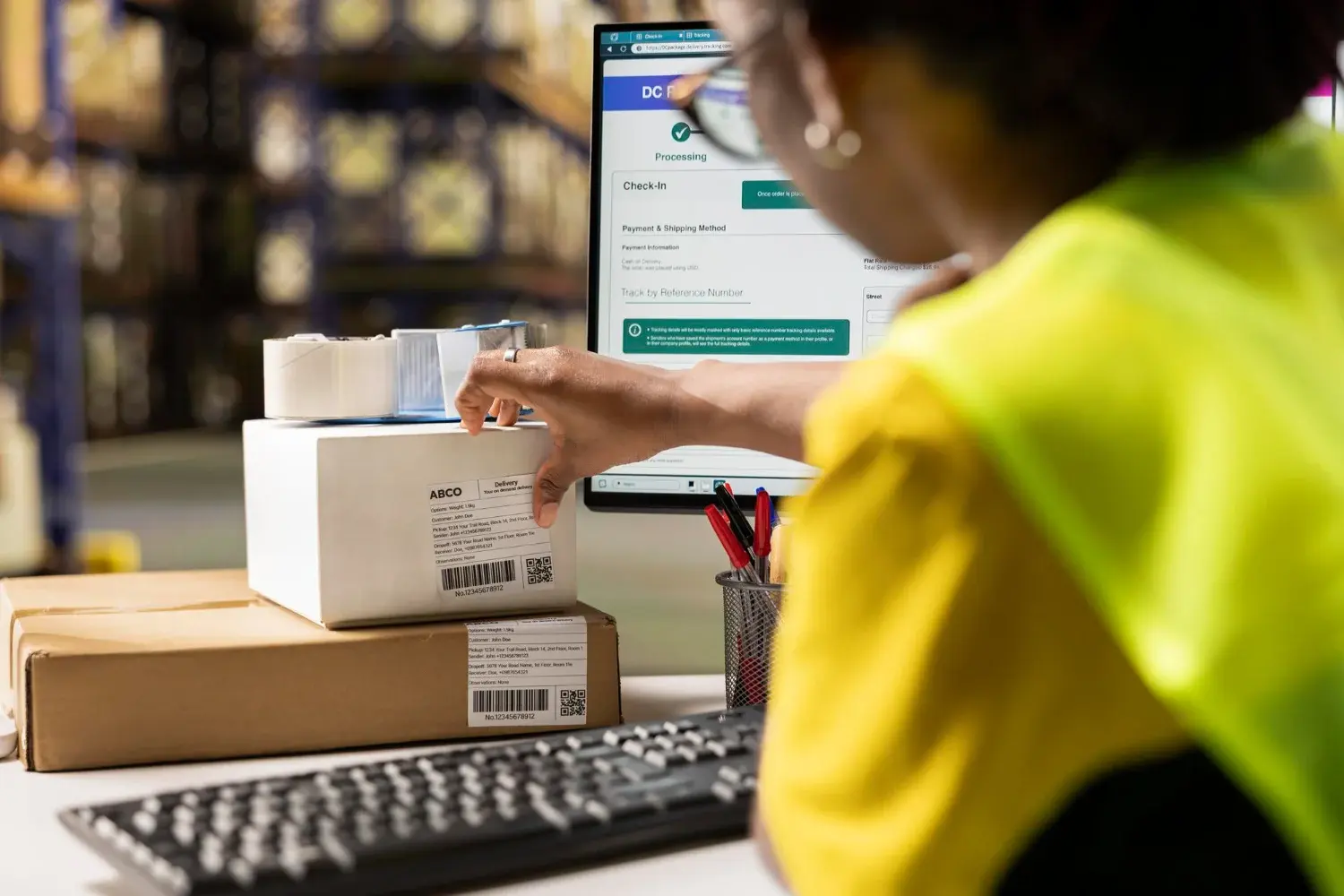
3. Place labels on the largest flat surface: Avoid placing labels on seams, edges, corners, or curved surfaces. Avoid covering them with tape (high-gloss tape can reflect scanner lasers, causing read failures). The largest flat face of the package is the right placement.
4. Generate labels close to ship date: Most carriers (USPS, FedEx, UPS) reject or flag labels older than 7-30 days from the printed ship date. For high-volume operations, generating labels too far in advance creates rework when ship dates slip. Understanding pre-shipment status and timing windows helps avoid this problem.
5. Treat each label as single-use: Tracking numbers are unique identifiers. Reusing a label by reprinting it for a different package creates routing conflicts and can trigger fraud-detection workflows. Always generate fresh labels for each shipment. This principle also applies to carrier allocation: the label generated must match the carrier actually handling the shipment.
How to Manage Prepaid Shipping Labels Across Multiple Carriers with ClickPost
For ecommerce merchants managing prepaid labels across multiple carriers, the operational challenge isn't generating a single label; it's managing them across carriers. It's the orchestration. You're choosing the right carrier for each order, generating labels in bulk through API, and validating addresses before printing. You're also connecting label generation to the broader post-purchase platform experience, including tracking, NDR workflows, and returns.
ClickPost is a post-purchase logistics intelligence platform integrated with 600+ carriers globally. For label-heavy operations, the structural value is unification: a single API for label generation across all your carriers, with carrier selection logic, address validation, and tracking number assignment running automatically.
Here's what this looks like operationally:
-
Bulk label generation through a single API: Generate thousands of labels across multiple carriers without juggling separate carrier portals.
-
Smart carrier allocation: Route each order to the optimal carrier based on cost, service tier, destination zone, and carrier performance. This is the operational definition of AI-driven carrier allocation.
-
Automated address validation: Catch address errors before labels are printed, rather than after packages are in transit.
-
Branded tracking integration: Tracking numbers flow back to your order management system and branded tracking page automatically.
-
Returns workflow: Generate prepaid return labels (or QR-based label-less returns) through the same platform that handles outbound, using reverse logistics software built for ecommerce scale.
If you want to dig deeper into how label automation would fit into your operation, the ClickPost team is the right place to ask. Talk to the team.
Prepaid Shipping Labels in 2026: Why Label Strategy Is Now a Competitive Advantage
Prepaid shipping labels look like simple stickers, but they sit at the intersection of three operational levers that increasingly define ecommerce competitiveness: shipping cost, customer experience, and fraud exposure. The merchants treating label strategy as a back-office detail are the ones absorbing higher carrier rates, slower return cycles, and more exception handling fees than necessary.
The 2026 shift is structural. Thermal printing has displaced inkjet for any operation above modest volumes. API-driven label generation has displaced manual workflows for roughly 1,000 shipments per month. QR-based label-less returns are displacing paper return labels in categories where customer experience matters at the product page. Each of these shifts compounds the cost gap between operations that have made the transition and operations that haven't.
For merchants still treating labels as a sticker problem, the cost of staying the same grows every quarter. The shipping strategy decisions made today will determine which operations are positioned to scale and which are absorbing preventable costs.
Frequently Asked Questions About Prepaid Shipping Labels
What is a prepaid shipping label and how does it work?
A prepaid shipping label is a shipping document where postage is paid at the time the label is generated rather than at the post office counter. It contains all routing data the carrier needs (sender, recipient, weight, service tier, tracking barcode, routing codes) to move the package from origin to destination. Prepaid labels are used for outbound merchant shipments, customer returns, and high-volume ecommerce operations where automated label generation is essential.
How is a prepaid shipping label different from a regular shipping label?
A regular shipping label is a generic term for any document that routes a package; a prepaid shipping label specifically has postage paid at the time of generation. The difference is operational: prepaid labels can move directly into the carrier's network without an additional payment step at the counter. Most ecommerce shipments use prepaid labels because they enable efficient outbound dispatch and label-less return workflows. You can learn more about how to create a shipping label for different carrier formats.
What is a label-less return and how do QR-code returns work?
A label-less return is a return process where the customer doesn't need to print a physical shipping label. The merchant sends a QR code to the customer's phone or email. The customer brings the package to a drop-off point (UPS Store, FedEx Office, USPS counter, or retail partner) and shows the QR code. The carrier scans it and prints the label at the counter. 72% of shoppers prefer this over traditional self-print returns. For merchants looking to build this into their operations, streamlining the returns process at the platform level is the right place to start.
Why do carriers prefer thermal labels over inkjet for shipping?
Carriers prefer thermal labels because they meet automated sorting scannability requirements more reliably than inkjet. Thermal printing produces high-contrast, smudge-proof, water-resistant output that automated scanners can read in fractions of a second. Inkjet ink can smudge or bleed when exposed to moisture, which reduces barcode scannability and triggers manual exception handling. For high-volume shipping operations, thermal is effectively the carrier-preferred standard.
Can a prepaid shipping label be reused for a different package?
No. Tracking numbers on prepaid labels are unique single-use identifiers. Reusing a label by reprinting it for a different package creates routing conflicts in carrier systems and can trigger fraud detection workflows. Each shipment requires a freshly generated label with its own unique tracking number. Reusing labels can result in package seizure or rejection at the carrier level.
How long does a prepaid shipping label remain valid before it expires?
Most carrier prepaid labels remain valid for 7-30 days from the printed ship date, depending on the carrier and service tier. USPS labels typically allow 7 days, FedEx and UPS allow 30 days for most service tiers. Carriers may reject or flag labels older than the validity window, requiring re-verification or fresh label generation. For ecommerce operations, generating labels close to the actual ship date avoids rework when dates slip.
How much can businesses save by buying shipping labels online versus at a retail counter?
Businesses buying labels through shipping carriers online or through carrier business accounts typically save 20-40% versus walk-in retail counter rates [VERIFY against current carrier rate cards]. The mechanism is Commercial Base Pricing: carriers offer lower rates for prepaid, address-validated, automation-ready labels because these reduce the carrier's processing costs. High-volume merchants can negotiate additional discounts on top of the base online rates.
What is the best printer for high-volume shipping label printing?
For operations generating 500+ shipments per month, thermal printers (such as Zebra, Rollo, or DYMO models) are the right choice. Thermal printing produces sharper, more scannable barcodes than inkjet or laser, costs less per label at scale (no ink or toner), and applies labels 4-5x faster than cut-and-tape sticker sheets. The upfront cost typically pays back within a few months through lower per-label costs and faster operational throughput. See the full breakdown of how to print shipping labels for small businesses for printer model comparisons.
How does Automated Package Verification (APV) affect prepaid label costs?
Automated Package Verification (APV) is a carrier system that re-weighs and re-measures packages at hub scanning. If the declared weight or dimensions on the prepaid label are inaccurate, the carrier automatically charges the difference to the merchant's account, often with a verification surcharge. There's no upside to underestimating: APV catches the discrepancy and bills accordingly. Accurate weight and dimension entry at label generation is the safest practice. This is one of the more overlooked drivers of avoidable shipping costs at scale.
What address validation should be used before generating prepaid shipping labels?
Address Validation Services (AVS) check destination addresses against carrier-approved databases (USPS CASS-certified, FedEx, and UPS proprietary databases) before the label is created. This catches errors at generation rather than after the package is in transit. Address-correction surcharges typically run $15-$30 per incident, and undeliverable shipments can cost the full forward freight in RTO charges. Pre-print validation is one of the highest-ROI label workflow practices available to any ecommerce operation.




We use cookies to keep the site working, understand usage, and improve your experience. Learn more
Always active for essential site performance and security.
Enables anonymous usage analysis to refine our services.
Used to present relevant promotions and advertising.