.png?width=193&height=27&name=ClickPost%20Logo%20(Blue).png)
.svg)
.svg)
.svg)
.svg)
.webp?width=286&height=206&name=ROI%20Calculator%20(2).webp)
.svg)
.svg)
.svg)
.svg)
.svg)
.svg)
.svg)
.svg)
.svg)
.webp?width=286&height=206&name=Frame%201171276203%20(11).webp)
.svg)
.svg)
.svg)
.svg)
.webp?width=286&height=206&name=ROI%20Calculator%20(3).webp)
.svg)

.svg)
.svg)

.svg)
.webp?width=286&height=206&name=ROI%20Calculator%20(4).webp)
What is 3PL? Understanding Third-Party Logistics and Choosing the Right Partner


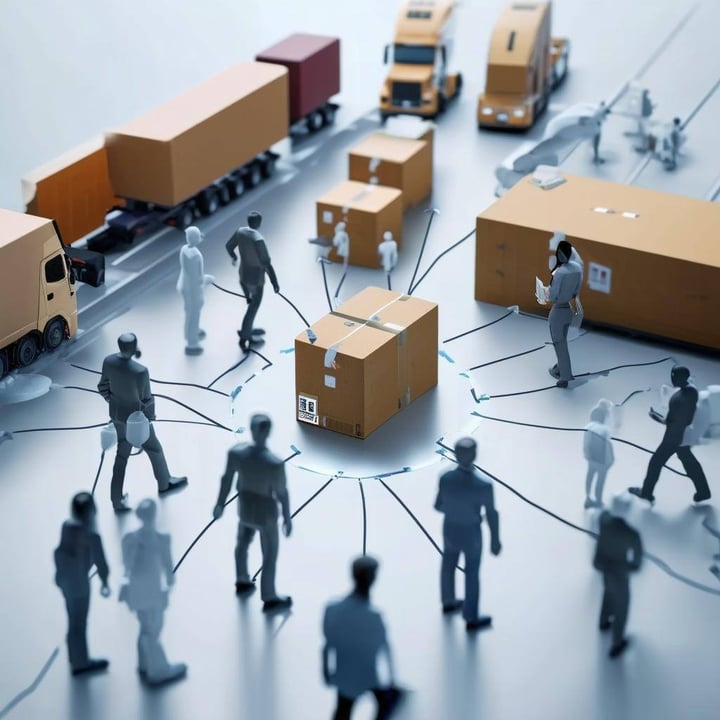
Ready to delight customers after checkout?
Trusted by 600+ brands
In this blog
TL;DR Summary
-
A third-party logistics (3PL) provider runs warehousing, fulfillment, transportation, and returns on behalf of a brand — so the brand doesn't have to own the trucks, warehouses, or labor.
-
3PLs fall into four working categories: warehouse-based, transportation-based, financial/IT-based, and full-service — each solves a different problem.
-
The right 3PL is decided by network density, technology depth, pricing transparency, and SLA discipline — not by who's largest.
-
A 3PL handles the physical movement of goods. A logistics intelligence platform like ClickPost — connecting 600+ carriers worldwide and processing millions of monthly shipments — sits on top, unifying tracking, NDR, returns, and customer communication across every 3PL and carrier you use.
What Is Third-Party Logistics (3PL)?
Third-party logistics (3PL) is the practice of outsourcing one or more parts of your supply chain — warehousing, order fulfillment, freight, last-mile delivery, returns — to an external specialist instead of running them in-house.
The brand keeps ownership of the inventory, the customer relationship, and the P&L. The 3PL keeps ownership of the operations: receiving stock, storing it, picking and packing orders, handing them to a carrier, and processing what comes back.
This split is what makes the model work. A growing D2C brand doesn't need to sign a 10-year warehouse lease in Mumbai to sell in Mumbai. A US retailer expanding into Texas doesn't need to hire a fleet to reach Houston by tomorrow — a local fulfillment partner in Texas already has the warehouse, the workforce, the carrier contracts, and the WMS. The brand pays a per-transaction or per-pallet fee and gets capacity that scales the moment its order volume does.
The global 3PL market generated $1.59 trillion in gross logistics revenue in 2024 according to Armstrong & Associates, and it's the operational backbone of nearly every ecommerce, retail, and B2B distribution business at scale.
What Does a 3PL Actually Do?
The day-to-day work of a 3PL breaks down into six functions. Most providers do all of them; some specialize in just one or two.
-
Receiving and inventory management. Inbound stock arrives at the warehouse, gets inspected, scanned into the WMS, and put away in a slot chosen for SKU velocity. From this point, the 3PL is accountable for stock accuracy — and any operations team worth its salt holds that number above 99% as a baseline contract expectation.
-
Order fulfillment. When an order drops in from the brand's storefront (Shopify, Magento, Amazon, an OMS), the 3PL picks the SKUs, packs them, generates the shipping label, and stages the parcel for carrier pickup. High-volume operations use batch picking, wave picking, or pick-to-light systems to keep cost-per-order down. For a deeper look at how this works end-to-end, see our breakdown of ecommerce fulfillment and the order fulfillment services landscape.
-
Transportation and carrier management. The 3PL either runs its own fleet or — more commonly in modern setups — allocates orders across a panel of carriers (FedEx, UPS, USPS, Bluedart, Delhivery, regional players) based on cost, zone, weight, and SLA. Allocation is increasingly rules-based or AI-driven; we've written about how AI and ML are reshaping carrier allocation if you want the technical view.
-
Last-mile delivery. The final leg from the local hub to the customer's door. This is where the bulk of shipping cost concentrates — Capgemini Research Institute's industry study pegs last-mile at 41% of total supply chain cost, and other estimates run higher. It's also where most customer-experience failures happen. See our analysis of what's driving last-mile delivery costs and how last-mile delivery software can help operations teams get ahead of them.
-
Returns and reverse logistics. Pickups from the customer, doorstep QC, restock if resaleable, dispose or refurbish if not. Refund triggered back to the brand's OMS.
-
Value-added services. Kitting, bundling, custom packaging, gift-wrap, FNSKU labeling for Amazon, light assembly, B2B compliance labeling, temperature-controlled storage.
The Four Types of 3PLs (and When Each One Fits)
Every 3PL is a variation on one of four operating models. Knowing which model a provider runs on tells you what they'll be good at — and where they'll quietly hand the work to someone else.
1. Warehouse-based 3PLs
Storage, inventory, and fulfillment specialists. They own or lease the warehouse and run the picking floor. They're typically weakest on transportation, which they outsource to carrier panels. The closest US-market reference points are specialist 3PL fulfillment companies that focus on ecommerce pick-pack-ship rather than freight. Brands evaluating options in major metros can also explore fulfillment companies by location to find warehouse-based providers close to their demand zones.
Fits when: you need fulfillment closer to demand and your existing carrier relationships are fine.
2. Transportation-based 3PLs
Asset carriers (own trucks, employ drivers) or non-asset freight brokers who match shippers with carrier capacity. In the US, this is what most shippers mean when they say "3PL" — C.H. Robinson, J.B. Hunt, RXO, Echo Global Logistics. In India, the equivalents include Delhivery's PTL arm, Blue Dart, and DTDC. For a directory of asset and non-asset options operating in the US, see our roundup of logistics companies in the USA.
Fits when: freight movement is the bottleneck and you already have warehousing handled.
3. Financial & information-based 3PLs
The least visible but often the highest-leverage category. These providers don't touch the cargo — they audit freight invoices, manage carrier payments, optimize routing through TMS software, and run the analytics layer across a shipper's entire logistics cost base. Think of them as the CFO function for a supply chain. Their value is closely related to what a well-built retail supply chain strategy looks like when cost visibility is the primary goal.
Fits when: you have multiple 3PLs already and visibility, billing accuracy, and spend control have become the real problem.
4. Full-service 3PLs
End-to-end providers that bundle warehousing, fulfillment, transportation, last-mile, returns, and tech under one contract. Amazon Logistics, GXO, DHL Supply Chain, UPS Supply Chain Solutions, Shadowfax, Ecom Express. The pitch is simplicity — one vendor, one SLA, one invoice.
Fits when: the brand wants to outsource the entire physical supply chain and focus internal headcount on product, marketing, and merchandising. For D2C brands scaling fast, this is usually the default starting point.
3PL vs 4PL vs Freight Broker vs Dropshipping
These four terms get used interchangeably and shouldn't be. Quick disambiguation:
-
3PL — executes logistics on your behalf. You own inventory; they move it.
-
4PL — manages your 3PLs on your behalf. They don't own warehouses or trucks; they own strategy, vendor management, and analytics across multiple 3PLs. Used by enterprises with complex multi-region supply chains.
-
Freight broker — a subset of 3PL focused only on matching loads to truck capacity. All freight brokers are 3PLs; not all 3PLs are freight brokers. You can find active brokers and asset carriers listed in our guide to trucking companies in the USA.
-
Dropshipper — not a 3PL. A dropshipper sources, owns, and ships the product directly to your customer. You never touch inventory.
Top 50 U.S. 3PLs by 2025 Revenue
For benchmarking purposes, here's the Armstrong & Associates 2026 ranking of the largest U.S.-based 3PLs by gross logistics revenue. Useful when shortlisting providers for enterprise contracts, evaluating financial stability, or benchmarking pricing against scale. For a broader look at the operator landscape including non-US providers, see our roundup of leading 3PL logistics companies and our guide to top 3PL logistics companies serving US markets.
| Rank | 3PL Provider | Revenue (US$ Mn) | HQ | Founded | 3PL Type | Core Services | Key Strength |
| 1 | Amazon.com | 172,162 | Seattle, WA | 1994 | Full-service | Fulfillment (FBA), last-mile, freight, air cargo | Largest fulfillment network globally; Prime ecosystem |
| 2 | C.H. Robinson | 14,768 | Eden Prairie, MN | 1905 | Non-asset / Freight broker | Truckload, LTL, intermodal, global forwarding | Largest non-asset 3PL in North America |
| 3 | GXO Logistics | 13,178 | Greenwich, CT | 2021 | Warehouse-based / Contract logistics | Warehousing, ecommerce fulfillment, reverse logistics | Pure-play contract logistics leader; heavy automation |
| 4 | J.B. Hunt Transport Services | 11,284 | Lowell, AR | 1961 | Asset-based / Intermodal | Intermodal, dedicated, ICS brokerage, final mile | Largest intermodal provider in North America |
| 5 | Expeditors | 11,069 | Seattle, WA | 1979 | Non-asset / Forwarder | Air freight, ocean freight, customs brokerage | Global forwarding specialist; strong tech stack |
| 6 | UPS Supply Chain Solutions | 8,771 | Atlanta, GA | 1907 | Full-service | Forwarding, contract logistics, healthcare logistics | Healthcare and high-value goods specialization |
| 7 | Kuehne + Nagel (North America) | 8,447 | Schindellegi, Switzerland | 1890 | Non-asset / Forwarder | Sea, air, road, contract logistics | Largest sea freight forwarder globally |
| 8 | Ryder Supply Chain Solutions | 7,802 | Miami, FL | 1933 | Asset-based / Contract | Dedicated transport, warehousing, e-fulfillment | Dedicated fleet operations and last-mile |
| 9 | Total Quality Logistics | 7,433 | Cincinnati, OH | 1997 | Non-asset / Freight broker | Truckload, LTL, refrigerated | Second-largest truckload broker in US |
| 10 | DSV (North America) | 7,250 | Hedehusene, Denmark | 1976 | Full-service | Air & sea, road, contract logistics | Aggressive M&A growth (Panalpina, Agility GIL) |
| 11 | RXO | 5,742 | Charlotte, NC | 2,022.00 | Non-asset / Freight broker | Truckload brokerage, managed transport, last-mile | Digital-first brokerage tech platform |
| 12 | DHL Supply Chain (North America) | 5,425 | Westerville, OH | 1,969.00 | Full-service | Contract logistics, ecommerce, lead logistics | Global LLP and 4PL capabilities |
| 13 | Lineage | 5,355 | Novi, MI | 2008 | Warehouse-based / Cold chain | Cold storage, temperature-controlled logistics | Largest cold-chain 3PL globally |
| 14 | WWEX Group | 5,181 | Dallas, TX | 1995 | Non-asset / Parcel & freight | Parcel, LTL, truckload | SMB-focused multi-modal shipping |
| 15 | Beon | 5,111 | Tampa, FL | 2023 | Non-asset / Freight broker | Truckload, LTL, managed transport | Spin-out of GXP brokerage assets |
| 16 | Uber Freight | 5,099 | San Francisco, CA | 2017 | Non-asset / Digital broker | Truckload, managed transport, TMS | App-based digital freight matching |
| 17 | Penske Logistics | 4,210 | Reading, PA | 1969 | Asset-based / Contract | Dedicated transport, DCM, lead logistics | Strong dedicated contract carriage book |
| 18 | Schneider | 4,146 | Green Bay, WI | 1935 | Asset-based / Multi-modal | Truckload, intermodal, logistics services | One of largest US truckload carriers |
| 19 | Echo Global Logistics | 4,000 | Chicago, IL | 2005 | Non-asset / Freight broker | Truckload, LTL, partial truckload | Tech-enabled brokerage; broad LTL panel |
| 20 | Hub Group | 3,946 | Oak Brook, IL | 1971 | Asset-light / Intermodal | Intermodal, dedicated, brokerage, final mile | Top-3 US intermodal marketing company |
| 21 | NFI | 3,750 | Camden, NJ | 1932 | Asset-based / Full-service | Dedicated transport, warehousing, brokerage, drayage | Strong port-adjacent drayage and warehousing |
| 22 | AIT Worldwide Logistics | 3,560 | Itasca, IL | 1979 | Non-asset / Forwarder | Air & ocean freight, customs, life sciences logistics | Life sciences and perishables specialization |
| 23 | CEVA Logistics (North America) | 3,305 | Marseille, France | 2007 | Full-service | Contract logistics, freight management, automotive | Automotive and industrial vertical strength |
| 24 | GEODIS (North America) | 3,100 | Levallois-Perret, France | 2008 | Full-service | Contract logistics, freight forwarding, road transport | Global ecommerce fulfillment network |
| 25 | Landstar | 2,860 | Jacksonville, FL | 1968 | Non-asset / Owner-op model | Truckload, heavy haul, expedited | Largest BCO/owner-operator network in US |
| 26 | Arrive Logistics | 2,691 | Austin, TX | 2014 | Non-asset / Freight broker | Truckload, LTL, drayage | Tech-driven growth brokerage |
| 27 | Americold | 2,602 | Atlanta, GA | 1903 | Warehouse-based / Cold chain | Temperature-controlled warehousing, transportation | Public cold-storage REIT; food supply chain leader |
| 28 | Maersk Logistics (North America) | 2,460 | Copenhagen, Denmark | 1904 | Full-service | Ocean, air, intermodal, contract logistics, customs | End-to-end integrator strategy |
| 29 | Flexport | 2,160 | San Francisco, CA | 2013 | Non-asset / Digital forwarder | Ocean, air, customs, trucking | Software-first digital freight forwarder |
| 30 | Werner Logistics | 2,149 | Omaha, NE | 1956 | Asset-light / Brokerage | Truckload brokerage, intermodal, final mile | Logistics arm of Werner Enterprises |
| 31 | Knight-Swift Transportation | 2,135 | Phoenix, AZ | 2017 | Asset-based / Multi-modal | Truckload, LTL, logistics, intermodal | Largest truckload carrier in US |
| 32 | MODE Global | 2,100 | Dallas, TX | 1989 | Non-asset / Agent-based | Truckload, intermodal, LTL, managed transport | Agent-based brokerage network model |
| 33 | Forward Air | 2,000 | Greeneville, TN | 1981 | Asset-light / Expedited | Expedited LTL, intermodal, final mile, forwarding | Airport-to-airport expedited LTL |
| 33 | PSA BDP | 2,000 | Singapore | 1966 | Non-asset / Forwarder | Forwarding, chemicals, energy, customs | Chemicals and energy supply chain niche |
| 34 | KLN (Americas) | 1,940 | Hong Kong | 1981 | Full-service | Forwarding, contract logistics, ecommerce | Asia-Pacific connectivity strength |
| 35 | TFI International (North America) | 1,932 | Saint-Laurent, Canada | 1957 | Asset-based / Multi-modal | LTL, truckload, package & courier, logistics | Canada's largest trucking conglomerate |
| 36 | Capstone Logistics | 1,920 | Peachtree Corners, GA | 2010 | Asset-light / Specialty | Warehouse services, freight management, last-mile | Distribution-center labor and freight services |
| 37 | Scotlynn | 1,811 | Ontario, Canada | 1990 | Asset-based / Refrigerated | Refrigerated truckload, produce logistics | Produce and refrigerated freight specialist |
| 38 | Kenco | 1,698 | Chattanooga, TN | 1950 | Warehouse-based / Contract | Distribution, transportation, material handling | Largest woman-owned 3PL in US |
| 39 | FedEx Logistics | 1,645 | Memphis, TN | 1971 | Full-service | Forwarding, customs, supply chain solutions | Leverages FedEx global air network |
| 40 | Priority1 | 1,560 | Little Rock, AR | 1995 | Non-asset / Freight broker | LTL, truckload, intermodal, parcel | Tech-enabled LTL-heavy brokerage |
| 41 | SEKO Logistics | 1,458 | Itasca, IL | 1976 | Non-asset / Forwarder | Ecommerce, forwarding, white glove, last-mile | Ecommerce cross-border specialist |
| 42 | Ruan Transportation Management Systems | 1,450 | Des Moines, IA | 1932 | Asset-based / Dedicated | Dedicated transport, managed transport, warehousing | Dedicated contract carriage focus |
| 43 | ArcBest | 1,410 | Fort Smith, AR | 1923 | Asset-light / Multi-modal | LTL, truckload, expedited, household goods | Parent of ABF Freight (LTL) |
| 43 | ITS Logistics | 1,410 | Sparks, NV | 1999 | Asset-light / Multi-modal | Distribution, fulfillment, drayage, intermodal | Port drayage and ecommerce distribution |
| 44 | Universal Logistics | 1,376 | Warren, MI | 1932 | Asset-based / Contract | Truckload, intermodal, contract logistics, value-added | Automotive and heavy manufacturing focus |
| 45 | Armstrong Transport Group | 1,350 | Charlotte, NC | 2007 | Non-asset / Agent-based | Truckload, LTL, specialized freight | Agent-based brokerage model |
| 46 | Allen Lund | 1,348 | La Cañada Flintridge, CA | 1976 | Non-asset / Freight broker | Refrigerated, dry, produce, intermodal | Produce and refrigerated freight expertise |
| 47 | Redwood Logistics | 1,282 | Chicago, IL | 2001 | Non-asset / Multi-modal | Truckload, LTL, intermodal, managed transport | Platform-based 4PL/Logistics-as-a-Service |
| 48 | Ryan Transportation Service | 1,260 | Overland Park, KS | 1989 | Non-asset / Freight broker | Truckload, LTL, intermodal | Truckload-focused brokerage with strong Midwest/Plains coverage |
Source: Armstrong & Associates, Top 50 U.S. 3PLs ranked by 2025 gross logistics revenue. Headquarters, founding year, and service mix compiled from company filings and public sources.
When a 3PL Is Worth It (and When It Isn't)
Outsourcing logistics isn't free, and the rule of thumb most providers won't tell you is this: a 3PL pays off when your fulfillment volume is high enough that the per-order margin advantage covers the loss of control. Below that threshold, in-house is cheaper and faster. We've laid out the full trade-off in our piece on 3PL advantages and disadvantages, and the US-market version in our guide to third-party logistics for US ecommerce.
The signal you've crossed it:
-
You're processing more than 250–500 orders a month and the warehouse work is starting to consume founder/operator hours.
-
You're shipping into geographies where you don't have a hub — and zone-skipping or regional fulfillment would cut delivery time by 24+ hours.
-
You're hitting a seasonal peak (Q4, festive, BFCM) and would otherwise need to hire and fire temp labor twice a year. See our tips on handling BFCM peak shopping performance for how leading brands prepare their 3PL stack in advance.
-
You're expanding into a new country and don't want to set up a legal entity, warehouse, and carrier panel from zero. Our guide to international logistics covers what gets complicated here, and our overview of international shipping companies can help you find providers with the right cross-border infrastructure.
-
Returns volume is high enough that reverse logistics is its own line item you can't manage manually.
When in-house still wins:
-
Very low volumes — under a few hundred orders a month. 3PL minimums will eat the unit economics.
-
Highly customized, fragile, or regulated products where pick accuracy and packaging need direct oversight.
-
Brands where unboxing is part of the product (luxury, gifting, subscription boxes) and the 3PL can't match the experience.
How to Choose a 3PL: The Six Things That Actually Matter
Most "how to choose a 3PL" checklists are 20 items long and treat each one as equal. They're not. Here are the six that decide whether the partnership works.
1. Network density in your demand zones.
A 3PL with 40 warehouses across the country is worthless if none of them are within 200 km of your top three cities. Pull your last 90 days of orders by pincode/ZIP and overlay the 3PL's hub map. The match matters more than the headcount of facilities. For brands concentrated in major metros, it's worth checking location-specific options — for instance, fulfillment companies in Chicago, fulfillment companies in Los Angeles, or fulfillment companies in New York to understand what's available in your highest-volume zones.
2. Technology and integrations.
The 3PL's WMS must integrate with your storefront, OMS, and ERP via documented APIs — not flat-file uploads at midnight. Ask for the API docs upfront. If they can't share them in a week, that tells you what their tech team looks like. See our breakdown of what to look for in 3PL software for a deeper checklist.
3. SLA discipline and how it's measured.
Every 3PL will quote you 99% on-time pickup. Fewer will tell you how they measure it, who arbitrates a dispute, and what the credit is when they miss. Get the SLA definitions and the remediation clauses in writing before you sign. A platform that offers automated shipment tracking across your carrier panel makes it significantly easier to hold 3PLs accountable against those SLA commitments.
4. Pricing transparency.
Per-order fees, storage by cubic foot or pallet, receiving fees, kitting, returns processing, peak surcharges, fuel adjustments, long-term storage penalties. Build a fully-loaded cost model based on your real order mix before comparing quotes. The cheapest sticker price is rarely the cheapest provider.
5. Carrier panel and last-mile options.
A full-service 3PL should give you a panel of carriers and an allocation logic — not lock you into one carrier they happen to own. If they push a single carrier hard, ask why. Multi-carrier setups consistently outperform single-carrier ones on both cost and SLA — that's worth knowing before you sign. You can also compare specific carriers head-to-head using resources like our FedEx vs UPS breakdown to understand where each performs best before locking in an allocation strategy.
6. Reverse logistics maturity.
Returns reveal more about an operation than outbound does. Ask how doorstep QC works, how fast refunds get triggered, what restock accuracy looks like, and how disposal of damaged goods is handled. A 3PL that's vague on this is a 3PL that hasn't built it properly. Our guide to how the ecommerce returns process works gives a useful framework for what a mature operation should look like end-to-end.
What a 3PL Won't Solve for You
This is the part most guides skip, and it's the part that matters most for any brand running multiple 3PLs or scaling across regions.
A 3PL moves the box. It doesn't unify the customer-facing experience around the box.
When you work with three 3PLs — say one for India domestic, one for US fulfillment, one for international — your customer doesn't see "your India 3PL" or "your US 3PL." They see your brand. And right now, your brand is sending three different tracking page experiences, three different NDR flows, three different return portals, and three different sets of WISMO ("Where is my order?") emails. The difference between a branded tracking experience and a carrier tracking page is something customers feel every time they click through.
That fragmentation is where logistics intelligence platforms come in. ClickPost connects 600+ carriers worldwide and processes millions of monthly shipments, sitting on top of your 3PLs and carriers to normalize their data into one tracking layer, one NDR workflow, one returns experience, and one set of branded customer communications — regardless of which 3PL physically handles the shipment. AI-powered automation reduces failed deliveries, converts returns to exchanges, and eliminates customer anxiety between "order placed" and "delivered." You can see a detailed look at how these platforms are evaluated in our guide to post-purchase platforms.
The way to think about it: the 3PL is the muscle. The logistics intelligence platform is the nervous system. You need both, and they solve different problems.
Get the Layer That Sits on Top of Every 3PL You Use
ClickPost is the logistics intelligence platform behind some of the world's fastest-scaling D2C, retail, and quick commerce brands. Whether you're running one 3PL or five, ClickPost unifies them into a single operational and customer-facing layer:
-
600+ carrier integrations — live in days, not quarters, across India, US, EU, MENA, and APAC.
-
AI-powered NDR automation — recover failed deliveries before they become returns. Brands using ClickPost typically see RTO drop 20–30%.
-
Returns to exchanges — convert refund requests into exchanges with a guided customer flow that protects revenue.
-
Branded tracking pages and proactive WISMO — cut "Where is my order?" tickets by up to 60% and turn the tracking page into a revenue surface.
-
One dashboard across every 3PL and carrier — real-time visibility, SLA monitoring, and carrier performance scorecards in one place.
Frequently Asked Questions
What's the difference between a 3PL and a 4PL?
A 3PL executes logistics — warehousing, fulfillment, transport, returns. A 4PL manages your 3PLs and acts as a strategic supply chain layer above them. Most growing brands need a 3PL. Enterprises with complex multi-region operations sometimes layer a 4PL on top.
Is a freight broker the same as a 3PL?
A freight broker is a specific type of 3PL focused only on matching shippers to truck capacity. All freight brokers are 3PLs; not all 3PLs are freight brokers. Full-service 3PLs go well beyond freight to include warehousing, fulfillment, and reverse logistics.
How much does a 3PL cost?
3PL pricing is built from several line items: receiving fees (per pallet or per unit), storage (per cubic foot or per pallet per month), pick-and-pack fees (per order plus per additional unit), packaging materials, shipping (passed through at the 3PL's negotiated rate or marked up), returns processing, and sometimes setup fees. For ecommerce, all-in cost typically lands between $4–$10 per order at moderate volumes, lower at scale.
When should I switch from in-house fulfillment to a 3PL?
The practical trigger points are: order volume above ~250–500/month, expansion into geographies where you don't have a hub, seasonal peaks that require temp labor, or returns volume that's started consuming operator time. Below those thresholds, in-house is usually cheaper and gives you more control over the customer experience.
Can I use multiple 3PLs at once?
Yes — and most brands at scale do. One for domestic fulfillment, one for international, sometimes a specialist for cold chain or oversized freight. The operational challenge with multi-3PL setups is unifying inventory visibility, tracking, and customer communication across them, which is what a logistics intelligence platform is built to solve. For more on how brands measure the ROI of adding this layer, see our guide to post-purchase metrics.



We use cookies to keep the site working, understand usage, and improve your experience. Learn more
Always active for essential site performance and security.
Enables anonymous usage analysis to refine our services.
Used to present relevant promotions and advertising.