.png?width=193&height=27&name=ClickPost%20Logo%20(Blue).png)
.svg)
.svg)
.svg)
.svg)
.svg)
.svg)
.svg)
.svg)
.svg)


.svg)
.svg)
.svg)
.svg)
.svg)


.svg)
.svg)
.webp?width=286&height=206&name=ROI%20Calculator%20(1).webp)
.svg)
.svg)

.svg)

.webp?width=286&height=206&name=RTO%20Playbook%20(1).webp)
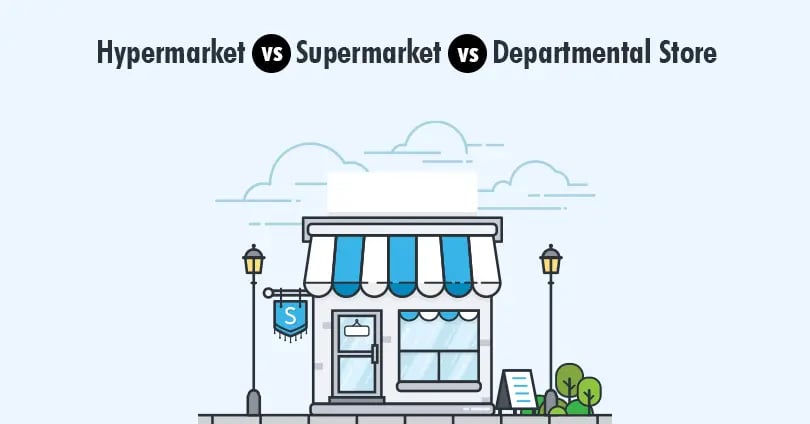
Hypermarket Vs. Supermarket Vs. Departmental Store: Key Differences

Ready to ship smarter? Talk to our logistics experts.
Trusted by 600+ brands
In this blog
TL;DR Summary
Hypermarkets, supermarkets, and departmental stores are three distinct retail formats differing fundamentally in size, product mix, pricing model, and shopping purpose.
-
Hypermarkets span 100,000 to 300,000 sq ft, stocking 120,000+ SKUs combining groceries, electronics, clothing, and furniture under one roof.
-
Supermarkets dedicate 85–90% of assortment to food and household essentials, ranging from 10,000 to 45,000 sq ft, because their model prioritizes convenience over breadth.
-
Departmental stores generate 95%+ of revenue from non-food categories like fashion, beauty, and wellness, leading to premium or aspirational pricing structures.
-
European hypermarket grocery sales share dropped from 12% in 2019 to 10% in 2024, with projections pointing to 9% by 2029, per Savills data.
-
McKinsey projects private labels will gain 1–3 percentage points in European grocery value share by 2030, reshaping supermarket shelf strategy.
What Are the Main Differences Between Hypermarkets, Supermarkets, and Departmental Stores?
Whether you're doing a quick grocery run, stocking up for the month, or shopping for fashion and home goods, the type of store you choose shapes your entire experience.
Hypermarkets, supermarkets, and departmental stores are three distinct retail formats, each built around a different size, product mix, pricing model, and shopping purpose. Understanding the key differences helps you shop smarter and, for retail businesses, make more informed decisions about store formats and fulfillment strategies.
Hypermarket vs Supermarket vs Departmental Store: Quick Comparison (2026)
| Factor | Hypermarket | Supermarket | Departmental Store |
| Typical Size | 100,000 to 300,000 sq ft | 10,000 to 45,000 sq ft | 20,000 to 200,000 sq ft |
| Product Focus | Groceries + general merchandise (electronics, clothing, furniture) | ~85% groceries and household essentials | Fashion, beauty, home goods, wellness |
| Pricing Model | Lowest unit price, bulk-led | Promotional and loyalty-led | Premium or aspirational pricing, seasonal sales |
| Tech Integration | Smart carts, self-checkout kiosks | Scan-as-you-shop, click-and-collect | AR mirrors, personal stylists, click-and-fit lounges |
| Store Layout | Warehouse-style, self-service aisles | Organized aisles by product category | Department-based floors or sections |
| Customer Service | Minimal staff assistance, self-service | Limited assistance, self-service | Dedicated sales staff per department |
| Location | Suburban "power centers," edge-of-city | Urban and suburban neighborhoods | Malls, luxury high streets, central shopping districts |
| Target Shopper | Families, bulk buyers, one-stop shoppers | Daily/weekly grocery and health-conscious shoppers | Fashion, lifestyle, beauty, and wellness shoppers |
| Food vs Non-food | 30% food, 70% general merchandise | 90% food and household, 10% non-food | < 5% food (gourmet hall only), 95%+ non-food |
| Ownership Model | Large retail chains (Walmart, Carrefour) | Chain-operated or independent | Chain or PE-backed (Macy's, Nordstrom, Saks) |
| Best Suited For | Bulk buying and one-stop family shopping | Routine grocery runs and daily essentials | Curated category shopping (fashion, beauty, wellness) |
This table covers the core structural differences. The rest of this article breaks down each format in detail and helps you understand which one fits different shopping needs.
What Is a Departmental Store? Definition, History, and Examples
A departmental store is a large-format retail establishment that sells products across multiple categories, each organized into its own department. Typical departments include clothing, footwear, cosmetics, accessories, home furnishings, luggage, and sometimes limited food or lifestyle items.
The concept originated in the 19th century following the Industrial Revolution. Harding, Howell & Co. is widely credited as the first departmental store, opening in London in 1796. In the United States, department stores like Macy's (founded 1858) and Nordstrom (founded 1901) became defining retail institutions through the 20th century.
Departmental stores are typically located in malls, central shopping districts, or luxury high-street locations. Their layout is department-based rather than aisle-based, with dedicated sales staff in each section to assist customers.
In 2026, leading department stores like Nordstrom, Macy's, and Selfridges have pivoted heavily toward "beauty-as-a-service" and wellness clinics to drive foot traffic, offering spa services, luxury dining, and click-and-fit lounges that hypermarkets and supermarkets cannot replicate.
Private equity now owns a significant portion of department store real estate (notably the Saks/Neiman Marcus consolidation), leading to a trend toward smaller, boutique-style neighborhood department stores alongside flagship locations.
The key distinction is that departmental stores are not primarily grocery-led. Their assortment is curated around lifestyle, fashion, beauty, and wellness categories, which differentiates them from both supermarkets and hypermarkets. Understanding how these stores manage inventory management across multiple departments is a major operational differentiator compared to the other two formats.
What Is a Supermarket? How It Works and Who It Serves
A supermarket is a self-service retail store primarily built for groceries, packaged food, beverages, and household necessities. Supermarkets typically range from 10,000 to 45,000 square feet and organize products into clearly marked aisles by category.
The supermarket format became dominant in the mid-20th century as a more efficient alternative to small grocery shops. Customers browse aisles, select items, and check out at a billing counter. Many modern chains also offer online ordering with click-and-collect or home delivery, with some operating as micro-fulfillment centers (MFCs) — a key part of modern ecommerce supply chain management.
Supermarkets are the most common retail format in dense urban areas because they fit convenience-led shopping habits and smaller store footprints.
In 2026, supermarkets have pivoted heavily toward organic, locally sourced fresh produce, and health-focused products to differentiate from hypermarkets and compete for health-conscious shoppers.
According to McKinsey's State of Grocery Europe report, private labels are projected to gain 1 to 3 percentage points in sales value share across European grocery by 2030, and 77% of Gen Z shoppers now purchase food-to-go monthly compared to 33% of baby boomers, reshaping how supermarkets allocate shelf space and design prepared food sections.
Capgemini's consumer research highlights that shoppers increasingly prioritize quality over price: 74% rank it as the most important factor when buying fresh produce, with dry groceries and personal care close behind at 73% each. This is pushing supermarkets to compete on quality perception rather than price alone.
Operating hours tend to be longer than traditional departmental stores, though shorter than many hypermarkets. The product mix is heavily skewed toward food and household items (roughly 85–90%), with limited non-food offerings. Efficient retail supply chain operations are critical to keeping shelves stocked and minimizing waste in this format.
Examples of supermarket chains: Kroger, Albertsons, Publix (US); Tesco, Sainsbury's (UK); Big Bazaar, D-Mart (India).
What Is a Hypermarket? Size, Product Range, and How It Differs From Other Formats
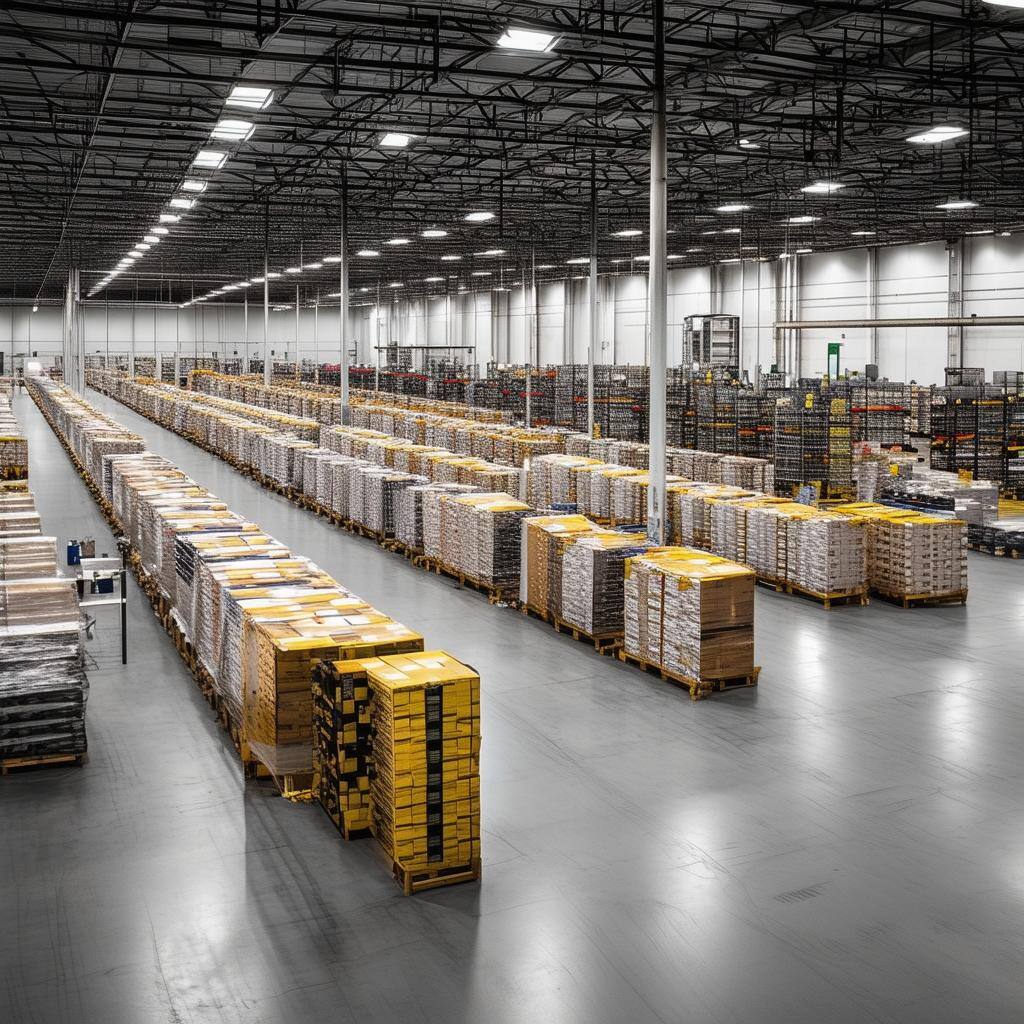
A hypermarket is the largest retail store format, combining the grocery focus of a supermarket with the broad merchandise assortment of a departmental store under one roof. Hypermarkets typically span 100,000 to 300,000 square feet and stock everything from groceries and household goods to electronics, clothing, furniture, and sometimes include food courts, pharmacies, or optical centers.
The hypermarket concept was pioneered by Carrefour in France in 1963 and later adopted globally by Walmart (Supercenter format), Tesco Extra, and E.Leclerc. The core proposition is one-stop shopping: customers complete their entire weekly or monthly shopping in a single trip.
According to Mordor Intelligence, food and grocery accounted for 56.98% of the hypermarket market share by product category in 2025, confirming that groceries remain the anchor category. However, consumer electronics within hypermarkets is projected to grow at a 6.18% CAGR through 2031, reflecting how hypermarkets are increasingly competing with departmental stores and specialty retailers in non-food categories.
In Europe, the hypermarket format has lost considerable ground: data from Savills show their share of European grocery sales dropped from 12% in 2019 to 10% in 2024, with projections pointing to a further slide to 9% by 2029. In emerging markets like India, Southeast Asia, and parts of Latin America, hypermarkets still represent a growing format.
Hypermarkets are typically located in suburban or edge-of-city areas where large floor space is available at lower real estate costs. The trade-off is that customers often need to travel longer distances to reach them, which favors car-owning families over urban convenience shoppers. Given the sheer volume of goods moved through these stores, last-mile delivery solutions and robust supply chain operations are increasingly critical to their omnichannel strategy.
Examples of hypermarket chains: Walmart Supercenter, Carrefour, Tesco Extra (global); Big Bazaar, Spencer's (India).
Key Differences Between Hypermarkets, Supermarkets, and Departmental Stores: Size, Pricing, and Layout
While the comparison table above summarizes the differences at a glance, the following breakdown covers the most important factors across these three major types of retail stores in detail.
How Do Hypermarkets, Supermarkets, and Departmental Stores Compare in Size and Floor Space?
Hypermarkets are the largest format, often 5x to 10x the size of a standard supermarket. Departmental stores vary widely but generally fall between the two. This size difference directly affects product range, store layout, and the customer experience.
Large hypermarkets like Walmart Supercenters now manage 120,000 to 140,000 SKUs in 2026, expanded by the growth of private-label electronics and home goods, while a typical supermarket carries 15,000 to 30,000 SKUs.
What Products Does Each Retail Format Sell? Grocery vs General Merchandise vs Fashion
Supermarkets focus on food and household essentials. Departmental stores focus on non-food categories like fashion, beauty, and home goods. Hypermarkets combine both, offering the widest assortment across food and non-food.
This is why hypermarkets are often described as a combination of a supermarket and a departmental store. Retailers operating across all three formats increasingly rely on assortment planning software to manage category depth and shelf allocation efficiently.
How Do Pricing Models Differ Between Hypermarkets, Supermarkets, and Departmental Stores?
Hypermarkets operate on a high-volume, low-margin model. They buy in bulk and pass on cost savings to customers through lower shelf prices. Supermarkets use a mix of everyday pricing and promotional offers (loyalty discounts, buy-one-get-one deals) to drive footfall.
Departmental stores typically price at standard or premium levels, with seasonal sales and clearance events providing periodic discounts. Deloitte research shows that roughly 40% of American consumers now prioritize deals and cost savings when shopping, a trend that extends even into higher-income households.
This value-seeking shift benefits hypermarkets and promotion-heavy supermarkets over premium-priced departmental stores. Understanding types of consumer purchasing behavior helps retailers in all three formats tailor their pricing and promotion strategies accordingly.
Store Layout and Customer Service: How Do the Three Formats Differ?
Supermarkets use organized aisles by product category for quick navigation. Hypermarkets use warehouse-style layouts with wider aisles and bulk displays. Departmental stores use department-based layouts, often spanning multiple floors, with dedicated staff per section. This customer service distinction matters: departmental stores offer the highest in-store assistance, while supermarkets and hypermarkets are primarily self-service.
Departmental Store vs Supermarket: What's the Real Difference?
A departmental store is a category-led retail format organized around product departments like fashion, beauty, and home goods. A supermarket is a grocery-led, self-service format built primarily for food and household essentials.
Supermarkets are typically limited to a single floor and carry 85–90% food and household items. Departmental stores span multiple floors or large sections, carry primarily non-food products, and employ dedicated staff per department.
You visit a supermarket for weekly groceries. You visit a departmental store for a specific category purchase: a new outfit, skincare products, or home furnishings. Each format also has a vastly different approach to ecommerce logistics and online order fulfillment as they expand their digital presence.
Supermarket vs Hypermarket: Which Format Offers Better Value and Convenience?
A supermarket focuses on groceries and household essentials within a compact, conveniently located store. A hypermarket combines that grocery focus with broad general merchandise in a much larger, typically suburban location.
The most visible difference is size. A supermarket at 10,000 to 45,000 sq ft is significantly smaller than a hypermarket at 100,000 to 300,000 sq ft. This gap translates directly into product range: hypermarkets carry electronics, clothing, furniture, and sporting goods alongside groceries.
Pricing also differs: hypermarkets leverage bulk purchasing power for lower per-unit prices, while supermarkets compete on convenience, location, and promotional offers. Both formats are investing heavily in quick commerce and same-day fulfillment capabilities to meet shifting consumer expectations.
If you value quick shopping close to home, a supermarket fits better. If you prefer one-stop shopping with broader selection and lower bulk prices, a hypermarket delivers more value per trip.
Hypermarket vs Departmental Store: Price, Assortment, and Shopping Experience Compared
A hypermarket is grocery-anchored with broad general merchandise. A departmental store is non-food-focused and organized around curated product categories. The overlap is in non-food categories like clothing, home goods, and electronics, but the approach differs.
Hypermarkets stock these as part of a high-volume, low-margin, self-service model. Departmental stores curate their assortment, invest in store design, and provide dedicated staff assistance.
Hypermarkets are almost always cheaper on overlapping categories. But departmental stores offer experience-led shopping with brand presentation, in-store wellness services, and personal styling that matters for premium fashion, cosmetics, and home furnishings. As both formats expand online, managing post-purchase experience and reverse logistics has become a key competitive battleground.
Which Retail Format Is Best for Different Shopping Needs?
Choosing between a hypermarket, supermarket, and departmental store depends entirely on what you are shopping for and how you prefer to shop.
| Shopping Need | Best Format | Why |
| Weekly grocery shopping | Supermarket | Convenient location, focused grocery assortment, quick in-and-out |
| Monthly bulk stock-up | Hypermarket | Lower bulk prices, widest assortment, one trip covers everything |
| One-stop family shopping | Hypermarket | Groceries, clothing, electronics, household goods in one location |
| Fashion and lifestyle shopping | Departmental Store | Curated departments, staff assistance, brand presentation |
| Quick daily essentials | Supermarket | Neighborhood location, shorter shopping time |
| Home furnishings and decor | Departmental Store or Hypermarket | Departmental stores for curated selection, hypermarkets for budget options |
| Electronics and appliances | Hypermarket or Departmental Store | Hypermarkets for price, departmental stores for after-sales support |
| Bulk buying for small business | Hypermarket | Lowest per-unit pricing, high stock availability |
Pros and Cons of Hypermarkets, Supermarkets, and Departmental Stores
Hypermarket Pros and Cons
Pros:
-
One-stop shopping across groceries and general merchandise
-
Lower prices due to bulk purchasing and high-volume, low-margin model
-
Longer operating hours (some operate 24 hours)
-
Wide product selection: 120,000 to 140,000 SKUs in large formats like Walmart Supercenter
Cons:
-
Usually located in suburban or edge-of-city areas, requiring longer travel
-
Minimal in-store staff assistance; primarily self-service
-
Store size can make the shopping experience time-consuming
-
Less curated product presentation compared to departmental stores
Supermarket Pros and Cons
Pros:
-
Convenient urban and suburban locations, close to residential areas
-
Organized aisle layout designed for quick, routine shopping
-
Fixed pricing with regular promotional offers and loyalty programs
-
Strong focus on food quality, freshness, and variety
Cons:
-
Limited non-food assortment (electronics, clothing, furniture typically absent)
-
Perishable goods can have shorter remaining shelf life if stock rotation is not managed well
-
Minimal staff assistance; primarily self-service
-
Less competitive on price for bulk purchases compared to hypermarkets
Departmental Store Pros and Cons
Pros:
-
Curated product assortment across fashion, beauty, wellness, and home
-
Dedicated sales staff per department, providing personalized assistance
-
Strong after-sales support and product guarantees on many items
-
Experience-led services in 2026: beauty-as-a-service, wellness clinics, luxury dining, and click-and-fit lounges that online retail cannot replicate
Cons:
-
Higher prices compared to supermarkets and hypermarkets on overlapping categories
-
Limited or no grocery offering (less than 5% food in most formats)
-
Less competitive for everyday essentials or bulk buying
-
Declining foot traffic in lower-tier mall locations, though flagship stores are seeing a resurgence through experiential services
The Future of Hypermarkets, Supermarkets, and Departmental Stores: 2025–2030 Outlook
The NRF forecasts 4.4% annual retail sales growth in the US, but that growth is unevenly distributed. McKinsey projects only 0.2% volume growth for European grocery through 2030, with private labels gaining 1 to 3 percentage points in sales value share.
Hypermarkets:
-
Facing structural pressure from discount retailers (Aldi, Lidl) and online grocery platforms
-
Average grocery store size fell 3% between 2020 and 2024 as smaller convenience formats gain ground
-
Diversifying into non-food: consumer electronics growing at 6.18% CAGR through 2031
-
Many operators are downsizing formats or investing in click-and-collect and last-mile delivery.
Supermarkets:
- Evolving toward omnichannel: online grocery penetration hit 15.8% of US grocery sales in 2026
- Operating as micro-fulfillment centers (MFCs) to serve online orders from the store, integrating with order fulfillment services
- Lines blurring with hypermarkets as 40,000+ sq ft "super-supermarkets" add cafes, prepared food, and home goods
Departmental stores:
- Repositioning around experiential services: beauty-as-a-service, wellness clinics, luxury dining, click-and-fit lounges
- Foot traffic is declining in lower-tier malls, but flagships are seeing a resurgence through high-touch experiences that online retail cannot replicate.
How ClickPost Supports Retail and Omnichannel Logistics for All Store Formats
As brands sell across hypermarkets, supermarkets, departmental stores, and online channels, managing inventory allocation, store fulfillment, last-mile delivery, and returns across formats requires a logistics intelligence layer.
ClickPost sits on top of your existing carrier contracts and automates carrier allocation, branded tracking across 600+ carriers, NDR management, and returns with self-service portals. Over 450 global brands use ClickPost to manage post-purchase logistics.
Conclusion: Hypermarket vs Supermarket vs Departmental Store — Which Is Right for You?
The difference between a hypermarket, supermarket, and departmental store comes down to size, product focus, pricing model, and shopping experience. Hypermarkets offer the widest assortment and the lowest bulk prices. Supermarkets focus on grocery convenience in accessible locations. Departmental stores provide curated, department-based shopping with personalized service and experiential offerings.
No single format is universally better. The right choice depends on what you are shopping for, how much you are buying, and whether you prioritize price, convenience, or curation. For retail businesses operating across all three formats, investing in the right supply chain management software and logistics management software is essential to staying competitive as consumer expectations continue to evolve.
FAQs: Hypermarket vs Supermarket vs Departmental Store
What exactly differentiates a hypermarket, supermarket, and departmental store from each other?
A hypermarket is the largest retail format (100,000 to 300,000 sq ft), combining groceries with general merchandise like electronics, clothing, and furniture. A supermarket (10,000 to 40,000 sq ft) focuses primarily on groceries and household essentials. A departmental store is organized into curated product departments like fashion, cosmetics, and home goods, and is not primarily grocery-led.
Which is bigger: a hypermarket or a supermarket?
A hypermarket is significantly bigger than a supermarket, typically 5x to 10x the floor space. Hypermarkets range from 100,000 to 300,000 sq ft and can stock 120,000 to 140,000 SKUs, while supermarkets typically span 10,000 to 45,000 sq ft and carry 15,000 to 30,000 SKUs.
What is the difference between a departmental store and a supermarket in terms of products and layout?
A departmental store sells products across curated categories like fashion, cosmetics, home furnishings, and accessories through separate departments with dedicated sales staff. A supermarket is a self-service format built primarily for groceries, packaged food, beverages, and household necessities, organized by product aisles rather than departments.
Does a hypermarket combine a supermarket and a departmental store?
Yes, a hypermarket combines the grocery focus of a supermarket with the broad non-food assortment of a departmental store under one roof. According to Mordor Intelligence, food and grocery accounted for 56.98% of hypermarket market share in 2025, with the remaining share split across electronics, clothing, home goods, and general merchandise.
Which is the best store format for grocery shopping: hypermarket, supermarket, or departmental store?
For routine grocery shopping, supermarkets are the most convenient option due to their urban locations, focused grocery assortment, and quick in-and-out shopping experience. Hypermarkets are better for bulk grocery stock-ups or one-stop family shopping. Departmental stores are generally not suited for regular grocery shopping as their assortment is category-led, not food-led.
Which retail format has the widest product range: hypermarket, supermarket, or departmental store?
Hypermarkets offer the widest product range because they combine grocery, household, lifestyle, electronics, and general merchandise categories in a single store spanning 100,000+ sq ft. Supermarkets focus on food and essentials (80–90% of assortment), while departmental stores prioritize curated non-food departments rather than bulk everyday assortment.
Which is cheaper for bulk buying: a hypermarket or a supermarket?
Hypermarkets are generally more price-competitive for bulk purchases due to their high-volume, low-margin business model. Supermarkets compete more on convenience, location, and promotional offers like loyalty programs and buy-one-get-one deals. Pricing differences vary by location, product category, and private-label strategy.
What types of products do departmental stores typically sell?
Departmental stores typically sell fashion, footwear, cosmetics, beauty products, accessories, home furnishings, luggage, and sometimes limited food or lifestyle items. Their layout is department-based with dedicated sales staff per section, which differentiates them from the self-service aisle layout of supermarkets and hypermarkets.
Which retail format is most common in urban areas — hypermarket, supermarket, or departmental store?
Supermarkets are the most common format in dense urban areas because they fit convenience-led shopping habits and require smaller store footprints (10,000 to 40,000 sq ft). Hypermarkets are typically located in suburban or edge-of-city areas where large floor space is available. Departmental stores are common in malls and central shopping districts.
Which is the best store format for one-stop family shopping?
Hypermarkets are the best format for one-stop family shopping because they combine groceries, household items, clothing, electronics, and everyday essentials in a single location. With food and grocery accounting for 56.98% of hypermarket sales and consumer electronics growing at 6.18% CAGR through 2031 (Mordor Intelligence), hypermarkets continue to be the most comprehensive single-trip shopping format. Retailers operating hypermarket chains also benefit from advanced B2B logistics and ecommerce automation tools to manage the complexity of high-volume, multi-category operations.




We use cookies to keep the site working, understand usage, and improve your experience. Learn more
Always active for essential site performance and security.
Enables anonymous usage analysis to refine our services.
Used to present relevant promotions and advertising.