.png?width=193&height=27&name=ClickPost%20Logo%20(Blue).png)
.svg)
.svg)
.svg)
.svg)
.svg)
.svg)
.svg)
.svg)
.svg)


.svg)
.svg)
.svg)
.svg)
.svg)


.svg)
.svg)
.webp?width=286&height=206&name=ROI%20Calculator%20(1).webp)
.svg)
.svg)

.svg)

.webp?width=286&height=206&name=RTO%20Playbook%20(1).webp)
Confused About Shipping Using USPS vs FedEx & UPS?


Ready to ship smarter? Talk to our logistics experts.
Trusted by 600+ brands
In this blog
TL;DR Summary
-
Cheapest for parcels under 2 lb going to homes: USPS Ground Advantage. No residential surcharge, no separate fuel line, and still the lowest published rate in the band despite three price actions this year.
-
Most reliable, and best for 5 lb to 50 lb commercial ground: UPS. It posted the highest peak on-time rate of the three at 97.2% and its network is now built around higher-margin parcels rather than Amazon volume.
-
Best for time-definite delivery, oversized boxes and international: FedEx. Its overnight commitments and One Rate flat pricing beat the other two on dense, urgent and awkwardly shaped freight.
-
The honest answer: no single carrier wins across the weight curve, and 2026 removed the shortcut that used to make that decision easy. Rate shopping every order is now the difference between a healthy shipping line and a leaking one.
Introduction
Something unusual happened to the American parcel market this year. Amazon Logistics passed the Postal Service to become the country's largest parcel carrier by volume, moving 6.9 billion packages, while smaller regional carriers more than doubled their revenue share from 3.4% to 7.2% in a single year, according to the Pitney Bowes Parcel Shipping Index. Comparing UPS vs USPS vs FedEx in 2026 means comparing three networks that are all shrinking their share of a growing market, and all repricing aggressively to protect margin while they do it.
That repricing is the real story. USPS, long the default answer for cheap lightweight shipping, raised parcel prices three separate times in the first seven months of 2026 and quietly gave up two structural advantages it had held for years. UPS and FedEx both landed a 5.9% general rate increase, their third consecutive year at that number, then layered fuel surcharges above 25% on top. If you last benchmarked your carrier mix in 2024 or 2025, your assumptions are stale.
This comparison uses published 2026 rate filings, third-party on-time performance data, and each carrier's own product announcements. It covers where each one genuinely wins, what each one costs once surcharges are stacked, and how to decide without guessing.
Which shipping carrier is the best: UPS, USPS, or FedEx?
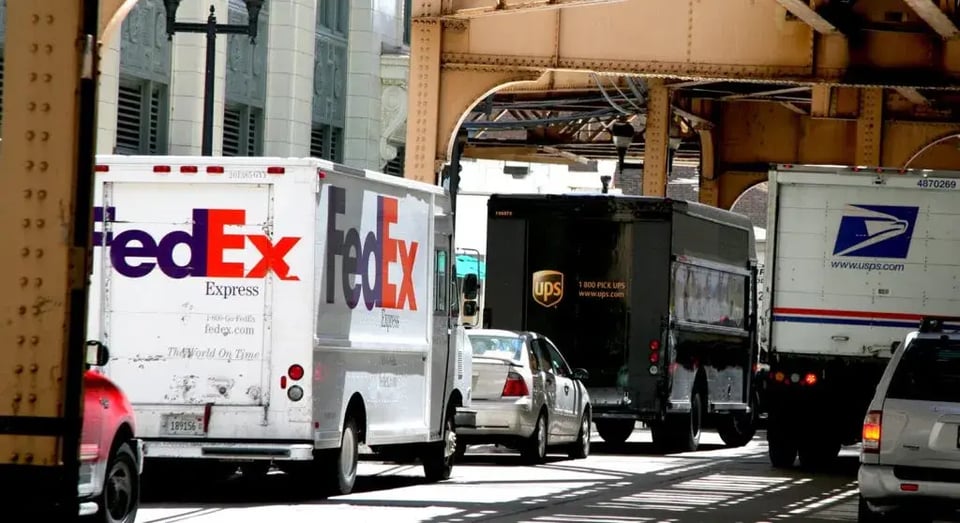
USPS is the best carrier for lightweight residential parcels under two pounds, UPS is the best for reliability and heavier commercial ground shipments, and FedEx is the best for time-definite overnight delivery and oversized boxes. No carrier is cheapest across all weights and zones, so most e-commerce brands above a few hundred orders a month use at least two.
The crossover point sits somewhere between six and ten pounds, depending on zone and on whether you have negotiated rates. Below it, the absence of a residential surcharge keeps USPS ahead. Above it, the private carriers' base rates and volume discounts pull them in front, and the gap widens the further the package travels.
UPS vs USPS vs FedEx: full 2026 comparison table
Every figure below reflects rates and rules in effect as of August 2026. Fuel surcharge percentages move weekly, so treat those two cells as a snapshot rather than a constant.
| Factor | USPS | UPS | FedEx |
| Best for | Light residential parcels, PO Boxes, rural ZIPs | Reliability, 5 lb to 50 lb commercial ground | Overnight, oversized, international |
| Flagship ground service | USPS Ground Advantage | UPS Ground and Ground Saver | FedEx Home Delivery, Ground Economy |
| Ground transit time | 2 to 5 business days | 1 to 5 business days | 1 to 5 business days |
| 2026 base rate action | Plus 7.8% on Jan 18, plus 8% temporary on Apr 26, structural repricing on Jul 12 | 5.9% GRI effective Dec 22, 2025 | 5.9% GRI effective Jan 5, 2026 |
| Ground fuel surcharge | 8% temporary adjustment, expires Jan 17, 2027 | About 25.5%, reset weekly | About 25.0%, reset weekly |
| Residential surcharge | None | About $6.50 per package | About $6.45 per package |
| Dimensional divisor | 139 (was 166 until Jul 12, 2026) | 139 | 139 |
| Dim pricing threshold | Packages over 1 cubic foot | Applied broadly | Applied broadly |
| Peak season on-time rate | 94.10% | 97.20% | 95.3% (Express) |
| Saturday delivery | Included | Available, fees may apply | Included on Home Delivery |
| PO Box delivery | Yes, exclusive | No | No |
| Insurance included | $100 on Ground Advantage | $100 declared value | $100 declared value |
| Maximum weight | 70 lb | 150 lb | 150 lb |
| Free pickup | Yes | Fee applies | Fee applies |
On-time figures are ShipMatrix measurements for the December 2025 peak against each carrier's actual commit times, reported by FreightWaves. All three improved year over year. The FedEx number covers Express specifically, so it is not a like-for-like ground comparison.
The three 2026 changes that reset the math
Most carrier comparisons still describe a market that stopped existing in July. Three USPS decisions this year removed the reasons shippers defaulted to it, and understanding them is the difference between an informed carrier mix and an expensive habit.
1. January 18: Ground Advantage rose 7.8%, and sub-pound parcels rose more
The Postal Service filed for Shipping Services increases of 6.6% on Priority Mail, 5.1% on Priority Mail Express, 7.8% on Ground Advantage and 6.0% on Parcel Select, according to the USPS competitive pricing announcement. The headline understates the impact on small sellers. Line-by-line analysis of the filing showed packages under one pound, the core weight band for direct-to-consumer retail, rising an average of 12.2%, while shipments between eight and twenty pounds went up only 4.4%. Supply Chain Dive noted the increases were approved by the board of governors before Postal Regulatory Commission review.
2. April 26: the first fuel surcharge in Postal Service history
Ten weeks after the January change, USPS filed for a time-limited 8% increase across Priority Mail Express, Priority Mail, Ground Advantage and Parcel Select. It took effect on April 26 and is scheduled to expire at midnight Central on January 17, 2027, per the USPS notice of a transportation-related, time-limited price change. Whatever the label, this is a fuel surcharge, and it is the first one the agency has ever applied to packages.
The framing matters for shippers weighing carriers. USPS pointed out that competitors had imposed fuel surcharges of 25% to 28% on ground and air after oil prices jumped, and that its own charge is "less than one-third of what our competitors charge for fuel alone". That claim holds up. UPS ground fuel currently sits around 25.5% and FedEx around 25.0%, and both are reset weekly against the diesel index.
3. July 12: the dimensional weight advantage disappeared
This is the change most shippers missed, and the most consequential. On July 12 the Postal Service dropped its dimensional weight divisor from 166 to 139, matching UPS and FedEx, and started rounding every fractional inch up rather than to the nearest inch. Pitney Bowes confirms the divisor change brings USPS dim rating into line with other carriers. For a box crossing the one cubic foot threshold, that is roughly a 19% jump in billable weight for the same carton.
The same day, USPS eliminated ounce-based pricing on published commercial Ground Advantage rates. Every sub-pound parcel in a given zone now bills at what used to be the twelve to sixteen ounce rate. Jewelry sellers, cosmetics brands and anyone shipping three-ounce items on published commercial pricing absorbed a step change overnight. Shippers on negotiated agreements were unaffected, which widened the gap between contracted and non-contracted merchants.
Taken together: the carrier that used to be forgiving on bulky-but-light boxes and granular on tiny ones is now neither. If you routed low-density parcels through USPS specifically to dodge dim penalties, that arbitrage is gone.
UPS vs USPS vs FedEx: carrier reviews
1. UPS: Best for reliability and heavier commercial ground
UPS is the largest US parcel carrier by revenue and, in 2026, the most deliberately smaller of the three. It is roughly two years into unwinding its Amazon relationship, having cut about one million Amazon packages a day from its network by the end of 2025 and targeting another million during 2026. Chief executive Carol Tomé described the position bluntly on the fourth-quarter call: the company is "in the final six months of our Amazon accelerated glide down plan". Alongside it came 30,000 operational job cuts and 24 facility closures, on top of the 34,000 positions and 93 buildings already removed in 2025, with a targeted $3 billion in savings, as reported by FreightWaves. About 68% of volume now flows through automated facilities. The payoff for shippers is visible in the service data: UPS turned in the highest peak on-time rate of the three carriers for the second consecutive year, and domestic revenue per piece climbed 8.3% in the quarter, which tells you exactly where its pricing discipline is pointed.
Pricing: 5.9% average GRI effective December 22, 2025, two weeks ahead of FedEx. Domestic ground averaged about 5.3%, with lighter one to five pound parcels closer to 5.6%. Ground fuel around 25.5% and a residential surcharge near $6.50 sit on top. Additional Handling now triggers on any package over 10,368 cubic inches regardless of length, effective January 26, 2026.
AI and tech: A June 2026 rollout added conversational AI to Happy Returns for reverse logistics and returns fraud, RFID combined with AI tracking for package-level visibility, agentic control tower capability that flags and prioritizes disruptions across multi-carrier networks, and AI-assisted customs brokerage including UPS Export Assure. UPS says it will handle more than 98% of customer service requests through AI and human agents by the end of 2026. See the UPS AI initiatives announcement for the full list.
Peak on-time rate: 97.2%, up from 96.5% a year earlier (ShipMatrix, December 2025).
-
Pro: Best measured reliability of the three, and the widest gap on time-definite commitments after moving noon commits to 3 PM.
-
Pro: Strongest position on 5 lb to 50 lb commercial ground, particularly zones 2 through 5, where negotiated discounts bite hardest.
-
Con: Every residential parcel carries about $6.50 plus 25.5% fuel before you touch base rates, which is brutal on low-value DTC orders.
-
Con: A network mid-restructuring means facility closures and route changes you do not control. Retiring the MD-11 fleet also thinned air capacity.
Verdict: If your parcels are heavy, your addresses are commercial, and you have the volume to negotiate, UPS gives you the most predictable delivery performance in the market, and you should expect to pay for it on anything light or residential.
2. USPS: Best for lightweight residential parcels and hard-to-reach addresses
The Postal Service remains the cheapest way to move a small package to a home address in the United States, and it is the only carrier obligated to reach every one of them.
Ground Advantage delivers in two to five business days with tracking and $100 of insurance included, accepts parcels up to 70 pounds, and carries no residential surcharge. It also overtook Parcel Select in volume for the first time in years during the 2025 peak, and its on-time rate improved more than either competitor, climbing from 90.4% to 94.1%. That progress is real, and it is happening against a difficult backdrop: a $9 billion net loss in fiscal 2025, quarterly parcel volumes down 12% year over year, and warnings to Congress about running out of cash.
Postmaster General David Steiner has made service consistency the stated priority for 2026, alongside network modernization and a push into AI-enabled tools and digital services. The Amazon relationship, which nearly collapsed, settled into a renegotiated deal at roughly 80% of prior volume, around 1.7 billion packages a year, per a Reuters report summarized by Logistics Management.
Pricing: Three actions in 2026. Ground Advantage rose 7.8% on average on January 18, with sub-pound parcels closer to 12.2%. A temporary 8% adjustment landed on April 26 and runs through January 17, 2027. On July 12 the dim divisor fell to 139, fractional inches began rounding up, and ounce tiers vanished from published commercial Ground Advantage. A 1 lb Ground Advantage parcel now runs roughly $9.55 retail against roughly $7.61 commercial.
AI and tech: Predictive arrival times, route optimization, fraud detection, contact center automation, Smart Lockers, self-service kiosks, Informed Delivery, and the USPS API Marketplace. Separately, USPS opened more than 18,000 delivery destination units to shippers of all sizes through a bidding process, which is the most interesting structural opening it has offered in years for anyone running parcel injection.
Peak on-time rate: 94.1%, up from 90.4% a year earlier (ShipMatrix, December 2025).
-
Pro: No residential surcharge and no weekly fuel index, so quoted cost is close to landed cost. Saturday delivery and PO Box access are included.
-
Pro: Still decisively cheapest under two pounds once you stack the private carriers' fuel and residential fees, and the only practical option for many rural ZIPs.
-
Con: Three price actions in seven months, and the July changes hit exactly the shippers who relied on it most: tiny parcels and low-density boxes.
-
Con: Lowest measured on-time rate of the three, a 70 lb ceiling, and a financial position that makes further pricing moves likely rather than possible.
Verdict: USPS is still the right default under two pounds and unavoidable for PO Boxes and remote routes, but it now behaves like a commercial carrier that reprices when its costs move, so stop treating its rate card as the stable one.
3. FedEx: Best for time-definite delivery, oversized boxes and international
FedEx spent 2026 finishing the largest restructuring in its history. It merged Express and Ground into one operating company, pushed Network 2.0 station consolidation across roughly 360 North American locations, and completed the spin-off of FedEx Freight as an independent public company on June 1, 2026. The commercial upside arrived from an unexpected direction: as UPS shed Amazon volume, FedEx signed a multi-year agreement to handle Amazon's oversized parcels, which plays directly to the part of its network the other two cannot match. Where FedEx still leads is precision and shape.
Its overnight tiers are the most granular of the three, One Rate flat pricing across seven container sizes up to 50 pounds is genuinely useful for dense heavy goods travelling far, and Ground Economy roughly matches USPS on one to five pound parcels heading to zone 5 and beyond. The trade-off is that its ground on-time performance has historically trailed UPS, and its 2026 surcharge changes were the most aggressive of the three on large packages.
Pricing: 5.9% average GRI effective January 5, 2026, with next-day air close to the average and zones 7 and 8 above 6%. Ground fuel around 25.0% and residential delivery near $6.45, up about 8% year over year. Two new cubic volume triggers matter: Additional Handling on anything over 10,368 cubic inches and Oversize on anything over 17,280 cubic inches, effective January 12, 2026. Large Package charges can exceed $250 per parcel depending on lane.
AI and tech: FedEx Tracking+ and FedEx Returns+, launched February 2, 2026 in collaboration with parcelLab, embed white-labeled AI tracking and returns inside a merchant's own site, with automated answers to order and refund questions, anomaly detection across delivery data, and rules-driven returns policy adjustment. Jason Brenner, who runs the digital portfolio, framed the logic simply: "Customer loyalty is often earned after the sale". FedEx reports 37% of business shippers already use AI for returns.
Peak on-time rate: 95.3% for Express, up 3.5 points year over year (ShipMatrix, December 2025).
-
Pro: Deepest overnight product ladder, including First Overnight by 8 AM in select cities, plus the strongest handling of oversized and irregular freight.
-
Pro: One Rate flat pricing and easy emailed return labels remove rate-shopping friction for dense, predictable, and reverse shipments.
-
Con: The new cubic volume thresholds pull low-density apparel and home goods into Additional Handling brackets they previously escaped.
-
Con: Ground reliability sits between UPS and USPS, and a network still consolidating stations introduces service variability in specific lanes.
Verdict: Choose FedEx when the delivery time is contractual, the box is awkward, or the shipment crosses a border, and price-check Ground Economy against USPS on every light parcel because the two are closer than most shippers assume.
Which carrier should you use? Recommendations by business type
Carrier choice is a function of weight, density, address type and negotiating power. Here is how those variables usually resolve.
| If you are | Primary carrier | Why, and what to watch |
| A solo seller under 300 orders a month, items under 1 lb | USPS Ground Advantage | Cheapest published option and free pickup. Check the July 12 flat sub-pound rate against your actual weights, because 3 oz items now bill like 15 oz ones. |
| A DTC apparel or beauty brand, 1,000 to 10,000 orders a month | Split USPS and UPS | USPS below two pounds, UPS Ground above five. The middle band is where rate shopping pays for itself several times over. |
| A B2B distributor shipping to loading docks | UPS Ground | No residential surcharge applies, discounts are deepest here, and commit-time reliability is measurably better. |
| Shipping bulky but light goods such as furniture or homeware | FedEx, then compare LTL | The USPS dim advantage ended in July. Right-size cartons below 10,368 cubic inches before comparing anything. |
| Running a subscription box with fixed dimensions | Negotiated UPS or FedEx contract, plus USPS cubic | Predictable cube is the strongest negotiating asset you have. Cubic pricing rewards it. |
| Selling to rural or PO Box heavy customer bases | USPS, no realistic alternative | It is the only carrier reaching every address. Budget for its pricing volatility rather than switching. |
| Shipping medical, spare parts or anything time-critical | FedEx Priority Overnight or UPS Next Day Air | Compare commit times, not just prices. UPS moved noon commits to 3 PM, which changes what on-time means. |
| An enterprise above 100,000 orders a month | All three, orchestrated | Single-carrier exposure is now a pricing risk. Regional carriers and DDU injection belong in the mix. |
Technology and AI capability comparison
All three carriers shipped named AI features in the first half of 2026. The differences reflect their strategies: UPS is automating operations and service, FedEx is selling post-purchase experience to merchants, and USPS is modernizing infrastructure.
| Named 2026 launch | Predictive arrival times, API Marketplace, Smart Lockers | Happy Returns conversational AI, agentic control tower, Export Assure | FedEx Tracking+ and Returns+ with parcelLab |
| Branded tracking for merchants | Informed Delivery, limited white-labeling | RFID plus AI package-level visibility | White-labeled, embedded in merchant site |
| AI returns handling | Not offered as a merchant product | Conversational returns plus fraud reduction | Automated policy adjustment, return prediction |
| Customs and cross-border AI | Limited | AI-assisted brokerage, landed cost at checkout | Established international tooling |
| Disruption modelling | Route optimization, fraud detection | Digital twin and what-if network planning | Network 2.0 station-level flexing |
| Public service automation target | Contact centre improvements | 98% of service requests by end of 2026 | Not disclosed as a percentage |
For most merchants this layer is less decisive than it looks. Each carrier's tooling only covers its own parcels, which is precisely the gap a multi-carrier platform fills.
UPS vs USPS vs FedEx pricing and total cost of ownership
Base rate comparisons mislead because surcharges are where the money goes. Below are the 2026 rate actions, then two worked landed-cost scenarios.
2026 rate actions at a glance
| Carrier | Action | Effective | Average impact |
| UPS | General Rate Increase | Dec 22, 2025 | 5.9% average, ground about 5.3% |
| FedEx | General Rate Increase | Jan 5, 2026 | 5.9% average, zones 7 and 8 above 6% |
| USPS | Competitive product price change | Jan 18, 2026 | Ground Advantage 7.8%, sub-1 lb 12.2% |
| FedEx | Cubic volume surcharge triggers | Jan 12, 2026 | Additional Handling and Oversize by volume |
| UPS | Cubic volume surcharge triggers | Jan 26, 2026 | Additional Handling by volume |
| USPS | Temporary transportation adjustment | Apr 26, 2026 | 8% on four competitive products |
| USPS | Dim divisor, rounding, ounce tiers | Jul 12, 2026 | About 19% more billable weight on dim-rated boxes |
Landed cost scenario one: 2 lb parcel, zone 5, residential
| Cost component | USPS Ground Advantage | UPS Ground | FedEx Home Delivery |
| Published base rate | About $9 to $11 | About $13 to $15 | About $13 to $15 |
| Fuel | Included in the 8% adjustment | About $3.40 to $3.85 | About $3.25 to $3.75 |
| Residential surcharge | $0 | About $6.50 | About $6.45 |
| Estimated landed cost | About $9 to $11 | About $23 to $25 | About $23 to $25 |
Read this carefully. These are published rates. Negotiated agreements commonly run 40% to 70% below base on UPS and FedEx, which can close most of that gap. The point of the table is not that USPS is always half the price, it is that the private carriers' surcharge stack is large enough that a merchant without a contract should almost never route a two pound residential parcel to them.
Landed cost scenario two: 15 lb parcel, zone 5, commercial
| Cost component | USPS Ground Advantage | UPS Ground | FedEx Ground |
| Published base rate | About $25 to $32 | About $22 to $27 | About $22 to $27 |
| Fuel | Included | About $5.60 to $6.90 | About $5.50 to $6.75 |
| Residential surcharge | Not applicable | $0, commercial address | $0, commercial address |
| Estimated landed cost | About $25 to $32 | About $28 to $34 before discounts | About $28 to $34 before discounts |
At fifteen pounds to a commercial address the published numbers are close, and a negotiated discount of even 25% puts UPS and FedEx clearly ahead. This is the crossover in action, and it is why brands shipping a wide weight range cannot pick one winner.
The costs that do not appear on a rate card
-
Dimensional weight. Since July 12 all three carriers use a 139 divisor, so an oversized carton costs the same penalty everywhere. Box right-sizing is now the highest-return shipping project available to most brands.
-
Address correction and delivery area surcharges. These stack quietly on UPS and FedEx and are effectively absent on USPS.
-
Peak season demand surcharges. UPS and FedEx both apply per-package demand fees above a shipper baseline during peak. USPS ran temporary holiday pricing from October 2025 to mid-January 2026.
-
Failed deliveries and WISMO tickets. A cheaper label that generates a support contact and a redelivery is not cheaper. Track cost per successfully delivered order instead.
-
Billing corrections. When UPS began rounding fractional inches up, many shippers saw charge corrections several times their normal amount. USPS extended dimension reporting to all shipments on July 12, with noncompliance fees starting early next year.
How to choose the right shipping carrier: a seven-step checklist
-
Pull ninety days of shipment data. Record actual weight, all three dimensions, destination ZIP, address type and service level for every order. Without dimensions you cannot model the 2026 dim rules.
-
Bucket by weight and address type. Under 2 lb residential, 2 to 6 lb residential, 6 to 20 lb commercial, over 20 lb, and oversized. These buckets, not averages, decide your carrier mix.
-
Rebuild landed cost per bucket. Base rate plus fuel plus residential plus delivery area plus additional handling. Compare that total, never the base rate.
-
Re-run every dim-rated box against the 139 divisor with fractional inches rounded up. Flag any carton within an inch of 10,368 or 17,280 cubic inches for redesign.
-
Check your sub-pound exposure. If you ship on published commercial USPS rates and most parcels sit under eight ounces, model the July flat rate and decide whether contracted rates are now worth pursuing.
-
Negotiate with the buckets, not the total. Carriers price by profile. Bring them the volume they want on the lanes they want and trade it for the discounts you need.
-
Automate allocation per order. Manual rules go stale the week a surcharge table changes. Rate shopping at order level is the only version of this that survives contact with a repricing year.
Frequently asked questions (FAQ)
Which is cheaper: USPS, UPS, or FedEx?
USPS is cheapest for parcels under two pounds, mainly because it charges no residential surcharge and no weekly fuel percentage. UPS and FedEx become cheaper above roughly six to ten pounds, especially to commercial addresses and with negotiated discounts. The crossover point shifts with zone and package density.
Which shipping carrier is the most reliable in 2026?
UPS posted the highest on-time rate during the December 2025 peak at 97.2%, ahead of FedEx Express at 95.3% and USPS at 94.1%, according to ShipMatrix. All three improved year over year. USPS improved the most, gaining nearly four points from 90.4%.
Does USPS charge a residential delivery surcharge?
No. USPS applies no residential surcharge, which is its single largest cost advantage for e-commerce. UPS charges about $6.50 per residential package and FedEx about $6.45 on Home Delivery, up roughly 8% in 2026. On a light parcel that fee alone can exceed half the base rate.
What changed with USPS pricing in July 2026?
On July 12, 2026 the dimensional weight divisor dropped from 166 to 139, fractional inches began rounding up instead of to the nearest inch, and ounce-based tiers were removed from published commercial Ground Advantage rates. Base rates did not move. Bulky-light and sub-pound shippers absorbed the increase.
Is UPS or FedEx better for overnight shipping?
FedEx offers the more granular overnight ladder, including First Overnight by 8 AM in select cities, Priority Overnight and Standard Overnight. UPS Next Day Air is competitive and UPS recorded better overall commit-time performance. Compare actual commit times on your specific lanes rather than headline service names.
Which carrier is best for a small e-commerce business?
Most small businesses should start on USPS Ground Advantage for anything under two pounds and add one private carrier for heavier orders. If you ship on published commercial rates and your parcels are very light, check the July 2026 flat sub-pound pricing before assuming USPS is still cheapest.
Can I use UPS, USPS and FedEx at the same time?
Yes, and above a few hundred orders a month you probably should. A multi-carrier setup rate shops each order against live carrier pricing and routes it to whichever carrier meets the delivery promise for the lowest landed cost. Single-carrier exposure became a pricing risk in 2026.
Which carrier delivers to PO Boxes?
Only USPS delivers to PO Boxes directly. UPS and FedEx cannot, though hybrid services such as UPS Ground Saver and FedEx Ground Economy hand the final leg to USPS, which allows PO Box delivery at slower transit times. For PO Box heavy customer bases USPS is not optional.
Why did USPS raise prices three times in 2026?
USPS reported a $9 billion net loss in fiscal 2025 and quarterly parcel volumes down 12% year over year. The January increase was its scheduled competitive price change, April added a temporary transportation adjustment tied to fuel, and July restructured dimensional and sub-pound pricing to align with private carrier practice.
How much are UPS and FedEx fuel surcharges right now?
Ground fuel surcharges sit near 25.5% for UPS and 25.0% for FedEx as of mid-2026, indexed to the national average on-highway diesel price and reset weekly. Both carriers have also raised the underlying surcharge tables repeatedly, meaning percentages can rise even when diesel prices hold flat.
Final verdict: there is no single best shipping carrier
Comparing UPS vs USPS vs FedEx in 2026 produces a clearer answer than it did two years ago, and it is not the answer most shippers want. USPS owns the sub-two-pound residential parcel and every hard-to-reach address. UPS owns reliability and the heavier commercial ground lane. FedEx owns urgency, awkward shapes and borders. Those boundaries are firm, and the price of ignoring them rose sharply this year.
What changed underneath is that carrier pricing stopped being annual. USPS moved three times in seven months. UPS lifted its fuel table repeatedly. FedEx introduced volume-based surcharge triggers that catch boxes which previously passed. Pitney Bowes executive Shemin Nurmohamed put the shipper-side implication of all this disruption plainly: "This disruption presents a unique opportunity for businesses to take advantage of competitive pricing". That opportunity only exists if you can act on it per order rather than per year.
That is the practical conclusion. Pick your default carrier by weight band, keep at least two live, and automate the choice. ClickPost layers AI-based allocation on top of the carrier contracts you already hold, scoring every eligible carrier per order on serviceability, SLA history and cost across 600 or more carriers, so a surcharge table change on Monday does not quietly erode your margin all quarter.






We use cookies to keep the site working, understand usage, and improve your experience. Learn more
Always active for essential site performance and security.
Enables anonymous usage analysis to refine our services.
Used to present relevant promotions and advertising.