.png?width=193&height=27&name=ClickPost%20Logo%20(Blue).png)
.svg)
.svg)
.svg)
.svg)
.webp?width=286&height=206&name=ROI%20Calculator%20(2).webp)
.svg)
.svg)
.svg)
.svg)
.svg)
.svg)
.svg)
.svg)
.svg)
.webp?width=286&height=206&name=Frame%201171276203%20(11).webp)
.svg)
.svg)
.svg)
.svg)
.webp?width=286&height=206&name=ROI%20Calculator%20(3).webp)
.svg)

.svg)
.svg)

.svg)
.webp?width=286&height=206&name=ROI%20Calculator%20(4).webp)
Best 20 Trucking Companies in the USA for Freight and Logistics


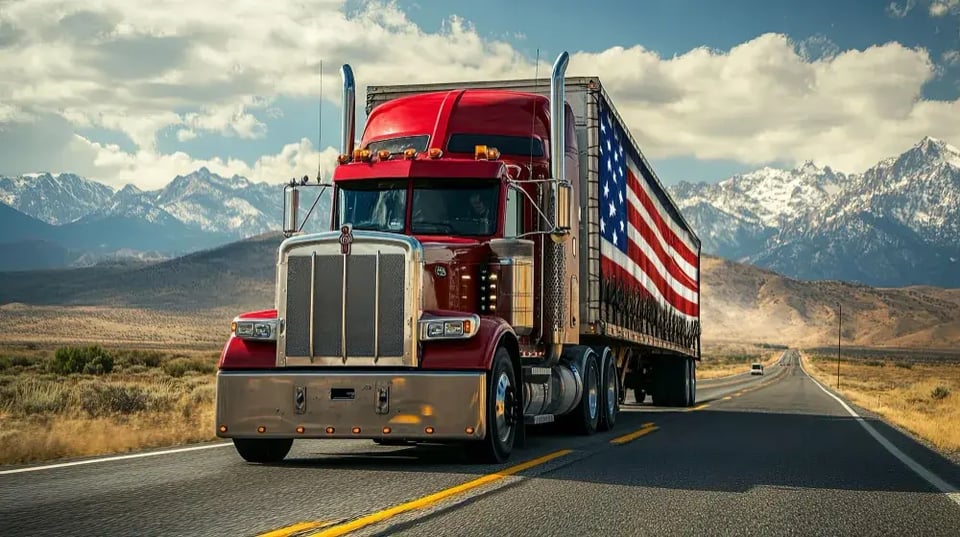
Ready to delight customers after checkout?
Trusted by 600+ brands
In this blog
Top 20 U.S. Trucking Companies in 2026: Key Takeaways
-
J.B. Hunt Transport leads all carriers with $12.0B in FY2025 revenue, processing approximately 2 million intermodal loads annually via its 360® digital platform.
-
Intermodal routing runs 10–15% cheaper than over-the-road truckload on high-volume lanes, making carrier selection a direct cost-reduction lever for shippers.
-
Yellow Corporation's liquidation and Knight-Swift's acquisition of U.S. Xpress triggered sector-wide consolidation, resulting in fewer but financially stronger national carriers by 2026.
-
Old Dominion Freight Line commands a pricing premium because its damage ratios and operating efficiency consistently outperform the LTL industry benchmark across 250+ service centers.
-
KPMG's 2026 Logistics Outlook identifies balance-sheet strength, AI-driven visibility, and ESG roadmaps as the three decisive criteria shippers use to select long-term carrier partners.
Why Trucking Still Dominates U.S. Freight in 2026
Trucking remains the undisputed backbone of American logistics, moving an estimated 73.1% of all U.S. freight tonnage as of early 2026, according to the American Trucking Associations' 2026 Economic Impact reports. Despite a decade of predictions that rail or intermodal solutions would erode this lead, trucking's share has held remarkably firm through 2027.
Shippers continue to "vote with their freight," prioritizing the door-to-door flexibility and last-mile precision that only motor carriers can provide. However, the internal economics of that flexibility have been fundamentally restructured following the "Great Correction" of the mid-2020s.
The prolonged freight recession of 2022–2024, which saw spot rates plummet nearly 30% from their post-pandemic peaks, forced a record number of smaller carriers to exit the market and paved the way for massive consolidation. This era of survival culminated in the high-profile liquidation of Yellow Corporation, once a cornerstone of the LTL sector, and the strategic acquisition of U.S. Xpress by Knight-Swift, which effectively removed a top-10 standalone name from the competitive landscape.
Research from McKinsey & Company suggests that this post-recession recovery is now defined by extreme capacity discipline and deep digital adoption. According to the KPMG 2026 Global Transportation and Logistics Outlook, three primary forces are dominating carrier selection for 2027: balance-sheet strength, technological depth, and sustainability commitments.
Shippers are no longer selecting partners based on the lowest rate alone; they are vetting carriers for long-term solvency to avoid the service disruptions seen during previous market failures, demanding AI-driven real-time visibility as a baseline requirement, and favoring fleets with documented decarbonization roadmaps as 2030 ESG targets approach.
For brands shortlisting carriers in 2027, the question is no longer "who is the biggest," but rather who has the resilience and financial stability to deliver consistently in an era of structural volatility. Understanding how ecommerce logistics layers on top of trucking capacity is equally critical for brands managing direct-to-consumer fulfillment.
Quick Comparison: Top 20 Largest Trucking Companies in the USA (2026)
| Rank | Company | HQ | FY2025 Revenue | Core Services | Best Fit For |
| 1 | J.B. Hunt Transport | Lowell, AR | $12.00B | Intermodal, Dedicated, Brokerage | Intermodal-heavy long-haul lanes |
| 2 | Ryder System | Miami, FL | $11.85B | Dedicated, Leasing, Warehousing | Integrated logistics outsourcing |
| 3 | TFI International | Montreal / MI | $8.52B | LTL, TL, Package, Logistics | Cross-border North America |
| 4 | Knight-Swift | Phoenix, AZ | $7.85B | TL, LTL, Intermodal, Brokerage | Multi-service shippers needing scale |
| 5 | XPO | Greenwich, CT | $7.74B | LTL, Last-Mile Heavy Goods | LTL plus big-and-bulky delivery |
| 6 | Penske Logistics | Reading, PA | ~$7.10B* | Freight Mgmt, Warehousing | Complex 3PL contracts |
| 7 | Old Dominion | Thomasville, NC | $5.45B | National and regional LTL | Premium LTL, low damage rates |
| 8 | Estes Express Lines | Richmond, VA | ~$5.20B* | National LTL, Global | High-volume LTL (Private/Stable) |
| 9 | Schneider National | Green Bay, WI | $5.12B | TL, Intermodal, Dedicated | Cross-border Mexico and Canada |
| 10 | Landstar System | Jacksonville, FL | $4.95B | TL, Flatbed, Heavy Haul | Specialized and oversized freight |
| 11 | Hub Group | Oak Brook, IL | $3.95B | Intermodal, Brokerage, Dedicated | Cost-efficient intermodal |
| 12 | NFI Industries | Camden, NJ | ~$3.75B* | Dedicated, Reefer, Drayage | Port-heavy omnichannel retail |
| 13 | ABF Freight (ArcBest) | Fort Smith, AR | $3.68B | LTL, TL, Expedited | Union LTL with broad service mix |
| 14 | Saia Inc. | Johns Creek, GA | $3.23B | LTL, Expedited, Consolidation | Fast-growing LTL, value pricing |
| 15 | Werner Enterprises | Omaha, NE | $3.15B | TL, Dedicated, Intermodal | Dedicated retail and e-commerce |
| 16 | Prime Inc. | Springfield, MO | ~$2.42B* | Reefer, Flatbed, Tanker | Reefer and specialty haul |
| 17 | R+L Carriers | Wilmington, OH | ~$2.38B* | LTL, TL, Expedited | Family-owned LTL plus logistics |
| 18 | CRST International | Cedar Rapids, IA | ~$2.10B* | Expedited, Flatbed, Final Mile | Team-driver expedited freight |
| 19 | C.R. England | Salt Lake City, UT | ~$1.85B* | Reefer, Dedicated, Intermodal | Long-haul refrigerated |
| 20 | Forward Air | Greeneville, TN | $1.72B | Expedited LTL, FTL | Airport-to-airport expedited |
1. J.B. Hunt Transport Services: Largest Intermodal Carrier in the USA
J.B. Hunt remains the undisputed king of intermodal, moving approximately 2 million loads annually. With FY2025 revenue holding steady at $12.0 billion, the company has successfully navigated the "Great Correction" by leveraging its massive J.B. Hunt 360® digital platform. Their intermodal scale remains their greatest "moat," typically landing 10% to 15% cheaper than over-the-road truckload on high-volume lanes. For shippers evaluating carrier allocation strategies across long-haul corridors, J.B. Hunt's intermodal pricing advantage is often the decisive factor.
2. Ryder System: Best Full-Service Logistics Outsourcing Partner
Ryder has transitioned into a full-service logistics powerhouse, reporting FY2025 revenue of $11.85 billion. Beyond fleet leasing, their Supply Chain Solutions and Dedicated segments have become essential for enterprises looking to outsource complex warehousing and distribution. For brands needing a single relationship to manage vehicles and labor, Ryder is the most mature market option among top 3PL logistics companies in North America.
3. TFI International: Top Cross-Border Trucking Company for U.S.-Canada Freight
Despite being headquartered in Canada, TFI operates one of the most expansive North American footprints with FY2025 revenue of $8.52 billion. Since the acquisition of UPS Freight (now TForce Freight), they have secured a top-10 U.S. LTL position. They are the go-to partner for shippers with significant cross-border volume into Canada. Brands managing international logistics across the U.S.-Canada border will find TFI's TForce network difficult to match on density and transit reliability.
4. Knight-Swift Transportation: Largest U.S. Truckload Carrier by Fleet Size
Knight-Swift sits at the apex of the U.S. truckload market, reporting FY2025 revenue of $7.85 billion. Having fully integrated U.S. Xpress and expanded its LTL presence through AAA Cooper, the fleet now exceeds 19,000 tractors. Their ability to offer truckload, LTL, and intermodal under a single master contract provides unmatched consolidation opportunities for large shippers managing multi-carrier shipping programs.
5. XPO: Best LTL Carrier for Big-and-Bulky Last-Mile Delivery
Now a focused LTL pure-play, XPO reported FY2025 revenue of $7.74 billion. Following the 2022 spin-offs of GXO and RXO, the company has doubled down on its service-center density and its last-mile heavy-goods network. For retailers shipping big-and-bulky items like exercise equipment or appliances, XPO's white-glove delivery is a critical differentiator. Their investment in last-mile delivery solutions for heavy goods remains among the most mature in the industry.
6. Penske Logistics: Leading 3PL for Automotive and Healthcare Sectors
A private power player under Penske Corporation, the logistics arm generated an estimated $7.1 billion in 2025 revenue. Known for high-touch service in the automotive and healthcare sectors, Penske has recently taken the lead in heavy-duty electric vehicle (EV) deployment, making them a top choice for shippers with immediate 2027 ESG mandates. Their integrated approach to integrated logistics management makes them particularly attractive for complex dedicated contract arrangements.
7. Old Dominion Freight Line: Gold Standard for LTL Shipping Reliability and Low Damage Rates
Old Dominion remains the gold standard for LTL efficiency, reporting FY2025 revenue of $5.45 billion. Their operating ratios consistently outperform the industry, allowing them to reinvest in a network of 250+ service centers. With industry-best damage ratios, ODFL commands a pricing premium that shippers are willing to pay for reliability. Understanding shipping cost trade-offs between ODFL's premium rates and its superior service metrics is a key decision point for LTL-heavy shippers.
8. Estes Express Lines: Largest Privately-Held LTL Carrier in the United States
As the largest privately-held LTL carrier, Estes reported an estimated $5.2 billion in 2025 revenue. The Richmond-based carrier was the most aggressive buyer of Yellow Corporation's assets, significantly expanding its terminal footprint in 2024. They offer a stable, family-owned service model that competes directly with the national giants.
9. Schneider National: Best Trucking Company for U.S.-Mexico Cross-Border Freight
Schneider's diversified mix across truckload and intermodal produced FY2025 revenue of $5.12 billion. Their "Schneider Logistics Mexico" division is among the strongest for cross-border transit, making them a primary beneficiary of the 2026 nearshoring trend. They are also a primary testing partner for alternative-fuel Class 8 tractors. Shippers using Schneider for cross-border lanes often pair their service with supply chain management software to maintain end-to-end visibility across the border.
10. Landstar System: Best Asset-Light Carrier for Specialized and Oversized Freight
Operating an asset-light model, Landstar reported FY2025 revenue of $4.95 billion. Their network of 1,200 independent agents and 11,000 owner-operators makes them the preferred choice for project cargo, heavy haul, and specialized flatbed work. Shippers benefit most when building relationships with specific agents who understand their niche freight. Landstar's model mirrors the flexibility that B2B logistics operations require when managing irregular freight across variable lanes.
11. Hub Group: Most Cost-Efficient Intermodal Carrier for Long-Haul Rail Lanes
Hub Group, a leader in cost-efficient intermodal conversion, reported FY2025 revenue of $3.95 billion. By leveraging partnerships with Class I railroads like Union Pacific, Hub often provides a more competitive second-bid to J.B. Hunt, helping shippers maintain pricing leverage in their intermodal RFPs. Brands managing ecommerce supply chain management at scale frequently use Hub Group as a cost-balancing alternative on high-volume corridors.
12. NFI Industries: Top Drayage and Port Logistics Carrier for High-Volume Importers
Privately held and port-focused, NFI reported an estimated $3.75 billion in 2025 revenue. Their dominance in drayage, particularly at the Southern California and New Jersey ports, makes them essential for high-volume importers. They are also a pioneer in battery-electric drayage fleets.
13. ABF Freight (ArcBest): Best Unionized LTL Carrier for Government and Manufacturing Shippers
The asset-based anchor of ArcBest, ABF reported FY2025 revenue of $3.68B. As a unionized carrier, ABF offers high labor stability and experienced drivers, which appeals to government and manufacturing shippers. Their integrated "Asset-Light" productivity reached record highs in late 2025. ABF's breadth across LTL, truckload, and expedited shipping makes them a strong single-source option for manufacturers with diverse freight profiles.
14. Saia Inc.: Fastest-Growing LTL Carrier in the U.S. After Yellow Corporation Collapse
Saia has been the fastest-growing LTL name of the mid-2020s, reporting FY2025 revenue of $3.23 billion. By acquiring 28 former Yellow terminals, they accelerated their national expansion by half a decade. Shippers often find Saia's pricing more aggressive than Old Dominion while maintaining high service standards.
15. Werner Enterprises: Best Dedicated Contract Carrier for Retail and E-Commerce Distribution
Werner reported FY2025 revenue of $3.15 billion, with dedicated contract trucking now accounting for nearly two-thirds of their business. They are a primary finalist for big-box retailers who require fixed, predictable capacity into distribution centers regardless of market volatility. Werner's deep retail focus aligns well with brands building out their ecommerce fulfillment networks that require consistent inbound freight to DCs.
16. Prime Inc.: Best Refrigerated Trucking Company for Food, Beverage, and Pharma
The refrigerated specialist, Prime reported an estimated $2.42 billion in 2025 revenue. Their driver-training schools ensure a steady pipeline of capacity for the food, beverage, and pharma sectors. For temperature-controlled long-haul, Prime remains a top-three national choice.
17. R+L Carriers: Best Family-Owned Regional LTL Carrier for Technology and Life Sciences
A family-owned staple with an estimated $2.38 billion in 2025 revenue, R+L sits in the sweet spot between a regional and a national carrier. Shippers in the technology and life sciences sectors often prefer their high-touch customer service model over the more corporate mega-carriers.
18. CRST International: Top Team-Driver Carrier for Expedited Coast-to-Coast Freight
CRST, with an estimated $2.1 billion in 2025 revenue, is the leader in expedited team-driver operations. Their model allows for nearly continuous movement, making them the default choice for high-value electronics and medical devices needing coast-to-coast transit in under 24 hours. For shippers evaluating same-day and expedited delivery options on critical freight, CRST's team-driver model offers the fastest over-the-road transit times available.
19. C.R. England: Best Long-Haul Refrigerated Carrier for Grocery and Frozen Food
Specializing in long-haul refrigerated transit, C.R. England reported an estimated $1.85 billion in 2025 revenue. Their dedicated reefer network is a cornerstone for the grocery and frozen-food industries, backed by one of the industry's most robust driver-development programs.
20. Forward Air: Best Expedited LTL Carrier for Airport-Adjacent and Time-Sensitive Supply Chains
Closing the list with FY2025 revenue of $1.72 billion, Forward Air has successfully moved beyond its airport-to-airport roots into a more diversified freight forwarding and expedited LTL model following the Omni Logistics acquisition. Shippers with time-sensitive, airport-adjacent supply chains remain their core clientele.
Methodology: How We Ranked the Top 20 U.S. Trucking Companies for 2026
These rankings are not based on revenue alone. We weighted four factors: scale and capacity (tractor counts, terminal density, and freight volume drawn from FY2023 10-K filings and Q4 2025 private-company estimates from Transport Topics and SJ Consulting Group); service breadth (depth across truckload, LTL, intermodal, dedicated, refrigerated, flatbed, and specialty); financial stability (operating ratios, debt levels, and trailing twelve-month performance through year-end 2025, which matters far more in 2026 than it did pre-2022 given how many mid-size carriers folded); and technology infrastructure (API depth, tracking quality, EDI maturity, and how easily a shipper's TMS or post-purchase platform can pull real-time data).
Public rankings from Transport Topics' Top 100 For-Hire Carriers and Logistics Management's Top 50 informed ordering, with the 2025 Mastio Quality Awards and shipper-survey data serving as tiebreakers.
How ClickPost Connects Your Carrier Stack to the Customer Experience Layer
The 20 companies above move freight. They are not built to manage the customer-facing layer that sits on top of that freight, which is where most ecommerce, D2C, and omnichannel brands actually feel pain.
ClickPost is a post-purchase logistics intelligence platform used by 450+ global brands. It is not a trucking carrier, not a 3PL, and not a shipping aggregator that resells carrier contracts. ClickPost sits on top of a brand's own carrier contracts across 600+ integrated carriers globally and adds the intelligence layer that turns shipment data into customer experience.
For brands shipping through carriers in this list, the practical use cases include Carrier Allocation, which automatically routes each order to the best-fit carrier across an active multi-carrier stack based on cost, transit time, capacity, and historical performance. Brands that have moved from single-carrier to multi-carrier models often cite automated allocation as the most immediate cost-reduction lever.
Shipment Tracking and Branded Tracking Pages unify carrier data into a single shipper-branded experience, replacing the generic carrier tracking links customers find confusing. A consistent branded tracking page across all carriers reduces "where is my order" contacts and lifts post-purchase satisfaction scores.
NDR Management automates failed-delivery handling. Returns and Exchanges runs exchange-first flows that, on the ClickPost platform, convert 54% of return requests into exchanges and retain 40% of return value as store credit. Apex Control Tower gives logistics ops a single dashboard for SLA monitoring, exception alerts, and carrier performance across the full stack.
Brands typically graduate to ClickPost when multi-carrier complexity outgrows what generic tracking widgets or basic aggregator dashboards can handle. If your operation runs through three or more carriers on this list, or a hybrid parcel-plus-LTL stack, book a demo to see how the intelligence layer changes the post-purchase economics.
How to Choose the Right Trucking Company for Your Business in 2026
The U.S. trucking industry in 2026 is more consolidated, more digitally mature, and more selectively profitable than three years ago. The carriers on this list are the survivors and the consolidators. Picking among them is rarely about who has the largest fleet and almost always about lane fit, service type, and the quality of the technology connecting the carrier to your stack.
A few practical filters: match service type to freight type first. LTL specialists (ODFL, Saia, Estes, XPO, ABF) outperform truckload generalists on small-shipment lanes. Intermodal specialists (J.B. Hunt, Hub Group, Schneider) win on long-haul rail-served corridors. Specialty carriers (Landstar for oversized, Prime and C.R. England for reefer, NFI for drayage) outperform generalists in their niche. Understanding the full spectrum of best shipping carriers across service types helps narrow the shortlist faster.
Weight balance-sheet strength heavily. The 2022 to 2024 freight recession removed weak carriers in waves. Operating ratios published in 10-K filings tell most of the story for public carriers. Test the technology before signing. APIs, tracking depth, and EDI quality vary enormously across this list. A four-week pilot on your TMS or post-purchase platform before annual commitment is cheap insurance. Evaluating supply chain disruption risk and a carrier's financial resilience should carry as much weight as rate negotiations in 2026.
For ecommerce brands, the trucking layer is half the equation. The other half is the post-purchase experience intelligence that turns carrier data into a customer experience your brand controls.
Frequently Asked Questions About U.S. Trucking Companies in 2026
What are the largest trucking companies in the USA in 2026 by revenue?
The largest U.S. trucking companies by 2023 revenue (the most recent fully reported year) include J.B. Hunt Transport Services ($12.8B), Ryder Supply Chain Solutions ($11.8B), Penske Logistics (~$10B), TFI International ($8.5B), XPO ($7.7B), and Knight-Swift Transportation ($7.4B).
Rankings shift depending on whether you measure pure trucking revenue or total logistics revenue, since Ryder and Penske bundle leasing and warehousing. Source: FY2023 10-K filings and Forbes America's Largest Private Companies 2024.
What is the difference between LTL and full truckload (FTL) shipping?
Less-than-truckload (LTL) shipping consolidates freight from multiple shippers into one truck, typically for shipments between 150 and 15,000 pounds. Full truckload (FTL) dedicates one truck to one shipment, usually above 15,000 pounds or for shippers prioritizing speed and damage control.
LTL is cost-efficient for small shipments but involves multiple terminal handoffs. FTL is faster and lower-damaged but more expensive per pound for small loads. Leading LTL carriers in 2026 include Old Dominion, Saia, and Estes; leading FTL carriers include Knight-Swift, Schneider, and Werner. For smaller ecommerce shipments, understanding ground shipping versus LTL cost structures is essential before committing to a carrier program.
Which trucking companies operate cross-border between the USA, Mexico, and Canada?
Schneider National, TFI International, Knight-Swift, R+L Carriers, ArcBest, and J.B. Hunt all operate substantial cross-border lanes between the U.S., Mexico, and Canada. Schneider Logistics Mexico is one of the largest U.S.-Mexico cross-border operations. TFI International, headquartered in Canada, has the deepest U.S.-Canada network. Cross-border capacity has become more strategic in 2026 as nearshoring shifts manufacturing from China to Mexico, per Kearney's 2025 Reshoring Index. Shippers moving goods from the U.S. into Canada should also review shipping from USA to Canada cost and transit benchmarks when evaluating carriers.
How many trucking companies are there in the United States?
The Federal Motor Carrier Safety Administration registers approximately 750,000 active motor carriers as of 2024, though the vast majority operate fewer than six trucks. The top 50 carriers control a disproportionate share of for-hire freight revenue and capacity. The 2022 to 2024 freight recession removed an estimated 30,000 small carriers from active registration per FMCSA Motor Carrier registration data, accelerating long-running industry consolidation.
What happened to Yellow Corporation and how did it affect LTL capacity?
Yellow Corporation, one of the largest LTL carriers in the U.S. for decades, filed for Chapter 11 bankruptcy in August 2023 and ceased operations. Its terminal network was sold through 2023 and 2024, with Estes Express, Saia, Knight-Swift, XPO, and others acquiring service centers. The Yellow shutdown removed roughly 8% of U.S. LTL capacity overnight and accelerated rate firmness through 2024, before easing as Saia and other acquirers brought new capacity online.
Which is the largest privately-held trucking company in the USA?
Estes Express Lines is the largest privately-held LTL carrier in the United States, with approximately $5.5 billion in 2023 revenue per Forbes America's Largest Private Companies 2024. Penske Logistics, also privately held under Penske Corporation, generates higher total revenue (approximately $10 billion in 2023) but operates across a broader logistics portfolio that includes fleet leasing and warehousing alongside dedicated trucking.
Which trucking companies are leading in electric and sustainable freight in 2026?
Schneider National, NFI Industries, and Knight-Swift have led U.S. battery-electric tractor deployment, primarily on short-haul drayage and regional lanes at California ports and inland warehouses. According to Deloitte's 2025 Transportation and Logistics Industry Outlook, more than 60% of large enterprise shippers now include scope-3 emissions reporting in carrier RFPs, which has accelerated investment. Long-haul electrification remains constrained by battery range and charging infrastructure and is unlikely to scale meaningfully before 2030.
What is the average cost of LTL shipping in the USA in 2025–2026?
LTL pricing in the U.S. is calculated per hundredweight (CWT), with rates varying by freight class, distance, density, and fuel surcharge. As of late 2025, average national LTL rates per hundredweight ranged from $25 to $45 for standard freight classes on common lanes, per industry pricing data published in Logistics Management. Discounts negotiated by mid-to-large shippers often reduce list rates by 60% to 80%. Specific quotes depend on origin-destination pair, freight class, and contract volume. Shippers can use carrier allocation strategies to reduce shipping costs further when managing multi-carrier LTL programs.
How do I evaluate which trucking company is right for my business?
Match service type to freight type first (LTL specialists for small shipments, intermodal specialists for long-haul rail-served lanes, specialty carriers for oversized or temperature-controlled freight). Weight balance-sheet strength using public 10-K filings, since the 2022 to 2024 freight downturn removed dozens of mid-size carriers.
Test the carrier's API, tracking, and EDI integration on your TMS or post-purchase platform before signing annual contracts. For ecommerce brands, also evaluate how the carrier's data flows into your last-mile carrier tracking and customer-facing post-purchase platform. A poor data integration with an otherwise excellent carrier can erode the customer experience gains you expect from upgrading your freight program.
What role does technology play in choosing a trucking partner in 2026?
Technology has become a primary carrier-selection criterion, not a tiebreaker. Per Gartner's 2024 Supply Chain Top 25 commentary, shippers rate carriers with mature API access, real-time tracking, and EDI quality significantly higher on overall partnership value, independent of rate.
Carriers with first-class data infrastructure increasingly capture share from carriers running on slower batch systems. For ecommerce and D2C brands, carrier data quality also determines how well a package and parcel tracking platform can unify tracking, automate NDR workflows, and run branded customer experiences across multiple carriers. Evaluating the benefits of automated shipment tracking before finalizing carrier contracts will help quantify the full ROI of your carrier technology stack.




We use cookies to keep the site working, understand usage, and improve your experience. Learn more
Always active for essential site performance and security.
Enables anonymous usage analysis to refine our services.
Used to present relevant promotions and advertising.