.png?width=193&height=27&name=ClickPost%20Logo%20(Blue).png)
.svg)
.svg)
.svg)
.svg)
.svg)
.svg)
.svg)
.svg)
.svg)


.svg)
.svg)
.svg)
.svg)
.svg)
.svg)


.svg)
.svg)
.webp?width=286&height=206&name=ROI%20Calculator%20(1).webp)
.svg)
.svg)

.svg)

.webp?width=286&height=206&name=RTO%20Playbook%20(1).webp)



In this blog
TL;DR Summary
Returns fraud and refund fraud are distinct ecommerce threats that U.S. retailers lost a combined $101 billion to in 2023, according to the National Retail Federation.
-
Returns fraud manipulates physical reverse logistics — empty boxes, wardrobing, and counterfeit swaps exploiting warehouse inspection gaps.
-
Refund fraud targets payment infrastructure, with chargeback abuse alone exceeding $11.6 billion annually, per Chargebacks911 data.
-
Friendly fraud accounts for 61–75% of all chargebacks filed against ecommerce merchants, because customers retain goods while disputing charges.
-
Apparel brands face compounded exposure, with wardrobing estimated at 5–10% of returns and category return rates regularly reaching 25–30%.
-
Behavioral analytics detects refund fraud patterns; physical verification at the warehouse catches returns fraud — one playbook cannot address both.
U.S. retailers lost $101 billion to return fraud in 2023 (National Retail Federation). That's roughly 13.7% of all returned merchandise — and if you're processing thousands of returns a month, you already feel it. Unexplained inventory shrinkage. Margins eroding on your best SKUs. Chargeback fees that compound quietly until someone finally asks why profitability dropped.
Here's the problem most brands run into: they use "returns fraud" as a blanket term for two very different problems. Returns fraud is physical — someone gaming your return process with empty boxes, counterfeit swaps, or used-then-returned products. Refund fraud is financial — someone exploiting your payment systems to extract money without ever sending anything back.
These two threats hit different parts of your operation, and the fixes for one won't catch the other. A tighter return policy won't stop a customer from filing a fake chargeback. And chargeback monitoring won't flag the counterfeit headphones sitting in your warehouse.
This guide breaks down both fraud types, shows you how to identify which one you're actually dealing with, and walks through the specific controls that work for each.
"Returns fraud involves physical product manipulation during the returns process, while refund fraud exploits payment and credit systems — and U.S. retailers lost a combined $101 billion to these two threat types in 2023, per NRF data."

These Are Two Separate Problems — Stop Treating Them as One
Most ecommerce ops teams lump all fraud into a single bucket within their returns process. That's a mistake. Returns fraud and refund fraud attack different layers of your business, need different detection systems, and respond to entirely different fixes.
Think of it this way: using the same approach for both is like grabbing a water extinguisher for a grease fire. Same-shaped tool, completely wrong application.
The core distinction is simple. Returns fraud hits your physical reverse logistics pipeline. Refund fraud hits your financial transaction layer. When you don't separate them in your fraud prevention setup, you leave a gap — and the people who do this professionally know exactly how to exploit it.
What Is Returns Fraud?
Returns fraud is when someone deliberately games your return process to get a refund they don't deserve. We're talking empty box returns, wardrobing (buying something, using it once, sending it back), counterfeit product swaps, and receipt manipulation.
It's a physical exploit. The fraudster ships a package, prints a return label, and bets on the fact that your warehouse team is processing returns at speed — not examining every box like it's a crime scene.
The most common plays:
-
Shipping back an empty box or a box stuffed with something heavy to fool weight checks
-
Buying a dress for a wedding, wearing it once, returning it as "unused" (wardrobing)
-
Keeping the real product and sending back a cheap counterfeit lookalike
-
Using a receipt from a different transaction to inflate the refund amount
Every one of these depends on a physical object (or the appearance of one) passing through your warehouse unchallenged. The customer who buys $400 noise-canceling headphones, swaps them for $30 fakes from a marketplace, reseals the box, and ships it back? Textbook returns fraud.
What Is Refund Fraud?
Refund fraud is when someone extracts money from your refund or credit system without making a legitimate return. The most common version is "friendly fraud" — a customer gets their order, keeps everything, and tells their bank the item never showed up or the charge was unauthorized. The bank issues a chargeback, and now you've lost the product, the revenue, and you're paying a chargeback fee on top.
Other flavors include filing false non-delivery claims on packages that tracking shows were delivered, using compromised accounts to redirect refunds, and systematically milking lenient refund policies across multiple throwaway accounts.
The key difference from returns fraud: there's often no physical package to inspect. The fraud lives entirely inside your payment infrastructure. That's why brands that pour resources into warehouse inspection while ignoring chargeback patterns keep missing the bigger loss.
How Big Is This Problem? Bigger Than Most Brands Realize.
The numbers are large enough to reshape your margin projections — especially if you're a mid-market ecommerce brand that hasn't been tracking fraud as its own category.
Returns Fraud vs. Refund Fraud: Side-by-Side Comparison
| Returns Fraud | Refund Fraud | |
| What it is | Manipulating the physical return process | Exploiting payment/credit systems |
| Physical product involved? | Usually yes (empty, fake, or wrong item) | Usually no |
| Where it's exploited | Return policy loopholes | Chargeback rules, account vulnerabilities |
| Common versions | Wardrobing, empty box, receipt fraud, counterfeit swap | Friendly fraud, false non-delivery, account takeover |
| Where you detect it | Warehouse, reverse logistics | Payment processor, fraud analytics |
| Who does it | Individual customers, organized retail crime rings | Individual customers, professional fraud networks |
| Avg. loss per incident | $25–$150 (consumer) / higher for ORC | $50–$500+ (varies by method) |
| U.S. annual losses | $101B total (NRF, includes both types) | $11B+ in chargeback fraud alone (Chargebacks911) |
| Primary fix | Return verification, restocking inspection | Chargeback monitoring, behavioral analytics |
The NRF's 2023 Consumer Returns report puts it bluntly: for every $1 billion in sales, retailers lose about $145 million to returns — and roughly $13.70 of every $100 returned is fraud. On the chargeback side, Chargebacks911's data shows $11.6 billion in annual losses, with "friendly fraud" accounting for 61–75% of all chargebacks filed against ecommerce merchants.
And these numbers are almost certainly low. Most brands bury fraud losses under "returns shrinkage" or "operational cost" rather than tracking them separately. For apparel brands where return rates regularly hit 25–30%, the exposure is even more concentrated. Wardrobing alone is estimated to hit 5–10% of apparel returns, per the Retail Industry Leaders Association.
The bottom line: if you only invest in warehouse inspection, you'll miss refund fraud entirely. If you only monitor chargebacks, you'll keep processing counterfeit returns without question. You need both.
Every Type of Returns Fraud and Refund Fraud You Need to Know
Understanding that fraud exists isn't enough. Your ops team needs to know the specific mechanisms — both to train warehouse staff and to set up the right triggers in your returns management software.
6 Types of Returns Fraud
1. Empty Box Returns — The customer ships back packaging with no product, or stuffs the box with something heavy (books, sand, bricks) to beat basic weight checks. Detection signal: return package weight doesn't match the original item's shipping weight.
2. Wardrobing / Bracketing Fraud — Buy it, wear it to the event, return it as "unused." This is the most common form in apparel and electronics. Detection signal: items returned without tags, with makeup residue or wear marks, or right after a holiday or seasonal peak.
3. Counterfeit / Wrong Item Swap — Buy the real product, keep it, return a cheap knockoff. Especially common in electronics, luxury goods, and branded apparel where convincing fakes are easy to source. Detection signal: returned item serial number or IMEI doesn't match the purchase record.
4. Receipt Fraud / Price Switching — Manipulating receipts to inflate the refund amount, or returning a sale-price item with a full-price receipt from another transaction. Detection signal: refund amount doesn't reconcile with the original purchase price in your OMS.
5. Stolen Merchandise Returns — Shoplifted items returned for store credit or cash. More relevant for omnichannel brands with physical stores, but increasingly affects D2C brands when stolen gift cards or promo codes enter the mix. Detection signal: return without a matching purchase record.
6. Organized Retail Crime (ORC) Returns — Fraud rings purchasing and returning at volume across multiple accounts, addresses, and payment methods. Highest per-incident losses, hardest to detect without cross-account analytics. Detection signal: high-velocity return patterns from clustered addresses or accounts created in tight time windows.
5 Types of Refund Fraud
1. Friendly Fraud / Chargeback Abuse — Customer gets the order, keeps it, disputes the charge with their bank claiming non-delivery or unauthorized purchase. Visa and Mastercard data suggest 86% of chargebacks are likely friendly fraud. Detection signal: chargeback on an order with a confirmed delivery signature.
2. False Non-Delivery Claims — "My package never arrived" — despite carrier tracking showing it was delivered. This exploits the gap between tracking data and CS team response protocols, especially when CS is trained to prioritize customer satisfaction over evidence. Detection signal: "not received" refund request on a shipment showing "delivered."
3. Account Takeover Refund Fraud — A bad actor compromises a legitimate account (credential stuffing, phishing, data breach) and initiates a return or refund, redirecting the credit to a new payment method. Detection signal: account login from a new device/IP immediately before a refund request. Since phishing campaigns are a common entry point for account takeover attacks, customers can reduce their risk by verifying suspicious URLs with a phishing link checker before entering login credentials or personal information.
4. Digital Goods / Code Exploitation — Customer buys a gift card, software license, or subscription, uses it, then disputes the charge. No physical return path means this is nearly impossible to reverse once the code's been redeemed. Detection signal: chargeback on a digital order where the license was activated.
5. Repeat Refund Profiteering — Systematically exploiting lenient refund policies across multiple accounts to accumulate credits or refunds over time. Especially effective against brands that auto-approve refunds below a dollar threshold. Detection signal: multiple accounts sharing the same device fingerprint or shipping address with abnormally high refund rates.
How to Tell Which Fraud You're Actually Dealing With
This matters because the wrong diagnosis leads to the wrong fix. If your losses are driven by chargeback fraud, tightening your return window will accomplish nothing — except annoying your legitimate customers.
Where It Shows Up in Your Operation
Returns fraud surfaces at the warehouse. The signs are physical: items that don't match the order, packages that are too light, products showing signs of use. Your warehouse inspection team and restocking workflow are the detection points.
Refund fraud surfaces at the payment layer. The signs are transactional: chargeback notifications, refund requests arriving suspiciously fast after delivery, CS escalation patterns that follow known fraud scripts. Your payment dashboard and customer service team are the detection points.
Physical vs. financial — that's your first and most reliable diagnostic clue.
Signals That Point to Returns Fraud
Look for these in your returns data: abnormally high return rates on specific high-value SKUs, consistent weight mismatches between return labels and expected product weight, a return surge right after promos or seasonal peaks, repeated returns from the same address across different accounts, and items arriving without original packaging or tags. If you're seeing this pattern in your returns analytics, the problem is physical — and the fix is warehouse-side.
Signals That Point to Refund Fraud
Different signals, different infrastructure. Watch for: chargeback spikes on orders within a specific delivery window, multiple refund requests from accounts sharing an IP or device fingerprint, refund requests within 24–48 hours of delivery confirmation, and CS escalations that mirror known fraud scripts — demands for immediate cash refunds (not store credit), implausible "item not as described" claims on well-reviewed products, or threats of negative reviews if the refund doesn't go through immediately.
When It's Both: The Hybrid Play
Sophisticated fraud operations combine both tactics at once. Someone ships back an empty box and files a chargeback claiming the order was unauthorized. If you process the return refund without inspecting the package and lose the chargeback dispute, you pay twice — plus a chargeback fee.
Catching this requires your warehouse data and payment data to be connected. If your returns team processes a refund without knowing a chargeback is already in progress on the same order, the brand eats a double loss. This is one of the strongest arguments for a unified post-purchase platform that spans physical returns and financial transactions.
How to Prevent Both: A 6-Step Framework
This isn't a single policy tweak or software purchase. It's a layered system that catches fraud at every entry point. The framework below is built for ops managers at D2C and mid-market brands — no enterprise budget required.
Step 1 — Tighten Your Return Policy (It's Free and High-Leverage)
Your current return language is probably too vague. "Hassle-free returns" and "no questions asked" are great for acquisition — and also a written invitation to fraudsters.
Get specific: set maximum return windows by category (30 days for apparel, 15 for electronics, 7 for digital accessories). Add condition requirements: "Item must be unused, with original tags, in original packaging." Tier your refund methods — store credit without a receipt, original payment method only with verified receipt inside the standard window. Reference the policy in order confirmations and shipping notifications.
NRF members report a 15–30% reduction in high-risk return requests after tightening policy language with clear condition requirements. This costs nothing to implement.
Step 2 — Implement Warehouse-Level Return Verification
Returns fraud is invisible without physical verification. Your warehouse team is the last line of defense.
Build a standard inspection checklist for every inbound return: verify serial numbers or SKU barcodes against the order record, weigh the package on receipt and flag variances over 10%, photograph the returned item before processing, log condition (sealed, opened, damaged, missing parts) in your returns system. Route anything that fails a checklist item to a supervisor hold queue before the refund goes out.
This creates an evidence trail that makes individual returns fraud operationally unsustainable.
Step 3 — Score Return Requests Before Approving Them
Not every return carries equal risk. Scoring lets you add friction where it matters while keeping the experience fast for the 90%+ of customers who return legitimately.
Score each request on: account age, prior return history and return-to-purchase ratio, SKU category risk tier, time from delivery to return request, and whether the account's been flagged before. Above a threshold score, require additional verification — photo evidence, a brief CS call, supervisor review. Use a returns management platform that supports rule-based scoring and automated routing.
Step 4 — Monitor Chargebacks in Real Time
Individual chargebacks are nearly impossible to reverse — merchants win only 20–30% of disputes (Chargebacks911). The leverage is in early detection and evidence preparation.
Integrate with a chargeback alert service (Verifi for Visa, Ethoca for Mastercard). Monitor for delivery-confirmed orders with disputes filed within 7 days, dispute clusters from the same device or IP, and chargeback rates exceeding 0.5% in any 30-day window (the threshold that triggers card network scrutiny). Pre-build evidence packets for each major reason code: tracking confirmation, delivery photo, customer communication log, and product description accuracy proof.
Industry benchmarks show 20–40% reduction in chargeback losses through early intervention and evidence-based responses.
Step 5 — Build a Fraud Risk Registry
Returns and refund fraud are disproportionately driven by repeat offenders. A small percentage of accounts generate a large share of losses (Loss Prevention Research Council). A maintained blacklist stops re-exploitation cold.
Flag accounts after two confirmed fraud incidents, one chargeback reversal won by the brand, or a pattern of serial number mismatches. Match on email, address, phone number, and device fingerprint — not just name, which is trivially spoofed. Review the registry quarterly and remove entries older than 18 months without recurrence.
Step 6 — Invest in a Returns Platform with Fraud Intelligence
At scale, manual detection is slow, expensive, and error-prone. The data gap between your warehouse, CS team, and payment processor is exactly the gap fraudsters exploit.
Evaluate platforms on: rule-based return request scoring, carrier integration for delivery validation, reverse logistics tracking from pickup to warehouse receipt, inspection workflow support with photo capture and condition logging, and dashboards that surface fraud patterns by SKU, region, and account cohort. Make sure it integrates via API with your payment processor, OMS, and ecommerce storefront.
How ClickPost Returns Helps DTC Brands Reduce Both Fraud Types
The framework above is operationally sound — but most D2C brands hit a practical wall: limited ops bandwidth, fragmented systems, and return workflows held together with spreadsheets and email chains. The gap between knowing what to do and having the infrastructure to do it is where most fraud prevention stalls.
ClickPost's Returns and Exchanges platform closes that gap by unifying the physical return workflow and the financial decision layer — without forcing you to rip out your existing OMS, payment processor, or carrier stack.
-
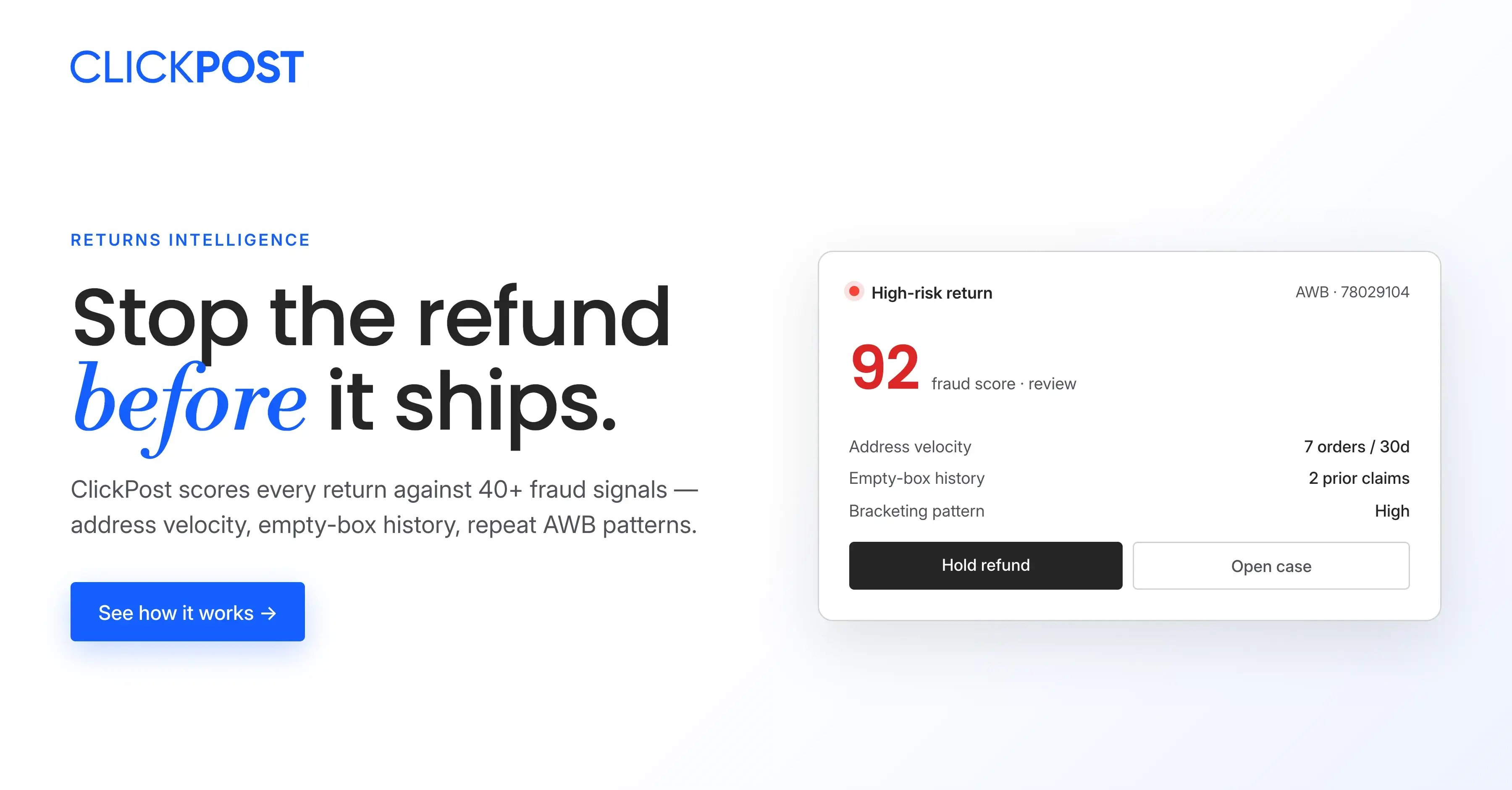
Return request intelligence: Rule-based scoring on every inbound request, evaluating customer return history, SKU risk tier, time since delivery, and account age. High-risk requests route automatically to manual review. Low-risk requests stay fast. Brands configure scoring rules by product category, segment, and region — no engineering resources needed.
-
Reverse logistics visibility: End-to-end tracking from label generation through carrier pickup, transit, and warehouse receipt. When inspection data (condition, weight, serial number) connects directly to the shipment record, you flag anomalies before authorizing the refund — not after the money's gone. ClickPost's carrier integrations across 500+ logistics partners keep this visibility consistent regardless of which carrier handles the return.
-
Conditional refund automation: Refunds stay in a pending state until warehouse inspection confirms the return — not triggered automatically on pickup scan. This single workflow change eliminates the most common double-loss scenario in hybrid fraud. Brands using conditional refund logic report measurable drops in both fraud losses and chargeback volume.
Book a demo to see how it works at your scale.
Returns Fraud Prevention Checklist
Use this to audit your current setup and assign ownership across ops, CS, finance, and warehouse teams.
-
Audit your return policy — update vague eligibility language with specific condition requirements, category-based windows, and tiered refund methods.
-
Build a physical inspection checklist at your warehouse — weight check, serial number match, photo documentation, condition grading before any refund goes out.
-
Configure risk-scoring rules in your returns platform for high-risk SKUs, new accounts, and elevated return-to-purchase ratios.
-
Set up real-time chargeback alerts via Verifi or Ethoca with pre-built evidence templates for each major reason code.
-
Maintain a fraud risk registry keyed to account, address, device fingerprint, and phone number — updated after every confirmed incident.
-
Verify your returns platform has API integrations with your OMS, payment processor, and carrier network for cross-functional data flow.
-
Train CS to recognize fraud scripts — demands for immediate cash refunds, implausible non-delivery claims on tracking-confirmed orders, threats of chargebacks or reviews as leverage.
-
Review fraud losses quarterly — segmented by type (returns vs. refund), SKU category, geography, and account cohort.
-
Check data retention requirements with legal counsel for fraud evidence — photos, serial number logs, chargeback records, customer comms.
-
Assess warehouse-to-payment visibility — if your warehouse team and finance team work in separate systems with no shared data, you have a structural vulnerability. Platforms like ClickPost unify both layers.
Frequently Asked Questions
What is returns fraud in ecommerce?
Returns fraud is when someone intentionally misuses a retailer's return process to get a refund they don't deserve — through empty box returns, wardrobing, counterfeit swaps, or receipt manipulation. It's distinct from honest return mistakes. The NRF estimates it costs U.S. retailers over $101 billion annually, with ecommerce channels hit harder due to the lack of in-person verification at the point of return.
What's the actual difference between returns fraud and refund fraud?
Returns fraud is physical — someone sends back an empty box, a counterfeit, or a used product claimed as new. Refund fraud is financial — someone files a fake chargeback, claims an item wasn't delivered, or exploits refund policies across multiple accounts. Returns fraud shows up at the warehouse level. Refund fraud shows up at the payment processor and CS level. Different detection systems, different fixes.
How much does this actually cost ecommerce brands?
The NRF puts total return fraud losses at $101 billion for 2023. For every $1 billion in returned merchandise, roughly $165,000 is fraudulent. Chargeback fraud adds another $11 billion+ per year (Chargebacks911). These are almost certainly underestimates — most brands don't track fraud as a separate category. Apparel and electronics verticals get hit hardest because of higher return rates and easily available counterfeits.
How can I tell if a return request is fraudulent?
Key red flags: the returned item's weight doesn't match the original product, the serial number doesn't match the purchase record, the customer has high return frequency across multiple accounts, the return is requested within 24–48 hours of delivery, or the customer insists on cash refunds despite policy terms allowing only store credit. Cross-referencing these signals through your returns management platform is the most reliable early-detection method.
Is friendly fraud the same as refund fraud?
Friendly fraud is a type of refund fraud — the most common and most costly type. It happens when a customer gets a legitimate order but disputes the charge, claiming non-delivery or unauthorized purchase. Visa estimates friendly fraud accounts for up to 75% of all chargebacks. The "friendly" label is misleading — the financial impact is anything but.
What policies prevent returns fraud most effectively?
The highest-impact policy changes: explicit condition requirements (unused, original tags, original packaging), category-specific return windows (shorter for electronics and apparel), photo evidence requirements for high-value returns, tiered refund methods based on verification level, and a no-return blacklist for confirmed fraud accounts. Policy clarity is the cheapest and fastest fraud prevention lever you have.
The Bottom Line
Returns fraud and refund fraud aren't one problem — they're two distinct threats targeting different parts of your ecommerce operation. One is physical, one is financial, and the fix for one won't catch the other.
The six-step framework in this guide — policy audit, warehouse verification, risk scoring, chargeback monitoring, account blacklisting, and platform investment — gives you a layered approach that addresses both. The goal isn't to make returns painful for everyone. It's to insert friction where risk is concentrated while keeping the experience fast for the customers who actually drive your business.
Brands that get this right don't just recover margin. They build infrastructure that scales — protecting revenue, strengthening trust, and turning returns from a cost center into a competitive edge.
Ready to move from reactive refund processing to proactive fraud detection? See how ClickPost Returns helps D2C brands build the ops infrastructure to stop both.