.png?width=193&height=27&name=ClickPost%20Logo%20(Blue).png)
.svg)
.svg)
.svg)
.svg)
.svg)
.svg)
.svg)
.svg)
.svg)


.svg)
.svg)
.svg)
.svg)


.svg)
.svg)
.webp?width=286&height=206&name=ROI%20Calculator%20(1).webp)
.svg)
.svg)

.svg)

.webp?width=286&height=206&name=RTO%20Playbook%20(1).webp)
USPS Priority Mail vs. USPS Flat Rates: Which Is Best for eCommerce Shipping?


Ready to ship smarter? Talk to our logistics experts.
Trusted by 600+ brands
In this blog
TL;DR
-
USPS Priority Mail pricing is based on package weight, dimensions, and shipping zone, while USPS Flat Rate charges a fixed price based only on the packaging size you choose, regardless of weight (up to 70 lbs) or destination.
-
According to USPS Notice 123, a Small Flat Rate Box ships for $13.66 retail ($12.10 commercial) anywhere in the US, making Flat Rate the better deal for heavy, small items traveling long distances.
-
Regular Priority Mail typically beats Flat Rate for lightweight packages shipped short distances (Zones 1 to 3), while Flat Rate becomes nearly unbeatable past Zone 4 for items over 5 lbs.
-
According to the USPS 2026 Integrated Financial Plan (IFP), USPS projects total mail and package volume of 101.5 billion pieces in 2026, a 6.6% decline from 2025 driven primarily by drops in First-Class Mail and Marketing Mail, even as package-specific services like Priority Mail continue to hold revenue.
-
For e-commerce brands managing multi-carrier shipping decisions at scale, platforms like ClickPost automate carrier allocation based on cost, speed, and serviceability so you don't have to compare rates manually for every order.
USPS Priority Mail vs USPS Flat Rate: Quick Comparison (2026)
| Feature | USPS Priority Mail | USPS Priority Mail Flat Rate |
| Pricing Basis | Weight + Dimensions + Shipping Zone | Fixed price per packaging type |
| Delivery Time | 1 to 3 business days | 1 to 3 business days |
| Weight Limit | Up to 70 lbs | Up to 70 lbs |
| Packaging | Your own boxes or USPS-provided | Must use USPS Flat Rate boxes/envelopes |
| Distance Sensitivity | Yes; farther zones cost more | No; same price coast-to-coast |
| Free Pickup | Included | Included |
| Tracking | Included | Included |
| Insurance | Up to $100 included | Up to $100 included |
| Saturday Delivery | Yes, no extra charge | Yes, no extra charge |
| Best For | Lightweight items, short-distance (Zones 1-3) | Heavy items (over 5 lbs), long-distance |
| Worst For | Heavy items going cross-country | Lightweight items going to nearby zones |
| Example Use Case | A 2 lb box shipped within the same state | A 15 lb box shipped from NY to CA |
This table covers the core trade-off: Priority Mail rewards you when your packages are light and your customers are nearby, while Flat Rate rewards you when your packages are heavy and your customers are spread across the country.
What Is USPS Priority Mail? How It Works and When to Use It
USPS Priority Mail is the United States Postal Service's expedited domestic shipping service, delivering packages within 1 to 3 business days based on origin and destination. According to the USPS 2026 Integrated Financial Plan, USPS projects total mail and package volume of 101.5 billion pieces in 2026, down 6.6% from 2025.
While overall volume is declining due to drops in First-Class Mail and Marketing Mail, Priority Mail specific revenue has held steady, partly because USPS Ground Advantage has absorbed lightweight, non-urgent volume that previously moved through Priority Mail.
Priority Mail pricing is calculated using three variables: the package's weight, its dimensional weight (length x width x height divided by 166 for retail, or 139 for commercial pricing), and the shipping zone (distance between origin and destination ZIP codes). USPS divides the US into zones 1 through 9, and charges based on whichever is greater: actual weight or dimensional weight.
Every Priority Mail shipment includes USPS Tracking, free package pickup, Saturday delivery at no extra cost, and up to $100 of included insurance. USPS does not add fuel surcharges, residential delivery surcharges, or rural delivery surcharges, which is a meaningful cost advantage over UPS and FedEx that routinely apply these fees. For a detailed breakdown of how shipping costs compare across major carriers, it helps to model each variable before committing to a service.
You can use your own packaging or order free USPS Priority Mail boxes and envelopes from usps.com. When you use your own packaging, the rate is always calculated based on weight, dimensions, and zone.
What Is USPS Priority Mail Flat Rate? Fixed Pricing Explained
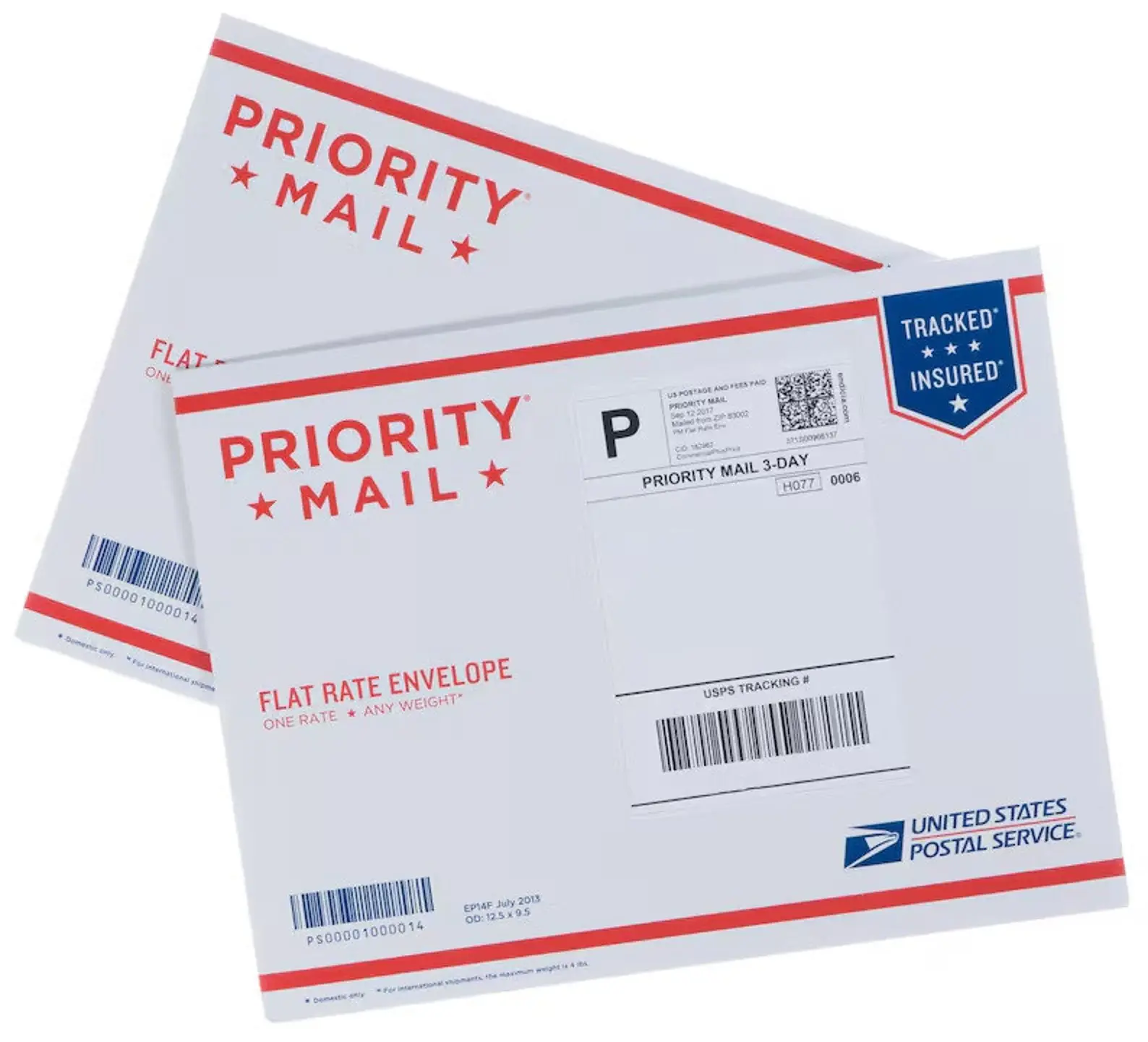
USPS Priority Mail Flat Rate is a subset of Priority Mail that charges a single fixed price per package, regardless of weight or destination, as long as the contents fit inside a designated USPS Flat Rate box or envelope and weigh no more than 70 pounds. Delivery is the same 1 to 3 business days as regular Priority Mail.
The critical constraint is packaging: you must use USPS-provided Flat Rate boxes or envelopes (available free at usps.com or any post office). You cannot use your own packaging and qualify for Flat Rate pricing.
Flat Rate removes zone-based distance calculations entirely. A Small Flat Rate Box costs the same whether shipping from Los Angeles to San Francisco or from Miami to Seattle. This predictability is why ecommerce businesses with nationwide customer bases gravitate toward flat rate shipping for certain product categories.
How USPS Shipping Pricing Works: Weight, Zone, and Packaging Options
Understanding how USPS calculates shipping costs is essential before deciding between Priority Mail and Flat Rate. There are three pricing models within the Priority Mail family.
-
Regular Priority Mail uses a zone-based pricing matrix. USPS assigns every origin-destination ZIP code pair a zone number from 1 (local) to 9 (coast to coast). The rate is determined by the shipping zone and the greater of actual weight or dimensional weight (L x W x H / 166 for retail, or / 139 for commercial). If your box is large but lightweight, dimensional weight can push the price significantly higher.
-
Priority Mail Flat Rate ignores weight and zone entirely. You select a Flat Rate box or envelope, and the price is fixed.
-
Priority Mail Cubic prices packages based on cubic volume rather than weight, available only through commercial pricing. Cubic Tier 1 (0.10 cubic feet) is often cheaper than a Small Flat Rate Box even for Zone 8 shipments, making it ideal for dense, compact products. However, Cubic is capped at 20 pounds.
How USPS Ground Advantage Compares to Priority Mail and Flat Rate in 2026
In 2026, the biggest competitor to Priority Mail is not just Flat Rate. It is USPS Ground Advantage, launched under the "Delivering for America" plan, consolidating legacy ground services into a single product for packages up to 70 lbs.
Ground Advantage is often 30% to 50% cheaper than Priority Mail for the same weight and zone, while still providing USPS Tracking and $100 of included insurance. The trade-off is speed: Ground Advantage takes 2 to 5 business days. For non-urgent shipments, it may beat both Priority Mail and Flat Rate on cost. Businesses managing logistics costs at scale should model all three options before defaulting to Priority Mail.
The decision now involves three tiers: Ground Advantage for cost-sensitive, non-urgent orders; Flat Rate for heavy items going long distances; and regular Priority Mail (or Cubic) for everything else.
USPS Zone Map: What Each Zone Means for Your Shipping Costs
|
Zone |
Approximate Distance |
Example Route |
| Zone 1 | Local / Up to 50 miles | Chicago, IL to Milwaukee, WI |
| Zone 2 | 51 to 150 miles | New York, NY to Philadelphia, PA |
| Zone 3 | 151 to 300 miles | Dallas, TX to Houston, TX |
| Zone 4 | 301 to 600 miles | Atlanta, GA to Nashville, TN |
| Zone 5 | 601 to 1,000 miles | Denver, CO to Phoenix, AZ |
| Zone 6 | 1,001 to 1,400 miles | New York, NY to Miami, FL |
| Zone 7 | 1,401 to 1,800 miles | Boston, MA to Dallas, TX |
| Zone 8 | 1,801+ miles | New York, NY to Los Angeles, CA |
| Zone 9 | US Territories / Military | Seattle, WA to Honolulu, HI (or Guam/PR) |
The higher the zone, the more expensive regular Priority Mail becomes relative to Flat Rate. This is where the two services diverge most sharply in cost. Using a USPS shipping calculator to plug in your exact weight and zone before choosing a service can prevent overpaying on high-volume shipments.
Current USPS Flat Rate Box and Envelope Prices in 2026
Current USPS Flat Rate pricing as of April 2026, sourced from USPS Notice 123. USPS publishes both retail prices (post office counter) and commercial prices (USPS.com Click-N-Ship, approved vendors, or ecommerce shipping software).
| Flat Rate Product | Dimensions | Retail Price | Commercial Price |
| Flat Rate Envelope | 12.5" x 9.5" | $12.91 | $11.10 |
| Legal Flat Rate Envelope | 15" x 9.5" | $13.23 | $11.45 |
| Padded Flat Rate Envelope | 12.5" x 9.5" | $13.99 | $12.00 |
| Small Flat Rate Box | 8.625" x 5.375" x 1.625" | $13.66 | $12.10 |
| Medium Flat Rate Box (Top Loading) | 11.25" x 8.75" x 6" | $24.79 | $21.20 |
| Medium Flat Rate Box (Side Loading) | 14" x 12" x 3.5" | $24.79 | $21.20 |
| Large Flat Rate Box | 12.25" x 12.25" x 6" | $34.02 | $30.95 |
| APO/FPO/DPO Large Flat Rate Box | 12.25" x 12.25" x 6" | $32.56 | $19.87 |
Data sources:
- USPS Postal Explorer – Price Change Index
- U.S. Postal Service Announces 2026 Rate Adjustments
- USPS Fiscal Year 2026 Financial Reports
Important pricing note: USPS has announced a transportation-related price adjustment effective April 26, 2026 (USPS Postal Explorer, Price Change Index). Always verify current pricing at usps.com or through USPS Notice 123 before committing to shipping rates.
The commercial vs. retail price gap is significant. For example, the Flat Rate Envelope is $1.81 cheaper at commercial rates. If you are shipping 500 envelopes per month, that translates to meaningful monthly savings just from using commercial pricing. Most shipping aggregator platforms and postage tools automatically apply commercial rates.
USPS Flat Rate Box Sizes and Dimensions: Which Box Should You Use?
Choosing the right Flat Rate box matters because you are paying the same price whether the box is full or half-empty. Here is a practical breakdown of each option and what typically fits inside.
The Flat Rate Envelope (12.5" x 9.5") is the cheapest option, suited for documents, t-shirts, small accessories, and similar flat or flexible products. The envelope must be sealable, so you cannot overstuff it. When comparing a Priority Mail envelope vs Flat Rate envelope, the key difference is that a regular Priority Mail envelope is priced by weight and zone, while the Flat Rate envelope is a fixed cost regardless of destination. For items under a pound shipping locally, regular Priority Mail may be cheaper; for heavier contents going cross-country, the Flat Rate envelope almost always wins.
The Small Flat Rate Box (8.625" x 5.375" x 1.625") is the most compact box option. It is best suited for small, dense items like jewelry, small electronics, cosmetics, or specialty food products. The low height (1.625") is the limiting factor: anything taller than about 1.5 inches after packaging will not fit.
The Medium Flat Rate Box comes in two shapes. The top-loading version (11.25" x 8.75" x 6") is better for items with some height, like mugs, small appliances, or stacked products. The side-loading version (14" x 12" x 3.5") works for flatter but wider items like books, framed photos, or folded clothing. Both cost the same.
Note that the side-loading Medium Flat Rate Box is subject to availability at local post offices, as USPS has occasionally restricted production of this variant. You can reliably order it online at usps.com.
The Large Flat Rate Box (12.25" x 12.25" x 6") is the biggest option and fits larger products like shoes, multi-item orders, or bulkier goods. However, as discussed in the next section, this box is not always the best deal.
When Is USPS Flat Rate Cheaper Than Priority Mail?
Flat Rate wins in specific, predictable scenarios. Knowing these scenarios prevents you from overpaying on shipments where regular Priority Mail would be cheaper.
Heavy items shipped long distances: Flat Rate's sweet spot
This is Flat Rate's strongest advantage and often the cheapest USPS shipping option for heavy packages. If you are shipping a 10-pound product from New York to California (Zone 8), regular Priority Mail might cost $25 to $35 depending on dimensions, while a Small Flat Rate Box costs a fixed $13.66 retail. The savings scale with both weight and distance. For USPS shipping for heavy small items specifically, the Small Flat Rate Box is hard to beat since you are paying a flat rate regardless of whether the contents weigh 2 pounds or 15 pounds.
The "Zone 4 rule of thumb" for choosing between Flat Rate and Priority Mail
Historically, for any package over 2 lbs, Flat Rate becomes cheaper than zone-based Priority Mail once you cross into Zone 4 or Zone 5. For Zones 1 to 3, regular Priority Mail is almost always the better deal. Past Zone 5, Flat Rate is nearly unbeatable for items over 5 lbs. This is a useful mental shortcut when you are deciding between the two services for a specific order.
Predictable product dimensions that fit Flat Rate packaging
If your product catalog consists of items that consistently fit into a Small Flat Rate Box or Flat Rate Envelope, you get the operational benefit of never having to calculate zone-based rates. For ecommerce fulfillment operations quoting shipping costs at checkout, this predictability means fewer pricing errors and more accurate margins.
High-density products where weight drives cost
Items like specialty food products, metal components, tools, or beauty products that are heavy for their size are prime Flat Rate candidates. The fixed price means the weight penalty you would face with regular Priority Mail disappears.
Nationwide shipping with a geographically dispersed customer base
If your customer base is geographically dispersed, the zone-agnostic pricing of Flat Rate eliminates the cost volatility that comes with zone-based pricing. A brand shipping from a single warehouse benefits most from Flat Rate when orders regularly cross multiple zones. This is especially relevant for D2C brands in the US that ship from centralized fulfillment locations.
When Is Regular USPS Priority Mail Cheaper Than Flat Rate?
Flat Rate is not always the better deal. In several common scenarios, regular Priority Mail with your own packaging will cost less.
Lightweight packages shipped short distances (Zones 1–3)
A 1-pound package shipped within Zone 2 might cost $8 to $10 via regular Priority Mail, which is cheaper than most Flat Rate box options. If most of your customers are regional, zone-based pricing works in your favor.
Large, lightweight items where dimensional weight is low
USPS shipping for lightweight large packages is where regular Priority Mail typically outperforms Flat Rate. If you are shipping a product that is bulky but light, like a pillow, a hat, or a large but lightweight toy, regular Priority Mail with your own appropriately sized box can be cheaper than a Large Flat Rate Box. The Large Flat Rate Box costs $34.02 retail, which is often more expensive than a lightweight package shipped at regular Priority Mail rates, even across several zones. Understanding how to ship a package cost-effectively means matching the packaging type to the product's actual weight profile.
Items that do not fit standard Flat Rate packaging
Flat Rate pricing requires USPS Flat Rate packaging. If your product is too large, too irregularly shaped, or too fragile to fit safely inside a Flat Rate box, regular Priority Mail with your own custom packaging is the only option. Shipping electronics or other items requiring custom protective packaging often falls into this category.
When you qualify for Priority Mail Cubic commercial pricing
Priority Mail Cubic, available through commercial pricing, calculates rates based on package volume rather than weight. For items under 20 pounds that are small and dense, Cubic can undercut both regular Priority Mail and Flat Rate. Cubic Tier 1 (0.10 cubic feet) for a Zone 8 shipment can cost as little as $8 to $10, compared to $13.66 for a Small Flat Rate Box. This makes Cubic the cheapest USPS option for compact, heavy items if you have access to commercial pricing.
Common USPS Shipping Mistakes That Cost Ecommerce Sellers Money
Ecommerce sellers frequently lose money on shipping because they default to one service without running the numbers. Here are the most common mistakes.
Assuming Flat Rate is always cheaper for heavy items
Medium and Large Flat Rate Boxes can be significantly more expensive than shipping the same item in your own packaging with regular Priority Mail or Cubic pricing. A 5-pound item shipped in a Medium Flat Rate Box across Zone 3 might cost $24.79, while the same item in your own box via regular Priority Mail might cost $12 to $14.
Using the wrong Flat Rate box size
Paying for a Medium Flat Rate Box when your item fits in a Small Flat Rate Box is a direct margin loss. Always test your product in the smallest Flat Rate packaging it will fit in before settling on a box size.
Ignoring commercial pricing when it's readily available
Retail Flat Rate prices are the rates you pay at the post office counter. Commercial prices, available through USPS.com Click-N-Ship or third-party multi-carrier shipping platforms, are consistently lower. Not using commercial pricing is one of the most common avoidable costs for small ecommerce businesses.
Not accounting for dimensional weight on large light boxes
With regular Priority Mail, USPS uses the greater of actual weight or dimensional weight (L x W x H / 166). Shipping a large, light box can trigger dimensional weight pricing that makes the shipment surprisingly expensive. If this happens frequently, switching to Flat Rate for those specific items may save money. Sellers who rely on accurate estimated delivery date tools alongside rate calculators tend to catch these discrepancies faster.
Overlooking Priority Mail Cubic pricing for small dense items
Many sellers do not know Priority Mail Cubic exists because it is only available through commercial pricing channels. For packages under 20 pounds, Cubic pricing based on volume can be cheaper than both regular Priority Mail and Flat Rate. Platforms that support automated shipping typically surface Cubic rates alongside other options so sellers can choose the lowest-cost service automatically.
USPS Priority Mail vs Flat Rate for Ecommerce Brands: How to Decide at Scale
For ecommerce businesses, the Priority Mail vs Flat Rate decision is not a one-time choice. Most brands running 500+ orders per month use both services depending on the product, destination, and order profile. A brand with 20 SKUs shipping to all 50 states faces hundreds of rate combinations, making manual comparison impractical at scale. Even small per-package savings compound: $2 saved per package across 5,000 monthly shipments is $10,000 per month. Choosing the right shipping carrier for each order type is one of the highest-leverage decisions in ecommerce operations.
Flat Rate vs Priority Mail: Ecommerce Decision Guide by Order Type
| Scenario | Recommended Service | Why |
| Subscription Box (Consistent size, ships nationwide) | Flat Rate |
Predictable cost per box; eliminates zone-based pricing volatility for nationwide reach.
|
| Jewelry or Small Accessories | Small Flat Rate Box or Cubic |
Ideal for high-density, low-volume items. Cubic Tier 1 often undercuts Flat Rate for Commercial users.
|
| Apparel (T-shirts, hoodies, lightweight items) | Flat Rate Envelope or Regular Priority Mail |
For single items, the Padded Flat Rate Envelope is a staple; for bulkier regional orders, regular Priority wins.
|
| Heavy Equipment Parts / Tools | Flat Rate (Small or Medium) |
Weight is the primary cost driver here; Flat Rate (up to 70 lbs) ignores the weight penalty.
|
| Oversized or Irregular Items | Regular Priority Mail (Own Packaging) |
Best for items that physically cannot fit in the standardized dimensions of Flat Rate boxes.
|
| Regional Business (Most customers within 300 miles) | Regular Priority Mail |
Zone 1–3 pricing is significantly cheaper than Flat Rate for almost all weights under 10 lbs.
|
| Non-urgent, Cost-sensitive Orders | USPS Ground Advantage |
New for 2026: 30–50% cheaper than Priority Mail with a 2–5 day delivery window and $100 included insurance.
|
| Nationwide D2C Brand (Single warehouse) | Mix of Flat Rate, Priority, & Ground Advantage |
Automated allocation is essential. Systems should choose Ground for savings and Priority/Flat Rate for speed.
|
How to Track USPS Priority Mail and Flat Rate Shipments
Both Priority Mail and Flat Rate shipments include USPS Tracking at no additional cost. Every package receives a tracking number that you can use on tools.usps.com or the USPS mobile app to monitor delivery progress. USPS Tracking provides scan events at major processing points: acceptance, arrival at facility, departure, out for delivery, and delivered.
For ecommerce brands, basic USPS tracking has limitations. The tracking page is generic and carrier-branded, with no ability to customize the experience or proactively notify customers about delays. Brands processing high volumes often layer a post-purchase platform on top to provide branded tracking pages, real-time delay alerts via SMS, email, or WhatsApp, and proactive NDR management to reduce RTO rates. The ability to surface ecommerce order tracking data in a unified dashboard is especially valuable when shipping with multiple carriers simultaneously.
How to Package Items Securely for USPS Priority Mail and Flat Rate
If using Flat Rate shipping, the USPS-provided Envelopes and Boxes are pre-designed to meet USPS standards. Ensure the packaging seals completely; overstuffed Flat Rate Envelopes may be returned or reclassified at a higher rate.
For fragile products, choose a box with at least 2 inches of clearance on all sides and use bubble wrap or packing peanuts. Mark the package as "Fragile" for handling guidance, though USPS does not guarantee special treatment.
Both Priority Mail and Flat Rate include up to $100 of insurance. For high-value items, purchase additional coverage through USPS or explore shipping insurance options from third-party providers, and document the item's condition with photos before shipping.
How to Handle USPS Shipment Problems: Delays, Damage, and Lost Packages
Start by checking tracking on tools.usps.com. If tracking has not updated in more than 7 days, submit a Missing Mail search request through the USPS website. For damaged packages, file an insurance claim at usps.com/help within 60 days of the mailing date with your tracking number, proof of value, and photos of damage. You can also contact USPS at 1-800-275-8777 or visit your nearest post office. For recurring shipping problems across carriers, tracking patterns at scale through a logistics platform can help identify systemic issues before they compound.
How ClickPost Helps Ecommerce Brands Automate Priority Mail vs Flat Rate Decisions
For brands shipping hundreds or thousands of orders daily, the Priority Mail vs Flat Rate comparison is just one piece of a larger carrier allocation puzzle. Most brands work with multiple carriers (USPS, UPS, FedEx, regional carriers) and need to select the optimal service for each order based on cost, speed, serviceability, and package profile. The challenges of courier allocation grow quickly once you move beyond a handful of daily shipments.
ClickPost is a post-purchase logistics intelligence platform that sits on top of your existing carrier contracts and automates these decisions. Instead of manually comparing services for each order, ClickPost's AI-powered allocation engine evaluates all available options across your carrier stack and selects the best one based on rules you define: lowest cost, fastest delivery, or highest reliability for a specific region. Learn more about how AI and machine learning in carrier allocation can reduce per-shipment costs at scale.
Beyond allocation, ClickPost provides branded tracking pages, proactive notifications via SMS, email, and WhatsApp across 600+ carriers, automated NDR management, and returns management with self-service portals. Over 450 global brands use ClickPost to manage post-purchase logistics.
USPS Priority Mail vs Flat Rate: Which Should You Use?
The core difference between USPS Priority Mail and USPS Flat Rate comes down to how USPS calculates the shipping cost. Priority Mail uses weight, dimensions, and shipping zone. Flat Rate uses only the packaging type, charging a fixed price regardless of weight or destination.
Neither service is universally cheaper. Flat Rate wins for heavy items shipped long distances (past Zone 4) and for brands that want predictable, zone-agnostic shipping costs. Regular Priority Mail wins for lightweight packages shipped short distances (Zones 1 to 3) and for items that do not fit standard Flat Rate packaging. Cubic pricing, available through commercial channels, adds a third option for small, dense items under 20 pounds. And for non-urgent shipments, USPS Ground Advantage can be 30% to 50% cheaper than Priority Mail while still providing tracking and $100 insurance.
For ecommerce businesses, the most cost-effective approach is not choosing one service over the other. It is using both strategically, selecting the cheapest option for each individual order based on weight, dimensions, and destination. Carrier allocation that reduces shipping costs requires automating this comparison at scale — manual rate shopping becomes unsustainable past a few hundred shipments per month.
USPS rates are subject to periodic adjustments. Always verify current pricing through USPS Notice 123 or the USPS Priority Mail product page before setting your shipping rates.
Frequently Asked Questions: USPS Priority Mail vs Flat Rate
What is the difference between USPS Priority Mail and USPS Flat Rate?
USPS Priority Mail pricing is calculated based on package weight, dimensions, and shipping zone (distance). USPS Flat Rate charges a fixed price based on the box or envelope size you choose, regardless of weight (up to 70 lbs) or destination within the US. Both services deliver in 1 to 3 business days and include USPS Tracking and up to $100 of insurance.
Which is cheaper for heavy packages: USPS Flat Rate or Priority Mail?
USPS Flat Rate is almost always cheaper for heavy packages shipped long distances. A Small Flat Rate Box costs $13.66 retail regardless of weight or zone, while a 10-pound package shipped coast-to-coast via regular Priority Mail can cost $25 to $35. Past Zone 4, Flat Rate becomes the more cost-effective option for items over 5 lbs.
Is USPS Priority Mail or Flat Rate cheaper for lightweight shipments?
Regular USPS Priority Mail is typically cheaper for lightweight packages shipped short distances. A 1-pound package shipped within Zone 2 costs roughly $8 to $10 via Priority Mail, which undercuts most Flat Rate box prices. Zone-based pricing works in your favor when packages are light and customers are nearby.
Can I use my own box with USPS Priority Mail?
Yes, USPS Priority Mail allows you to use your own packaging. Shipping costs are then calculated based on weight, dimensions, and delivery zone. Flat Rate pricing only applies when you use official USPS Flat Rate boxes or envelopes, which are available free from usps.com or any post office.
What are the current USPS Flat Rate box prices in 2026?
As of April 2026 (USPS Notice 123), retail prices are: Flat Rate Envelope $12.91, Small Flat Rate Box $13.66, Medium Flat Rate Box (Top Loading) $24.79, and Large Flat Rate Box $34.02. Commercial prices are lower across all box types. USPS adjusts rates periodically, so always verify at usps.com before quoting shipping costs.
Which is faster: USPS Flat Rate or Priority Mail?
Neither is faster. Both USPS Flat Rate and regular Priority Mail deliver within 1 to 3 business days using the same USPS Priority Mail network. The difference between the two services is entirely in how the shipping cost is calculated, not in delivery speed.
What is the weight limit for USPS Flat Rate shipping?
USPS Flat Rate shipments can weigh up to 70 pounds per package. As long as the item fits inside the designated Flat Rate box or envelope and stays within this weight limit, the price remains fixed regardless of destination. Most ecommerce products fall well below this threshold.
Which is better for ecommerce businesses: USPS Priority Mail or Flat Rate?
Most ecommerce brands running 500+ orders per month use both services. Flat Rate works best for heavy, standardized products shipped nationwide, while Priority Mail is better for variable-sized or lightweight items and regional shipments. Using multi-carrier shipping strategies with automated carrier allocation to select the cheapest service per order is the most cost-effective approach at scale.
Does USPS Priority Mail include tracking and insurance?
Yes, both standard Priority Mail and Flat Rate shipments include free USPS Tracking and up to $100 of insurance coverage. USPS does not charge fuel surcharges, residential delivery surcharges, or rural delivery surcharges on Priority Mail, which is a cost advantage over private carriers. For a broader carrier comparison, see how FedEx vs USPS vs UPS stack up across key metrics.
How do I choose between USPS Priority Mail and Flat Rate for my shipment?
Compare your package weight, dimensions, and destination zone. Use Flat Rate for heavy items going past Zone 4, and regular Priority Mail for lighter packages or nearby shipments (Zones 1 to 3). For small, dense items under 20 lbs, also check Priority Mail Cubic pricing, which can undercut both options. For businesses managing this decision across thousands of orders, shipping tools built for small and growing businesses can automate the comparison and apply the cheapest rate at checkout automatically.




We use cookies to keep the site working, understand usage, and improve your experience. Learn more
Always active for essential site performance and security.
Enables anonymous usage analysis to refine our services.
Used to present relevant promotions and advertising.