.png?width=193&height=27&name=ClickPost%20Logo%20(Blue).png)
.svg)
.svg)
.svg)
.svg)
.svg)
.svg)
.svg)
.svg)
.svg)


.svg)
.svg)
.svg)
.svg)
.svg)
.svg)


.svg)
.svg)
.webp?width=286&height=206&name=ROI%20Calculator%20(1).webp)
.svg)
.svg)

.svg)

.webp?width=286&height=206&name=RTO%20Playbook%20(1).webp)



In this blog
What Is a Delivery Exception? Causes, Types, and How to Prevent Them in 2025
E-commerce has transformed the way consumers shop, making deliveries faster and more convenient. However, despite advances in logistics, shipping delays remain an unavoidable challenge. One of the most frustrating experiences for both businesses and customers is encountering a delivery exception — an unforeseen delay that prevents a package from reaching its intended destination on time.
For ecommerce merchants, delivery exceptions can lead to delayed shipments, frustrated customers, and additional operational costs. Customers who encounter these exceptions often blame the retailer, even when the issue lies with major carriers like FedEx, UPS, or USPS.
According to recent data:
-
62% of online shoppers have faced a delivery exception.
-
78% of consumers expect the retailer—not the carrier—to resolve the issue.
-
1 in 20 online orders never reaches the correct shipping address due to delivery exceptions.
Businesses that fail to handle delivery exceptions effectively risk a damaged brand reputation, increased return rates, and lower customer satisfaction. While such events are often beyond a merchant's control, understanding their causes and solutions can minimize delivery exceptions and improve the overall ecommerce shipping process.
Key points to keep in mind:
-
A delivery exception notice typically indicates an unexpected event that has disrupted the delivery process.
-
FedEx shipments and other major carriers frequently encounter shipment exceptions due to weather conditions, customs delays, or address errors.
-
Ecommerce businesses can take proactive measures to reduce common exceptions and ensure a successful delivery.
Now, let's explore delivery exceptions, their common causes, and how businesses can prevent them.
What Does Delivery Exception Mean? Definition and How It Affects Your Shipment
A delivery exception occurs when a shipment is delayed in transit due to an unforeseen circumstance, preventing it from being delivered on time. While an exception does not always mean a package will miss its delivery date, it does indicate a disruption in the shipping process that requires attention or resolution.
How Delivery Exceptions Work: What Happens to Your Package
A shipment exception can occur due to carrier issues, regulatory delays, customs hold-ups, or problems with the shipping label. When a package encounters such a delay, the carrier updates the delivery status to reflect the reason for the exception. Businesses and customers can track the status updates using the tracking number provided by the shipping carrier.
Key characteristics:
-
The carrier has encountered an issue that delays the shipment.
-
The package is stalled in transit but may still reach its intended destination.
-
Customers may receive a delivery exception notification explaining the delay.
For businesses that rely on FedEx shipments, UPS, DHL, and USPS, delivery exceptions are common occurrences that require quick intervention. Whether due to inclement weather, incorrect addresses, or customs delays, the goal is to resolve exceptions swiftly to maintain customer satisfaction. Using a reliable package tracking software can help businesses stay on top of these disruptions in real time.
What Are the Most Common Causes of Delivery Exceptions?
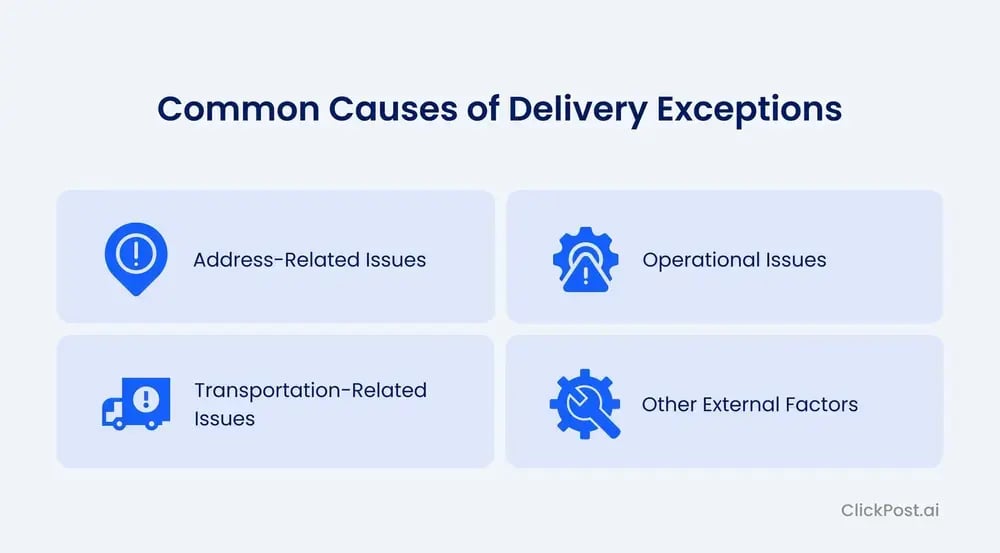
Delivery exceptions can occur for multiple reasons, many of which are beyond a business's control. Understanding these causes can help ecommerce merchants proactively manage potential delays and ensure a smoother delivery process.
1. Incorrect or Incomplete Shipping Address
One of the most frequent causes of delivery exceptions is incorrect address details. If a package is sent to a wrong address or contains incomplete information, the carrier may be unable to deliver packages successfully.
Common issues include:
-
Misspelled or missing unit numbers in the shipping address.
-
The recipient's address does not exist or is unclear.
-
Unreadable or damaged shipping labels, preventing proper scanning.
Example: A customer enters "Apt 12" instead of "Apt 102," which causes the delivery driver to return the package.
2. Weather Delays, Road Closures, and Transportation Disruptions
Disruptions in the delivery route can cause delayed shipments. It may happen due to:
-
Inclement weather (storms, hurricanes, snow).
-
Traffic congestion or road closures preventing access.
-
Mechanical failures affecting carrier vehicles.
Example: A FedEx truck encounters weather delays due to a snowstorm, preventing successful delivery on the expected delivery date.
3. Carrier Operational Issues: Sorting Errors and Peak Season Backlogs
Internal carrier problems can lead to shipment exceptions. Some examples include:
-
Sorting facility errors, where packages are misrouted.
-
High package volumes can cause delayed shipments during peak seasons.
-
Technical glitches, where system failures impact tracking updates.
Example: During the holiday season, carriers experience shipping delays due to an overload of parcels.
4. Customs Delays, National Holidays, and Other External Factors
External circumstances beyond anyone's control can also lead to a delivery exception status. These include:
-
Customs delays for international shipments.
-
National holidays, when the postal service is closed.
-
Regulatory delays due to non-compliant shipments.
Example: A package from the U.S. to Canada is flagged for a customs inspection, leading to a shipment exception.
4 Most Common Types of Delivery Exceptions and What They Mean
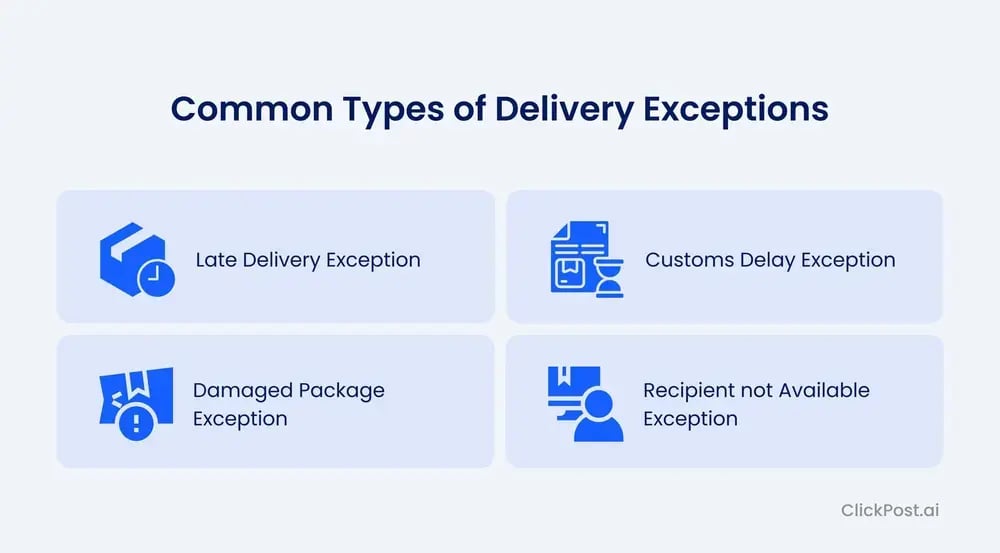
Delivery exceptions come in different forms, each with unique causes and resolutions. Here are four of the most common exceptions businesses and customers encounter:
1. Late Delivery Exception: Why Your Package Didn't Arrive on Time
A late delivery exception occurs when a package does not arrive on its expected delivery date due to the following:
-
Severe weather disruptions.
-
Mechanical failures with carrier vehicles.
-
Missed processing deadlines at carrier hubs.
Example: A FedEx delivery is expected by Monday but is delayed due to a hurricane warning in the area.
2. Damaged Package Exception: What Happens When a Shipment Is Damaged in Transit
If a package sustains damage during transit, it may be held by the carrier or returned to the sender. Common reasons include:
-
Inadequate packaging leading to damage.
-
Rough handling during the shipping process.
-
External impacts from accidents or drops.
Example: A fragile item arrives crushed due to poor packaging, leading to a poor delivery experience for the customer.
3. Customs Delay Exception: Why International Packages Get Held Up
For international shipping, customs delays can occur due to:
-
Incomplete or missing documentation.
-
Regulatory restrictions on certain items.
-
Random package reviews by customs officers.
Example: A package containing electronics is held at customs for inspection, delaying its arrival by a week.
4. Recipient Not Available Exception: What Carriers Do When No One Is Home
If the recipient's unavailability prevents a successful delivery, the package may be:
-
Rescheduled for another delivery attempt.
-
Held at a local carrier facility for pickup.
-
Returned to sender after multiple failed attempts.
Example: A delivery driver arrives at the recipient's home, but no one is available to sign for the package.
How Delivery Exceptions Impact Ecommerce Businesses: Costs, Loyalty, and Cash Flow
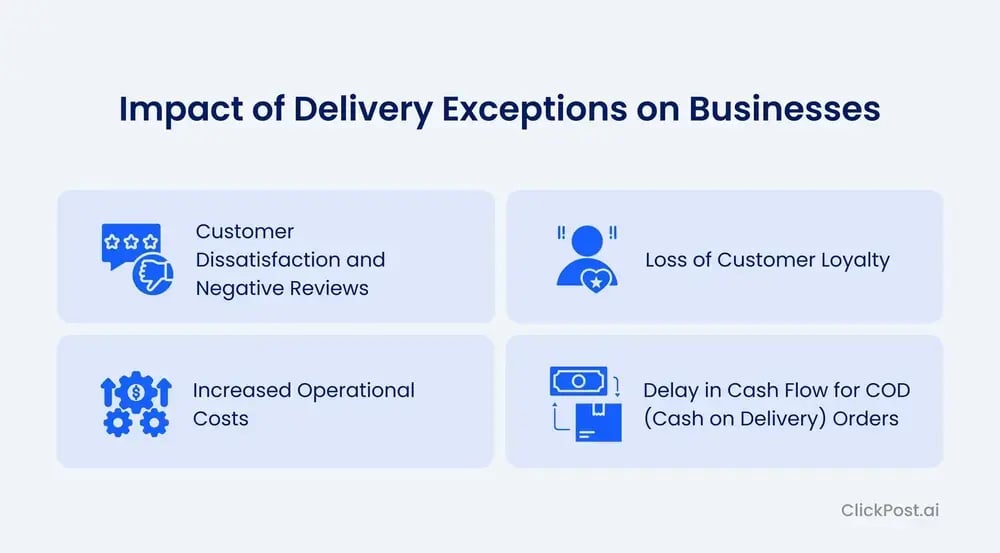
Delivery exceptions can significantly impact an ecommerce store's operations, profitability, and brand perception. While occasional exceptions may seem like minor setbacks, frequent delivery issues can erode customer trust, inflate operational costs, and disrupt cash flow. Businesses that do not avoid delivery exceptions risk long-term consequences that go beyond a single undelivered package.
1. Customer Dissatisfaction, Negative Reviews, and Loss of Brand Trust
A delivery exception can lead to a frustrating experience for customers, particularly when they are left without proper tracking information or an estimated resolution time. Many shoppers expect smooth transactions from start to finish, and any disruption in the ecommerce logistics process can diminish their confidence in a brand.
When a package fails to arrive as expected, customers often contact the customer support team, expecting quick answers. If the issue is not resolved efficiently, the likelihood of negative reviews, public complaints on social media, and a drop in customer satisfaction increases.
Given the competitive nature of eCommerce, one poor experience can deter a customer from returning, forcing businesses to spend more on acquiring new buyers instead of retaining existing ones. This directly affects the overall post-purchase experience that customers associate with a brand.
2. Increased Operational Costs and Fulfillment Expenses
Every delivery exception creates a ripple effect on business expenses. Customer inquiries spike, increasing the workload of customer support teams, which must investigate the shipment exception and liaise with FedEx shipments or other carriers. Additionally, businesses may need to arrange replacements, refunds, or expedited reshipping, all of which add to the cost burden.
Operational disruptions also extend to warehouse management, where undelivered or returned shipments need to be processed again. Inventory adjustments, reshelving, and order reprocessing take up valuable time and resources, leading to inefficiencies. If unpredictable delays become frequent, businesses must invest in better ecommerce fulfillment strategies to avoid delivery exceptions and optimize logistics.
3. Loss of Customer Loyalty and Repeat Business
Loyalty in eCommerce is built on reliability. A seamless delivery process fosters trust, while frequent delivery issues can push customers toward competitors. A single delivery exception may not immediately drive away a customer, but repeated instances can lead to lost business over time.
Customers who experience shipping exceptions may start associating the brand with inconsistent service. Even if the FedEx delivery exception or issue was caused by external factors like weather conditions, the business still bears the brunt of customer dissatisfaction. To maintain loyalty, companies must proactively communicate about shipment exceptions, set clear expectations, and offer quick resolutions.
4. Cash Flow Delays for COD (Cash on Delivery) Orders
For businesses that rely on cash-on-delivery (COD) orders, delivery exceptions can lead to cash flow disruptions. Since payment is collected upon delivery, any shipment exceptions, such as an undelivered or returned package, result in delayed or lost revenue.
When a package is delayed or undeliverable, businesses must not only wait longer for payment but also incur additional costs for storage or reattempted delivery. High COD order failure rates due to unpassable conditions or recipient unavailability of the delivery route can create cash flow imbalances, impacting financial planning. To mitigate this risk, businesses need strong delivery exception management strategies to ensure smoother last-mile delivery logistics.
How to Prevent Delivery Exceptions: 5 Proven Strategies for Ecommerce Businesses

While shipment exceptions are sometimes unavoidable, businesses can implement strategies to significantly prevent delivery exceptions and ensure a more reliable delivery process. By optimizing address validation, using weather-resistant labels, improving tracking visibility, and streamlining logistics communication, companies can reduce the likelihood of delivery issues and improve overall efficiency.
1. Use Accurate Address Validation to Avoid Misdeliveries
Address errors are one of the leading reasons for delivery exceptions. If a package is sent to an incorrect address, it may be delayed, returned, or lost entirely. Address validation ensures that the recipient's details are correct before the package is dispatched. An excellent example of an automated tool for this is a UPS address verification tool.
-
Use automated address verification tools to detect errors in real time.
-
Require customers to double-check their shipping address during checkout.
-
Cross-check addresses against courier databases to avoid undeliverable locations.
-
Implement fraud detection to prevent fake or incomplete address entries.
2. Provide Real-Time Shipment Tracking and Proactive Delay Alerts
Providing shipment tracking information helps customers and businesses monitor FedEx shipments and other deliveries in real-time. Live updates enable quick intervention if a package encounters unpredictable delays. Investing in a robust ecommerce order tracking system ensures customers stay informed at every stage of the journey.
-
Enable SMS and email notifications for every status update.
-
Integrate real-time carrier tracking on order pages.
-
Use AI-powered tracking to predict delivery route unpassable conditions.
3. Streamline Customer Communication Before and During Exceptions
A well-informed customer is less likely to feel frustrated when facing a delivery exception. Transparent communication can prevent delivery exceptions from escalating into complaints or refund requests.
-
Set up proactive customer alerts for potential shipping exceptions.
-
Train customer support teams to handle inquiries efficiently.
-
Offer self-service options for customers to update their shipping address before dispatch.
4. Partner With Reliable Carriers and Diversify Your Logistics Network
Not all shipping companies offer the same level of reliability. Choosing a logistics partner with a strong track record can help businesses prevent delivery exceptions before they occur. Working with best-in-class shipping carriers and using multi-carrier shipping software reduces dependency on a single provider.
-
Assess carrier performance based on past shipment exceptions.
-
Diversify carrier partnerships to reduce dependency on a single provider.
-
Negotiate service-level agreements (SLAs) that cover exception handling.
5. Ensure Customs Compliance for International Shipments
Customs delays are a significant cause of delivery exceptions in international shipping. Proper documentation and compliance can help prevent unexpected hold-ups.
-
Ensure all customs forms are correctly filled out.
-
Partner with fulfillment partners who specialize in cross-border logistics.
-
Use automated customs clearance tools to minimize processing time.
Delivery Exceptions by Carrier: FedEx, UPS, USPS, and DHL Compared
Each logistics provider takes a different approach to handling shipment exceptions. Understanding how different carriers manage delivery exceptions can help businesses plan accordingly. For a detailed comparison of carrier performance and pricing, see our guide on FedEx vs USPS vs UPS.
1. FedEx Delivery Exceptions: Common Causes and How to Resolve Them
FedEx is known for express shipping, but FedEx shipments can still experience delivery exceptions due to weather, address issues, or customs delays for international orders. Customers can use the FedEx tracking number to monitor delays and contact FedEx customer service for resolution. You can also review FedEx shipping rates to understand cost implications of rerouted or returned shipments.
2. UPS Delivery Exceptions: Wrong Addresses, Failed Signatures, and More
UPS frequently encounters delivery issues related to wrong addresses, failed signatures, or operational disruptions. Customers experiencing a shipping exception with UPS may need to verify their address or reschedule delivery. Understanding UPS shipping costs can also help businesses budget for potential re-delivery charges.
3. USPS Delivery Exceptions: Holiday Delays and Postal Disruptions
USPS exceptions often arise due to national holidays or postal service disruptions. Customers are advised to use USPS tracking services to check delivery updates and arrange alternative pickup locations if necessary. Businesses can consult the USPS shipping calculator to plan shipping timelines around known disruption periods.
4. DHL Delivery Exceptions: Customs Holds and International Regulatory Delays
Since DHL primarily handles international shipments, most DHL delivery exceptions result from regulatory delays or customs holds. Businesses shipping internationally should ensure proper documentation and compliance to avoid clearance issues. Reviewing DHL courier charges in advance can also help with cost planning when exceptions require rerouting.
How to Handle Delivery Exceptions Effectively: A Step-by-Step Response Plan
Even with the best logistics planning, delivery exceptions occasionally occur. Ecommerce businesses must have a structured approach to efficiently resolving shipment exceptions to keep customers happy and maintain operational stability.
1. Communicate Proactively With Customers the Moment an Exception Occurs
Customers appreciate transparency. Businesses should notify customers as soon as a delivery exception is detected and provide an estimated resolution timeline.
-
Send automated alerts via SMS and email.
-
Offer self-service tracking updates through an online portal.
-
Provide clear instructions on how customers can contact FedEx customer service or other carriers for updates.
2. Offer Quick Resolutions: Rescheduling, Refunds, and Expedited Reshipping
If a shipping exception causes delays or failed deliveries, businesses should act swiftly to prevent escalations.
-
Reschedule missed deliveries at no extra charge.
-
Offer store credit or free shipping on replacement orders.
-
Arrange expedited shipping for high-priority packages.
Having a well-structured delivery exception response plan ensures that businesses can handle delivery exceptions efficiently, maintain customer satisfaction, and minimize the impact on operations.
Best Tools and Software for Managing Delivery Exceptions in Ecommerce
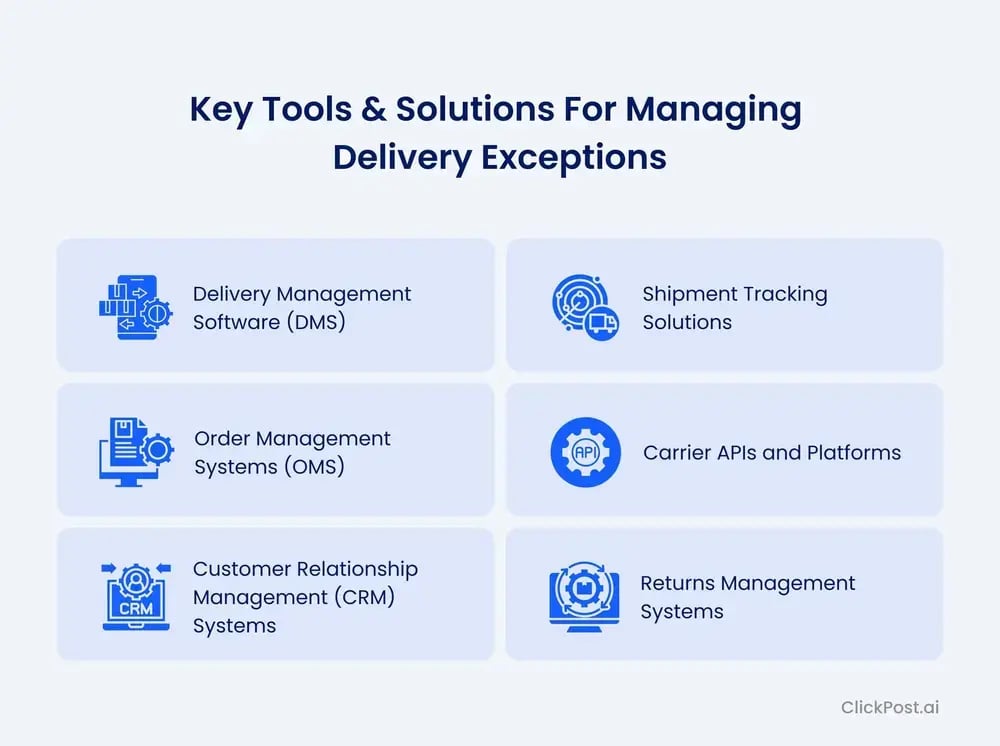
Managing delivery exceptions effectively requires a combination of technology, automation, and proactive intervention. Businesses can leverage specialized software and systems to streamline logistics, improve tracking visibility, and minimize disruptions. Below are the key tools that help companies manage delivery exceptions efficiently.
1. Delivery Management Software (DMS): Automate Dispatch and Route Optimization
Delivery Management Software (DMS) is an all-in-one platform that enables businesses to oversee their logistics operations in real-time. It automates dispatching, optimizes routes, and provides status updates on active shipments.
DMS solutions help businesses prevent unpassable delivery ways by leveraging AI-powered route planning and traffic monitoring. They also provide alerts when shipments encounter potential disruptions, allowing companies to take immediate action. By integrating a DMS, small business owners can enhance operational efficiency while reducing the impact of unforeseen delivery challenges.
2. Order Management Systems (OMS): Sync Fulfillment, Inventory, and Carrier Dispatch
An Order Management System (OMS) centralizes order processing, inventory updates, and shipment tracking in one platform. This tool helps businesses synchronize order fulfillment with warehouse operations and carrier dispatching, reducing errors that may lead to delivery exceptions.
Businesses can use an OMS to track an order's entire lifecycle, from placement to delivery. The system automatically flags orders with incomplete addresses or missing details, reducing the likelihood of misrouted shipments. Additionally, businesses can integrate OMS with real-time tracking platforms to identify bottlenecks in the delivery process and take corrective action.
3. Customer Relationship Management (CRM) Systems for Delivery Exception Alerts
A CRM system is a vital tool for businesses dealing with delivery issues. It helps track customer interactions, automate support workflows, and ensure clear communication when exceptions occur.
When a shipment is delayed, a CRM system can automatically send email or SMS updates, reducing inbound inquiries and frustration. Additionally, it allows businesses to segment high-value customers who require priority resolution, ensuring that brand loyalty is preserved even when delays occur. By integrating CRM with logistics platforms, businesses can proactively provide customers with estimated delivery timelines and alternative solutions.
4. Real-Time Shipment Tracking Solutions to Detect Exceptions Before They Escalate
One of the most effective ways to manage delivery exceptions is through automated shipment tracking solutions that offer real-time visibility into the movement of goods. ClickPost's tracking platform provides end-to-end monitoring, allowing businesses to detect potential delays before they escalate.
With ClickPost, businesses can send automated tracking notifications, minimizing customer support inquiries about shipment status. The platform consolidates tracking details from multiple carriers, enabling enterprises to manage FedEx shipments and others in a single interface. By offering proactive status updates, ClickPost ensures a smoother delivery experience for customers.
5. Carrier APIs: Connect Directly With Logistics Providers for Live Exception Data
Carrier APIs allow businesses to connect directly with major logistics providers for real-time shipment data. ClickPost offers seamless API integrations with global carriers, providing businesses with up-to-the-minute tracking, automated route optimization, and exception alerts.
With ClickPost's API solutions, businesses can anticipate unforeseen delivery challenges and reroute shipments before they result in delays. Additionally, automated workflows can be set up to trigger communications with customers, reshipments, or refunds in case of undeliverable packages, reducing brand reputation damage and improving customer experience.
6. Returns Management Systems: Streamline Reverse Logistics After Failed Deliveries
Managing returns efficiently is just as important as minimizing delivery exceptions. ClickPost's Returns Management System simplifies the reverse logistics process by automating return requests, providing customers with easy return shipping labels, and streamlining restocking workflows.
A well-implemented returns system helps businesses handle failed deliveries by offering hassle-free solutions for customers. ClickPost's platform ensures that returned products are processed swiftly, minimizing revenue losses while maintaining customer trust.
Final Thoughts: Building a Resilient Logistics Strategy to Minimize Delivery Exceptions
In today's fast-paced eCommerce landscape, delivery exceptions are a defining factor in how businesses are perceived by their customers. While some delays are inevitable, companies that embrace proactive solutions and technology-driven strategies will always be ahead of the curve.
By leveraging automation, predictive analytics, and shipment tracking tools, businesses can significantly reduce exceptions and enhance efficiency. Whether it is integrating a DMS, using AI-powered routing, or partnering with ClickPost for real-time tracking, the key to mitigating delivery issues lies in data-driven decision-making. Understanding last-mile delivery costs and investing in logistics automation are critical steps toward building operational resilience that ensures customers receive their orders without disruptions.
In a world where consumer expectations are rising, delivering reliability is the foundation of lasting success.
Frequently Asked Questions About Delivery Exceptions
How can I avoid delivery exceptions as an ecommerce business?
To avoid delivery exceptions, businesses should focus on accurate address validation, real-time shipment tracking, and efficient carrier selection. Ensuring that customer details are verified before dispatch reduces the risk of misdeliveries. Additionally, using Delivery Management Software (DMS) and integrating tracking APIs helps prevent unexpected delays by optimizing routes and providing instant status updates.
What should I do if my package has a delivery exception status?
If a package encounters a delivery exception, the first step is to check the tracking system for updates. Businesses should proactively communicate with customers, providing them with estimated resolution timelines. If needed, contact the shipping carrier for more details and determine whether rerouting, reattempting delivery, or issuing a refund is the best course of action.
Can I get a refund or compensation for a delivery exception?
Refund policies for delivery exceptions vary by carrier and retailer. Some businesses offer refunds for delayed shipments if the cause is within their control, while others may provide store credit. Customers can review the retailer's shipping policy or contact the carrier directly for reimbursement options, especially in cases where shipping insurance coverage applies.
Are delivery exceptions more common during peak seasons like the holidays?
Yes, delivery exceptions tend to increase during peak shopping seasons such as Black Friday, Christmas, and other holidays. High shipment volumes, weather conditions, and operational bottlenecks contribute to delays. Businesses can mitigate these risks by planning ahead, partnering with multiple carriers, and using predictive analytics to anticipate potential disruptions.
How does a delivery exception impact the customer experience and brand reputation?
A delivery exception can create uncertainty for customers, leading to frustration and potential dissatisfaction. If not addressed promptly, it may result in negative reviews, increased support inquiries, and even loss of brand trust. Companies that handle exceptions proactively — by sending real-time alerts and offering alternative solutions — can maintain customer confidence even in challenging situations.
What are the common delivery exception statuses I might see on a tracking page?
Common delivery exception updates include "Address Not Found," "Recipient Unavailable," "Weather Delay," "Customs Hold," and "Damaged in Transit." Each status indicates a specific reason for the delay. Customers and businesses can use last-mile carrier tracking systems to get more details on the issue and take appropriate steps to resolve it.