.png?width=193&height=27&name=ClickPost%20Logo%20(Blue).png)
.svg)
.svg)
.svg)
.svg)
.svg)


.svg)
.svg)
.svg)
.svg)


.svg)


.svg)
.svg)
.svg)
.svg)
.svg)
.svg)
.svg)
.webp?width=286&height=206&name=ROI%20Calculator%20(1).webp)
.svg)
.svg)

.svg)

.webp?width=286&height=206&name=RTO%20Playbook%20(1).webp)



In this blog
TL;DR Summary
Live shopping platforms now sit at the centre of how brands blend content and commerce. This article walks through 10 options, from social-native tools to enterprise-grade video commerce, explains how they help businesses run live shopping events that actually drive sales, and breaks down how to choose the right one for your business model.
Key Takeaways
-
Live shopping combines live streaming, chat, and shoppable overlays so viewers can watch, ask questions, and purchase in a single flow.
-
Different live shopping platforms solve different problems: some focus on social engagement, others on owned sites, and some on hybrid events.
-
Tools like Channelize and Videeo bring live selling and shoppable videos into a Shopify store or branded site, keeping traffic close to the brand.
-
Amazon Live, Instagram Live, and Shopify Live tap into existing customer audiences who already shop and follow their favourite brands.
-
Enterprise tools such as Skeepers, Grip, GoLive, and Bambuser add advanced features, deeper analytics, and more control for global brands.
-
Live shopping is no longer a side project. It is a practical way to connect with viewers in real time, drive traffic, lift conversion rates, and build customer loyalty that lasts beyond a single event. The right platform is the one that fits your audience, your content style, and your broader commerce roadmap.
What Are Live Shopping Platforms and Why Do They Matter for Ecommerce in 2026?
Live shopping platforms are changing how brands talk to their audiences. Instead of static pages, shoppers watch live video, ask questions, and buy in the same flow. Done well, live shopping feels closer to in-store conversations than traditional online shopping, while still scaling across the world. For ecommerce logistics teams, it is now a serious growth lever, not just a marketing experiment.
The numbers back this up. The global live commerce market size was estimated at USD 172.86 billion in 2025 and is projected to reach USD 2,546.48 billion by 2033, growing at a CAGR of 41.0% from 2026 to 2033, according to Grand View Research. McKinsey research has noted that live commerce events can achieve conversion rates of up to 30%, roughly ten times higher than conventional e-commerce.
These are not fringe figures. They point to a channel that is quickly becoming essential for brands competing on engagement and speed-to-purchase.
How Do Live Shopping Platforms Work? A Complete Technical Breakdown
A live shopping platform lets brands sell products through real-time video, interactive chat, and clickable product elements so that shoppers can watch a demonstration, ask questions, and buy, all without leaving the stream. Think of it as a digital evolution of TV home shopping, rebuilt for mobile-first audiences who expect interactivity and instant checkout.
These platforms typically provide the streaming infrastructure, the shoppable product overlays, the chat and engagement tools, and the commerce integrations needed to process an order the moment a viewer decides to buy. Some are built into social networks. Others are standalone tools that plug into a brand's own website or app. The best ones do both.
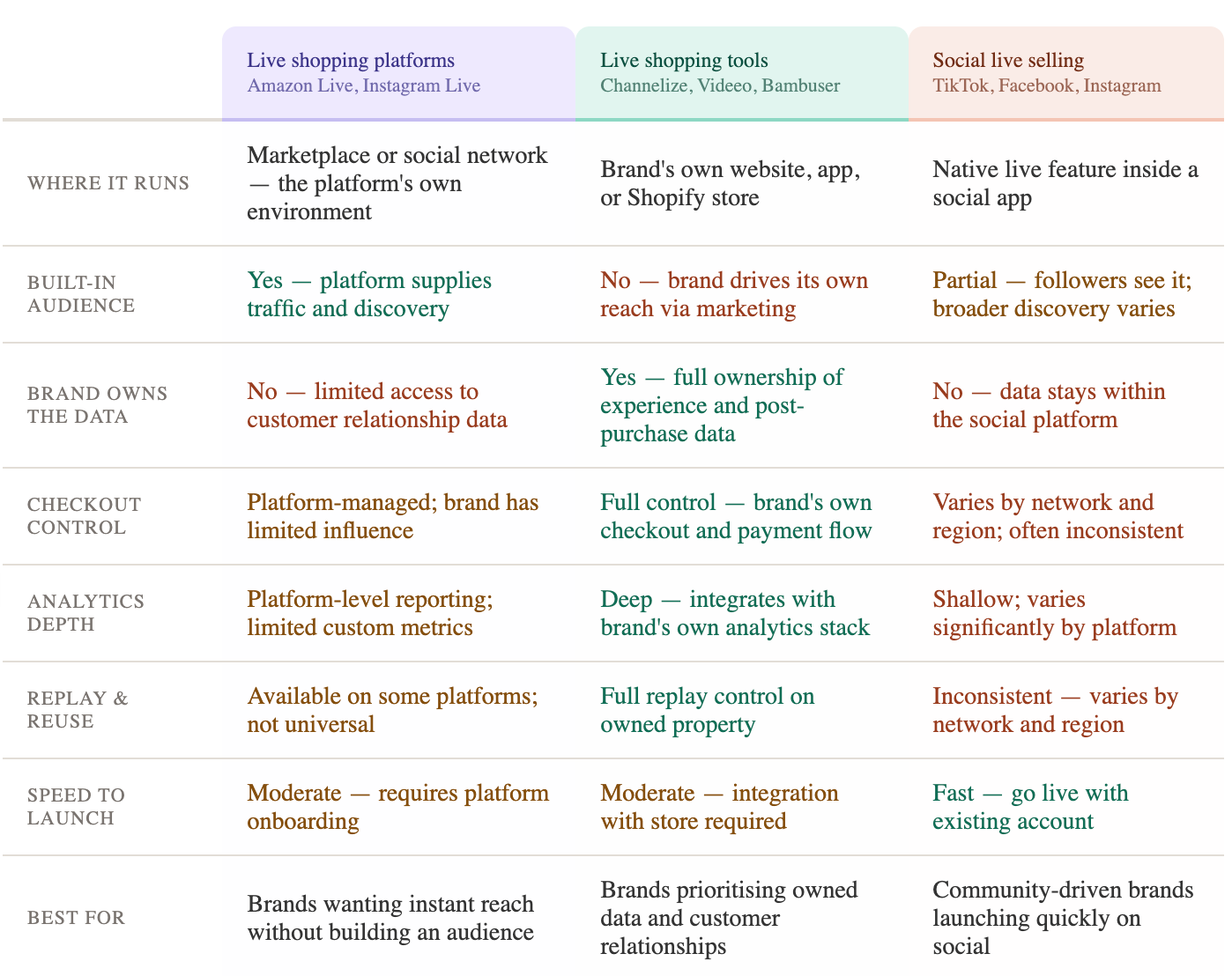
Live Shopping Platforms vs Live Shopping Tools vs Social Live Selling: What Is the Difference?
Not every solution labelled "live shopping" works the same way, and the distinction matters when choosing where to invest.
How to Choose the Right Live Shopping Platform for Your Ecommerce Business in 2026
Picking a platform is not just about features. It is about fit. The right choice depends on where your audience already is, how much control you need, and what your commerce stack looks like today. Here are the criteria that matter most:
-
Audience ownership: Do you want to build on a marketplace audience (Amazon Live) or drive traffic to your own site (Channelize, Bambuser)? Marketplace platforms offer discovery; owned-site tools offer data and brand control.
-
Checkout flow: A seamless in-stream checkout reduces drop-off. Look for platforms where the viewer can add to the cart and pay without being redirected away from the video. High cart abandonment rates are a persistent problem in ecommerce, and a frictionless live checkout helps counter it.
-
Platform and store integrations: If you run on Shopify, your live shopping tool needs to sync products, inventory, and orders natively. The same logic applies to WooCommerce, Magento, or any other commerce backend.
-
Simulcasting and multistreaming: Broadcasting to your site, Instagram, and YouTube simultaneously using live streaming tools like Riverside extends reach without multiplying production effort.
-
Replay and shoppable video support: A live show's value should not end when the stream stops. Platforms that automatically turn broadcasts into shoppable clips let brands reuse content across product pages, emails, and ads.
-
Analytics and attribution: Real-time dashboards are useful during a show, but post-event reporting that ties viewer behaviour to revenue is what drives long-term strategy.
-
Moderation and interaction tools: Chat, polls, Q&A, and pinned products keep viewers engaged. Moderation tools keep the experience safe and on-brand.
-
Scalability and pricing model: Some platforms charge flat monthly fees, others take a percentage of sales, and some are usage-based. Match the pricing model to your expected volume and growth trajectory.
Top 10 Live Shopping Platforms in 2026: Compared and Ranked by Use Case
These 10 live shopping and video commerce tools take different routes to the same goal: help brands host compelling live shopping events, keep engagement high, and make it simple to purchase during the show. The list below focuses on practical use cases, not hype.
| Platform | Best For | Platform Type | Owned-Site vs Marketplace vs Social | Key Strength | Pricing Model |
| Channelize | Brands wanting live selling on their own site | Live shopping tool | Owned-site | Plug-and-play embed with in-stream checkout | Subscription, tiered |
| Amazon Live | Brands wanting massive built-in traffic | Marketplace live shopping | Marketplace | Access to Amazon's shopper base | Performance-based / included with seller account |
| Instagram Live | Social-first brands with active followings | Social live selling | Social | Native tap-to-buy and co-hosting | Free (platform fees on checkout) |
| CommentSold | Boutiques running frequent live shows | Live selling platform | Hybrid (social + branded app) | Comment-to-buy automation | Subscription + transaction fees |
| Videeo | Shopify merchants adding live video | Live shopping tool | Owned-site (Shopify) | AI-powered shoppable video for Shopify | Free plan available, paid tiers |
| Skeepers | Global brands wanting premium live commerce | Enterprise live shopping | Owned-site | UGC-driven shows with deep analytics | Custom enterprise pricing |
| Grip | Brands blending commerce with events | Event + live commerce | Hybrid | AI matchmaking inside events | Custom pricing |
| GoLive | Brands needing white-label live commerce | Live shopping tool | Owned-site | Multi-destination streaming with white-label | Custom pricing |
| Shopify Live | Shopify merchants via partner ecosystem | Ecosystem / integrations | Owned-site (Shopify) | Unified back office across live selling apps | Varies by partner app |
| Bambuser | Enterprise brands wanting broadcast-quality shows | Enterprise video commerce | Owned-site | High-production players with deep reporting | Enterprise subscription |
1. Channelize: Best Live Shopping Platform for Owned-Site Selling Without Social Dependency
Channelize is built as a plug-and-play live commerce platform for brands that want live selling on their own website and apps, not just on social channels. It turns product pages into shoppable video experiences without heavy engineering.
Key features
Channelize offers embedded live video and shoppable videos directly on a brand's site, in-stream checkout so shoppers can purchase without leaving the show, simulcasting to social media channels to widen audience reach, and tools to answer questions live and drive stronger engagement. Teams can also use an AI video Generator to turn product highlights into short promotional clips for social channels.
Best for: Mid-market and growing DTC brands that want to keep the shopping experience on owned property while still reaching social audiences through simulcasting.
2. Amazon Live: Best Live Shopping Platform for Built-In Marketplace Traffic and High Purchase Intent
Amazon Live gives brands access to a massive built-in audience and shopping mindset. It behaves like an updated home shopping channel, with live video streams next to the Buy Now button.
Key features
Amazon Live includes interactive live stream shows embedded in Amazon product pages, a shoppable carousel that lets viewers purchase products with one tap, creator tiers that reward higher sales and brand performance, and analytics that connect live events to downstream revenue.
Best for: Brands already selling on Amazon that want to convert browsing shoppers through demonstration and real-time engagement without building their own streaming infrastructure.
3. Instagram Live Shopping: Best Platform for Social-First Brands and Influencer-Led Selling
Instagram Live is ideal for social-first brands with an active follower base. It turns casual scrolling into livestream shopping, powered by tags and checkout inside the app.
Key features
Instagram Live provides tap-to-buy tags on products showcased during live video, built-in tools to host live shopping events with co-hosts and guests, native checkout that lets shoppers buy without leaving the stream, and replays that keep shopping going long after the event ends.
Best for: Lifestyle, beauty, and fashion brands with strong Instagram communities that want to monetise live engagement without redirecting followers off-platform.
4. CommentSold: Best Live Selling Platform for Boutiques and High-Frequency Sellers in 2026
CommentSold is a live selling platform that connects social feeds, live streams, and a branded app. It is popular with boutiques that run frequent shows and want automation around invoicing and ecommerce fulfilment.
Key features
CommentSold delivers comment-to-buy flows that turn viewers into buyers in the chat, a central dashboard that syncs orders, sales, and inventory management, a branded mobile app to build a tight community of loyal customers, and automations that nudge shoppers back before a pending sale expires.
Best for: Boutique retailers and small fashion brands that run multiple live shows per week and need automation to handle high-volume comment-driven orders.
5. Videeo: Best Live Shopping Platform for Shopify Merchants Who Want AI-Powered Video Commerce
Videeo focuses on Shopify merchants who want to bring live commerce and shoppable video into their existing Shopify store. It turns static product pages into streams and clips that customers love to watch.
Key features
Videeo offers AI-powered shoppable videos embedded across product pages, one-to-many live streaming and one-to-one consults from the same platform, native mobile apps for always-on shopping and push-led engagement, and a free plan for testing before scaling into larger events.
Best for: Shopify-native brands that want to add video commerce to their existing store without migrating platforms or investing heavily upfront.
6. Skeepers: Best Enterprise Live Shopping Platform for UGC-Driven Global Brands
Skeepers combines UGC and live shopping so brands can put real people at the centre of the show. It is suited to global brands that want premium production and measurable impact from live commerce.
Key features
Skeepers provides hosted live shopping events with experts, creators, and loyal customers, rich interactivity including polls, chat, codes, and entertainment segments, tight commerce integrations so viewers can shop in a few clicks, and reporting that ties engagement and ecommerce conversion rates back to each event.
Best for: Enterprise and global consumer brands that want to combine influencer and UGC-driven content with shoppable live events at scale.
7. Grip: Best Live Commerce Platform for Brands Running Virtual Events and Trade Shows
Grip bridges live shopping with wider event technology. It is useful when a brand wants commerce plus networking in the same virtual or hybrid experience.
Key features
Grip includes live selling sessions embedded inside larger digital events, AI-based matchmaking to connect shoppers, partners, and hosts, global live streams with chat and reactions to keep the audience active, and insights that show how viewers move from content to sale.
Best for: Brands and B2B organisations that run trade shows, expos, or hybrid events and want to layer commerce directly into the event experience.
8. GoLive: Best White-Label Live Shopping Platform for Agencies and Multi-Channel Brands in 2026
GoLive positions itself as an AI-led live commerce and video tool that brands can white-label. It is a fit for teams that want advanced control over production and data without building in-house.
Key features
GoLive delivers multi-destination live streaming across web, apps, and social channels, real-time insights on show performance and audience engagement, white-label widgets including a floating video widget for ongoing shows, and fast, embedded checkout to boost sales from impulse watchers.
Best for: Brands and agencies that need a fully branded, white-label live shopping experience they can deploy across multiple properties and channels.
9. Shopify Live: Best Live Shopping Ecosystem for Shopify Store Owners Who Want Unified Order Management
Shopify Live is not a single app, but an ecosystem that lets merchants plug live selling into their core commerce stack. It connects partners' live streams to the same back office that runs the rest of the store.
Key features
Shopify Live offers direct links between live shopping apps and the Shopify store, a unified view of sales, order management, and customers across shopping events, a range of partners like Bambuser and Livescale for different growth opportunities, and a simple setup so smaller businesses can start live selling quickly.
Best for: Shopify merchants of any size who want to add live selling through vetted partner apps while keeping order management, inventory, and customer data unified in Shopify's back office.
10. Bambuser: Best Enterprise Video Commerce Platform for Broadcast-Quality Live Shopping Events
Bambuser is an enterprise-grade video commerce platform that powers high-production live shopping for global brands. It specialises in polished shows that mirror broadcast TV, but with a built-in checkout.
Key features
Bambuser provides one-to-many shows and one-to-one live selling for high-intent shoppers, fully branded players on a brand's site and other owned properties, shoppable video clips that extend events beyond the original stream, and deep reporting on purchase behaviour and long-term customer value.
Best for: Large-scale and luxury brands that need broadcast-quality production, full brand control over the player experience, and enterprise-level analytics on purchase behaviour.
Best Live Shopping Platforms by Use Case and Business Model: Which One Is Right for You?
Different brands have different starting points. Here is a quick breakdown by business model:
-
For Shopify brands: Videeo Live and Shopify Live offer the tightest native integration. Products, inventory, and orders stay in sync without middleware. Channelize and Bambuser also support Shopify, but add capabilities for brands that want more production control or simulcasting.
-
For social-first brands: Instagram Live and CommentSold are built for audiences that already live on social feeds. Instagram works best for brands with strong organic followings; CommentSold adds automation that helps high-frequency sellers manage volume. Brands running multi-carrier shipping for fashion stores will also find CommentSold's fulfilment integrations useful.
-
For enterprise and global brands: Bambuser, Skeepers, and GoLive deliver the production quality, analytics depth, and white-label flexibility that large organisations need. These tools support multi-market rollouts and integrate with complex commerce stacks.
-
For boutiques and SMBs: CommentSold and Videeo both offer accessible entry points. CommentSold's comment-to-buy flow suits boutiques that sell through personality-driven shows. Videeo's free plan lets smaller Shopify merchants test live video before committing a budget.
-
For brands wanting marketplace discovery: Amazon Live is the clearest choice. It puts a brand's live stream in front of shoppers who are already searching with purchase intent, which is difficult to replicate on any owned-site tool.
-
For brands wanting owned-site control: Channelize, GoLive, and Bambuser all let brands embed live shopping on their own domain. This keeps the data, the customer relationship, and the brand experience under one roof.
How ClickPost Powers the Post-Purchase Side of Live Shopping Fulfilment
Live shopping platforms handle the front of the funnel: the stream, the engagement, and the checkout. But the moment a viewer taps "buy," the experience shifts to logistics, and that is where ClickPost steps in.
ClickPost is a logistics intelligence platform that helps e-commerce brands manage everything that happens after the order is placed. For brands running live shopping events, where order volumes can spike unpredictably during a single broadcast, that post-purchase experience matters more than usual.
How ClickPost Supports Live Commerce Operations and Order Fulfilment at Scale
ClickPost integrates with over 600 carriers and a wide range of warehouse and inventory management systems, including platforms like Increff, Unicommerce, and Eshopbox. This means that when a live shopping event drives a sudden wave of orders, the fulfilment pipeline does not break. Carrier allocation, label generation, and dispatch can be automated based on pre-set rules that account for delivery speed, cost, and serviceability.
Real-time tracking and branded communication are handled through ClickPost's post-purchase platform. Buyers who purchased during a live stream get proactive automated shipment tracking updates, branded tracking pages, and estimated delivery timelines — all of which reduce "where is my order" tickets and keep the goodwill from the live event intact.
Returns management is another area where ClickPost closes the loop. Live shopping often drives impulse purchases, which means ecommerce return rates can be higher than standard e-commerce. ClickPost's reverse logistics automation lets brands set approval rules, generate return labels, and manage reverse logistics without manual intervention.
NDR (non-delivery report) management helps brands recover failed deliveries before they become cancellations or complaints. When a live show sends hundreds of orders to new addresses in a short window, proactive NDR handling protects both revenue and customer satisfaction. For brands running high-frequency live events, managing shipping delays and return-to-origin rates in ecommerce becomes a critical operational priority.
In short, ClickPost does not compete with live shopping platforms. It complements them by making sure that the surge in orders a successful live event creates actually reaches the customer on time and with a post-purchase experience for ecommerce brands that matches the energy of the live show itself.
How We Selected and Evaluated These Live Shopping Platforms
This list is based on a review of publicly available platform capabilities, integration ecosystems, pricing transparency, user reviews on sites like G2 and Shopify App Store, and documented use cases from brand case studies.
We prioritised platforms that are actively maintained, have clear commerce integrations, and serve distinct segments of the live shopping market, from SMBs to enterprise. No platform paid for placement in this list. Where possible, we have linked directly to official vendor pages so readers can verify features and pricing independently.
Where Is Live Shopping Headed? Key Trends and Predictions Beyond 2026
Live shopping is moving from novelty to a steady part of the commerce mix. The platforms above help brands host credible live events, reuse shoppable videos, and maintain high engagement without rebuilding their tech stack.
The smart move now is to pilot one or two shows, read the data, and double down where you see a clear impact on revenue and repeat shoppers. As formats mature, the brands that learn fastest will own the strongest live communities. Pairing your live shopping tool with robust ecommerce automation across fulfilment and shipping is what separates brands that scale from those that stall.
Frequently Asked Questions About Live Shopping Platforms in 2026
What is a live shopping platform and how does it work?
A live shopping platform lets brands sell products through real-time video, interactive chat, and clickable product overlays so shoppers can watch a demonstration, ask questions, and complete a purchase in the same flow. These platforms provide the streaming infrastructure, shoppable elements, and commerce integrations needed to turn a live broadcast into a sales channel.
What is the difference between live shopping and live commerce?
The terms are often used interchangeably, but live shopping typically refers to the consumer-facing experience of buying during a live stream, while live commerce is the broader category that includes the technology, logistics, and business strategy behind it. Live commerce encompasses everything from the platform and production to ecommerce fulfilment and post-purchase operations.
Which live shopping platforms work best with Shopify in 2026?
Videeo and Shopify Live (through its partner ecosystem) offer the most native Shopify integration, with direct product sync, unified order management software, and in-store embedding. Channelize and Bambuser also support Shopify and add features like simulcasting and enterprise-grade analytics for brands that need more flexibility.
What are the best live shopping platforms for small businesses and boutiques?
CommentSold and Videeo are strong starting points for small businesses. Videeo offers a free plan for Shopify merchants to test live video before scaling. CommentSold suits boutiques that sell through frequent, personality-driven shows and need automation for comment-based ordering and invoicing.
What features should I look for in live shopping software?
The most important features depend on your business model, but broadly: in-stream checkout, product tagging, replay and shoppable video support, simulcasting to multiple channels, real-time analytics, chat and moderation tools, and native integration with your commerce platform. Scalability, pricing transparency, and post-event content reuse are also worth evaluating. For brands at scale, ecommerce automation that connects live selling to fulfilment and shipping is equally important.
Are social media live shopping tools better than owned-site platforms?
Neither is universally better. Social platforms like Instagram Live offer built-in audiences and low setup costs, but brands have limited control over customer data and checkout. Owned-site tools like Channelize, GoLive, or Bambuser give brands full control over the experience, data, and customer relationship, but require the brand to drive its own traffic. Many brands use both.
Can live shopping platforms support one-to-one selling and one-to-many streams?
Yes, several platforms support both formats. Bambuser and Videeo, for example, offer one-to-many live broadcasts alongside one-to-one video consultations for high-intent shoppers. One-to-many is ideal for product launches and promotions, while one-to-one suits categories like luxury, furniture, or complex products where personalised advice drives conversion.
How much do live shopping platforms cost in 2026?
Pricing varies widely. Some platforms like Videeo offer free entry-level plans. Subscription-based tools like Channelize and CommentSold charge monthly fees that scale with features or usage. Enterprise platforms like Bambuser and Skeepers use custom contracts. Amazon Live and Instagram Live are free to use but operate within the platform's broader seller fee structure. Always check whether pricing is flat-rate, usage-based, or commission-based before committing.
How does post-purchase logistics affect live shopping success?
A successful live event can generate hundreds or thousands of orders in a short window. If fulfilment, tracking, and last-mile delivery software do not keep up, the goodwill from the live experience erodes quickly. Logistics management platforms like ClickPost help brands automate carrier selection, provide branded order tracking, and manage returns at scale, ensuring that the post-purchase experience matches the quality of the live show.
Can I simulcast a live shopping event to multiple channels at once?
Yes. Platforms like Channelize, GoLive, and several Shopify Live partners support simulcasting, which lets a brand broadcast a single live stream to its own website, Instagram, YouTube, Facebook, and other channels simultaneously. This maximises reach without requiring separate production for each platform. Brands managing high-volume simultaneous orders across channels should also consider a multi-carrier shipping solution to keep fulfilment running smoothly at peak moments.