.png?width=193&height=27&name=ClickPost%20Logo%20(Blue).png)
.svg)
.svg)
.svg)
.svg)
.svg)
.svg)
.svg)
.svg)
.svg)


.svg)
.svg)
.svg)
.svg)
.svg)


.svg)
.svg)
.webp?width=286&height=206&name=ROI%20Calculator%20(1).webp)
.svg)
.svg)

.svg)

.webp?width=286&height=206&name=RTO%20Playbook%20(1).webp)
What is RTO in eCommerce: Tips and Best Practices


Ready to ship smarter? Talk to our logistics experts.
Trusted by 600+ brands
In this blog
TL;DR: What Is Return to Origin (RTO) and Why It's Costing You Money
Return to Origin (RTO) in eCommerce occurs when carriers are unable to deliver shipments and return them to the seller, costing businesses 30% or more of their profit margins per incident.
-
RTO rates climb between 20–40% depending on payment method, serviceability, and product niche, representing a systemic revenue drain.
-
COD orders fail at 62%, compared with 38% for prepaid orders, because payment flexibility reduces buyer commitment at the doorstep.
-
Each RTO compounds costs across doubled shipping fees, warehouse handling, repackaging, and COD reconciliation, eroding overall profitability.
-
Address verification APIs, real-time tracking, and automated NDR management reduce failed delivery attempts by resolving issues before RTO is triggered.
-
Repeated RTOs damage carrier relationships, block warehouse inventory, and accelerate customer churn to competitors after a single poor delivery experience.
Why Return to Origin Is One of the Biggest Profit Killers in eCommerce
Return to Origin (RTO) isn't simply a one-time mishap for eCommerce companies; most of the time, it's a constant battle. It is often considered an inevitability when you're offering online shopping options.
Think of all the effort that goes into order fulfillment and shipping. But a single factor, one missing digit in a customer's contact information, can send the order back to its origin. That's the horror of RTO in the ecommerce industry.
20–40% How high RTO rates can climb depending on customer behavior, payment options, area serviceability, and the niche your brand operates in.
We know the only way to succeed in a highly competitive environment is to sell more and retain customers over the long term. But situations such as RTO can create a serious deficit in your bottom line and, worse, in customer satisfaction.
In this article, we'll discuss the deficit caused by RTO, how it is calculated, and ways you can overcome these exceptional situations not just with sheer will but with solid strategy. Let's begin.
What Is Return to Origin (RTO) in eCommerce Shipping?
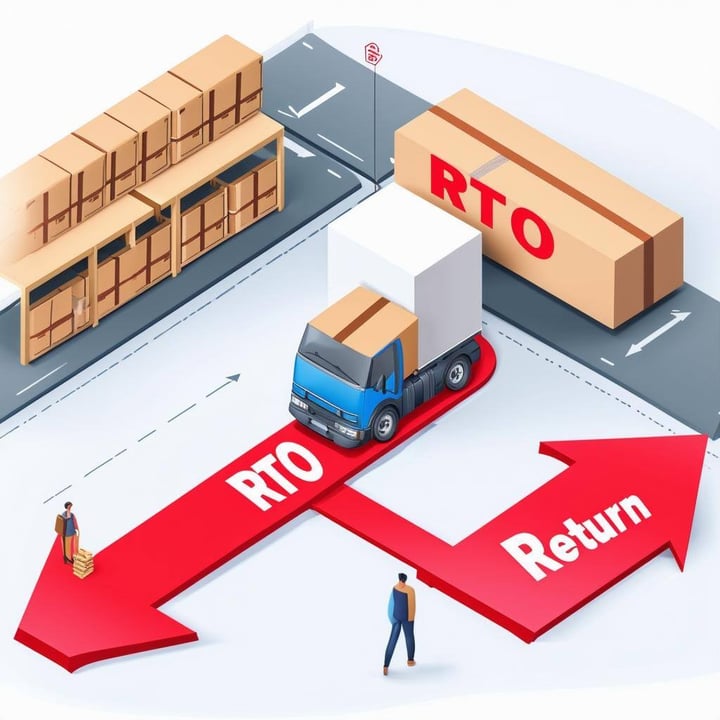
In logistics, Return-to-Origin is a term used primarily by online businesses. It indicates that a carrier was unable to deliver an order to a customer. As a result, the courier partner sends the shipment back to the seller.
In most cases, it's brought back to the warehouse from which the order was first dispatched, or to any other address provided by the merchant, such as a retail outlet. The shipment undertakes a long return journey home, incurring the risk of damage and carrying a heavy fee for the seller.
This isn't limited to high shipping costs and carrier surcharges. It snowballs into major logistical inefficiencies: inventory blockage, loss of merchandise due to damage, packaging waste, and negative environmental externalities.
How Poor Customer Experience Directly Drives Return to Origin (RTO) Rates
Customer expectations are being redefined around successful delivery, with cash-on-delivery (COD), last-minute cancellations, free delivery, hassle-free return policies, and prompt refunds all in play. Customers are empowered to choose not to accept an order if they have reasons to do so.
Often, there are genuine concerns. Take this case as an example.
📦 A Real-World RTO Story
Sushma (name changed) ordered a shirt for her father's birthday from a popular D2C brand. Her only concern was that the product arrive before the birthday, as she was prepared to receive it on the promised estimated delivery date.
However, the order still hadn't shipped after 5 days. Worried, she contacted customer service but was told to wait. Losing patience, Sushma tried to cancel the order, but it wasn't processed. After 12 days, the shirt arrived. By then, she had lost all trust in the brand. After the delivery was refused, the order was returned to the seller, resulting in an RTO.
This story isn't an exception; it's a reality of why shipments remain undelivered. Logistical problems, poor customer communication, and shipping exceptions contribute to revenue loss and reputational damage—enough of these lead to high RTO percentages. But before we delve into the impact of failed deliveries, let's understand what causes them.
How Multiple NDRs Lead to Return to Origin (RTO): What Sellers Need to Know
Return-to-origin is usually the final blow, but first, merchants have to grapple with NDR (Non-Delivery Report). An NDR is a situation reported by the delivery agent when they are unable to reach the customer to deliver the parcel.
Reasons for NDRs may include:
-
Problem finding the customer due to wrong address, incorrect contact details, or customer unavailability.
-
Delivery exceptions such as delays in order dispatch, shipments stuck in the first-mile or second-mile journey, holdups in last-mile delivery, or destinations out of the delivery area.
-
Changes in customer intent, especially when the payment is Cash-on-Delivery, make it easier to refuse the package.
-
Fake delivery attempts or late reattempts by delivery agents that prompt them to cancel the order or directly file an RTO.
62% vs 38% COD orders are returned at a rate of 62% compared to only 38% for prepaid orders, highlighting the outsized impact of payment method on delivery success.
A report is registered whenever your shipping carrier is unable to reach the buyer after 3 or more attempts, or when they reject the order at the time of delivery—a series of consecutive NDRs results in an RTO.
NDRs also offer the opportunity to reconnect with customers and solve issues when a problem is first recorded. With automated, streamlined communication, you can get the right address or schedule a time when the recipient is available.
How Does RTO Impact an eCommerce Business? 7 Consequences You Can't Ignore
Businesses in the fashion, footwear, and jewelry verticals are highly susceptible to parcels being returned without ever reaching customers. However, every eCommerce niche is likely to encounter delivery failures. With every returned shipment, sellers grapple with consequences that affect their next delivery and their long-term business viability.
1. How RTO Increases Operational Costs for eCommerce Sellers
Backhauling an undelivered package to its origin involves several operational and shipping costs. The most significant is the doubled shipping charges covering both the forward and reverse transit journey. This expense compounds across packaging fees, labor handling charges, fuel surcharges, and more.
Additional cost centers involved:
-
Loss of marketplace fee whenever a package is returned to the sender.
-
Order processing expenditure for quality checks, packaging, and labeling.
-
Expense incurred in disposing of or refurbishing a damaged product.
-
Cost involved in issuing refunds or COD reconciliation.
-
Running costs in tracking and reallocating the shipment to carriers.
2. Why RTO Triggers Negative Cash Flow in COD-Heavy eCommerce Businesses
Shipment failure on COD orders can trigger negative cash flow, where more money leaves your business than stays in. You not only lose revenue when the delivery is unsuccessful, but also incur additional logistical expenses, leading to a cash deficit.
Negative cash flow has major consequences: it limits your budget for investing, procuring supplies, fulfilling and warehousing activities, and shrinks your marketing spend.
3. Inventory Management Issues Caused by High RTO Rates
While a returned shipment is not the end of a product's lifecycle, it certainly adds stress to already strained resources, warehouse space, and inventory management.
Consider this: if you ship 5,000 orders in a month and have a 20% RTO rate, that's 1,000 orders returning to your warehouse each month. This creates a cascade of problems:
The inventory crisis caused by high RTO:
-
Inventory blockage as returned items clog up warehouse space, making it difficult to manage existing SKUs alongside incoming merchandise.
-
A higher margin of error in inventory records, since putting returned items back on shelves requires inspection for damage, repackaging, and re-categorization.
-
Product depreciation as some SKUs lose value over time, leading to potential write-offs.
4. How RTO Damages Customer Experience and Long-Term Brand Loyalty
RTOs drastically erode customer satisfaction, especially when they result from delivery delays, fulfillment errors, or damaged packaging. But the worst culprit is fake delivery attempts, which waste all the effort you put into customer acquisition. Data shows 89% of shoppers in countries like India prefer home delivery. One bad delivery experience is enough to drive them to a competitor.
5. Impact on Delivery Partner Relations and Carrier Performance
Your shipping carrier is responsible for late or failed deliveries and bounced-back parcels. Since delivery partners serve as brand representatives, their actions can negatively impact your relationships with customers.
Every shipping company has a list of serviceable areas, but may not have the same expertise or fleet required to deliver across every pincode, especially in tier-2 and tier-3 areas. A high RTO percentage with a shipping partner will affect your association with them, irrespective of their excellent metro service.
6. Damage and Devaluation of Goods During Return Shipping
Nearly 10–20% of shipments are damaged en route to the customer's address and on return to the warehouse, due to harsh weather, mishandling during transit, and insufficient packaging. Fragile items are particularly vulnerable.
Stuck shipments and returned items can also lose their worth even when intact. Time-sensitive products like perishables and trendy apparel have limited shelf lives. When returns are prolonged, they may become obsolete or less desirable, forcing you to sell at a discount or discard them entirely.
7. How RTOs Erode Overall Profit Margins Over Time
RTOs impact profitability in ways that ripple across all future endeavors. The various fees and charges associated with each RTO eat into the profit margin of every sale. Repeat instances of returned parcels can significantly erode your overall bottom line over time.
How to Calculate Your RTO Rate: Formula and Example
There is a simple formula to measure your return-to-origin rate. Tracking this metric regularly is the first step towards reducing it.
|
RTO Rate Formula RTO Rate (%) = (Number of RTO Orders ÷ Total Orders Dispatched) × 100 Example: (900 ÷ 3,000) × 100 = 30% RTO Rate |
10 Proven Strategies to Reduce RTO in eCommerce in 2025
Now that we've diagnosed the problems and seen the consequences that even a single RTO can bring, here are the most effective solutions typically delivered through a robust NDR Management system.
1. Use Address Verification APIs to Prevent Failed Deliveries at Checkout
The first step in stopping RTO is to have an accurate delivery address. Customers can provide temporary addresses, such as an office or university, which are not ideal for doorstep delivery. Equally, wrong geo-coordinates or a misspelled pincode can send the delivery agent to the wrong location entirely.
When you ensure customers provide the correct address and phone number at checkout, you automatically reduce failed delivery attempts.
✔ Ask customers to enter their pincode at checkout to confirm serviceability, and use an address verification API to auto-fill and validate incomplete addresses.
2. Implement Real-Time Order Tracking to Reduce Missed Deliveries
Customers are more likely to miss a delivery if they've forgotten its arrival date or step out right before the courier arrives. Real-time order tracking keeps shoppers in the loop at every stage of their order journey.
Key delivery milestones to communicate:
-
When the shipment is dispatched.
-
When it reaches the customer's nearest hub.
-
When it is out for delivery.
-
When the order is successfully handed over.
-
When the delivery partner couldn't reach the customer.
-
When a delivery attempt fails.
-
When a delivery is rescheduled.
Alongside milestone notifications, offering accurate Estimated Delivery Dates (EDDs) helps shoppers plan their day to accept the package. Automated traceability benefits you, too, by providing alerts for stuck shipments and transit delays, enabling proactive risk mitigation.
3. How Clear Post-Purchase Communication Cuts RTO Rates
The golden rule in eCommerce is excellent post-purchase communication. The ideal mode is multichannel SMS, email, IVRS, and WhatsApp, so customers can engage however they prefer.
Send a clear timeline for when an order will arrive, and offer a direct way to connect with customer support for queries or changes, such as updating contact details or rerouting to a different address.
4. Offer Flexible Delivery Options Including BOPIS and Hyperlocal Slots
The rise of BOPIS (Buy-Online-Pickup-In-Store), parcel lockers, and pick-up and drop-off networks gives customers control over how and when they receive their orders, dramatically reducing failed delivery attempts.
Flexibility also means offering preferred delivery time slots. Slot-based and hyperlocal delivery models give customers the reliability that their orders will arrive within hours at a time that works for them.
5. How to Improve COD (Cash on Delivery) Processes to Lower RTO
In South-East Asian markets like India, cash on delivery is non-negotiable; it's the most preferred mode of payment. However, COD carries a high risk of rejection and RTO. Improving COD processes and nudging customers toward prepaid payment is essential.
Practical ways to improve your COD process:
-
Offer an easy COD-to-prepaid conversion option embedded in your tracking page or sent via notification.
-
Reduce friction in online payments by minimizing checkout steps and offering more digital payment options.
-
Ask delivery agents to accept digital payments and cards at the door if the customer is short of cash.
-
Set a small COD fee at checkout to curb impulsive cancellations and changes in customer intent.
6. Optimize Delivery Attempts with Automated NDR Management
When an NDR is raised, you should act immediately. As soon as your tracking system alerts you of a delivery exception, inform the customer in real time, keeping them in the loop about potential delay, which can prevent order cancellations.
Trigger automated notifications to customers, requesting the necessary details the moment an NDR is filed. Coordinate with your carrier for the next delivery attempt. Implement OTP verification at the point of delivery to prevent fake attempts, one of the most damaging causes of customer trust erosion.
✔ Leverage omnichannel alternatives like store pick-up when an NDR is filed due to customer unavailability. Keep real-time visibility of all NDR issues and their root causes.
7. Implement Accurate Inventory Management to Prevent Wrong-Item RTOs
Many eCommerce retailers now offer open-box delivery to promote transparency, but this also means misplaced products trigger an immediate return. Accurate inventory management is critical to minimizing this.
Inventory best practices to reduce RTO:
-
Install an inventory tracking system to record every incoming item, outbound shipment, and return.
-
Use an online barcode scanner to catch picking errors and identify mismatched SKUs before dispatch.
-
Deploy a warehouse management system (WMS) to store, count, and analyze inventory data properly.
-
Set up automatic sorting centers to eliminate manual dispatching errors at scale.
8. Improve Packaging and Shipping Labels to Reduce Damage-Related RTOs
Damage is one of the leading causes of customer refusals. Strengthening your packaging is the best line of defense, even for premium carriers like UPS and FedEx, which cannot fully eliminate in-transit damage.
Use dunnage to fill empty space, choose the right box size, and wrap fragile items with adequate cushioning materials to absorb shock. For fragile goods, mark your shipping label accordingly.
Labeling errors, missing tracking IDs, and incorrect destination addresses cause confusion and delivery failures. Always confirm every shipment detail before allocating to a carrier.
9. Gather and Act on Customer Feedback to Identify RTO Patterns
Customers are sometimes prone to impulse buying. They place orders by mistake, cancel for a better deal, or purchase the same item from a physical store, then refuse the delivery. Their unavailability and invalid contact details are equally common triggers for RTO.
Gathering structured customer feedback is your best resource for understanding and addressing these patterns. Put in place multiple feedback channels, in-app forms, feedback widgets, customer interviews, IVRS, and actively use the data to improve processes.
10. Use Data Analysis and Carrier Performance Metrics to Cut RTO Long-Term
You cannot overcome a high RTO rate without critically analyzing, collating, and interpreting the causes. Focus on two broad categories: customer feedback and carrier performance.
What to measure and monitor:
-
Customer purchasing history and reasons for cancellation or return, to gauge intent and behavior patterns.
-
Carrier performance metrics: number of failed or fake deliveries, proportion of stuck shipments, SLA breach rates.
-
EDD adherence and non-delivery resolution rates to recategorize and re-evaluate delivery partners.
How to Reduce RTO in eCommerce: Final Thoughts
While RTO poses significant challenges to eCommerce businesses in scaling up and retaining profits, it can be managed with the right plan. From optimizing customer-enabled problems to streamlining operations, each strategy in this article has been proven to reduce RTO rates.
Remember: alongside the right strategy, you also need technology to automate the resolution process and help you regain customer loyalty. That's why investing in a dedicated shipping management solution is essential for any eCommerce business serious about growth.
✔ ClickPost's NDR Management and intelligent carrier allocation platform helps brands reduce RTO by 20–40% through proactive, automated re-engagement workflows. Book a demo at clickpost.ai
Frequently Asked Questions About Return to Origin (RTO) in eCommerce
1. What Is RTO in Online Delivery and How Does It Work?
RTO (Return to Origin) is a phenomenon in which an order is returned to its original source after repeated unsuccessful delivery attempts. It occurs when the carrier cannot reach the customer due to an incorrect address, customer unavailability, refusal, or delivery exceptions, and returns the package to the seller.
2. What Are the Main Reasons for High RTO Rates in eCommerce?
The most common causes include incorrect or incomplete delivery addresses, customer unavailability, COD order rejections, delivery exceptions (delays, out-of-area pincodes), fake delivery attempts by agents, poor post-purchase communication, and changes in customer intent after placing an order.
3. Why Are COD Orders More Prone to RTO Than Prepaid Orders?
COD orders carry no upfront financial commitment, making it easy for customers to change their minds or simply refuse delivery. Research shows that 62% of COD orders are returned, compared with only 38% of prepaid orders. Customers on prepaid orders are also more willing to wait through delivery delays.
4. Can Offering Prepaid Payment Options Significantly Reduce RTO?
Yes, significantly. Nudging customers toward prepaid payment through COD-to-prepaid conversion prompts, simplified checkout, and digital payment options at the door is one of the most effective levers for reducing RTO. Adding a small COD fee at checkout also helps curb impulsive cancellations.
5. What Is a Typical RTO Rate for eCommerce Businesses in 2025?
RTO rates vary widely by category, region, and business model. On average, eCommerce businesses see RTO rates between 8–12% for prepaid-heavy businesses. In COD-dominant markets like India, rates in fashion and lifestyle categories can reach 20–40%. Brands using proactive NDR management typically reduce their RTO by 20–40%.
6. What Happens After an RTO — What Is the Next Process for the Seller?
Once a shipment is returned to the origin, it goes through a quality inspection at the warehouse. If the product is undamaged, it is repackaged, recategorized, and made available for resale. If damaged, it may be refurbished or written off. The seller also needs to process any applicable refunds and investigate the root cause to prevent repeat RTOs. Using a reverse logistics solution can help streamline this entire process efficiently.






We use cookies to keep the site working, understand usage, and improve your experience. Learn more
Always active for essential site performance and security.
Enables anonymous usage analysis to refine our services.
Used to present relevant promotions and advertising.