.png?width=193&height=27&name=ClickPost%20Logo%20(Blue).png)
.svg)
.svg)
.svg)
.svg)
.webp?width=286&height=206&name=ROI%20Calculator%20(2).webp)
.svg)
.svg)
.svg)
.svg)
.svg)
.svg)
.svg)
.svg)
.svg)
.webp?width=286&height=206&name=Frame%201171276203%20(11).webp)
.svg)
.svg)
.svg)
.svg)
.webp?width=286&height=206&name=ROI%20Calculator%20(3).webp)
.svg)

.svg)
.svg)
.svg)
.webp?width=286&height=206&name=ROI%20Calculator%20(4).webp)
FedEx Return Label: How to Create, Use, and Manage Returns in 2026


Ready to delight customers after checkout?
Trusted by 600+ brands
In this blog
TL;DR: What You Need to Know About FedEx Return Labels
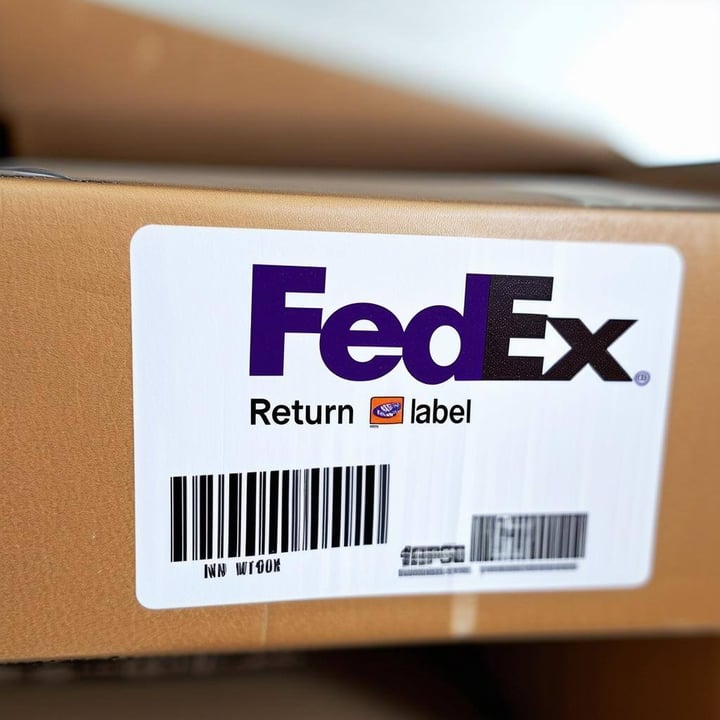
A FedEx return label is a prepaid shipping label that allows customers to send purchases back to a merchant at no direct cost.
-
Merchants pay only when a return label is scanned for shipment, not when it is included in the packaging, because FedEx bills on the first carrier scan.
-
QR code returns eliminate the need for home printers, allowing FedEx staff to scan and print labels on-site at authorized drop-off locations.
-
U.S. eCommerce returns surpassed $890 billion in 2025, making returns management a critical margin-protection priority for online retailers.
-
FedEx return labels remain valid for up to 12 months from creation, supporting seasonal or delayed-return scenarios across Ground, Express, and International service tiers.
-
Automated return label platforms convert a measurable share of return requests into exchanges, reducing net revenue loss from post-purchase reversals.
Why FedEx Return Labels Matter for eCommerce Brands in 2026
Returns are one of the most underestimated cost centers in eCommerce. Every return request is a signal: the product did not meet expectations, the size was wrong, the description was unclear, or the order arrived damaged. But how a brand handles that return smoothly or poorly determines whether the customer ever comes back.
A FedEx return label is the physical or digital instrument that initiates the return journey. Creating one is operationally simple. Managing returns well at scale, especially in markets like India, where Return-to-Origin (RTO) rates can erode 15–25% of margins, requires a different level of operational intelligence.
This guide covers everything from the mechanics of creating a FedEx return label to the strategic layer that separates brands that lose money on returns from brands that convert them into revenue opportunities.
U.S. eCommerce returns surpassed $890 billion in 2025, with online return volumes growing year-on-year as eCommerce penetration deepens, making returns management one of the highest-stakes operational decisions in eCommerce.
What Is a FedEx Return Label and How Does It Work?
A FedEx return label is a prepaid or merchant-funded shipping label that authorizes and routes a customer's return package back to the original seller or a designated return address via the FedEx carrier network.
Unlike a standard outbound shipping label, a return label is typically arranged by the brand rather than the customer, meaning the sender is not required to visit a FedEx counter, generate their own label, or pay at the point of drop-off. The logistics cost is borne by the merchant, and the customer experience is streamlined to a single action: hand the package to FedEx.
Return labels are available in three formats, which differ primarily in how the customer accesses and uses them:
| Label Type | How the Customer Uses It | Home Printer Needed? |
| Print-at-home label | PDF label emailed to customer; printed and affixed to package before drop-off | Yes |
| Email link label | The customer clicks a link to download and print the label directly | Yes |
| QR code (printless) | Customer presents a digital QR code at a FedEx location; staff scans and prints the label on-site. | No |
Key distinction: FedEx allows returns via QR code that can be scanned at drop-off locations to print labels on-site, removing the need for a home printer entirely and significantly reducing return friction for customers.
How Does a FedEx Return Label Work? The 3-Phase Process Explained
A FedEx return label encodes the routing information for a reverse shipment from the customer's address back to the seller's return center into a barcode that FedEx's network can scan and track at every point in the journey.
The mechanics break down into three phases:
Phase 1: How FedEx Return Labels Are Generated
The merchant generates a return label via FedEx Ship Manager, the FedEx API, or a returns management platform integrated with FedEx. The label is assigned a unique tracking number and encodes the destination (return warehouse), the sender (customer), the service type (e.g., FedEx Ground, FedEx Express), and any special handling instructions.
Phase 2: How the Customer Hands Over a FedEx Return
The customer receives the label (as a PDF attachment, email link, or QR code), packages the item, affixes the label (or presents the QR code), and drops it off at any authorized FedEx location. The package is scanned into the FedEx network at the point of drop-off, triggering the tracking record.
Phase 3: Return Transit, Tracking, and Delivery Confirmation
FedEx routes the package through its carrier network to the designated return address. The merchant receives tracking updates at each scan event and a delivery confirmation when the return arrives. Returns management platforms integrated with FedEx can automate the notification layer, alerting the merchant's operations team and automatically triggering refund or exchange workflows.
Step-by-Step FedEx Return Label Flow: From Request to Refund
| Step | Action | Who acts |
| 1 | Merchant initiates return via FedEx Ship Manager or API | Merchant/platform |
| 2 | Return label (PDF, email link, or QR) sent to customer | Automated system |
| 3 | The customer packages the item and presents the label at the FedEx drop-off | Customer |
| 4 | FedEx scans the package into the network; tracking begins | FedEx |
| 5 | The package was routed to the merchant's return address | FedEx |
| 6 | Delivery confirmed; refund or exchange workflow triggered | Merchant/platform |
3 Ways eCommerce Brands Use FedEx Return Labels
FedEx return labels serve three primary use cases in an eCommerce operation. Each has a different implementation approach, cost, and customer experience profile.
1. In-the-Box Return Labels: The Proactive Approach
The merchant includes a pre-printed return label inside every outbound shipment. The customer does not need to request a return; the label is already there if needed.
Cost consideration: Under FedEx Global Returns, if a pre-printed return label is not used, FedEx does not apply a surcharge; brands are charged only when a label is actually scanned for shipment. This makes the in-the-box approach financially safe for brands with moderate return rates.
Best for: Fashion, footwear, and apparel brands where fit-related returns are frequent and a frictionless return experience directly affects brand loyalty.
2. On-Demand Return Labels: The Reactive Approach
The merchant generates and sends a return label only when a customer submits a return request. This approach gives the brand greater control over the return process and enables eligibility checks before a label is issued.
Best for: Electronics, home goods, and higher-average-order-value categories with lower return rates, where merchants need to verify eligibility before initiating a return.
3. API-Automated Return Labels for High-Volume Operations
For brands processing hundreds or thousands of returns per month, manual label creation is operationally unsustainable. Returns management platforms (including ClickPost) integrate with the FedEx API to automate label generation at the point of return request, triggering dispatch, tracking, and post-return workflows without manual intervention.
Best for: High-volume eCommerce brands, marketplaces, and D2C brands in growth phases where returns volume has outpaced manual processing capacity.
How to Create a FedEx Return Label Step by Step in 2025
Creating a FedEx return label through FedEx Ship Manager is a five-minute process for individual shipments. Here is the complete step-by-step.
Step 1: Log In to FedEx Ship Manager
Go to fedex.com and sign in to your FedEx account. If you are creating return labels as a business, ensure you are logged in to the correct business account and that the appropriate return service is enabled.
Step 2: Select "Create a Return Shipment"
From the Ship Manager dashboard, select the option to create a return shipment. This distinguishes the label as a return (with the customer as the sender and your return address as the destination) from a standard outbound label.
Step 3: Enter Sender and Recipient Details
Enter the customer's address as the shipment origin and your return warehouse or return center address as the destination. For bulk label creation via the API, this information is automatically pulled from your order management system.
Step 4: Select FedEx Service Type and Package Details
Choose the FedEx service appropriate for your return: FedEx Ground, FedEx Express, or FedEx International (for cross-border returns). Enter the estimated package weight and dimensions.
Step 5: Choose Your FedEx Return Label Format
Select your preferred label delivery format:
-
Print-at-home PDF: Label sent as a PDF attachment for the customer to print and affix. If the file contains multiple pages, you can extract the PDF page containing the return label before printing it.
-
Email link: Label sent as a download link, which the customer clicks to print
-
QR code: A digital code sent via email or SMS that the customer presents at a FedEx drop-off location for on-site printing, no printer required
Step 6: Confirm and Send the Return Label to Your Customer
Review the shipment details and confirm. The label or QR code is delivered to the customer's email. The tracking number is activated when the package is first scanned at a FedEx drop-off point.
Validity: FedEx return labels are typically valid for up to 12 months from the date of creation, though validity periods can vary by account type and selected service. Always confirm the validity period in FedEx Ship Manager, particularly for seasonal or delayed-return scenarios.
Which FedEx Return Label Service Should You Use? Ground, Express, and International Compared
FedEx return labels operate across several distinct service tiers. Understanding which service type matches your return use case determines the cost, speed, and geographic coverage of the return.
1. FedEx International First: Fastest Cross-Border Returns
FedEx International First is the fastest cross-border return service, offering morning delivery to select destinations the next possible business day. It is best suited for high-value or time-critical return shipments such as luxury goods, electronics with warranty obligations, or items that must be inspected and restocked within a tight window. Full end-to-end tracking and customs clearance documentation are included.
2. FedEx International Priority: Best for Time-Sensitive International Returns
FedEx International Priority delivers cross-border return shipments within 1 to 3 business days to more than 220 countries and territories. It is the most widely used international return service for eCommerce brands managing time-sensitive returns, particularly relevant for Indian D2C brands that receive returns from international customers expecting fast confirmation and refund processing. Customs brokerage, door-to-door tracking, and money-back guarantees are standard features.
3. FedEx International Economy: Cost-Optimized Cross-Border Return Shipping
FedEx International Economy is the cost-optimized cross-border return option, offering delivery within 2 to 5 business days across more than 215 countries. It is the appropriate service for non-urgent international returns where shipping costs matter more than transit speed, such as lower-average-order-value categories, off-season apparel returns, or bulk return consolidations. Full tracking and customs clearance are included, making it a practical default for brands managing predictable, non-time-critical return volumes from international markets.
4. FedEx International Priority Freight: Returns for Heavy and Oversized Items
FedEx International Priority Freight is designed for heavy or oversized cross-border return shipments that exceed standard parcel weight thresholds, typically packages weighing more than 68 kg (150 lbs). It offers 1- to 3-business-day delivery with the same priority routing as FedEx International Priority, but on a freight-optimized infrastructure. This service is most relevant for brands in furniture, industrial equipment, large appliances, or any category where individual return units are too large for standard express handling.
5. FedEx International Economy Freight: Budget-Friendly Bulk Return Shipping
FedEx International Economy Freight is the cost-effective freight-tier return service for heavy cross-border shipments where speed is secondary to cost efficiency. Delivery typically ranges from 2 to 5 business days and covers more than 130 countries. It is suitable for brands managing bulk or B2B return flows, such as retail stock recalls, distributor returns, or end-of-season consolidations, where the priority is to minimize per-kilogram return costs without sacrificing tracking visibility or customs compliance.
| Service | Best For | Transit Time |
| FedEx International First | Fastest cross-border returns; high-value or morning-delivery-critical shipments | Next possible business day |
| FedEx International Priority | Time-sensitive cross-border returns; refund-critical customer SLAs | 1–3 business days |
| FedEx International Economy | Cost-optimized, non-urgent cross-border returns; lower AOV categories | 2–5 business days |
| FedEx International Priority Freight | Heavy/oversized returns above 68 kg; furniture, appliances, industrial goods | 1–3 business days |
| FedEx International Economy Freight | Bulk or B2B return flows where per-kg cost takes priority over speed | 2–5 business days |
Where to Drop Off a FedEx Return Package: US and India Locations
FedEx return packages can be dropped off at any of the following locations:
-
FedEx Office and FedEx Ship Centers
-
Authorized FedEx retail partners (Walgreens, Dollar General, Kroger in the US)
-
FedEx drop boxes (for packages that fit and have pre-paid labels)
-
Scheduled FedEx pickup from the customer's address (arranged by the merchant)
In India, FedEx operates drop-off service centers in major metros, including Mumbai, Delhi, Bengaluru, Chennai, Hyderabad, Pune, and Kolkata. Coverage in tier-2 cities may vary. Use the FedEx Location Finder at fedex.com and enter the local pin code to identify the nearest authorized drop point before issuing a label for that zone.
FedEx Return Label Value-Added Services That Save Time and Money
Beyond the basic label mechanics, FedEx and integrated returns platforms offer a range of value-added services that materially affect the cost, experience, and revenue outcome of the return process.
FedEx Packaging Services for Returns
For customers who do not have the original packaging or a suitable box, FedEx locations offer packaging materials and assistance. This reduces friction in the return experience, particularly for consumers returning fragile or oddly sized items.
Real-Time Return Tracking with FedEx
Every FedEx return label includes end-to-end tracking. Merchants integrated with FedEx via API or a returns platform receive automated tracking events at each scan point, enabling proactive customer communication and operational exception management before the return arrives.
Signature Confirmation for High-Value Returns
For high-value returns, merchants can require a signature upon delivery to confirm receipt. This creates a verifiable proof-of-delivery record that is particularly important for fraud mitigation in categories like electronics, jewelry, and luxury goods.
FedEx Collect-on-Delivery (COD) for Returns
In select markets, FedEx supports arrangements where the cost of the return shipment is collected from the customer at the point of drop-off rather than prepaid by the merchant. This is relevant to brands whose return policies require customers to pay for return shipping in certain scenarios.
NDR Automation and Returns-to-Exchanges Conversion via ClickPost
For eCommerce brands operating at scale, the highest-value service layer sits above the carrier: returns management intelligence. ClickPost's platform integrates with FedEx and 500+ other carriers to provide:
-
NDR management: Automated re-attempt workflows that intercept failed deliveries before they become RTO shipments, reducing RTO rates by 20–40%
-
Returns-to-exchanges conversion: 54% of return requests converted to exchange orders, retaining revenue that would otherwise leave the business as a refund
-
Store credit retention: 40% of at-risk revenue is retained via store credits when the post-purchase experience is managed intelligently
-
Higher-value exchanges: 39% higher-value exchange orders when customers are guided through an exchange flow rather than a refund flow
-
The maturity ladder: Brands processing 50 to 5,000 orders per month can manage return labels manually or via basic aggregators. Brands that have outgrown that model, where every failed delivery compounds into a margin problem and every return is a revenue decision, need the operational intelligence layer that platforms like ClickPost provide. ClickPost is trusted by 450+ global brands across 500+ carrier integrations.
How ClickPost Automates FedEx Return Label Management at Scale
Managing FedEx return labels at scale is not a shipping problem; it is a revenue and customer experience problem. The brands that recover the most value from their returns are not those with the cheapest labels, but those with the smartest post-purchase operations.
| ClickPost capability | Impact on returns operations |
| 500+ carrier integration | Automated return label generation across all carrier networks from a single platform |
| NDR management automation | Reduces RTO rates by 20 to 40% without adding operational headcount |
| Returns-to-exchanges conversion | 54% of return requests converted to exchange orders, retaining revenue at risk |
| Store credit retention | 40% of at-risk revenue retained via store credits, converting refunds into future purchase intent |
| Higher-value exchanges | 39% higher-value exchange orders when customers are guided through an exchange flow |
See how ClickPost helps 450+ brands reduce RTO by up to 40%. Manage FedEx and 500+ carrier return labels, retain 40% of revenue at risk from failed deliveries, and convert 54% of return requests into exchanges. Book a demo for more information.
FedEx Return Labels in 2026: Final Thoughts for eCommerce Brands
A FedEx return label is the starting point of the return journey, not the end of the strategic conversation. Creating one is operationally simple. The complexity and the competitive advantage lie in what happens next: whether the return becomes a refund, an exchange, a store credit, or a customer relationship that survives the friction of a product that did not work out.
For brands at the early stages of their returns operation, FedEx Ship Manager and manual label creation are entirely adequate. For brands managing thousands of returns per month across multiple carriers, markets, and fulfillment nodes, particularly in the Indian market, where RTO rates and COD complexity add structural challenges, the operational intelligence layer becomes the primary lever for returns profitability.
The brands that win on returns in 2026 are not those with the most generous policies, but those with the smartest operations: automated label generation, proactive NDR management, and exchange-first return flows that convert a cost center into a revenue recovery engine.
Frequently Asked Questions About FedEx Return Labels
How do I create a FedEx return label for my eCommerce store?
Log in to FedEx Ship Manager at fedex.com, select "Create a Return Shipment," enter the customer address as the origin and your return warehouse as the destination, choose your label format (print-at-home, email link, or QR code), and confirm. The label is generated immediately and sent to the customer. For high-volume operations, label generation can be fully automated via the FedEx API or a returns platform like ClickPost.
Can I print a FedEx return label using a QR code without a printer?
Yes. FedEx's QR code return option allows customers to receive a digital code via email or SMS and present it at any FedEx drop-off location, where staff scans and prints the label on-site. No home printer is needed. This is one of the most effective ways to reduce friction in the return process, particularly for mobile-first shoppers.
Do FedEx return labels cost money if the customer never uses them?
Under FedEx Global Returns, if a pre-printed return label is issued but the customer never uses it, FedEx does not apply a shipping surcharge. Brands are charged only when a label is scanned for shipment. This makes proactive label-in-box policies financially safe for brands with moderate or unpredictable return rates.
How long is a FedEx return label valid before it expires?
FedEx return labels are typically valid for up to 12 months from the date of creation. The exact validity period may vary by account type and the service selected. Always confirm the validity window in FedEx Ship Manager when generating labels, especially for seasonal return programs or customers who may delay their returns.
Where can I drop off a FedEx return package in India?
FedEx return packages in India can be dropped off at FedEx service centers and authorized drop-off points in major metro areas, including Mumbai, Delhi, Bengaluru, Chennai, Hyderabad, Pune, and Kolkata. Tier-2 city coverage may be limited. Use the FedEx Location Finder at fedex.com and enter the local pin code to verify availability before issuing a return label for that zone.
What's the difference between a return label and a prepaid return label?
A return label is any label routing a package back to the sender; the cost may be borne by the customer or the merchant, depending on the arrangement. A prepaid return label is one where the merchant has pre-funded the shipping cost, so the customer ships for free. Prepaid labels are standard in consumer eCommerce and are associated with higher return completion rates and better customer satisfaction scores.
How much do eCommerce returns cost brands in 2025?
U.S. eCommerce returns surpassed $890 billion in 2025, with online return volumes continuing to rise as eCommerce penetration deepens. For individual brands, return costs typically run 15 to 30% of the item's sale price when accounting for carrier fees, processing, restocking, and loss of resale value. In India, the compounding effect of RTO rates on top of standard return costs makes returns one of the highest-impact operational variables in D2C logistics.
How can platforms like ClickPost help automate FedEx return label management?
ClickPost integrates with FedEx and 500+ other carriers to automate return label generation, tracking, NDR management, and post-return workflows at scale. Brands using ClickPost convert 54% of return requests into exchange orders, retain 40% of revenue via store credits, and reduce RTO rates by 20–40% through automated NDR workflows. This is the operational layer that manual FedEx label creation cannot provide at volume.
What is RTO and why does it hurt Indian eCommerce brands using FedEx?
RTO (Return to Origin) occurs when a delivery attempt fails, and the package is sent back to the seller. In India's COD-heavy market, RTO rates can reach 20–40% in some categories, resulting in direct revenue and margin losses. NDR (Non-Delivery Report) automation intercepts failed deliveries before they become RTO shipments by triggering automated reattempt scheduling and proactive customer communication, reducing RTO rates by 20 to 40%.
What is FedEx Global Returns and how does it work for cross-border eCommerce?
FedEx Global Returns is FedEx's international reverse logistics service, enabling brands to manage cross-border return shipments with tracking, customs documentation, and the no-charge policy on unused pre-printed labels. It is particularly relevant for Indian brands selling into global markets and for international brands receiving returns from India. Service availability and transit times vary by origin and destination country.



We use cookies to keep the site working, understand usage, and improve your experience. Learn more
Always active for essential site performance and security.
Enables anonymous usage analysis to refine our services.
Used to present relevant promotions and advertising.