.png?width=193&height=27&name=ClickPost%20Logo%20(Blue).png)
.svg)
.svg)
.svg)
.svg)
.svg)
.svg)
.svg)
.svg)
.svg)


.svg)
.svg)
.svg)
.svg)
.svg)
.svg)


.svg)
.svg)
.webp?width=286&height=206&name=ROI%20Calculator%20(1).webp)
.svg)
.svg)

.svg)

.webp?width=286&height=206&name=RTO%20Playbook%20(1).webp)


In this blog
TL/DR summary
Shopify Bundle Apps have moved beyond simple discounts. In 2026, the strongest apps behave like merchandising engines: they guide product discovery, present savings clearly, and keep inventory and fulfillment stable when demand spikes. Your best choice depends on whether you need fixed bundles, mix-and-match builders, subscription-style kits, or funnel placements that nudge customers at the cart and post-purchase moments.
Key takeaways
-
If you want the lowest operational risk, start with the Bundles app for fixed sets and multipacks.
-
If your growth plan relies on experimentation, pick an app that supports testing and reporting, not just bundle creation.
-
Mix-and-match converts better when the rules are visible, and the selection flow is short.
-
Treat bundling like supply chain planning: avoid offers that create edge cases your warehouse cannot fulfill.
-
Choose based on your dominant motion: promotions (discount mechanics), curation (kits), or personalization (add-ons and options).
Bundling is a long game. When the app supports clean offer design, accurate inventory behavior, and readable reporting, you can scale bundles without turning every promotion into a manual firefight.
Introduction
The “Bundle strategy” has evolved from a simple discount tactic into a way to shape how customers discover products, make decisions faster, and complete checkout with fewer clicks. In 2026, Shopify Bundle Apps are less about forcing a pack and more about orchestrating choice: mix-and-match builders, subscription-friendly kits, cart-aware incentives, and clean inventory logic that does not break fulfillment.
If your operations team cares about pick-pack accuracy and your growth team cares about average order value, bundling is where both sides finally agree.
Key highlights
-
The best bundle experiences reduce decision fatigue, not just price.
-
Inventory-aware logic matters as much as offer design (especially during spikes and launches).
-
Mix-and-match bundles work better when the rules are visible, and the steps are short.
-
Subscription hybrids are becoming mainstream: recurring kits with optional swaps.
-
Bundle performance is easiest to improve when you can A/B test and read clean reporting.
-
Checkout behavior is shifting: merchants want bundles that play nicely with discounts, cart drawers, and Shopify’s native flows.
Top Shopify Bundle Apps in 2026
The 10 Shopify Bundle Apps below cover the full spectrum, from Shopify’s own fixed bundles to advanced builders that support tiered discounts, box-style kits, and cart-native funnels.
Quick comparison: Shopify Bundle Apps in 2026
|
App |
Best-fit features |
Typical pricing signal |
|
Fixed bundles as products; inventory synced to components; theme-block merchandising |
Free (native Shopify option) |
|
|
Mix-and-match bundles; auto-applied checkout discounts; simple bundle placement |
Free tier + paid upgrades |
|
|
Collection-based mix-and-match; BOGO mechanics; one-click bundle add-to-cart |
Paid monthly plans |
|
|
Quantity breaks; A/B testing for offers; free gifts and progress incentives |
Free to install + paid tier around $15/month |
|
|
Build-a-box experience; tiered incentives; large bundle configurations |
Paid plans (order-volume driven) |
|
|
Paid add-ons as upgrades; conditional logic; reusable option sets |
Free tier + paid tiers |
|
|
Category-based kit rules; guided kit builder; inventory-safe swaps |
Paid plan with trial |
|
|
Tiered pricing; cart and thank-you funnels, and discount stacking options |
Paid plan tiers |
|
|
Frequently-bought-together; mix-and-match; performance-friendly widgets |
Dev-store free + paid by volume |
|
|
Scheduled bundles; reporting for attach-rate decisions; auto discounts |
Free tier + analytics upgrades |
1. Bundles app
The Bundles app (Shopify’s native option) is the cleanest way to sell fixed sets and multipacks as a single bundle product without introducing a separate system. It is built for merchants who want a straightforward “bundle SKU” experience, with inventory synchronized across components and the storefront presentation consistent with modern themes.
Key features
-
Create fixed bundles and multipacks as standard products that customers understand
-
Keep inventory aligned across bundle components to avoid oversells
-
Present bundles using theme blocks, so merchandising stays visual
-
Support common variant selection patterns for bundled items
The biggest advantage here is operational reliability: native behavior tends to age well as Shopify updates checkout, POS, and theme tooling. If you want low-risk bundling that does not disrupt fulfillment workflows, this is the “start here” app for 2026.
2. Bundler app
The Bundler app focuses on flexible bundle mechanics that support classic sets, mix-and-match, and volume-style incentives, without forcing merchants to configure extensively. It is a strong fit for stores that want to run multiple bundle styles across categories, then iterate based on performance rather than rebuild offers every season.
Key features
-
Offer classic bundles plus mix-and-match, where customers choose items
-
Apply different discount structures (percentage, fixed amount, or fixed bundle price)
-
Auto-apply discounts at checkout to keep the experience friction-light
-
Use simple placement options to surface bundles on product pages
Many merchants start on a free tier and move up when mix-and-match or reporting becomes essential. The standout appeal of 2026 is how quickly you can launch and tune offers without redesigning your storefront.
3. Bold Bundles app
Bold Bundles is built for merchants who want more than “buy these together.” It is designed for bundle promotions that function as a merchandising layer: mix-and-match collections, multipacks, and BOGO-style mechanics, with the goal of increasing cart value while keeping stock logic aligned with Shopify inventory.
Key features
-
Build mix-and-match bundles from collections, not just single products
-
Create multipacks and BOGO-style promotions without manual discount juggling
-
Let shoppers add a bundle in one action instead of multiple cart steps
-
Display savings clearly at the point of decision, not after checkout
Bold typically sits in the paid-app tier and earns its place when you need structured promos that remain stable during high-traffic moments. It is a strong pick for brands that run frequent campaigns and want bundling to behave predictably.
4. Rapi Bundles Quantity Breaks
Rapi Bundles Quantity Breaks is the “promotions lab” option for 2026: bundles, volume discounts, mix-and-match, and A/B testing in one environment. It suits merchants who want to run offer experiments while keeping the storefront fast and the rules transparent to customers.
Key features
-
Set up combo bundles, mix-and-match, and quantity breaks with clear savings
-
Run A/B tests to validate which bundle structure actually drives lift
-
Add free gifts and progress-style incentives that push order size upward
-
Style offers with elements like swatches, ensuring that bundles feel native to the theme
Rapi is free to install with a forever-free tier, and a common paid tier starts around $15/month. Its standout appeal is experimentation: if you treat bundling like performance marketing, this app supports that mindset.
5. MBC Mix and Match Bundles App
The MBC Mix and Match Bundles App is built for “build-a-box” commerce, where the customer is part of the merchandising. It leans into flexible selection and advanced rules, which help brands sell curated variety packs without confusing customers or breaking inventory logic.
Key features
-
Build mix-and-match bundles where customers pick from a controlled catalog
-
Offer tiered discounts that reward adding more items without messy math
-
Support large bundle configurations that exceed standard variant limitations
-
Track bundle performance so you can double down on what converts
This is typically a paid app once order volume grows, because the value is in the “builder” experience. It is especially strong for giftable categories, replenishment bundles, and discovery kits.
6. EasyFlow Product Options
EasyFlow Product Options sits slightly adjacent to classic bundling, but it earns a place on this list because merchants increasingly use “options + add-ons” as a bundle-like growth lever. If you sell customizable products, EasyFlow lets you attach paid add-ons and structured options that function as a personalized kit.
Key features
-
Add unlimited product options and paid add-ons that increase cart value
-
Use conditional logic, so options appear only when relevant
-
Reuse option sets across products to keep admin work under control
-
Support uploads and personalization workflows for custom fulfillment
EasyFlow often includes free and paid tiers depending on product count and feature depth. The advantage is operational clarity: add-ons flow into orders cleanly, which reduces back-and-forth during fulfillment.
7. Bundable Customizable Kits app
Bundable is designed around curated kits where customers choose within guardrails. The experience feels intentional: select items from categories, build the kit, and check out in a few steps. In 2026, this is the style of bundling that pairs well with gifting, seasonal boxes, and “build your own” sets.
Key features
-
Create customizable kits with category rules (pick 2 from A, 1 from B)
-
Offer a storefront builder that feels like a guided product page
-
Keep inventory accurate while customers swap items inside a kit
-
Improve merchandising for bundles without custom theme development
Bundable is usually positioned as a paid app with a trial. Its standout appeal is the customer experience: the kit flow can increase conversion by making the bundle feel curated rather than random.
8. Bundle Bear
Bundle Bear is built for stores that want multiple bundle mechanics plus funnel placement: product page incentives, cart nudges, and post-purchase opportunities. It is especially relevant for 2026 because merchants want offers that adapt to how customers shop—quick scans, cart drawers, and mobile-first checkout patterns.
Key features
-
Run volume discounts, tiered pricing, and mix-and-match bundles
-
Add cart and thank-you page funnels to keep upsells contextual
-
Support discount stacking strategies when your promo calendar is dense
-
Track results so bundle decisions are based on numbers, not instincts
Bundle Bear is generally a paid app with plan tiers. The 2026 draw offers end-to-end coverage: a single app supports both bundle creation and the moments when shoppers decide to add more.
9. Fast Bundle
Fast Bundle is built for speed-to-launch: create bundle offers, “frequently bought together,” mix-and-match, and BOGO mechanics with a builder that is designed to stay lightweight. Performance matters because bundles often appear on pages where page speed is most sensitive: product pages and the cart.
Key features
-
Launch fixed bundles, mix-and-match offers, and BOGO promotions quickly
-
Add frequently-bought-together suggestions to increase attach rate
-
Use product add-ons that feel like curated upgrades, not random upsells
-
Keep offer widgets responsive across modern themes and mobile layouts
Fast Bundle typically has a development-store option plus paid tiers based on bundle sales volume. The standout is operational simplicity: quick setup, a clean display, and a lower risk of storefront slowdowns.
10. Bundler- Product Bundle App
Bundler- Product Bundle App (as listed separately by many merchants) emphasizes structured bundle creation plus reporting that makes bundling decisions easier. It matters because bundles are rarely “set once.” They need constant refinement based on conversion rate, attach rate, and inventory movement.
Key features
-
Run classic bundles, mix-and-match deals, and volume-based incentives
-
Auto-apply savings so customers understand value immediately
-
Track bundle performance to identify what truly drives incremental revenue
-
Schedule offers so bundles align with drops, seasonality, and campaigns
Expect a free entry point with paid upgrades for advanced mix-and-match and deeper analytics. The appeal is decision support: it provides merchants with enough data to treat bundles as a revenue system, not a one-off promotion.
ClickPost turn returns into exchanges and repeat purchases, not losses
Automated returns & Exchanges with a self-serve portal, tracking, policies & analytics.
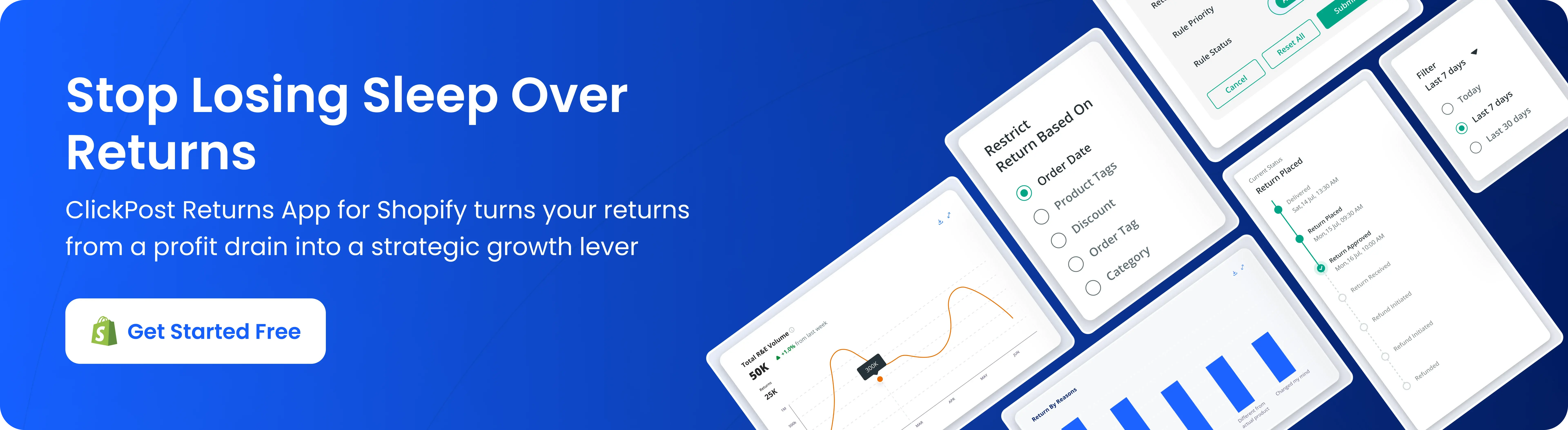
ClickPost Returns & Exchanges streamlines return and exchange management with automation, refunds, and a self-serve portal. Customers get real-time tracking, automated updates, and quick refunds. Merchants manage all return and exchange requests in one dashboard with customizable policies, eligibility rules, and reasons. Detailed return analytics and reporting give insights to cut costs and boost repurchases. Setup is fast, with everything ready in under 30 minutes.
-
Automated self-serve portal for easy returns, exchanges & refunds.
-
Dashboard to manage, track, and resolve return & exchange requests.
-
Process refunds to via gift cards or original payment methods.
-
Customizable return and exchange policies, rules, and eligibility.
-
Analytics & reporting with insights on return and Exchange trends.
ClickPost Returns Plus offers a free plan for up to 100 monthly returns. Paid plans start at $49/month. You can also integrate our returns management product with your ecommerce website. The total reviews on the ClickPost tool at Shopify are a testament to the ease it offers to merchants. The app support provided also makes it one of the best in the app categories for returns, exchanges, and refunds.
Closing thoughts: Bundling that stays profitable
The best bundling setup is the one your storefront can explain in three seconds, and your fulfillment team can execute without exception. In 2026, Shopify Bundle Apps are most effective when they pair a clear customer journey with inventory-aware logic, so you grow order size without creating downstream chaos.