.png?width=193&height=27&name=ClickPost%20Logo%20(Blue).png)
.svg)
.svg)
.svg)
.svg)
.svg)
.svg)
.svg)
.svg)
.svg)


.svg)
.svg)
.svg)
.svg)
.svg)
.svg)


.svg)
.svg)
.webp?width=286&height=206&name=ROI%20Calculator%20(1).webp)
.svg)
.svg)

.svg)

.webp?width=286&height=206&name=RTO%20Playbook%20(1).webp)

%20Apps.webp?width=960&height=720&name=Shopify%20Print%20on%20demand%20(POD)%20Apps.webp)
In this blog
TL/DR summary
Print-on-demand is no longer about finding a printer. It is about choosing a system that protects your customer promise while you scale SKUs, test creative, and sell across regions. The 10 Print-on-Demand Shopify Apps listed above cover different strategies (from low-cost validation to high-margin personalization to local production at global scale), allowing merchants to choose based on operational priorities, not hype.
Key takeaways
-
If you need global reach with faster delivery, choose a network-first model that produces close to the customer.
-
If your brand wins on gifting or personalization, prioritize platforms built for custom workflows and higher-value products.
-
If you are still validating your niche, pick a pay-per-order app with low fixed costs and quick listing creation.
-
If you sell across multiple channels, prioritize apps that keep order sync and tracking updates consistent, reducing support tickets.
-
If you want stronger retention, invest in white-label touches that make the package feel like your brand, not a vendor shipment.
Introduction
Print-on-demand stopped being a side-hustle feature the moment shoppers started expecting fast delivery, clean branding, and easy personalization on every product page. In 2026, the best Print on Demand Shopify Apps behave less like plug-ins and more like fulfillment partners that automate order routing, keep production time predictable, and return tracking numbers without manual babysitting.
If your margins live and die by last-mile reliability, customer experience, and how quickly you can test new designs, the right POD stack becomes a supply chain decision as much as a creative one.
Key highlights
-
Look for apps that auto-sync orders and send tracking data back to Shopify without delays or manual approvals.
-
Prioritize catalog depth only if print quality and fulfillment consistency match your brand promise.
-
Choose a provider with local production options if you sell cross-border and want lower shipping costs and a smaller carbon footprint.
-
Treat mockups as conversion assets: better previews reduce pre-purchase doubt and cut reverse logistics headaches.
-
Branding controls matter more than many sellers admit: packing slips, inserts, and labels shape repeat purchase behavior.
Top Print on Demand Shopify Apps in 2026
In a crowded POD market, these 10 apps stand out for a practical reason: they help merchants ship faster, personalize smarter, and run an inventory-free model with fewer operational surprises.
Quick comparison: 10 POD picks, side-by-side
|
App |
Best-fit features merchants actually use |
Pricing (from your reference content) |
|
Automated order sync, mockups, broad catalog, global shipping with tracking |
Free to install; pay per order |
|
|
Multi-provider routing, large catalog, automation, optional branding |
Free; Premium $29/month |
|
|
Print-on-demand production + fulfilment network |
Free to install; pay per product + shipping |
|
|
Unique SKUs, combo listings, transparent base costs, branded packing slips |
Free to install |
|
|
Hands-off fulfillment, fast US/EU production, varied print methods |
Free to use; pay when fulfilled |
|
|
Personalized gifts, video mockups, upsells, training-led ecosystem |
Free; Starter $27/month; $77/month; $87/month |
|
|
Fast US fulfillment, DTG/sublimation/embroidery, strong margins |
Free; Pro $30/month |
|
|
Multi print areas, DTG/DTF/UV, branding add-ons |
Free to install; fees vary |
|
|
Footwear and AOP categories, 3D mockups, global shipping |
Free |
|
|
Local production network, sustainability angle, and personalization |
Free; Gelato+ $23.99/month |
|
|
Low base costs, fast setup, quick production on core apparel |
Free to install |
1. Podbase
Podbase is a straightforward POD platform built for merchants who want a clean workflow: create products, publish to Shopify, and let the app handle production and dispatch when orders land. It is particularly attractive if you want breadth without overcomplication, including tech accessories and everyday merchandise that can be launched quickly.
Key features
-
Automatic order sync from Shopify to production queues
-
Built-in design tool with product templates for quick setup
-
Mockup generation that supports faster listing creation
-
Wallet-style balance and approval controls for order processing
-
Global shipping support with tracking pushed back into Shopify
Pricing-wise, Podbase is free to install and works on a pay-per-order model, which keeps risk low for testing. The standout is the “publish fast, fulfill automatically” approach, making it a sensible pick for merchants validating new product ideas without building a complex tech stack.
2. Printify: Print on Demand Network
Printify is a print-on-demand platform that connects Shopify merchants to a global network of third-party print providers, producing and shipping custom products only after an order is placed. Rather than operating its own facilities, Printify functions as an orchestration layer—routing orders based on cost, location, and production capabilities, with tracking synced back to your store. It’s recent FYUL moment, becoming part of the same organization as Printful, positions Printify as the network-first arm of a broader POD ecosystem built for flexibility, scale, and long-term merchant choice.
Key features
-
Large catalogue of printable products across apparel, accessories, and home
-
Multiple print providers per product, selectable by price, location, and lead time
-
Built-in product creator with mockups and placement controls
-
Automated order routing, production triggers, and tracking sync
-
Basic branding options such as packing slips and limited label customization
Free to install; you pay per product and shipping as orders are fulfilled. Printify stands out in 2026 because it enables a flexible POD supply chain—letting merchants balance cost, speed, and redundancy while scaling globally without committing to a single fulfilment provider.
3. Printful: Print on Demand
Printful is a print-on-demand fulfilment network that plugs into Shopify and ships custom products only after an order is placed. It handles production, packing, and shipping while pushing tracking back into your store. For many brands, POD is the cleanest way to build differentiation without inventory risk.
Key features
-
Extensive catalogue of printable products (apparel, accessories, homeware)
-
Built-in mockup generator and design tooling for listing speed
-
Automated order ingestion, production triggers, and tracking sync
-
Global fulfilment centres to reduce cross-border delivery lead time
-
Branding options such as pack-ins and branded packing slips
Free to install; you pay per product and shipping when orders come in. Printful stands out in 2026 because POD is a low-risk supply chain model: fewer supplier switches, clearer production SLAs, and better brand consistency than generic dropship SKUs.
4. Teelaunch
Teelaunch is known for a catalog that goes beyond the usual basics, which helps merchants build bundles, upsells, and seasonal drops without hunting for niche suppliers. It fits brands that want variety, stable operations, and clear unit economics from the start.
Key features
-
Specialty items beyond apparel, including engraved and home products
-
Combo listings for multi-item offers shipped as one unit
-
Transparent base costs that support consistent margin planning
-
Manual or automatic order approval windows for control
-
Custom packing slips and return-address options for branding
Teelaunch is free to install, with no subscription required in the information provided, so merchants pay when they fulfill orders. Its edge is product uniqueness paired with predictable execution, which is useful when you want differentiation but still need fulfillment that behaves like a reliable line-haul-to-door workflow.
5. Spreadconnect: Print on Demand
Spreadconnect (from Spreadshop) is designed for merchants seeking fast, hands-off fulfillment and a simple way to populate their store with sellable products. It is positioned as “launch-friendly,” with no upfront investment and a workflow that keeps inventory-free operations clean.
Key features
-
Auto-processing: print, pack, and ship triggered by Shopify orders
-
Large catalog for building collections without supplier juggling
-
Multiple print techniques for different product types and finishes
-
Quick turnaround targets from US and EU facilities for core items
-
Profit-margin control through merchant-set pricing
Pricing is described as free to use, with costs incurred only when orders are fulfilled. The standout is speed-to-market: it benefits merchants who prioritize fast listing creation and reliable fulfillment loops over deep customization.
6. ShineOn: Print On Demand
ShineOn is built around high-margin personalization, especially in categories such as jewelry and gift products, where emotional intent drives conversion. It suits merchants selling story-led products, where personalization is not a feature; it is the product.
Key features
-
Personalized product workflows for engraving, photos, and custom text
-
Product catalog optimized for gifting and higher perceived value
-
Video mockups and ad-friendly creatives for faster campaign launches
-
Upsell and post-purchase add-ons to lift average order value
-
White-label touches like inserts and branded packing experiences
Pricing includes a Free plan, plus paid tiers: Starter ($27/month), Side-Hustle ($77/month), and Empire Builder ($87/month). ShineOn stands out for merchants who want POD to feel like a premium brand operation, not a generic print service.
7. CustomCat
CustomCat is positioned as a practical, margin-aware POD option, especially for merchants seeking fast domestic fulfillment and a broad range of product types. Its offering works well when you want one supplier to cover multiple printing styles, including apparel and home categories, while keeping turnaround tight.
Key features
-
Multiple production methods, including DTG, sublimation, and embroidery
-
High catalog breadth designed for varied storefront merchandising
-
Automated order processing with tracking updates returned to Shopify
-
White-label shipping flow that keeps branding consistent
-
Volume-style pricing support for stores scaling beyond test volumes
Pricing includes CustomCat Lite (free to install) and CustomCat Pro ($30/month or $300/year). The standout is cost discipline combined with speed: a strong fit for stores that want predictable fulfillment without premium pricing overhead.
8. Print Melon – Print on Demand
Print Melon is built for merchants who want tighter brand control while still operating without inventory. It combines a broad catalog with in-house fulfillment messaging, appealing to sellers who value print consistency and packaging options. If you are building a brand that wants to look “retail ready” from day one, Print Melon’s branding touches can make a difference.
Key features
-
Multi-print-area support for detailed product customization
-
DTG, DTF, and UV printing for different materials and design needs
-
Product listing flow designed to push items to Shopify quickly
-
Branding add-ons like neck tags, sleeve prints, and poly bags
-
Order tracking and customer-level details are managed inside the app
The pricing shared is free to install, with fees varying by product, printing location, and shipping. Print Melon’s differentiator is the blend of catalog depth with brand-ready finishing, which helps merchants reduce the “generic POD” look.
9. JetPrint
JetPrint is a good match for merchants seeking POD products that are less common in the Shopify ecosystem, particularly in categories such as shoes and accessories. It relies heavily on visual presentation, with previews designed for marketing. If your store wins on design-led differentiation, JetPrint’s catalog can help you avoid competing on the same t-shirt-and-mug terrain.
Key features
-
Product catalog that includes footwear, watches, and all-over-print items
-
Visual preview tools, including 3D-style mockups for marketing
-
Automated order sync to production and fulfillment workflows
-
Personalization support that allows customer text or image inputs
-
Trackable global shipping timelines suitable for international selling
JetPrint is listed as free in the reference content. Its standout is novelty plus presentation: useful for brands that want distinctive SKUs and stronger product visuals, while still keeping the fulfillment workflow automated.
10. Gelato
Gelato is built around local production at scale, making it attractive to merchants selling internationally who want to keep delivery speed, shipping rates, and sustainability aligned. Instead of shipping everything cross-border from a single hub, Gelato emphasizes producing closer to the customer.
Key features
-
Local production network that reduces transit time and emissions
-
Built-in design tools with strong mockup support for storefront assets
-
Automated fulfillment flow with tracking numbers synced to Shopify
-
Personalization features that enable customer-driven custom products
-
White-label packaging options to support brand consistency
Gelato offers Gelato Free (pay for what you print) and Gelato+ at $23.99/month (or $239.88/year). The standout is routing logic at a network level. It is helpful for merchants that treat POD as a real distribution model, not a short-term experiment.
11. Fuel
Fuel is positioned as a low-cost entry point for POD sellers who want to validate ideas quickly without expensive monthly commitments. It suits merchants who are still proving product-market fit and want a clean operational flow: list products, capture orders, and let the app handle production and delivery.
Key features
-
Factory-direct pricing structure designed for margin-first testing
-
Shopify-native order sync with automated fulfillment processing
-
Quick mockup creation to speed up listing and ad asset production
-
Fast production targets on core apparel items to support SLAs
-
Simple product range for stores that want a focus on catalog sprawl
Fuel is free to install, with sample base price references like apparel from $5.50. The standout is simplicity plus cost control, making it a practical choice for lean teams that want POD to behave like a predictable operations lane.
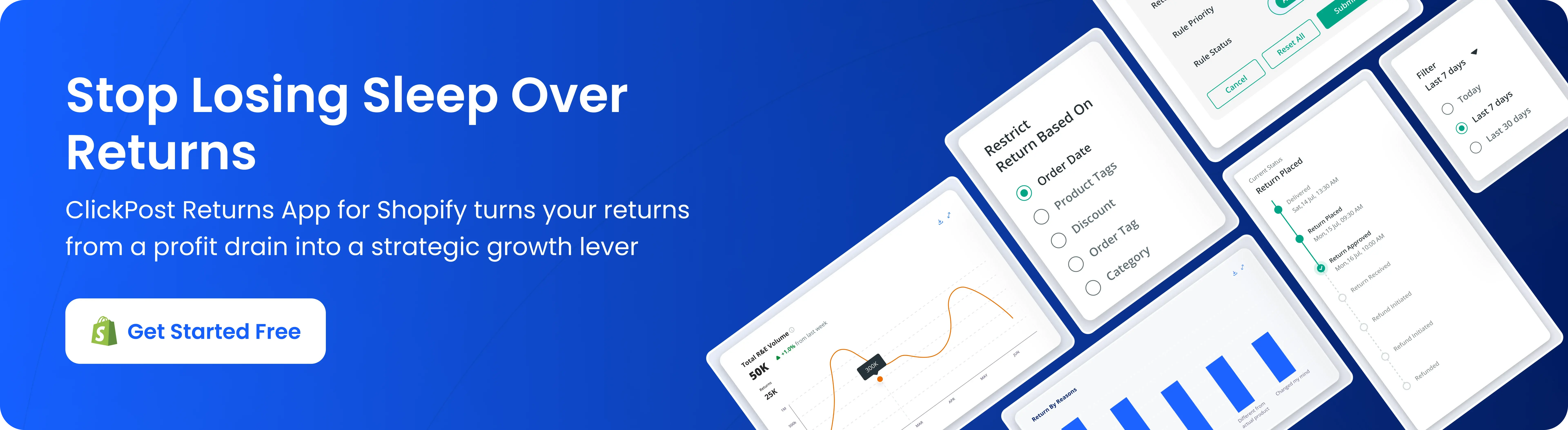
ClickPost turn returns into exchanges and repeat purchases, not losses
Automated returns & Exchanges with a self-serve portal, tracking, policies & analytics.
ClickPost Returns & Exchanges streamlines return and exchange management with automation, refunds, and a self-serve portal. Customers get real-time tracking, automated updates, and quick refunds. Merchants manage all return and exchange requests in one dashboard with customizable policies, eligibility rules, and reasons. Detailed return analytics and reporting give insights to cut costs and boost repurchases. Setup is fast, with everything ready in under 30 minutes.
-
Automated self-serve portal for easy returns, exchanges & refunds.
-
Dashboard to manage, track, and resolve return & exchange requests.
-
Process refunds to via gift cards or original payment methods.
-
Customizable return and exchange policies, rules, and eligibility.
-
Analytics & reporting with insights on return and Exchange trends.
ClickPost Returns Plus offers a free plan for up to 100 monthly returns. Paid plans start at $49/month. You can also integrate our returns management product with your ecommerce website. The total reviews on the ClickPost tool at Shopify are a testament to the ease it offers to merchants. The app support provided also makes it one of the best in the app categories for returns, exchanges, and refunds.
Closing thoughts: POD is now an operations decision
The fastest-growing POD brands in 2026 are not the ones with the most designs; they are the ones with the cleanest handoff between storefront, production, and delivery. When a POD app keeps tracking updates timely, production windows stable, and branding consistent, it reduces friction across the entire post-purchase experience. That is where repeat orders come from, and where avoidable returns management costs stop eating your margins.
In the end, the best POD pick is the one that matches your promise: delivery speed, print quality, personalization depth, and the amount of operational control you need to sleep at night.