.png?width=193&height=27&name=ClickPost%20Logo%20(Blue).png)
.svg)
.svg)
.svg)
.svg)
.svg)
.svg)
.svg)
.svg)
.svg)


.svg)
.svg)
.svg)
.svg)
.svg)
.svg)


.svg)
.svg)
.webp?width=286&height=206&name=ROI%20Calculator%20(1).webp)
.svg)
.svg)

.svg)

.webp?width=286&height=206&name=RTO%20Playbook%20(1).webp)
Supply Chain Excellence Starts With Visibility: How ClickPost Apex Closes the Gaps?


Ready to ship smarter? Talk to our logistics experts.
Trusted by 600+ brands
In this blog
TL;DR: ClickPost Apex Control Tower for Supply Chain Visibility
ClickPost Apex Control Tower delivers real-time supply chain visibility, SLA monitoring, and exception management across forward shipments, reverse logistics, and warehouse operations.
-
Fragmented carrier data and delayed exception detection cause brands to miss intervention windows, resulting in preventable RTO losses and SLA breaches.
-
ClickPost Apex NDR automation reduces Return to Origin rates by 20% to 40% in high-COD markets by identifying at-risk shipments before delivery failure.
-
Reverse logistics visibility within Apex converts 54% of returns to exchanges, directly recovering revenue typically lost to unmanaged return flows.
-
IBM Institute for Business Value found supply chain disruptions cost companies 45% of one year's profits over a decade, with poor visibility as a primary contributor.
-
Control tower platforms detect exceptions, fire threshold-based alerts, and provide decision context because operations teams cannot monitor multi-carrier logistics manually at scale.
What Is Supply Chain Excellence and Why Does It Matter in 2026?
Supply chain excellence used to mean getting shipments from point A to point B on time. That definition no longer holds.
Today, the brands that win on logistics are those that can see what is happening across their entire supply chain in real time, identify risks before they escalate, and respond to exceptions without depending on manual follow-ups.
The gap between a good supply chain and a great one is no longer about how many carriers you use or how fast your warehouse dispatches orders. It is about how clearly and how quickly your operations team can see, decide, and act.
Visibility has become the foundation. Without it, SLA breaches go undetected, failed deliveries pile up, and returns become an unmanaged cost center. With it, teams move from reactive firefighting to structured, data-informed decisions.
This article breaks down what supply chain excellence looks like in practice, where most brands fall short, and how a centralized control tower changes the operating model for logistics and ecommerce teams managing scale.
What Does Supply Chain Excellence Actually Mean for Ecommerce Operations?
Supply chain excellence is no longer a fixed standard. It is a moving target shaped by customer expectations, carrier complexity, and the volume of data modern logistics operations generate.
For most operations leaders, it means four things.
-
Visibility across every node: From the moment an order is placed to the moment it is delivered or returned, teams need to know where things stand without manually chasing couriers or pulling fragmented reports.
-
Fast, accurate exception response: Delays, failed deliveries, stuck shipments, and RTO risks are inevitable at scale. What separates high-performing ecommerce supply chains is how quickly teams detect these exceptions and what they do next.
-
SLA adherence at every stage: Whether your SLA is with a customer, a carrier, or an internal warehouse team, breaches are expensive. Monitoring SLAs in real time allows teams to act before a breach becomes a complaint.
-
Data that drives decisions: The best supply chain teams do not rely on gut instinct. They use carrier performance data, exception trends, and delivery analytics to make smarter policy decisions over time.
Why Has Real-Time Visibility Become Central to Supply Chain Performance?
The scale of modern ecommerce logistics makes manual oversight nearly impossible. A brand shipping tens of thousands of orders a day across multiple carriers, regions, and delivery types cannot rely on spreadsheets or periodic courier reports.
Real-time visibility solves this by giving operations teams a live, consolidated view of shipment movement, exceptions, and performance metrics. When something goes wrong, the team sees it immediately. When an SLA is at risk, an alert surfaces before the breach happens.
According to research from McKinsey and Company, companies with strong supply chain visibility capabilities recover from disruptions significantly faster than those operating with limited data access.
The supply chain itself has also grown more complex. Most mid-to-large ecommerce brands now work with multiple carriers, multiple warehouse locations, and a mix of forward and reverse shipment flows. Managing all of this without a centralized visibility layer creates blind spots at every handoff.
Real-time shipment tracking across all carriers is one piece of this puzzle, but visibility at the supply chain level means going further: understanding SLA risk, exception rates, carrier performance patterns, and inventory readiness all in one place.
Common Gaps That Prevent Ecommerce Brands From Achieving Supply Chain Excellence
Most operations teams know their supply chain has gaps. The harder question is where exactly those gaps are and how much they cost.
-
Fragmented data across carriers and systems: When each carrier provides its own tracking data in its own format, operations teams spend hours compiling reports instead of acting on insights. Multi-carrier software addresses this by consolidating tracking into a single feed.
-
Delayed exception detection: By the time a failed delivery or a stuck shipment surfaces in a weekly report, the window for intervention has often closed.
-
No SLA monitoring layer: Many brands track delivery performance in aggregate, but have no system to flag individual shipments that are at risk of breaching SLA commitments.
-
Returns as a black box: Reverse logistics is often the most poorly tracked part of the supply chain. Without visibility into return pickups, transit status, and warehouse delivery timelines, operations teams cannot identify patterns or fix root causes.
-
Customer support operating blind: Support teams handling delivery queries often have no live shipment data. They escalate to carriers, wait for responses, and pass delays on to customers — a pattern that directly increases WISMO inquiry volume.
According to the CSCMP State of Logistics Report, logistics costs as a percentage of GDP remain significant, with visibility gaps and exception mismanagement cited as major contributors to inefficiency.
The MHI Annual Industry Report has consistently found that supply chain visibility tools rank among the top technologies companies plan to invest in, precisely because the cost of operating without them has become measurable.
How Does a Supply Chain Control Tower Help Operations Teams Act Faster?
A supply chain control tower is a centralized system that gives operations teams real-time visibility into shipments, exceptions, carrier performance, and SLA risks. It helps teams detect issues early and respond before delays affect customers.
The key difference between a control tower and basic shipment tracking is scope and action. Tracking tells you where a package is. A control tower tells you where every package is, which ones are at risk, which carrier is underperforming, and what your team should do about it right now.
Control towers operate across three layers.
-
Detection: Surfacing exceptions, SLA risks, and operational anomalies as they happen rather than after the fact.
-
Alerting: Sending targeted notifications to the right stakeholders, whether that is an operations lead, a carrier partner, or a customer support manager, when specific thresholds are crossed.
-
Decision support: Providing the data context needed to decide whether to reattempt a delivery, escalate to a carrier, update a customer proactively, or adjust a dispatch management policy.
According to Deloitte, supply chain control towers are among the most impactful investments for companies looking to improve operational resilience and reduce logistics costs.
The World Economic Forum has noted that digital supply chain tools, including real-time visibility and control tower platforms, can reduce logistics costs by a meaningful margin while improving service levels.
How ClickPost Apex Control Tower Fits Into Multi-Carrier Logistics Operations
Brands that need real-time visibility, exception management, SLA monitoring, and multi-carrier intelligence often graduate from aggregator-led workflows to logistics intelligence platforms like ClickPost.
The ClickPost Apex Control Tower is built for operations teams managing complex, multi-carrier logistics at scale. It brings forward shipments, reverse logistics, warehouse inventory health, and customer support data into a single centralized view.
Here is what that looks like in practice.
-
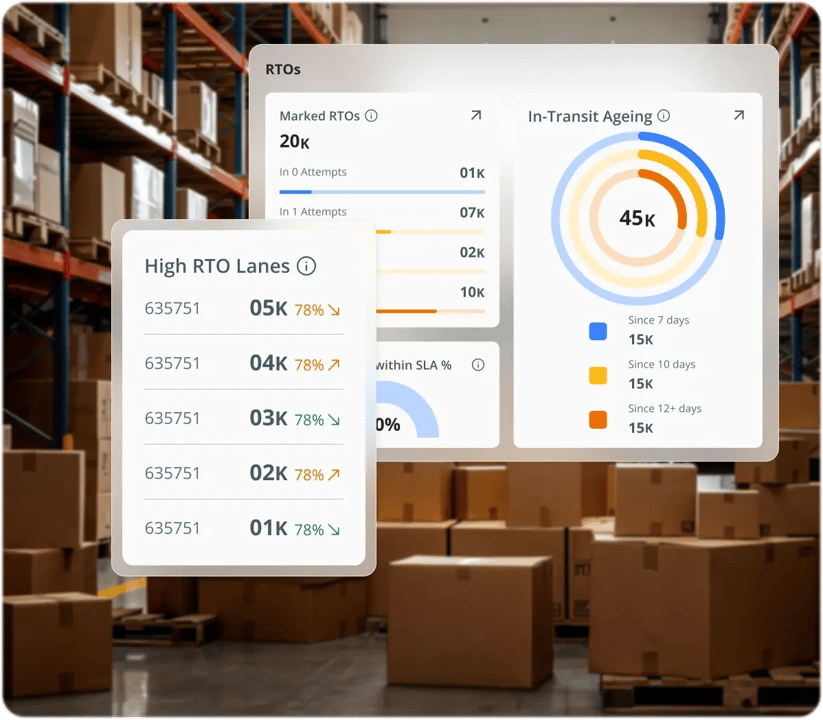
Forward shipment visibility: Apex monitors every active shipment across all carriers, flagging pre-pickup delays, mid-mile exceptions, and last-mile risks in real time. Operations teams do not need to log into individual carrier portals or wait for daily reports. The exceptions come to them.
-
Reverse logistics management: Returns are one of the costliest blind spots in ecommerce logistics. Apex provides full visibility into the reverse flow, from pickup request through transit to warehouse delivery. By analyzing failure patterns in returns data, teams can identify which carriers, pin codes, or product categories are driving return failures and make targeted improvements. This connects directly with ClickPost's returns and exchanges capability, where 54% of returns are converted to exchanges.
-
RTO prevention: Every undelivered order that comes back as a Return to Origin is a direct revenue loss. Apex identifies at-risk shipments early enough for teams to intervene, whether through NDR management automation, customer outreach, or delivery reattempt scheduling. ClickPost's NDR automation has helped brands achieve 20% to 40% RTO reduction in high-COD markets.
-
Warehouse and dispatch readiness: Apex extends visibility beyond carrier handoffs to include inventory health across warehouse locations. Operations teams can monitor SKU levels against demand, track dispatch readiness, and trigger replenishment alerts before stockouts affect order fulfillment.
-
Customer support integration: When support teams can see live shipment status alongside every customer ticket, resolution times drop. Apex surfaces the exact location, status, and exception history of any shipment directly within the support workflow, removing the need for manual carrier escalations.
-
Smart alerts and configurations: Teams can define the exact thresholds that matter to their operation: SLA cutoffs, exception rates, carrier performance benchmarks. Apex fires alerts when those thresholds are crossed, keeping operations leaders focused on what requires action rather than monitoring everything manually.
The analytics and reporting layer within Apex ties all of this together, giving supply chain leaders the dashboards and trend data to make better decisions over time, not just respond to today's exceptions.
Industry Benchmark Data: Why Supply Chain Visibility and Exception Management Directly Impact Revenue
Supply chain visibility is not a strategic preference. It is a measurable performance driver.
-
This McKinsey report shows companies can expect losses equal to almost 45% of one year's profits over a decade due to supply chain disruptions.
-
Accenture research found that companies with high supply chain visibility experience significantly lower logistics costs and faster issue resolution compared to those relying on reactive, report-based operations.
-
FreightWaves highlights that carrier on-time performance fluctuates based on seasonal demand, route variations, and capacity constraints. As a result, real-time SLA monitoring becomes essential for brands shipping at scale, ensuring consistent performance tracking through dynamic market conditions.
-
Supply Chain Dive has reported that exception management delays, where teams detect and respond to delivery failures too slowly, are among the top contributors to avoidable logistics cost increases.
-
According to Gartner's supply chain research, organizations that implement centralized control tower capabilities see measurable improvements in exception resolution speed and SLA adherence within the first year of deployment.
-
According to the Council of Supply Chain Management Professionals, reverse logistics costs represent a substantial percentage of total supply chain spend, and visibility into return flows is critical for reducing that cost.
-
According to McKinsey, end-to-end supply chain transparency is one of the top five capabilities separating top-quartile supply chain performers from the rest of the market.
The MHI Annual Industry Report reveals that 79% of supply chain leaders plan to invest in real-time visibility tools within the next five years. This investment is driven by the strong link between visibility and improved cost performance in supply chain operations.
How to Use Real-Time Supply Chain Data to Improve Logistics Decision-Making
Visibility data is only useful if it changes how decisions get made. Here is how operations teams translate Apex data into better outcomes.
-
Carrier performance benchmarking. By tracking on-time rates, exception frequencies, and SLA adherence by carrier, operations leaders can identify which carriers are underperforming on specific routes or shipment types and adjust their carrier allocation logic accordingly.
-
Exception pattern analysis. When the same type of exception keeps surfacing, such as pre-pickup delays in a specific region or last-mile failures for a particular product category, that pattern is a signal. Apex surfaces these trends so teams can address root causes rather than just individual incidents. Understanding the last-mile delivery challenges driving exceptions is the first step toward resolving them.
-
SLA risk management: Rather than discovering SLA breaches in end-of-month reports, teams using Apex can monitor SLA risk at the shipment level and intervene before breaches occur.
-
Proactive customer communication. When exceptions are detected early, automated customer notifications can be triggered before the customer contacts support. This reduces WISMO volume and improves post-purchase experience without adding to support team workload.
-
Return process improvement. Data from reverse logistics flows reveals which return failure modes are most common and which carrier or routing decisions are contributing to them. This feeds directly into policy improvements that reduce return costs over time.
When Should an Ecommerce Brand Invest in a Supply Chain Control Tower?
Not every brand needs a control tower on day one. But there are clear signals that an operation has grown to the point where the absence of centralized visibility is costing real money.
A brand should consider a supply chain control tower when it operates with three or more carriers simultaneously and has no unified view of performance across them. When exception detection currently depends on manual carrier follow-ups or weekly reports. When SLA breaches are discovered after the fact rather than flagged in real time.
When the customer support team routinely escalates delivery queries to carriers and waits for responses. When reverse logistics is a significant cost center with no structured visibility into pickup success rates, transit status, or warehouse delivery timelines.
The maturity ladder here is straightforward. Smaller brands or early-stage shipping operations can manage with basic tracking tools or aggregator-led workflows. Aggregators are useful because they simplify carrier access and contract management. But aggregators resell carrier contracts; they do not add intelligence, exception monitoring, or SLA management on top of a brand's own operations.
Brands that have outgrown that model and need visibility, intelligence, automation, and control at scale benefit from a dedicated logistics intelligence platform. The ClickPost carrier integrations network spans 600+ carriers globally, giving Apex users broad coverage without sacrificing the intelligence layer.
How ClickPost Apex Delivers Measurable Supply Chain Excellence in Practice
For operations teams managing multi-carrier logistics at scale, having a centralized layer that surfaces exceptions, monitors SLA risk, and tracks both forward and reverse shipment flows in real time makes a measurable difference to daily decision-making. The ClickPost Apex Control Tower is built specifically for that purpose, giving logistics and ecommerce teams the visibility and control they need to move from reactive to proactive operations. If your team is spending more time chasing exceptions than preventing them, that is usually the clearest sign that a more structured visibility layer is overdue.
Ready to see how it works for your supply chain? Book a demo
Conclusion: Building a Supply Chain That Runs on Visibility, Not Guesswork
Supply chain excellence is not a destination. It is a set of capabilities that compound over time: the ability to see what is happening across your logistics network, respond to exceptions before they become problems, monitor SLAs at the shipment level, and use data to improve decisions continuously.
The brands that have built these capabilities share a common foundation: centralized visibility, real-time exception management, and an operational intelligence layer that connects forward logistics, reverse flows, and warehouse readiness in one place.
Control towers are not new, but the operational need for them has sharpened as supply chains have grown more complex and customer expectations have risen. Getting from reactive to proactive does not happen through better intentions. It happens through better data, better tooling, and a clear operational framework for acting on what you see.
For supply chain and logistics teams ready to move past fragmented carrier data and manual exception handling, building that visibility layer is the most direct path to the kind of performance consistency that customers notice and competitors find difficult to replicate.
Frequently Asked Questions About Supply Chain Visibility and Control Towers
What Is Supply Chain Excellence and How Is It Measured?
Supply chain excellence is about managing inventory, fulfillment, delivery, and returns with accuracy. It relies on real-time visibility, adherence to SLAs (Service Level Agreements), and rapid exception response, rather than just speed.
Why Does Supply Chain Visibility Matter for Ecommerce Brands Shipping at Scale?
Visibility enables teams to track shipment status, exceptions, and potential SLA risks in real-time. Without it, problems are often detected only after impacting customers or revenue. Brands using automated shipment tracking consistently outperform those relying on manual carrier follow-ups.
What Is a Supply Chain Control Tower and How Does It Work?
A control tower is a centralized platform that consolidates shipment data, exception alerts, SLA monitoring, and carrier performance into one view, helping teams address issues before they escalate. It goes beyond basic parcel tracking software by adding decision context and threshold-based alerting.
How Does ClickPost Apex Improve Supply Chain Visibility Across Multiple Carriers?
ClickPost Apex provides teams with a unified view of forward shipments, reverse logistics, warehouse readiness, and support workflows. It allows monitoring of exceptions, SLA thresholds, and triggering alerts, without the need to check multiple carrier portals.
What Is the Difference Between Shipment Tracking and End-to-End Supply Chain Visibility?
Shipment tracking monitors the status and location of individual packages, while supply chain visibility covers a wider scope, including trends in exceptions, SLA risks, and operational performance. Ecommerce order tracking is a component of visibility, not a replacement for it.
How Does Real-Time SLA Monitoring Help Prevent Logistics Breaches?
SLA monitoring helps identify shipments at risk of breaching deadlines. This early detection enables swift carrier escalation, reattempts for delivery, and customer communication before a breach becomes a complaint or a chargeback.
How Can Ecommerce Brands Reduce Delivery Exceptions and Failed Deliveries?
Brands can minimize exceptions by detecting issues early, identifying root causes, and improving carrier allocation or operational policies. ClickPost Apex identifies exception patterns based on carrier, route, and shipment type, enabling targeted intervention rather than blanket process changes.
When Should a Brand Switch From Basic Tracking to a Logistics Control Tower?
A logistics control tower is useful when managing multiple carriers or when performance data is spread across various systems, making it difficult to track. It is also valuable when exceptions are found manually or SLA breaches occur too late. Brands experiencing high RTO rates in ecommerce or rising WISMO volumes are typically the clearest candidates for a control tower upgrade.
What Supply Chain Metrics Should Operations Teams Track Daily?
Supply chain teams should track on-time delivery rates, exception volume, SLA adherence, RTO rates (Return to Origin), return pickup success rates, and inventory dispatch readiness. A control tower centralizes this data for easy access, replacing the manual report-pulling that slows down decision-making across supply chain management workflows.
How Does Real-Time Shipment Visibility Improve the Post-Purchase Customer Experience?
With real-time visibility, teams can identify delivery issues early, sending proactive updates to customers. This reduces WISMO (Where Is My Order) inquiries, improves resolution times, and creates a more reliable post-purchase experience that drives repeat purchases and reduces support costs.




We use cookies to keep the site working, understand usage, and improve your experience. Learn more
Always active for essential site performance and security.
Enables anonymous usage analysis to refine our services.
Used to present relevant promotions and advertising.