.png?width=193&height=27&name=ClickPost%20Logo%20(Blue).png)
.svg)
.svg)
.svg)
.svg)
.svg)
.svg)
.svg)
.svg)
.svg)


.svg)
.svg)
.svg)
.svg)
.svg)
.svg)


.svg)
.svg)
.webp?width=286&height=206&name=ROI%20Calculator%20(1).webp)
.svg)
.svg)

.svg)

.webp?width=286&height=206&name=RTO%20Playbook%20(1).webp)
Best ERP Inventory Management Software in 2026


Ready to ship smarter? Talk to our logistics experts.
Trusted by 600+ brands
In this blog
TL;DR: Best ERP Inventory Management Software in 2026
ERP inventory management software embeds real-time stock control within a unified business platform, automatically connecting procurement, finance, sales, and logistics.
-
NetSuite ERP starts at approximately $1,099 per month, making it a leading choice for mid-market eCommerce brands scaling past $5 million in revenue.
-
SAP S/4HANA suits enterprises with 500 or more employees because its Extended Warehouse Management module delivers bin-level visibility across multi-plant networks.
-
AI-driven demand forecasting in Oracle Fusion Cloud SCM and SAP reduces stockouts by enabling scenario modeling, thereby reducing supply chain disruptions.
-
Microsoft Dynamics 365 Business Central integrates natively with Excel, Teams, and Power BI, lowering operational friction for Microsoft-centric distributors and manufacturers.
-
Odoo and Zoho Inventory offer free or low-cost entry tiers, allowing SMBs to adopt multi-channel stock tracking without enterprise-level implementation costs.
What Is ERP Inventory Management Software and Why Does It Matter in 2026?
Managing inventory across multiple warehouses, sales channels, and supplier relationships has become one of the most complex operational challenges for businesses in 2026. Spreadsheets and standalone stock tools no longer keep pace with the demands of modern eCommerce logistics, manufacturing, and distribution.
ERP inventory management software addresses this by embedding inventory control directly within a broader business platform, connecting stock data with procurement, finance, sales, and logistics in a single system. This guide covers 16 of the best ERP inventory tools available today, with a comparison table, selection criteria, and answers to the most common questions buyers ask.
How Does an ERP Inventory Module Work?
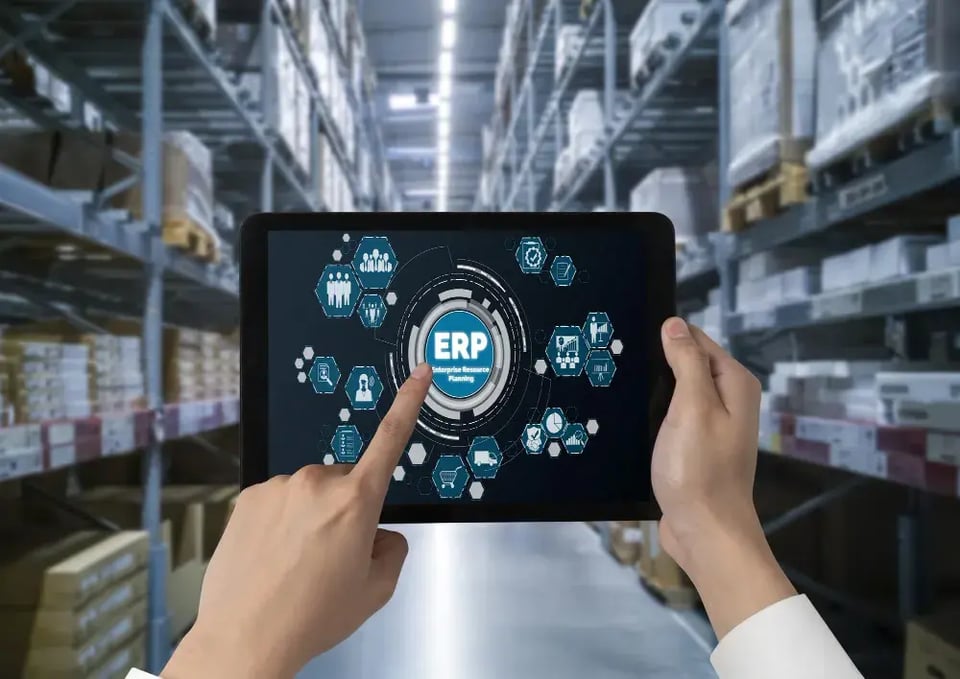
An ERP inventory module is a component of an Enterprise Resource Planning (ERP) system that tracks, plans, and optimizes stock levels. Unlike standalone inventory apps, it shares data in real time with the rest of the business. Hence, a sale on Shopify immediately adjusts stock levels, triggers a reorder if needed, and posts to the accounts ledger, all automatically.
Core capabilities typically include:
-
Real-time stock tracking across locations and channels
-
Automated purchase order generation based on reorder rules
-
Demand forecasting and safety stock management
-
Lot, batch, and serial number traceability
-
Inventory valuation using FIFO, LIFO, or weighted average cost
-
Returns and reverse logistics handling
The difference between a good and a poor ERP inventory implementation often comes down to data quality and integration depth, how well the system connects with your actual sales, warehouse, and supplier workflows.
How We Evaluated and Selected These 16 ERP Inventory Management Platforms
We evaluated 16 ERP inventory management platforms against seven criteria: core inventory capabilities (real-time tracking, automated replenishment, and demand forecasting); integration depth with ecommerce channels, accounting systems, and courier APIs; pricing transparency and total cost of ownership including implementation; scalability from SMB to enterprise; industry fit for manufacturing, distribution, and retail; AI and automation maturity; and localization support for compliance requirements such as GST in India and multi-currency operations globally.
Platforms were selected to represent the full spectrum of business sizes and use cases, rather than being ranked by a single score, so that buyers can identify the right fit based on their specific stage of growth, operational complexity, and budget.
Why ERP Inventory Management Is More Critical Than Ever in 2026
Several converging trends have made robust inventory management more important than before:
-
eCommerce growth and multi-channel complexity: Businesses now sell across their own website, Amazon, Flipkart, and social commerce simultaneously. Keeping stock accurate across all channels without a centralized ERP leads to overselling, canceled orders, and lost customer trust.
-
Multi-warehouse operations: Faster delivery expectations have pushed many businesses to operate regional fulfillment centers. Managing transfers, allocation rules, and replenishment across multiple sites requires more than a basic system. The rise of quick commerce has intensified this pressure further.
-
Supply chain volatility: Post-pandemic disruptions normalized longer lead times and unreliable supplier schedules. Businesses that invested in demand planning and safety stock modeling within their ERP were better placed to absorb these shocks. Effective supply chain management software has become a competitive necessity rather than an optional investment.
-
AI-assisted forecasting: Most leading platforms now embed machine learning for demand sensing, anomaly detection, and automated replenishment suggestions. Businesses that do not use these tools are making inventory decisions with less information than their competitors.
In India specifically, the growth of quick commerce, ONDC adoption, and GST compliance requirements has raised the bar for what an inventory system needs to handle out of the box.
ERP Inventory Software Comparison Table: 16 Tools at a Glance (2026)
The table below summarises all 16 tools reviewed in this article. Pricing is indicative; always request a vendor quote based on your user count, modules, and deployment preference.
| Tool | Key Strength | Best For | Pricing |
| SAP S/4HANA | End-to-end supply chain with embedded AI and EWM | Large enterprises | Custom/quote |
| Oracle Fusion Cloud | Global multi-entity inventory and supply chain planning | Multinationals | Custom/quote |
| NetSuite ERP | All-in-one cloud ERP for scaling mid-market businesses | Mid-market, eCommerce | ~$1,099/mo base |
| Microsoft Dynamics 365 | Inventory is tightly integrated with the Microsoft 365 ecosystem | Microsoft-heavy orgs | $70–$180/user/mo |
| Epicor Kinetic | Manufacturing-first with deep BOM and production inventory | Discrete manufacturers | Custom/quote |
| IFS Cloud | Asset-heavy industries and field service inventory | Aerospace, energy, utilities | Custom/quote |
| Rootstock | Manufacturing ERP built natively on Salesforce | Salesforce-centric manufacturers | Per user, quote |
| Striven | All-in-one platform for smaller, unified operations | Small businesses | Per user, SaaS tiers |
| SYSPRO | Industrial ERP for complex manufacturing and distribution | Mid-market manufacturers | Subscription, quote |
| Acumatica | Flexible cloud ERP for multi-entity and eCommerce companies | Growing mid-market | Consumption-based |
| inFlow Inventory | Practical stock control with a B2B ordering portal | Small product businesses | From $89/mo |
| Freshservice | IT asset and CMDB-focused inventory for digital orgs | IT departments | Per agent, SaaS |
| Zoho Inventory | Multi-channel selling and stock tracking for online brands | SMBs, eCommerce | Free tier + paid plans |
| Sortly | Visual, image-based inventory for lightweight needs | Small teams, non-warehouse | Tiered SaaS |
| Odoo | Modular ERP linking inventory to the full business stack | SMBs to mid-market | Free Community; paid Enterprise |
| Brightpearl | Retail and wholesale ERP with strong order orchestration | Retailers, wholesalers | Custom subscription |
16 Best ERP Inventory Management Tools Reviewed and Compared for 2026
1. SAP S/4HANA: Best ERP Inventory Software for Large Enterprises
Best for: Large enterprises with complex, multi-plant inventory.
SAP S/4HANA is the most widely deployed enterprise ERP globally. Its inventory capabilities are built on an in-memory HANA database that delivers real-time stock visibility across plants, warehouses, and distribution networks.
The Extended Warehouse Management (EWM) add-on bridges ERP and warehouse management system functionality, supporting bin-level picking, cross-docking, and labor management. SAP also leads on compliance, supporting GST, VAT, customs documentation, and industry-specific regulatory requirements across most major markets.
The trade-off is implementation complexity and cost. SAP projects typically require certified implementation partners and dedicated internal teams. It is best suited to businesses with 500 or more employees and a multi-year digital transformation roadmap.
2. Oracle Fusion Cloud SCM: Best for Global Supply Chain and Inventory Planning
Best for: Multinationals and large enterprises needing integrated finance and supply chain.
Oracle Fusion Cloud SCM provides a fully cloud-native platform covering inventory planning, procurement, order management, and logistics. Its supply chain planning suite uses AI-driven demand sensing and scenario modeling, making it particularly strong for businesses with seasonal or unpredictable demand patterns. Multi-currency and multi-ledger support make it a practical choice for organizations operating across several countries.
For complex deployments involving data migration, system integration, or custom workflows, experienced Oracle consulting services can help businesses configure the platform around their operational requirements.
3. NetSuite ERP: Best All-in-One Cloud ERP for Mid-Market eCommerce Businesses
Best for: Fast-growing mid-market businesses and multi-channel eCommerce brands.
NetSuite has become a default ERP for VC-backed businesses and mid-market companies scaling from £5 million to several hundred million in revenue.
Its inventory module includes multi-location stock management, demand planning, landed cost tracking, and native integrations with Shopify, Amazon, and other eCommerce shipping platforms. The value proposition is a single source of truth across finance, inventory, CRM, and order management without requiring extensive custom development.
4. Microsoft Dynamics 365 Business Central: Best Inventory ERP for Microsoft 365 Users
Best for: Businesses already using Microsoft 365 or Azure infrastructure.
Dynamics 365 Business Central provides solid inventory management, bin-level warehouse tracking, automated reorder point calculation, lot and serial number tracking, and Power BI dashboards, all within the Microsoft ecosystem.
Its main strength is integration: Excel, Teams, and Power Automate connect natively, reducing the friction teams experience when moving between tools. It suits distributors, light manufacturers, and service businesses with physical inventory. And to maximize these capabilities, you can explore Reliable Microsoft Dynamics Business Central Implementation Services that help align system functionality with operational requirements and long-term business goals. For outbound logistics management, businesses typically layer a dedicated platform on top.
5. Epicor Kinetic: Best ERP Inventory Software for Discrete Manufacturers
Best for: Discrete manufacturers with complex production inventory.
Epicor Kinetic is built specifically for manufacturers. Where most ERPs treat inventory as a stock count, Epicor tracks raw materials, work-in-progress, and finished goods through each stage of production. Bill of Materials management, MRP runs, production scheduling, and shop-floor data collection are tightly integrated, giving manufacturers real-time visibility into material availability relative to production demand.
6. IFS Cloud: Best ERP for Asset-Intensive Industries and MRO Inventory
Best for: Asset-intensive industries: aerospace, energy, utilities, and field service.
IFS Cloud is designed for organizations in which inventory is tied to physical assets and service contracts rather than to warehouse shelves.
Its MRO (maintenance, repair, and operations) inventory module tracks spare parts, tools, and consumables across field locations and service depots. For organizations in aerospace, defense, or utilities, IFS offers depth that general-purpose ERPs cannot match.
7. Rootstock: Best Manufacturing ERP Built on Salesforce
Best for: Manufacturers operating on the Salesforce platform.
Rootstock is a manufacturing-centric ERP built natively on Salesforce, which makes it unusual among ERP platforms. Businesses already invested in Salesforce CRM benefit from a single platform for sales, manufacturing, and inventory, with no data synchronization issues across systems. It covers MRP, multi-site stock control, production costing, and traceability, all within the Salesforce environment. Pricing is per user and quote-based.
8. Striven: Best All-in-One ERP for Small Businesses on a Budget
Best for: Small businesses needing all-in-one operations without enterprise complexity.
Striven is an all-in-one business platform that combines stock and order management, basic production tracking, CRM, HR, and accounting in a single subscription. It targets smaller businesses that want to consolidate tools rather than manage a portfolio of integrations. The inventory capabilities are practical rather than deep, suitable for businesses with straightforward stock needs and limited IT resources. It is available in Standard and Enterprise tiers, priced per user.
9. SYSPRO: Best ERP Inventory Platform for Industrial Manufacturers and Distributors
Best for: Industrial manufacturers and distributors with complex supply chains.
SYSPRO is a long-established ERP focused on manufacturing and distribution. Its inventory module includes demand planning, economic order quantity (EOQ) rules, flexible costing methods, and supply chain operations modules.
It is well-suited to businesses in food production, electronics manufacturing, and industrial distribution, where traceability and compliance matter as much as stock accuracy. Pricing is subscription-based with a minimum user count and is available by quote.
10. Acumatica: Best Cloud ERP for Multi-Entity and eCommerce-Heavy Operations
Best for: Multi-entity businesses and eCommerce-heavy operations.
Acumatica offers a flexible cloud ERP with strong inventory, order management, and financial modules. Its consumption-based pricing model, where cost is based on the resources used rather than the number of users, makes it attractive for businesses with many occasional users. Industry-specific editions for retail, manufacturing, and distribution provide pre-built workflows, and their open API supports a wide range of integrations. It is a solid choice for businesses that have outgrown QuickBooks or Xero but are not ready for SAP or Oracle.
11. inFlow Inventory: Best Affordable Inventory Software for Small B2B Businesses
Best for: Small product-based businesses and B2B wholesale operations.
inFlow is a straightforward inventory management tool with a built-in B2B customer ordering portal, allowing wholesale customers to place orders directly without manual entry. It covers multi-location tracking, barcode scanning, serial- and lot-number management, and purchase-order workflows. It integrates with QuickBooks and Xero for accounting. Plans start at $89 per month, making them accessible to small businesses that need more than a basic stock spreadsheet.
12. Freshservice: Best IT Asset Inventory Management Software for IT Departments
Best for: IT departments managing digital assets and software inventory.
Freshservice is an IT service management platform with strong asset inventory capabilities. It is not a traditional warehouse inventory tool; its strength is tracking IT hardware, software licenses, contracts, and digital assets through a CMDB (Configuration Management Database). For organizations with large IT estates, multiple devices, SaaS licenses, and compliance obligations, Freshservice provides discovery, lifecycle tracking, and compliance dashboards that general ERPs do not offer. Pricing is per agent across several SaaS tiers.
13. Zoho Inventory: Best ERP Inventory Software for Indian SMBs and eCommerce Brands
Best for: Growing eCommerce brands, particularly in India.
Zoho Inventory is a purpose-built inventory tool within the Zoho ecosystem, with native integrations for Amazon, Flipkart, Meesho, Shopify, and major Indian courier platforms. It supports GST-compliant invoicing, e-way bill generation, composite item kitting, backorder management, and barcode scanning. For Indian D2C brands and SMBs managing multi-channel orders, it offers capabilities at a price point significantly below comparable Western tools. Plans include a free tier and paid options scaled by order volume.
14. Sortly: Best Visual Inventory Tracking App for Small Teams
Best for: Small teams needing simple, visual inventory without the complexity of a warehouse.
Sortly takes a different approach to inventory management, using image-based cataloging to make stock tracking more accessible to non-technical teams. Items are organized visually with photos, QR codes, or barcodes, and the platform supports alerts, basic reporting, and team access. It is not an ERP and does not integrate deeply with accounting or procurement workflows. However, for small businesses, property managers, or teams tracking equipment and supplies, it is quick to adopt and easy to maintain. User and record counts tier pricing.
15. Odoo: Best Free and Open-Source ERP Inventory Software for SMBs
Best for: Businesses that want modular flexibility without enterprise pricing.
Odoo's Community edition is free and open-source, making it one of the few ERP platforms accessible to very small businesses or those with technical resources to self-host. Its inventory module uses a double-entry stock system that provides complete traceability from supplier receipt to customer delivery. Push-and-pull replenishment rules, multi-step receipt and delivery routes, cross-docking, and putaway strategies are all included. The Enterprise edition adds cloud hosting, official support, and advanced modules. With over 30 app modules available, businesses can build a custom ERP stack incrementally.
16. Brightpearl: Best Retail ERP with Multi-Channel Order Management
Best for: Retail and wholesale businesses with high-volume multi-channel order management.
Brightpearl is a retail operations platform that combines order management, inventory, accounting, warehouse workflows, and CRM into a single system. Its central order hub consolidates orders from multiple sales channels and automates eCommerce fulfillment workflows. Demand forecasting, purchase order management, and warehouse operations are tightly integrated, reducing the manual steps that slow down high-volume retail operations. Pricing is a custom subscription scaled by the size and scope of the business.
How to Choose the Right ERP Inventory Management Software for Your Business
Choosing the wrong platform is expensive both in license fees and in the cost of a failed implementation. For businesses with complex workflows or requirements that standard ERP platforms cannot fully address, partnering with a custom ERP software development company can provide greater flexibility and control over system functionality. The following criteria provide a structured way to evaluate options before committing.
-
Business size and transaction volume: SMB-focused tools like Zoho or inFlow are designed for smaller catalogs and simpler workflows. Mid-market and enterprise platforms like NetSuite, SAP, or Oracle are built for higher transaction volumes, more users, and greater complexity. Choosing a platform above your current scale adds unnecessary cost; choosing one below it creates a ceiling you will hit within a year or two.
-
Integration requirements: List every system that needs to connect to your inventory platform: accounting software, eCommerce channels, 3PL partners, courier APIs, and marketplaces. Verify whether integrations are native, require middleware, or need custom development. Integration costs are frequently underestimated.
-
Automation depth: Look specifically for automated reorder points, demand-driven replenishment, and auto-generated purchase orders. In 2026, better platforms layer AI-assisted forecasting atop rule-based automation. If your team is still manually deciding when to reorder, you are losing time and money. Pairing your ERP with supply chain automation tools can close gaps that even leading ERPs leave open.
-
Warehouse operations: If you need bin-level picking, multi-step receipts, or cross-docking, confirm the platform supports these either natively or through an embedded WMS module. Basic ERPs often handle inventory at the location level but lack the granularity for warehouse floor operations.
-
Total cost of ownership: The license fee is only part of the cost. Implementation (typically two to four times the annual license for enterprise platforms), data migration, training, and ongoing customization all contribute to the true cost. Get itemized estimates for all of these before shortlisting.
-
Compliance and localization: For businesses in India, verify GST e-invoicing, e-way bill generation, and support for Indian courier integrations. For businesses operating across borders, check multi-currency, multi-tax, and international logistics documentation support.
-
Scalability: Assess the platform's ceiling for SKU count, warehouse locations, users, and order volume. Cloud-based platforms generally scale on demand; on-premise solutions have hardware constraints that require planning.
How ClickPost Complements Your ERP: Closing the Post-Dispatch Logistics Gap
ERP inventory tools are designed to manage internal business operations, including purchasing, stock levels, warehouse operations, and order processing. What most of them do not handle well is everything that happens after an order leaves your facility.
Once a shipment is dispatched, businesses typically handle carrier tracking across multiple logistics partners, failed delivery attempts, customer inquiries about order status, and return processing. These are separate workflows that most ERPs treat as an afterthought or hand off to manual processes.
ClickPost is a logistics intelligence platform that addresses this gap. It connects with 350+ carriers, automates carrier allocation based on performance and cost, manages non-delivery reports (NDRs), and provides post-purchase tracking for customers. For businesses using an ERP for inventory and order management, ClickPost serves as the outbound logistics layer, and its post-purchase experience capabilities keep customers informed at every step.
Book a demo to see how ClickPost powers 450+ global brands across 600+ carrier integrations.
It is worth considering if your business ships through multiple courier partners, has a meaningful volume of failed deliveries, or spends significant time on customer queries about order status. It does not replace your ERP; it handles the part of the order journey that starts where most ERPs stop. Businesses that want to understand the full picture of logistics costs will find that the post-dispatch layer is often where savings are largest.
Choosing the Best ERP Inventory Software in 2026: Final Recommendations
There is no single best ERP inventory management platform for 2026; it is only the right fit for your business size, industry, and stage of growth. Enterprise organizations with global supply chains need the depth of SAP, Oracle, or IFS. Fast-growing mid-market businesses will find NetSuite or Acumatica better matched to their needs. SMBs, particularly in India, have strong options in Zoho Inventory and Odoo without the cost or complexity of enterprise tools.
The most common mistake in ERP selection is choosing a platform based on features alone, without considering implementation effort, total cost of ownership, and your internal team's readiness to adopt it. A well-implemented mid-tier ERP will outperform a poorly implemented enterprise one every time.
Use the comparison table and selection criteria in this guide as a starting point, then shortlist two or three platforms for a structured evaluation that includes a data migration assessment and a realistic estimate of implementation costs before making a final decision.
Frequently Asked Questions About ERP Inventory Management Software
What is an ERP inventory module and what does it do?
An ERP inventory module is a component of an Enterprise Resource Planning system that manages stock levels, tracks goods across warehouses, automates purchase orders, and integrates inventory data with other business functions, including finance, sales, and logistics, in real time.
How much does ERP inventory management software cost in 2026?
Costs vary significantly by platform and scale. SMB tools like Zoho Inventory or inFlow start from around $29 to $89 per month. Mid-market platforms such as NetSuite typically start from $1,000 per month plus per-user fees. Enterprise systems like SAP S/4HANA and Oracle Fusion are custom-quoted and can cost $1,500 per month or more, with implementation costs often reaching several times the annual license fee.
Do ERP inventory tools replace a Warehouse Management System (WMS)?
Not always. ERP inventory modules cover strategic inventory management, procurement, stock valuation, demand planning, and reporting. A Warehouse Management System (WMS) handles granular warehouse operations such as bin-level storage, pick-and-pack workflows, and barcode scanning. Many businesses use both. Some enterprise ERPs, such as SAP with its EWM module, include embedded WMS capabilities. Still, most standard ERP inventory modules do not replace a dedicated WMS for high-volume warehouse operations.
What is the best ERP inventory software for small businesses in India?
Zoho Inventory is the most commonly recommended option for Indian SMBs. It is GST-compliant, supports e-way bill generation, and integrates natively with Amazon India, Flipkart, and Meesho. Odoo Community is a strong alternative for businesses with technical resources. Both offer meaningful functionality without the cost or complexity of enterprise platforms. Indian eCommerce companies in India also benefit from Zoho's native integrations with local courier networks.
Can ERP inventory software integrate with eCommerce platforms like Shopify and Amazon?
Yes. Most modern ERP inventory tools integrate with Shopify, WooCommerce, Amazon, and Flipkart either natively or through middleware. These integrations enable real-time stock synchronization, automated order processing, and unified inventory reporting across sales channels. Where native integrations are unavailable, platforms such as Celigo, Zapier, or Make can bridge the gap.
How long does an ERP inventory implementation take?
Timelines vary by platform and complexity. Cloud-based SMB tools like Zoho Inventory or inFlow can be operational within one to four weeks. Mid-market platforms like NetSuite typically take three to six months. Enterprise ERPs such as SAP S/4HANA or Oracle Fusion typically take 12 to 24 months to deploy fully. Data migration complexity, the number of integrations, and the level of customization required are the primary variables.
What is the difference between ERP inventory management and standalone inventory software?
Standalone inventory software manages stock in isolation; it tracks what you have and where it is. ERP inventory management connects stock data with the rest of the business: a purchase automatically creates an accounts payable entry, a sale automatically reduces stock and updates the order status, and a reorder request automatically generates a supplier purchase order. The integration removes manual data entry between systems and reduces errors. Businesses using standalone tools often find that eCommerce automation integrations become difficult to maintain as order volumes grow.
Is cloud-based ERP inventory software better than on-premise?
Cloud-based ERP is generally preferred for most businesses today. It offers lower upfront costs, automatic updates, and the ability to scale without hardware investment. On-premise ERP gives businesses more control over their data and can be preferable for organizations with strict data sovereignty requirements or in regions with unreliable internet infrastructure. Many enterprise vendors, including SAP and Oracle, now offer hybrid options.
What features should I prioritize when evaluating ERP inventory software?
The most important features depend on your business type, but generally include: real-time, multi-location stock visibility; automated replenishment and reorder rules; integration with your accounting and eCommerce systems; demand forecasting; and mobile or barcode-scanning support for warehouse teams. Manufacturers should also prioritize BOM management and work-in-progress tracking. Businesses in India should check for GST compliance and local courier integrations. After order dispatch, pairing your ERP with a multi-carrier shipping platform ensures end-to-end visibility.
What is the best ERP inventory software for manufacturing businesses?
Epicor Kinetic is purpose-built for discrete manufacturers with complex production inventory needs. SAP S/4HANA is the strongest option for large manufacturers. Rootstock is worth considering for manufacturers already on Salesforce. Fishbowl suits smaller manufacturers that use QuickBooks. SYSPRO is well-regarded in the food production and electronics industries. For budget-conscious manufacturers, Odoo's MRP module offers production and inventory management without enterprise pricing. Manufacturers shipping finished goods through multiple carriers should also evaluate a dedicated delivery management software solution to handle the outbound leg of their supply chain.






We use cookies to keep the site working, understand usage, and improve your experience. Learn more
Always active for essential site performance and security.
Enables anonymous usage analysis to refine our services.
Used to present relevant promotions and advertising.