.png?width=193&height=27&name=ClickPost%20Logo%20(Blue).png)
.svg)
.svg)
.svg)
.svg)
.svg)
.svg)
.svg)
.svg)
.svg)


.svg)
.svg)
.svg)
.svg)
.svg)


.svg)
.svg)
.webp?width=286&height=206&name=ROI%20Calculator%20(1).webp)
.svg)
.svg)

.svg)

.webp?width=286&height=206&name=RTO%20Playbook%20(1).webp)


In this blog
The carrier relationships exist. Dark stores and retail touchpoints are close to demand. The speed is achievable. What's still being worked out is the infrastructure layer: the gap between what the system knows and what the customer sees, and the gap between what the customer is promised and what actually gets executed.
It's a systems integration problem more than a logistics one.
Two specific problems drive most of the failure here.
Problem One: Two Systems, No Common Output
Hyperlocal and standard delivery run on fundamentally different infrastructure. Different carrier networks, different serviceability logic, different data models. They've been integrated separately because they are separate. That's not a mistake, it's the reality of how these systems were built.
The problem surfaces at the product experience layer.
When a customer lands on a PLP and wants to filter by "2-hour delivery," that filter needs to resolve serviceability across both systems for every product in view. When they open a PDP, the delivery promise shown needs to be accurate at the product level, not estimated from a generic pincode. At cart, the 2-hour option the customer selected needs to be confirmed against real availability, not just carried forward from what was shown earlier.
If those checks are running as separate API calls to separate systems, you get latency on every page load, inconsistency between what PLP shows and what cart confirms, and engineering overhead every time either system changes.
The fix isn't to merge the two systems. It's to create a common reference layer that abstracts them.
How ClickPost's Unified Serviceability API Solves the Integration Gap
ClickPost's Unified Serviceability and Delivery Modes API does this. One call returns all delivery modes, hyperlocal and standard, resolved against a hybrid of pincode and latitude/longitude. The two underlying systems stay independent. The output the brand receives is unified, with no sequential resolution overhead. PLP filters, PDP promises, and cart confirmation all draw from the same call.
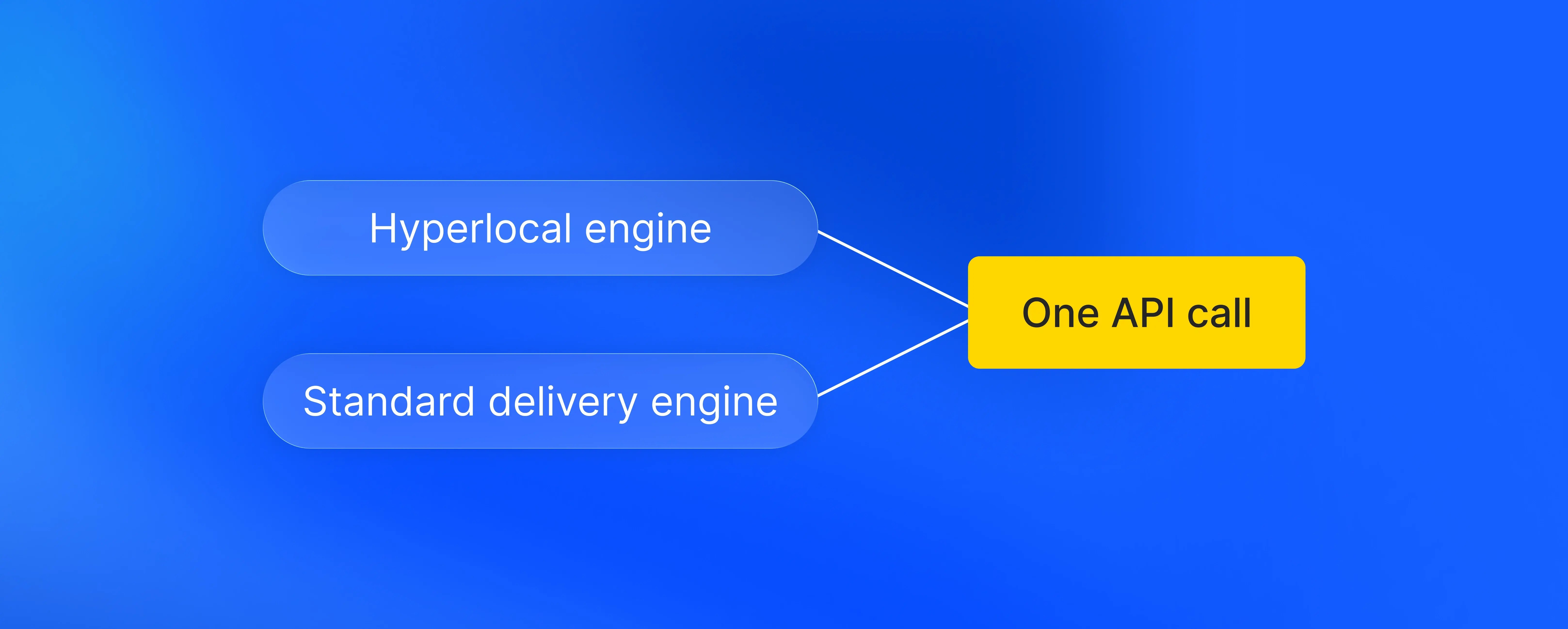
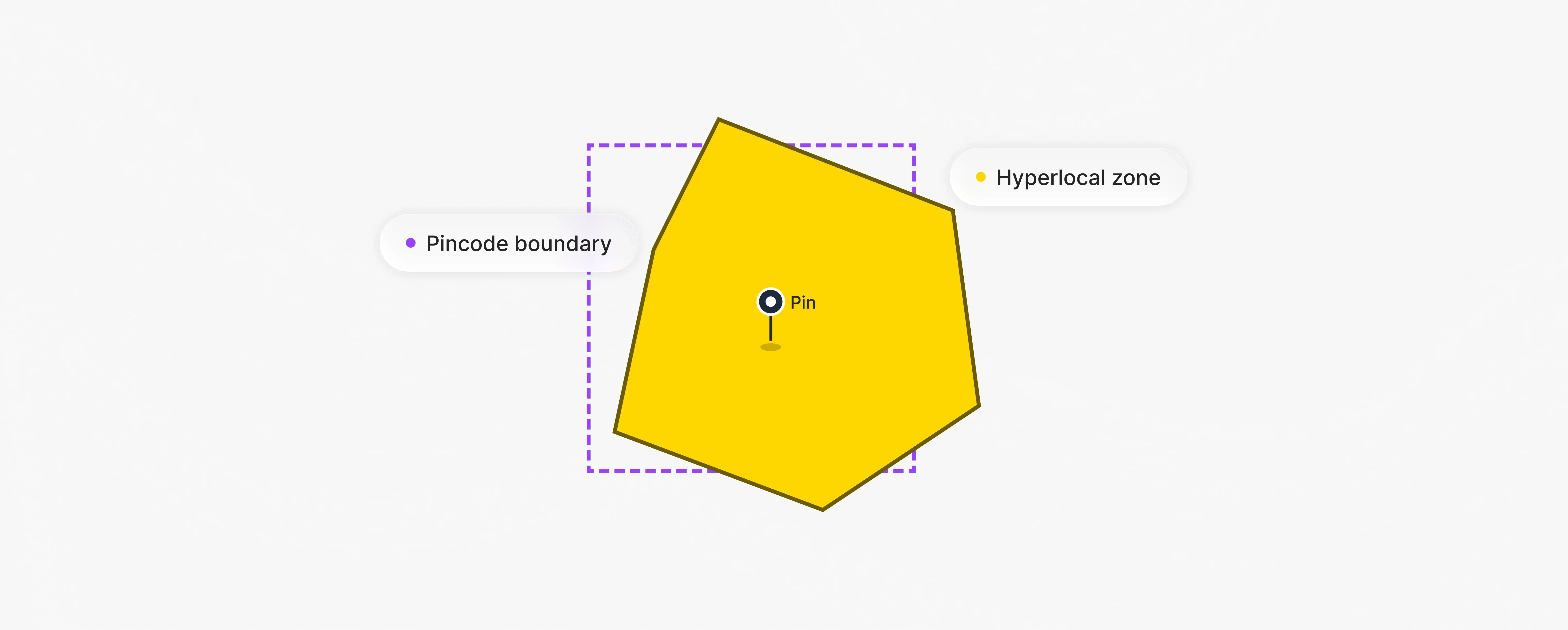
Under the hood, hyperlocal serviceability runs on polygon-based configurations with multi-layered ETA logic, zone geometry rather than distance from a pincode centroid. Pincode boundaries and hyperlocal delivery zones rarely align cleanly. Brands don't manage that complexity directly; the API handles it.
Problem Two: Promises Made Without Execution Confidence
This problem is more operationally expensive, and harder to see until it's already a customer experience failure.
A customer selects 2-hour delivery at checkout. That selection was based on availability shown at PLP. But at the moment of order confirmation, has anyone checked whether a rider is actually available to fulfill it?
In many setups, no. The promise is surfaced based on serviceability configuration. Rider availability at the point of cart is a different check, and if it isn't happening, the brand is confirming a delivery window it may not be able to meet.
How Real-Time Rider Checks Prevent Failed Delivery Promises
ClickPost checks real-time rider availability at cart level for hyperlocal orders. If availability doesn't support the promise, it doesn't get confirmed. This single check eliminates a significant share of failed hyperlocal deliveries, not by improving execution, but by not making promises the execution layer can't keep.
The second execution gap is post-allocation. A rider is assigned but doesn't reach the pickup point within threshold. The order is now running late against its ETA, and without intervention it will breach.
The standard resolution is manual: someone on the store operations team notices, escalates, finds an alternative. That works at low volume. It doesn't scale, and the lag between a problem occurring and a human acting on it consistently costs the ETA.
How Automated Re-Allocation Protects the Delivery Window

ClickPost's re-allocation system monitors allocation and pickup progression continuously. When a threshold is missed, it switches to another carrier automatically. No human in the loop, no lag. The order continues toward its promised window, and store operations isn't pulled into managing individual shipments. This is the same carrier allocation logic that powers ClickPost's standard shipping — extended to handle the tighter SLAs of quick commerce.
What the Product Outcome Looks Like
- Accurate delivery filters on PLP — powered by unified serviceability across hyperlocal and standard systems.
- Product-level promises on PDP — backed by real estimated delivery date logic, not generic pincode assumptions.
- Cart confirmation backed by real-time rider availability — so promises aren't made that execution can't keep.
- Automated fallback when execution starts to slip — through continuous monitoring and automated carrier re-allocation that protects the ETA without manual intervention.
None of this is visible to the customer. That's the point. The customer sees a promise, and the promise is kept. The complexity lives in the system, not in the experience.
D2C quick commerce doesn't fail because of speed. It fails because the infrastructure between the promise and the delivery isn't built to be reliable at scale.
Related reading: Quick Commerce Companies in India | Dark Stores Explained | Last-Mile Delivery Software | Post-Purchase Experience Guide