.png?width=193&height=27&name=ClickPost%20Logo%20(Blue).png)
.svg)
.svg)
.svg)
.svg)
.svg)
.svg)
.svg)
.svg)
.svg)


.svg)
.svg)
.svg)
.svg)
.svg)


.svg)
.svg)
.webp?width=286&height=206&name=ROI%20Calculator%20(1).webp)
.svg)
.svg)

.svg)

.webp?width=286&height=206&name=RTO%20Playbook%20(1).webp)


In this blog
TL/DR summary
Customer service on Shopify is shifting from reactive ticket handling to a system that blends AI deflection, unified channel management, and operational actions tied to orders. The tools on this list cover the full spectrum, from Shopify’s free Inbox to enterprise desks and AI-first assistants.
Key takeaways
-
Prioritize tools that show order context inside the ticket and allow common actions without tab switching.
-
Use self-service and automation to reduce WISMO and return-related load.
-
Treat WhatsApp and social DMs as core channels if your customers live there.
-
Match the platform to your reality: simple chat for small teams, structured helpdesks for scale, enterprise tooling for governance.
In plain terms: your support stack in 2026 is a retention lever. Choose the option that shortens resolution time, reduces inbound volume, and keeps the customer experience consistent across all channels.
Introduction
Support is now part of merchandising. If shoppers cannot get an answer within minutes on sizing, delivery timelines, return eligibility, or a damaged-item claim, they bounce and remember. The best Customer Service Shopify Apps in 2026 do two things well: they pull real-time order context from Shopify, and they reduce repetitive tickets through automation, self-service, and AI-assisted workflows.
Key highlights
-
Unified inboxes are the new baseline. Email, chat, social DMs, WhatsApp, and sometimes voice now all sit in a single agent workspace.
-
AI is moving from drafts to resolutions. The goal is not clever chat. It is ticket deflection, faster triage, and fewer handoffs.
-
Post-purchase is the main battleground. WISMO, returns, exchanges, and address edits drive most volume and most frustration.
-
Operational actions inside the helpdesk matter. Refunds, cancellations, reships, and edits without tab-switching save real hours.
-
Support is increasingly tied to logistics. Proactive shipping updates and exception handling reduce inbound contacts.
Top Customer Service Shopify Apps in 2026
Here are ten options worth watching because they closely align with how Shopify brands will manage support teams in 2026: unified channels, Shopify-native context, automation, and measurable impact on retention.
|
App |
What it is best at |
Pricing (starting) |
|
Self-service + eCommerce-first helpdesk |
$89/month |
|
|
Shopify-native chat for lean teams |
Free |
|
|
Shopify-integrated helpdesk with order actions |
$10/month |
|
|
Enterprise workflows, SLAs, governance |
$19/agent/month |
|
|
Unified inbox + proactive cues + help centre |
$29/month |
|
|
Live chat + chatbot automation for SMBs |
Free; ~$29/month |
|
|
AI assistant for product Q&A + tracking |
Free; $19/month |
|
|
Helpdesk + AI + social moderation |
Free; $39/month |
|
|
WhatsApp-first support + messaging |
Free; $15/month |
|
|
Multichannel support across marketplaces |
$49/month |
1. Richpanel
Richpanel is an eCommerce-first helpdesk built around the Shopify context and self-service. It combines a unified inbox with a customer portal that lets shoppers handle routine tasks like tracking, returns, exchanges, and cancellations without waiting for an agent. For teams tired of WISMO volume, it is designed to reduce repetitive contacts while keeping agents in a single workspace.
Key features
-
Omnichannel inbox (email, chat, social; optional channels by plan)
-
Self-service flows for tracking, returns, and exchanges
-
Customer profile view with order history and LTV signals
-
AI assistance for drafting, tagging, and repetitive actions
-
Reporting for response time, resolution time, and satisfaction
Pricing starts at $89/month (Pro) and $119/month (Pro Max / Self Service tiers). Richpanel stands out in 2026 for treating “support” as a blend of automation and customer-controlled workflows, which directly reduces ticket volume.
2. Shopify Inbox
Shopify Inbox is Shopify’s free, built-in chat and messaging app. It sits close to your admin so that it can surface shopper context during live conversations: what a customer is viewing, what is in the cart, and prior orders. For lean teams, it is often the simplest way to start real-time support without building a full helpdesk stack.
Key features
-
Storefront chat with Shopify-native context
-
Quick replies, FAQs, and basic automations
-
Suggested replies (AI-assisted) for faster responses
-
Easy handoff across staff accounts
-
Product links and discount sharing in chat
It is free to use. It earns a place in 2026 because it is the lowest-friction option for merchants seeking to improve response speed and reduce purchase hesitation, especially during peak season.
3. Gorgias
Gorgias is a Shopify-focused helpdesk that centralises email, chat, social messages, and other channels into one ticketing system. Its strength is operational support: agents can act on orders directly within the ticket view, which is especially useful for address changes, refunds, and replacement workflows. It is built for support teams that want both speed and structure.
Key features
-
Unified inbox across major support channels
-
Deep Shopify integration with order actions in-thread
-
Macros, rules, and automation for routing and tagging
-
FAQ and self-service tools to deflect common questions
-
Revenue and support analytics tied to outcomes
Pricing starts at $10/month (Starter, ticket-based) and scales with ticket volume. Gorgias stands out in 2026 for reducing the “support swivel-chair” problem: fewer tab switches, faster resolutions, cleaner accountability.
4. Zendesk
Zendesk is the enterprise option many fast-scaling brands adopt as complexity increases: multiple teams, multiple queues, global coverage, SLAs, and governance. The Shopify integration pulls order context into tickets, and the broader Zendesk ecosystem supports knowledge bases, advanced routing, and automation at scale.
Key features
-
Mature ticketing with omnichannel coverage
-
Workflow automations, SLAs, and skills-based routing
-
Knowledge base and structured self-service
-
Advanced analytics and QA tooling (by plan/add-on)
-
Strong security controls for larger operations
Pricing typically starts at $19 per agent/month (Support Team, billed annually). Zendesk Suite plans typically start at around $55 per agent/month and increase with feature depth. It stands out in 2026 for brands that need process, compliance, and scale more than “lightweight simplicity.”
5. Reamaze
Reamaze is a customer messaging platform built for online brands that want chat, email, social, and automation in one place. It pairs a shared inbox with proactive triggers, a help centre, and AI-assisted workflows. If you want support to feel conversational while still being trackable, this sits in the middle ground between basic live chat and heavy enterprise desks.
Key features
-
Unified inbox (email, chat, social; SMS/voice on higher tiers)
-
Proactive “cues” and behavioural triggers on-site
-
Shopify context inside conversations
-
Workflows, macros, and AI assistance
-
Help centre and FAQ search inside the widget
Pricing starts at $29/month (Basic), with $49/month (Pro) and $69/month (Plus). Reamaze stands out in 2026 for blending support and proactive engagement without requiring a sprawling enterprise setup.
6. Tidio – Live Chat & AI Chatbot
Tidio combines live chat, ticketing, and AI chatbots in a single helpdesk-style console. It is popular with small to mid-sized Shopify stores that want faster first-response times, automated answers to routine questions, and the ability to nudge conversions with product recommendations during chats.
Similarly, platforms like Janitor AI highlight how AI chatbots can be customized for more engaging and conversational experiences, which can inspire businesses to create more personalized and interactive customer support interactions within tools like Tidio.
Key features
-
Live chat with ticketing and team collaboration
-
Chatbot builder for FAQ, order-status, and workflow automation
-
AI agent options for higher deflection and 24/7 coverage
-
Visitor context for better, faster replies
-
Integrations with common marketing and support tools
Pricing includes a Free plan, with paid tiers commonly starting around $29/month (chat/ticketing) and $39/month for AI chatbot features (plan structure varies by usage). Tidio stands out in 2026 for its practical “AI + human” model, which does not require a large support organization.
7. Convi – AI Chatbot & Helpdesk
Convi is an AI shopping assistant that doubles as a support layer. It is designed to answer product questions, recommend items, and handle basic post-purchase queries, such as order tracking. The key idea is to handle common questions instantly, then hand off to a human agent only when needed.
Key features
-
AI chatbot trained on store and product data
-
Order tracking and common support intents 24/7
-
Product recommendations inside chat
-
Live chat handover for complex issues
-
Custom FAQs and response rules
Pricing starts with a Free plan (limited AI replies), with paid plans starting at $19/month and higher tiers for higher reply volume. Convi stands out in 2026 because brands are increasingly treating pre-purchase questions as support tickets that directly influence conversion rate.
8. Commslayer – Helpdesk & Chat
Commslayer is a Shopify-centric helpdesk with a unified inbox plus AI support features designed for eCommerce operations. The appeal is operational: the platform brings order context into the agent view and supports automations that reduce manual triage. It is also built to handle social comments and DMs alongside classic tickets.
Key features
-
Unified inbox for email, chat, social, and messaging channels
-
Shopify sidebar with order and customer context
-
AI agent for routine requests (WISMO, address edits, basic actions)
-
Social moderation tools for ad comments and spam management
-
Macros, views, and reporting for team workflow
Pricing includes a Free tier, with paid plans starting around $39/month and scaling up to $99/month for larger AI usage. It stands out in 2026 because support teams are now expected to manage “support + social” in the same operational loop.
9. Marketing+Support on WhatsApp
Marketing+Support on WhatsApp (by SuperLemon) is designed for brands that want WhatsApp to serve as both a support and an engagement channel. It centres around widgets, a shared team inbox, automated messages, and templated campaigns. For many D2C brands, WhatsApp is where customers actually respond.
Key features
-
WhatsApp chat and share widgets on the storefront
-
Shared team inbox for support handling
-
Automated messages for updates and common flows
-
Campaign templates for outreach and follow-ups
-
Basic operational messaging around orders and notifications
Pricing includes a Free Forever tier, with paid plans starting at $15/month (Engage) and $40/month (Engage Plus). It stands out in 2026 because WhatsApp has become a first-class service channel, not a side tool.
10. eDesk
eDesk is built for multichannel sellers who support customers across marketplaces and Shopify at the same time. It unifies messages from channels such as Amazon, eBay, and social media into a single dashboard, while pulling order context into tickets. That makes it useful for brands managing marketplace SLAs alongside their D2C store.
Key features
-
Unified inbox across Shopify and marketplace channels
-
Order context, tracking details, and customer history in-ticket
-
Rules, automations, and internal collaboration tools
-
Live chat options for store support
-
Performance analytics aligned to eCommerce response expectations
Pricing starts at $49/month (Essential), with higher tiers around $115/month (Growth) and $149/month (Professional). eDesk stands out in 2026 because “support” is often a cross-channel operational function, not just a Shopify-only workflow.
ClickPost turn returns into exchanges and repeat purchases, not losses
Automated returns & Exchanges with a self-serve portal, tracking, policies & analytics.
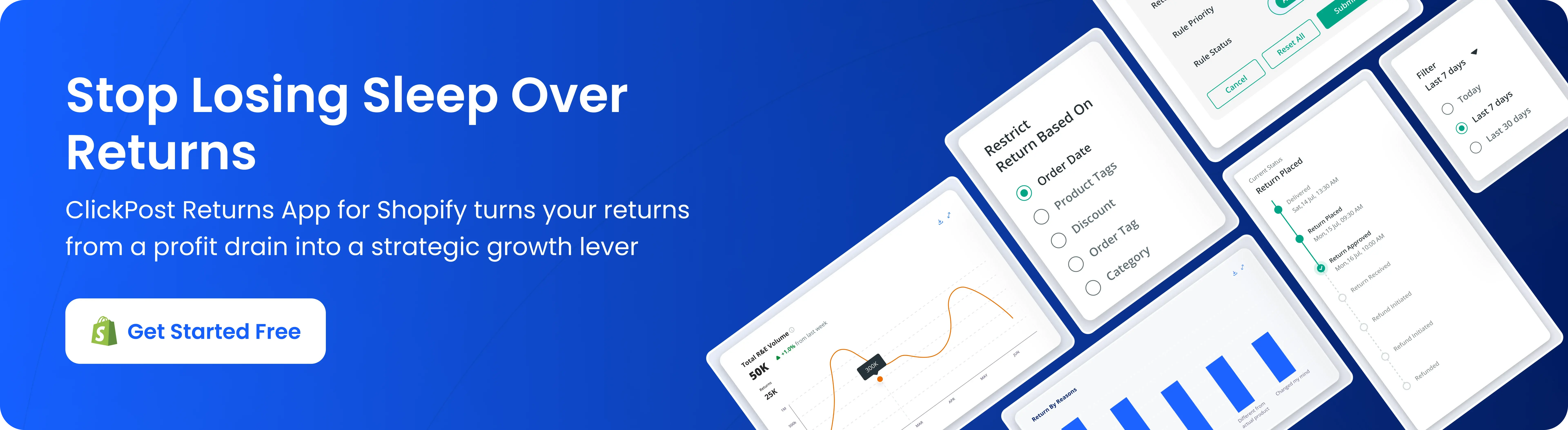
ClickPost Returns & Exchanges streamlines return and exchange management with automation, refunds, and a self-serve portal. Customers get real-time tracking, automated updates, and quick refunds. Merchants manage all return and exchange requests in one dashboard with customizable policies, eligibility rules, and reasons. Detailed return analytics and reporting give insights to cut costs and boost repurchases. Setup is fast, with everything ready in under 30 minutes.
-
Automated self-serve portal for easy returns, exchanges & refunds.
-
Dashboard to manage, track, and resolve return & exchange requests.
-
Process refunds to via gift cards or original payment methods.
-
Customizable return and exchange policies, rules, and eligibility.
-
Analytics & reporting with insights on return and Exchange trends.
ClickPost Returns Plus offers a free plan for up to 100 monthly returns. Paid plans start at $49/month. You can also integrate our returns management product with your ecommerce website. The total reviews on the ClickPost tool at Shopify are a testament to the ease it offers to merchants. The app support provided also makes it one of the best in the app categories for returns, exchanges, and refunds.
Closing Note: Support is now part of retention economics
In 2026, the best support teams will not win by “working harder.” They will win by designing fewer reasons for customers to contact them, then resolving the remaining issues in fewer steps. Pick the platform that matches your volume and channels, then focus on two metrics: time-to-first-response and time-to-resolution. If you improve those without burning out agents, customer loyalty follows.