.png?width=193&height=27&name=ClickPost%20Logo%20(Blue).png)
.svg)
.svg)
.svg)
.svg)
.svg)
.svg)
.svg)
.svg)
.svg)


.svg)
.svg)
.svg)
.svg)
.svg)


.svg)
.svg)
.webp?width=286&height=206&name=ROI%20Calculator%20(1).webp)
.svg)
.svg)

.svg)

.webp?width=286&height=206&name=RTO%20Playbook%20(1).webp)



In this blog
TL/DR Summary
Not every Shopify app deserves a place in your stack. This guide highlights a short list of marketing apps that consistently help merchants drive sales, acquire more customers, and turn store traffic into repeat revenue.
Key takeaways
-
Privy, Trustoo Popup Email Marketing, and Trustoo AI Product Reviews App cover email marketing, sms, pop-ups, and reviews without demanding enterprise budgets.
-
GemPages and Shogun help you create better product pages and landing experiences that support SEO and increase conversion rates.
-
Loox, Trustoo, and Stamped.io lean into user-generated content and loyalty to build trust and long-term customer engagement.
-
Releasit and Kaching Bundles Quantity Break focuses directly on average order value and cart recovery, which matters in markets with high COD usage.
-
The strongest setups must have Shopify apps across channels, not just a single flashy plugin from the Shopify App Store.
In short, the apps highlighted here provide modern Shopify merchants with practical tools to create better experiences, better understand customers, and turn one-time transactions into lasting relationships and increased sales over time.
How to Choose the Right Shopify Marketing Apps for Your Store in 2026
If you run a serious Shopify store, you already know there is no shortage of Shopify marketing apps promising more traffic, better targeting, and higher revenue. The hard part is separating the nice-to-have plugins from the few Shopify marketing apps that actually drive results across email, SMS, social, and the on-site experience.
Going into 2026, merchants are under pressure to make every dollar and every click count. Customer acquisition is costly, data privacy rules are tighter, and buyers expect relevant, respectful communication. In this environment, the right Shopify app stack becomes part of your core marketing engine, not just decoration from the Shopify app store. Just as ecommerce automation streamlines backend operations, the right marketing apps automate customer engagement and conversion.
The list below is designed for merchants who prioritize conversion rates, customer engagement, and long-term customer retention, not vanity metrics.
What Makes a Shopify Marketing App Worth Installing in 2026?
-
AI and automation are no longer bonuses; they are baked into the best Shopify apps for personalisation, segmentation, and cart recovery.
-
Email marketing and SMS marketing still deliver the strongest return when combined with smart pop-ups and abandoned cart reminders.
-
Visual user-generated content is now a primary driver of social proof and customer loyalty, especially for D2C brands.
-
On-site builders such as GemPages and Shogun help you create campaign-specific product pages and collection pages without waiting on developers.
-
Bundling and volume-discount apps are central to increasing conversion rates and average order value, especially during peak season.
-
Review and loyalty program platforms are becoming comprehensive tools that cover reviews, UGC, referrals, and lifecycle campaigns in one place.
-
Facebook and Instagram presence, fueled by native integrations, still matters for discovery, performance ads, and new customers.
Top 10 Shopify Marketing Apps for 2026: Complete Feature Comparison
The apps below are not random favourites. They are must-have Shopify apps that frequently appear in real merchant stacks, forum discussions, and the wider Shopify community. Together, they cover list growth, on-site experience, social commerce, social proof, and post-purchase marketing efforts.
|
App |
Best For |
Stand-out 2026 Angle |
|
Small to mid-sized merchants who want unified email and SMS |
Strong balance of pop-ups, email list growth, and sms marketing without overwhelming dashboards |
|
|
COD-heavy markets and dropshippers |
1-page COD checkout with upsells that protect margins and support cart recovery |
|
|
Social-first acquisition and retargeting |
Native bridge between Meta ads, shops, and your core Shopify journey |
|
|
Early-stage brands building their email list |
Completely free core plan with pop-ups and abandoned carts flows that feel simple to run |
|
|
Merchants running frequent campaigns and tests |
Visual funnel builder focused on SEO, conversion rates, and rapid page launches |
|
|
Scaling brands with bigger content budgets |
Advanced controls for layout, A/B tests, and detailed analytics across key landing pages |
|
|
Visual-first D2C brands |
Deep focus on social proof from photos and videos, plus referral and upsell options |
|
|
Stores focused on a higher average order value |
Flexible product bundles and quantity discounts that encourage larger baskets |
|
|
Data-driven teams managing a high volume of reviews |
AI analysis of store reviews, smart widgets, and rich snippets to help with search engine visibility |
|
|
Brands investing in lifecycle and loyalty |
Connected stack of reviews, loyalty, and lifecycle campaigns that help drive more customers back to the store |
1. Privy – How Does Email, SMS & Pop-Up Marketing Work for Small Shopify Stores?
Privy is a mature Shopify app focused on email marketing, SMS, and conversion-focused pop-ups for small and mid-sized merchants. It plugs directly into your Shopify store, providing list-building widgets, automated sequences, and basic segmentation without requiring a full-blown marketing team.
Key Features of Privy for Shopify Marketing in 2026
-
Drag-and-drop editor for emails, pop-ups, and forms
-
Targeted displays with exit-intent, timers, and triggers
-
Automated welcome flows and abandoned cart reminders
-
Integrated SMS marketing for cart saver and win-back messages
-
Simple reporting to track sales and sign-ups
Privy uses tiered pricing, with a free plan for small lists and paid plans that scale based on contacts and SMS usage. It stands out in 2026 because it offers sales with email marketing and SMS under one roof, helping merchants increase sales without juggling multiple tools. For brands focused on post-purchase engagement for ecommerce brands, Privy's automated flows keep customers connected after checkout.
2. Releasit COD Form & Upsells– What's the Best Cash on Delivery Solution for Shopify?
Releasit COD Form & Upsells is built for Cash on Delivery-heavy markets where checkout friction and fake orders can quietly erode margins. This Shopify app replaces the standard checkout flow with a one-page COD form and integrates upsells and quantity offers to increase average order value.
How Releasit Reduces RTO and Increases Average Order Value
-
One-click COD form embedded on product pages or as pop-ups
-
Built-in upsells, downsells, and quantity breaks to drive sales
-
OTP-based verification via SMS or WhatsApp to cut fake orders
-
Cart recovery and event tracking for ad platforms
-
Google Sheets export and integrations for simple back-office workflows
Releasit is free to install, with higher tiers unlocking more advanced options. It has a 5-star rating and a significant number of reviews back its reliability. For Shopify merchants in COD-first regions, it is a practical way to increase conversion rates while still staying on top of risk. Merchants dealing with RTO in ecommerce find Releasit's verification features particularly valuable for reducing failed deliveries.
3. Instagram & Facebook by Meta (InstaShop)– How to Sell on Instagram and Facebook from Shopify?
The official Facebook and Instagram app from Meta is the backbone of social commerce for many Shopify store owners. Instead of treating social as a separate channel, this Shopify app syncs your product catalogue. It lets you manage your Facebook presence, Instagram Shop, and performance ads in one place.
Meta Integration Features for Shopify Merchants in 2026
-
Automatic product sync from your Shopify store to Meta surfaces
-
Native storefronts for in-app checkout and shoppable posts
-
Pixel and Conversion API setup to track customer behavior
-
Campaign and catalog management for performance ads
-
Insights into top-performing content and products
The app is free to install, with ad spend managed through your Meta account. For 2026, it remains a foundation for merchants who want a stronger Facebook and Instagram presence and a clean bridge between discovery, ads, and on-site sales.
4. Trustoo Popup Email Marketing (EcomSend)– What's the Best Free Popup App for Shopify?
Trustoo Popup Email Marketing, often listed as EcomSend, focuses on growing your email list using engaging pop-ups, gamified formats, and basic automation. It is aimed at Shopify store owners who want fast list growth and simple campaigns without getting lost in complex dashboards.
How Trustoo Popup Email Marketing Grows Your Email List
-
Customizable pop-ups, spin wheels, and discount pop-ups
-
Drag-and-drop editor for on-brand sign-up forms
-
Automated welcome emails and cart recovery flows
-
Exit-intent triggers to rescue abandoning visitors
-
Integrations with leading marketing apps for deeper journeys
Trustoo Popup Email Marketing is free to install with a generous free version, making it one of the more approachable marketing apps for early-stage merchants. In 2026, its appeal lies in how completely free it can feel for core use cases while still giving you enough notifications and flows to capture more customers.
5. GemPages – How to Build High-Converting Landing Pages on Shopify Without Code?
GemPages is a conversion-focused landing page builder that helps merchants create high-performing product pages, collection pages, and sales funnels without touching code. It is popular with Shopify merchants who treat their store like a testing ground and want to iterate quickly on layouts. Much like store building and design tools streamline the setup process, GemPages accelerates campaign launches.
GemPages Features for CRO and Conversion Rate Optimization
-
Visual drag-and-drop editor with responsive layouts
-
CRO widgets such as scarcity timers and stock alerts
-
A/B testing and detailed analytics for page performance
-
Prebuilt templates for different industries and campaign types
-
Integrations with upsell, review, and analytics tools
GemPages offers a free plan to experiment, with paid plans unlocking premium features, advanced testing, and higher traffic limits. In 2026, it remains one of the best Shopify apps for creating fast, campaign-specific pages that help increase conversion rates across the funnel.
6. Shogun – What's the Best Advanced Page Builder for Growing Shopify Brands?
Shogun is another heavyweight in the Shopify app store for page building, but it leans more towards scaling brands that want fine control over layout, content, and performance. It spans product pages, blogs, and landing pages, and is widely used by merchants running large content and ad programs.
Shogun's Advanced Features for Shopify Merchants
-
Precise, grid-based drag-and-drop editor for all page types
-
Powerful support for product pages and collection pages
-
Built-in A/B testing tied to conversion rates
-
SEO controls, including metadata and structured content blocks
-
Support for headless or hybrid builds for advanced users
Shogun is typically offered on paid plans, with no free plan available beyond trials, and pricing scales with usage. It earns its place on a 2026 short list because it is a comprehensive tool for merchants who want page design, SEO, and experimentation in one app, backed by thousands of strong reviews.
7. Loox Product Reviews & Photos – How Do Visual Reviews Increase Shopify Sales?
Loox is a specialist in visual product reviews, helping brands turn happy customers into a steady stream of user-generated content. It combines review collection, rich media, and referral capabilities, making it a practical choice for D2C businesses that rely on strong social proof. Brands in the D2C space in India and D2C brands in the USA use Loox to build trust and authenticity.
Loox Features for User-Generated Content and Social Proof
-
Automated review request emails after purchase
-
Photo and video reviews displayed in carousels and widgets
-
Referral program tools to reward new customers and repeat buyers
-
Widgets that match your theme and build trust on key pages
-
Integrations with Google Shopping and social channels
Loox runs on a paid model with a free plan available for testing and entry-level stores. With thousands of reviews and 5-star ratings on the Shopify app store, it remains one of the must-have Shopify apps for merchants who want store reviews and visual proof to convert more customers with fewer ads.
8. Kaching Bundles Quantity Break– How to Increase Average Order Value on Shopify?
Kaching Bundles Quantity Break is designed to increase average order value by making product bundles and volume discounts feel natural rather than pushy. The app lets merchants offer tiered pricing, “buy X get Y” deals, and bundles of complementary products without heavy setup.
Kaching Features for Product Bundles and Volume Discounts
-
Flexible product bundles, volume discounts, and quantity breaks
-
Layouts that fit neatly into product pages and carts
-
A/B testing options to see which offers generate more sales
-
Analytics around uplift in average order and conversion
-
Strong support and quick onboarding for new users
Kaching is free to install with revenue-linked plans that unlock more advanced options. With its 5-star average and large number of reviews, it is a favorite among Shopify merchants who want to turn frequently purchased combinations into structured offers rather than one-off discounts.
9. Trustoo AI Product Reviews App– What's the Best AI-Powered Review App for Shopify?
Trustoo AI Product Reviews App takes a more data-driven approach to reviews. It is designed for merchants who want automation around collecting, importing, and analysing reviews, while still keeping control over how that content appears on the store.
Trustoo AI Features for Review Automation and Analysis
-
Automation to send review requests and reminders by email or sms
-
Import tools for existing reviews from marketplaces and other platforms
-
Flexible widgets for showcasing text, photo, and video reviews
-
AI-based summaries and insights into customer behavior
-
Multi-language support for global brands
Trustoo offers a free plan and paid tiers with more capacity and advanced options, including rich snippets for SEO. It is particularly attractive in 2026 for merchants seeking an app that enables cleaner review flows, surfaces user-generated content, and maximizes value from the existing reviews.
10. Stamped.io– How Does a Combined Reviews and Loyalty Program Work on Shopify?
Stamped.io brings reviews, UGC, and loyalty under one roof, giving merchants a single Shopify app to manage customer feedback and behaviour-based rewards. It is widely used by growth-focused businesses that want both social proof and structured incentives to support customer retention.
Stamped.io Features for Reviews, Loyalty, and Lifecycle Marketing
-
Collection and display of reviews, photos, and videos with flexible widgets
-
Loyalty program engine with points, VIP tiers, and referral program tools
-
Integrated email and sms campaigns for review and reward nudges
-
Analytics to understand which segments and rewards drive more sales
-
Integrations with Facebook, Google, and major helpdesk and ESP tools
Stamped.io offers a free plan, with paid plans that scale based on order volume and feature depth. With thousands of total reviews in the Shopify app store, it is a natural choice for merchants who want to build trust, run a modern loyalty program, and tie it all back to measurable business results.
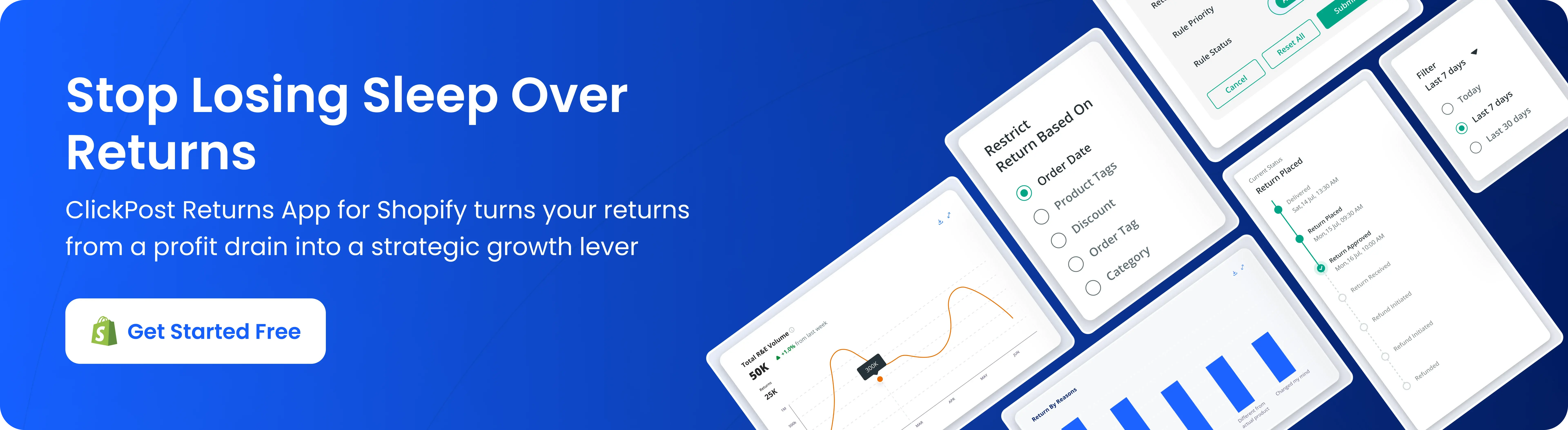
ClickPost turn returns into exchanges and repeat purchases, not losses
Automated returns & Exchanges with a self-serve portal, tracking, policies & analytics.
ClickPost Returns & Exchanges streamlines return and exchange management with automation, refunds, and a self-serve portal. Customers get real-time tracking, automated updates, and quick refunds. Merchants manage all return and exchange requests in one dashboard with customizable policies, eligibility rules, and reasons. Detailed return analytics and reporting give insights to cut costs and boost repurchases. Setup is fast, with everything ready in under 30 minutes.
-
Automated self-serve portal for easy returns, exchanges & refunds.
-
Dashboard to manage, track, and resolve return & exchange requests.
-
Process refunds to via gift cards or original payment methods.
-
Customizable return and exchange policies, rules, and eligibility.
-
Analytics & reporting with insights on return and Exchange trends.
ClickPost Returns Plus offers a free plan for up to 100 monthly returns. Paid plans start at $49/month. You can also integrate our returns management product with your ecommerce website. The total reviews on the ClickPost tool at Shopify are a testament to the ease it offers to merchants. The app support provided also makes it one of the best in the app categories for returns, exchanges, and refunds.
How to Build a Complete Shopify Marketing Stack in 2026
The right mix of Shopify marketing apps is less about chasing trends and more about building a resilient acquisition and retention engine. As you plan 2026, think in systems: how you attract merchants’ attention with ads, convert on-site visitors with pop-ups and on-brand product pages, recover abandoned carts, and keep customers coming back through reviews, notifications, and rewards.
When these apps work together, they help you increase sales, strengthen relationships, and quietly improve the health of the business month after month. Successful Shopify apps for clothing stores combine marketing automation with operational efficiency. Leveraging Shopify order tracking apps alongside marketing tools creates a seamless customer experience from discovery through delivery. Understanding shipping cost dynamics also helps you structure promotions and bundle offers that protect margins while increasing conversions. For returns management, exploring Shopify returns apps ensures you maintain customer satisfaction even after purchase.
Additionally, automating Shopify returns reduces friction and builds trust with customers. To close the loop, many brands use branded tracking pages to extend their marketing reach into the post-purchase phase. Advanced merchants also leverage ecommerce order tracking to reduce support tickets and improve transparency. As your store scales, integrating with multi-carrier software becomes essential for managing shipping complexity. Understanding the broader ecommerce logistics landscape helps you make smarter decisions about fulfillment and customer delivery expectations.
Finally, implementing delivery management software ensures your backend operations match the promises your marketing apps make to customers.