.png?width=193&height=27&name=ClickPost%20Logo%20(Blue).png)
.svg)
.svg)
.svg)
.svg)
.svg)
.svg)
.svg)
.svg)
.svg)


.svg)
.svg)
.svg)
.svg)
.svg)


.svg)
.svg)
.webp?width=286&height=206&name=ROI%20Calculator%20(1).webp)
.svg)
.svg)

.svg)

.webp?width=286&height=206&name=RTO%20Playbook%20(1).webp)



In this blog
Shopify vs Shopify Plus in 2025: Which Platform Is Right for Your Business?
In the evolving world of digital commerce, the United States continues to lead with a booming eCommerce landscape. As new and established businesses rush to establish their digital presence, Shopify remains one of the most popular choices for building an online store. However, the real dilemma many companies face today lies in choosing between Shopify and Shopify Plus.
While both platforms offer robust eCommerce functionalities, their differences are more than skin-deep. The right decision depends on your business scale, sales volume, feature requirements, and future ambitions. In this article, we provide a comprehensive examination of the key differences between Shopify Plus and Shopify, enabling businesses to make an informed, strategic decision.
Shopify vs Shopify Plus: Complete Features Comparison & Key Differences (2025)
While Shopify suits most small to medium-sized businesses, Shopify Plus is designed for fast-scaling brands that require deeper customization, automation, and support. Below is a detailed analysis comparing these platforms in terms of features, pricing, and scalability.
| Feature | Shopify | Shopify Plus |
| Target Users | Small to medium eCommerce businesses |
High-growth, enterprise-level brands
|
| Pricing | $39 to $399/month (based on plan) |
Starts at $2,000/month (scales with volume and complexity)
|
| Transaction Fees | 2% with third-party gateways, 0% with Shopify Payments |
As low as 0.15% with Shopify Payments
|
| Number of Stores | 1 store per account |
Up to 10 stores (main + 9 expansion stores)
|
| Multi-Store Management | Limited, requires workarounds |
Native support with Organization Settings Dashboard
|
| Checkout Customization | Limited |
Fully customizable checkout with Checkout Extensibility & Scripts
|
| Checkout Extensibility | Not available |
Advanced support using Shopify Functions, Scripts, and Editor
|
| Staff Accounts | Up to 15 (Advanced plan) |
Unlimited staff accounts with advanced permissions
|
| Custom Reports | Available on Advanced plan |
Advanced reports + ShopifyQL Notebooks
|
| Shopify Flow | Not available |
Included — full access to automated workflows
|
| Launchpad | Not available |
Available — automate flash sales, launches, campaigns
|
| Wholesale/B2B Selling | Not natively supported |
Built-in wholesale tools + customer-specific catalogs
|
| Shopify POS Pro Locations | Up to 10 |
Includes 20 locations with possibility to expand
|
| Custom Apps & API Access | Standard API rate limits |
Higher API limits, access to custom/private apps
|
| Advanced Customization Options | Basic theme customization |
100 stored themes, advanced scripts, and storefront flexibility
|
| Advanced Analytics | Limited to standard reports |
Deep analytics with ShopifyQL + custom dashboards
|
| Customer Segmentation | Basic filters |
Dynamic segments and automation integrations
|
| Support | Shopify support team |
Dedicated account manager + priority support
|
| Merchant Success Program | Not included |
Included — with Merchant Success Manager
|
| Shopify Academy Access | Standard courses |
Premium courses & certifications
|
| Omnichannel Sales | Available across social platforms |
100+ social platforms, 80+ marketplaces with mapping tools
|
| Digital Marketing Tools | Via Shopify Apps |
Enhanced integrations + Shopify Audiences support
|
| Custom Pricing and Catalogs | Not available |
Available for B2B and regional pricing rules
|
| Flash Sales Readiness | Basic |
Launchpad scheduling + site-speed optimization
|
| Inventory Management | Included |
Enhanced with better analytics and flow triggers
|
| Online Sales Management | Available |
Advanced tools to scale internationally and across verticals
|
| Scalability | Best for stable, smaller operations |
Engineered for growing eCommerce stores and brands
|
| Theme Customization | Standard |
Custom themes and sandbox environments
|
| Custom Scripts | Not supported |
Supported — powerful checkout and cart customizations
|
| Priority Support | Not included |
Included, with 24/7 access and faster resolution
|
| Multiple Locations | Up to 10 |
Up to 200 locations managed via dashboard
|
| Customer Data Access | Basic |
Granular access to customer behavior, segmentation, and LTV
|
| Custom Domain Support | Included |
Included, with advanced domain and redirect options
|
How Do Shopify and Shopify Plus Actually Differ? A Feature-by-Feature Breakdown
Let us begin by examining the most critical features of both platforms and delve into how they perform across various business functions. This breakdown offers a side-by-side view of the key differences that matter — from inventory management and automation to checkout customization and omnichannel selling.
| Feature | Shopify | Shopify Plus |
| Multi-store Management | Single storefront |
Up to 9 expansion stores, centralized control
|
| Checkout Customization | Fixed checkout, limited branding |
Fully customizable checkout, custom fields & functions
|
| Automation (Shopify Flow) | Not included |
Automate tasks with Shopify Flow
|
| Custom Apps & API | Standard API limits |
Higher API limits, access to Launchpad & custom apps
|
| Scalability & Performance | Suitable for small to mid-sized stores |
Handles high traffic & flash sales with ease
|
| Advanced Reporting | Basic analytics |
Custom reports, ShopifyQL, real-time dashboards
|
| Support & Account Management | General support |
Dedicated Success Manager, priority support
|
| Wholesale/B2B Selling | Limited options |
Dedicated B2B tools, catalogs, pricing & terms
|
| Omnichannel Support | Limited integrations |
100+ platforms, marketplaces, POS Pro access
|
| Staff/Admin Access | Limited staff accounts |
Unlimited accounts, advanced permissions
|
1. How Does Multi-Store Management Work on Shopify vs Shopify Plus?
Shopify allows you to operate a single storefront, with some flexibility using language and currency tools. Shopify Plus, on the other hand, offers up to nine expansion stores, perfect for brands managing multiple brands or operating in international markets. Through the Organization Settings Dashboard, Shopify Plus simplifies control across all stores with centralized user permissions, billing, and analytics. This is a critical advantage for brands working with Shopify Plus agencies to manage complex multi-brand operations.
-
Manage multiple stores from one dashboard.
-
Customize stores per region, brand, or B2B clients
-
Use up to 50 markets and 200 locations
-
Maintain consistent design via stored themes (up to 100)
2. What Checkout Customization Does Shopify Plus Offer That Standard Shopify Doesn't?
Regular Shopify provides a fixed checkout page with limited branding options. Shopify Plus gives complete control over the checkout experience through the new Checkout Editor. Merchants can personalize the checkout page to align with branding and user preferences, which directly impacts cart abandonment rates and conversion performance.
-
Fully customizable checkout with custom fields
-
Checkout extensibility with Shopify Functions and Scripts
-
Add custom pricing, localized tax handling, and personalized discounts
-
Multilingual and multi-currency support for global buyers, making it easier than ever to translate your Shopify store and adapt to international markets seamlessly
3. How Does Shopify Flow Automate eCommerce Workflows on Shopify Plus?
Shopify Flow, a visual automation tool, is exclusive to Shopify Plus. It enables the creation of workflows to automate repetitive tasks, such as reordering stock, tagging VIP customers, or flagging high-risk orders. This kind of eCommerce automation can dramatically reduce operational overhead for scaling brands.
-
Reduce manual effort via automation.
-
Improve inventory management and fulfillment speed.
-
Create conditional flows based on customer segments.
4. Custom Apps & API Access: What Can Shopify Plus Do That Shopify Can't?
Shopify Plus supports higher API limits, enabling seamless integration with custom apps and external systems. Brands can build unique solutions for inventory, eCommerce fulfillment, and digital marketing. Unlike standard Shopify, Plus gives brands the flexibility to work with developers on advanced integrations for marketing, logistics, and automation, including connecting to order management software and third-party logistics platforms.
-
Build or integrate with custom apps through Shopify Plus development.
-
High API rate limits for complex workflows.
-
Access to apps like ShopifyQL Notebooks and Launchpad
5. How Does Shopify Plus Handle High-Traffic Scalability and Flash Sale Performance?
Shopify Plus is built for growing eCommerce stores handling large traffic and order volumes. Brands like Nestlé and Gymshark trust its infrastructure. When paired with strong last-mile delivery software, the end-to-end customer experience stays seamless even at peak demand.
-
Better site speed during flash sales and high-traffic events
-
Handles thousands of transactions per minute
-
Launchpad support for automated sales campaigns
6. What Advanced Reporting and Analytics Does Shopify Plus Provide?
While core Shopify plans include basic analytics, Shopify Plus offers access to advanced reporting and tools, such as ShopifyQL and custom reports. These deeper insights support smarter decisions around return trends, customer lifetime value, and supply chain operations.
-
Custom dashboards for inventory, sales campaigns, and customer data
-
Deep analytics for online sales, returns, and conversion trends
-
Real-time reporting during flash sales
7. What Kind of Dedicated Support Does Shopify Plus Include?
Shopify Plus offers dedicated support, including a Merchant Success Manager and access to the Shopify Plus Partners Program. Regular Shopify users rely on general customer service.
-
Dedicated account manager for strategic guidance
-
24/7 priority support
-
Shopify Academy premium training access
8. How Does Shopify Plus Support Wholesale and B2B Selling?
Shopify Plus includes tools to manage wholesale customers with dedicated catalogs, pricing, and user permissions. This makes it well-suited for brands operating across B2B eCommerce supply chains and looking to manage complex buyer relationships at scale.
-
Manage customer-specific catalogs
-
Apply custom pricing and payment terms
-
Simplify bulk purchases and reordering
9. What Omnichannel and Retail Capabilities Come with Shopify Plus?
Shopify Plus expands off-site selling capabilities and includes 20 Shopify POS Pro locations for managing retail stores and pop-ups. Connecting these channels with a robust post-purchase experience platform ensures customers receive consistent service whether they buy in-store or online.
-
Sell across 100+ social media platforms.
-
Access 80+ online marketplaces
-
Manage retail and online inventory centrally.
10. How Does Staff and Admin Access Differ Between Shopify and Shopify Plus?
Shopify Plus supports unlimited staff accounts with advanced role permissions, unlike the capped staff access in core Shopify plans. As teams grow, this becomes essential for maintaining security and operational efficiency across fulfillment, customer service, and marketing functions.
-
Control permissions at granular levels
-
Simplify internal collaboration
-
Access to Shopify admin for all team members
Shopify vs Shopify Plus Pricing: How Much Does Each Plan Cost in 2025?
One of the most critical considerations for store owners is pricing. Let us compare the two in terms of cost and what you get for each dollar spent.
| Feature | Shopify | Shopify Plus |
| Pricing | Basic: $39/mo | Shopify: $105/mo | Advanced: $399/mo | Lite: $9/mo |
Starts at $2,000/mo (varies by business)
|
| Transaction Fees | Up to 2% with 3rd-party gateways |
As low as 0.15% with 3rd-party gateways
|
| Included Features | Hosting, SSL, Shopify Payments |
All Shopify features + unlimited staff, better APIs, exclusive apps
|
Shopify Pricing Plans: How Much Does Shopify Cost Per Month?
-
Basic Shopify: $39/month
-
Shopify: $105/month
-
Advanced Shopify: $399/month
-
Shopify Lite (only Buy Button): $9/month
How Much Does Shopify Plus Cost?
Starts at $2,000/month, but varies based on store complexity and sales volume. For brands processing high order volumes, the reduction in shipping and operational costs can offset much of this premium.
Shopify vs Shopify Plus Transaction Fees: What's the Difference?
-
Shopify charges up to 2% for third-party payment gateways unless you use Shopify Payments.
-
Shopify Plus can reduce this fee to 0.15%, significantly lowering operational costs for large stores — savings that can be reinvested into eCommerce shipping software and fulfillment infrastructure.
Other Cost Considerations When Choosing Between Shopify and Shopify Plus
-
Shopify Plus includes added features such as unlimited staff, better APIs, and exclusive apps.
-
Businesses offering recurring products or memberships can also benefit from a shopify subscription app to automate recurring payments and subscription management as they grow.
-
Web hosting, SSL certificates, and Shopify Payments are included in all plans.
Shopify vs Shopify Plus: Which Platform Should Your Business Choose?
Choosing between Shopify and Shopify Plus depends on your business size, aspirations, and operational complexity. Here is a verdict to guide you.
If you are a small-to-medium eCommerce business focused on launching quickly and managing costs, the core Shopify plans offer everything you need. Examples are inventory management, customer segments, Shopify Payments integration, and theme customization. With additional apps from the Shopify App Store — including tools like discount apps for Shopify and invoice apps — you can scale gradually.
However, once your business grows and begins to serve wholesale customers, or you manage multiple brands or markets, Shopify Plus becomes indispensable. It is designed to offer advanced customization options, reduce transaction fees, and scale your infrastructure as your operations expand. At this stage, pairing Shopify Plus with tools for automating Shopify returns and streamlining the returns process becomes equally important to sustaining growth.
Summing Up: When to Choose Shopify and When to Upgrade to Shopify Plus
-
Choose Shopify if you are starting out or scaling gradually.
-
Opt for Shopify Plus when handling high traffic, needing advanced reports, or targeting international markets.
-
Shopify Plus is ideal for managing multiple brands, flash sales, and complex digital marketing workflows.
How ClickPost Returns Plus Helps Shopify and Shopify Plus Stores Scale Effortlessly
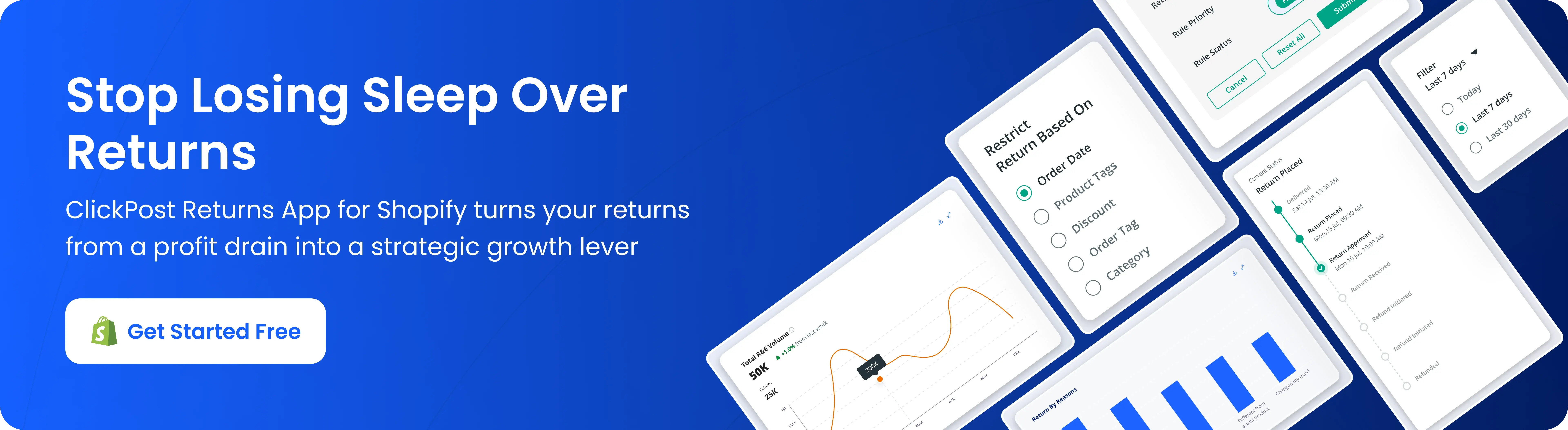
ClickPost's Shopify Returns App is more than just a returns portal — it is a retention tool, a profit lever, and an operational ally. Whether you are on Shopify or Shopify Plus, returns can drain profits if not managed well. ClickPost transforms your return process into a growth engine. It ranks among the top returns management software solutions built specifically for Shopify merchants, and is a leading choice among Shopify returns apps available today.
Key features:
-
Branded Returns Portal: Fully customizable interface for a smooth customer experience.
-
Automated Approvals: Use automated rules to reduce manual work.
-
Return Trends & Product Feedback: Gain detailed analytics to improve inventory planning.
-
Seamless Integration: Compatible with both Shopify and Shopify Plus stores, and works alongside your existing reverse logistics software.
ClickPost Shopify Returns is the smart companion your eCommerce business needs to scale without bottlenecks. Book a free demo today and discover how easy returns can drive loyalty.
Final Word: Choose the Right Shopify Plan to Match Your Growth Strategy
There is no one-size-fits-all when it comes to eCommerce platforms. Shopify delivers power and simplicity to new entrants, while Shopify Plus pushes the ceiling higher for ambitious brands. From checkout extensibility to unlimited staff accounts, from Shopify order tracking to deeper analytics, the choice is not just about now — it is about where you see your business tomorrow.
So before making a decision, ask not just what you need today, but what you want to achieve next quarter, next year, and beyond. And remember that platform choice is only one piece of the puzzle: pairing the right Shopify plan with the right post-purchase strategy for eCommerce brands is what separates fast-growing stores from the rest. Choose wisely, scale boldly.