.png?width=193&height=27&name=ClickPost%20Logo%20(Blue).png)
.svg)
.svg)
.svg)
.svg)
.svg)
.svg)
.svg)
.svg)
.svg)


.svg)
.svg)
.svg)
.svg)
.svg)


.svg)
.svg)
.webp?width=286&height=206&name=ROI%20Calculator%20(1).webp)
.svg)
.svg)

.svg)

.webp?width=286&height=206&name=RTO%20Playbook%20(1).webp)


In this blog
TL/DR summary
Shopify subscriptions apps in 2026 go far beyond recurring payments. They shape retention, inventory planning, and customer experience across the entire lifecycle.
Key takeaways
-
Prioritize customer self-service to reduce churn and support load.
-
Choose dunning and retry logic that protects revenue without hurting trust.
-
Use hybrid carts and flexible billing to meet modern buying behavior.
-
Align subscription cadence with inventory and fulfillment planning.
-
Match tool complexity to your growth stage, not just feature lists.
Subscriptions reward consistency. The right app helps you deliver it without adding operational drag.
Introduction
Shopify subscription apps are becoming central to how brands plan for revenue, inventory, and customer relationships heading into 2026. As acquisition costs stay high, subscriptions give merchants something rare: predictability. But predictable revenue only works when billing, fulfillment timing, customer controls, and churn management are handled cleanly.
The apps in this list stand out because they treat subscriptions as an operating system, not a discount toggle, balancing customer flexibility with backend discipline.
Key highlights
-
Subscription success in 2026 depends more on churn control than discount depth.
-
Customer self-service portals now directly influence retention and support costs.
-
Mixed carts and hybrid models are becoming standard, not advanced features.
-
Payment retry logic and dunning workflows quietly but materially protect revenue.
-
Inventory planning improves when subscription cadence is visible to operations teams.
Top Shopify Subscriptions Apps in 2026
The strongest subscription tools are the ones that integrate seamlessly with Shopify checkout, customer accounts, and fulfillment workflows, without requiring workarounds.
|
App |
Standout capabilities |
Pricing |
|
Bundles, loyalty, customer portal, dunning |
Free; from ~$29/month |
|
|
Deep customization, churn control, no transaction fees |
Free; from ~$10/month |
|
|
Prepaid plans, swaps, and a strong free tier |
Free; from ~$5.95/month |
|
|
Fast setup, bundling, conversion-focused widgets |
From ~$9.99/month |
|
|
Subscriptions + memberships + loyalty |
Free; from ~$19/month |
|
|
Enterprise-scale subscriptions, APIs, analytics |
From ~$50/month |
|
|
Mixed carts, build-a-box, hybrid models |
Free; from ~$19/month |
|
|
Custom billing logic, flexible pricing |
Free; from ~$9/month |
|
|
Recurring B2B ordering and contracts |
From ~$49/month |
|
|
Churn reduction, smart dunning, retention insights |
Free; from ~$99/month |
1. Joy Subscription App
Joy Subscription App helps merchants turn everyday products into predictable recurring revenue through flexible subscription widgets and customer controls. It supports classic subscribe-and-save models, bundles, and subscription boxes, all managed directly in Shopify.
Key features
-
Subscribe-and-save widgets embedded on product pages
-
Customer portal for pausing, skipping, or rescheduling deliveries
-
Flexible billing frequencies and prepaid subscription options
-
Automated payment retries and renewal notifications
-
Optional loyalty and rewards integrations
Joy offers a free plan with revenue thresholds, with paid plans starting around $29/month plus transaction fees, and higher tiers at $99/month. Joy appeals to brands that want broad functionality without overengineering their stack.
2. Appstle
Appstle is one of the most feature-complete Shopify subscriptions apps, built for merchants who want control over how subscriptions behave at the SKU, variant, and customer level. It supports everything from replenishment to curated boxes, while keeping checkout native and customer management centralized.
Key features
-
Support for replenishment, bundles, boxes, and memberships
-
Passwordless customer portal with skip, queue, and cancel actions
-
Variant-level subscription logic and flexible billing rules
-
Automated dunning and failed-payment recovery
-
Analytics covering churn, retention, and subscriber behavior
Appstle includes a free plan for low-volume sellers, with paid plans starting at $10/month and scaling to $100/month based on subscription revenue. In 2026, it stands out for its depth and has no transaction fees.
3. Seal Subscriptions App
Seal Subscriptions is known for delivering strong subscription functionality at accessible pricing, with an emphasis on customization and control. It supports prepaid plans, product swaps, and loyalty-style incentives while keeping the customer experience white-labeled and on-brand.
Key features
-
Subscribe-and-save and prepaid subscription models
-
Customer portal with skip, pause, swap, and cancellation flows
-
Product swaps and interval-based automations
-
Inventory-aware renewals to prevent overselling
-
Churn and retention analytics with delivery forecasting
Seal offers a generous free plan and paid tiers starting under $10/month with no transaction fees. It is attractive to brands seeking flexibility without enterprise pricing.
4. Kaching
Kaching Subscriptions is designed for speed and conversion, with a focus on fast setup and a clean subscription experience that does not slow storefront performance. It pairs subscription logic with bundling and upsell capabilities, making it useful for brands focused on increasing order value alongside retention.
Key features
-
Pay-per-delivery and prepaid subscription plans
-
Customer portal for managing delivery and billing
-
Built-in payment retry logic for failed charges
-
Subscription-friendly bundling and upsell support
-
Real-time subscription performance dashboards
Pricing starts at $9.99/month and scales based on subscription revenue. Kaching is well-suited for brands that want subscriptions to work seamlessly with upsell and bundle strategies.
5. Subi
Subi is built for merchants who want to combine subscriptions, memberships, and loyalty-style perks in one system. It focuses on ease of setup while still offering flexibility in billing, discounts, and customer management, making it accessible for growing DTC brands.
Key features
-
Subscription plans with custom billing frequencies
-
Memberships and recurring perks for subscribers
-
Customer portal for self-management and updates
-
Automated billing and failed-payment retries
-
Reporting on growth, churn, and recurring revenue
Subi offers a free plan with revenue limits, with paid tiers starting around $19/month and scaling to enterprise plans. It is well-suited for brands blending subscriptions with membership benefits.
6. Recharge
Recharge is a long-established subscription platform for high-volume DTC brands that require reliability, scale, and advanced retention tools. It emphasizes customer control and data visibility, while offering APIs for deeper customization.
Key features
-
Customizable customer portal for skip, swap, and reschedule actions
-
Support for prepaid, pay-as-you-go, and hybrid models
-
Upsells, bundles, and add-ons within subscriptions
-
Cancellation insights and churn-reduction workflows
-
Advanced analytics and developer APIs
Recharge plans start around $50/month, with higher tiers adding transaction fees and advanced analytics. It remains a strong choice for brands operating at scale with complex subscription logic.
7. Recurpay
Recurpay is built around flexibility, allowing merchants to mix subscriptions and one-time purchases in the same checkout flow. It supports build-a-box models and prepaid subscriptions while keeping the setup approachable for non-technical teams.
Key features
-
Mixed carts with subscription and one-time items
-
Build-your-own subscription box functionality
-
Customer portal with flexible management options
-
Support for multiple payment gateways
-
Analytics for subscription growth and retention
Recurpay is free to install with revenue-based fees, with paid plans starting at $19/month and scaling for larger operations. It is appealing for brands experimenting with hybrid subscription models.
8. PayWhirl
PayWhirl focuses on customizable subscription logic and pricing control, making it suitable for merchants with non-standard billing needs. Its visual configuration tools help teams design subscription flows without extensive development.
Key features
-
Drag-and-drop subscription plan creation
-
Flexible pricing, discounts, and billing schedules
-
Customer portal with full self-service controls
-
Cancellation prevention and retention prompts
-
Analytics and data exports for reporting
PayWhirl offers a free-to-install option with processing fees, with paid plans starting at $9/month. It stands out for flexibility in pricing and plan design.
9. SparkLayer B2B & Wholesale
SparkLayer is not a traditional subscription app, but it plays a role in recurring revenue for B2B and wholesale brands. It enables contract-style ordering, repeat purchasing, and account-based pricing from a single Shopify storefront.
Key features
-
Account-specific pricing and payment terms
-
Repeat ordering and saved lists for B2B buyers
-
Invoicing, quoting, and sales agent workflows
-
Multi-currency and international support
-
Unified B2C and B2B operations from one store
SparkLayer plans start around $49/month, with higher tiers for sales teams and larger order volumes. It is relevant for brands building recurring wholesale relationships rather than consumer subscriptions.
10. Loop Subscriptions App
Loop Subscriptions focuses heavily on retention by redesigning how cancellations, pauses, and payment failures are handled. It adds behavioral logic and insights to subscription management, helping brands understand why customers churn and how to prevent it.
Key features
-
Smart cancellation flows with reason capture
-
Advanced dunning and payment recovery logic
-
Customer portal with skip, swap, and upsell options
-
Analytics on churn drivers and subscriber behavior
-
Integrations with support and CRM tools
Loop offers a free tier for small programs, with paid plans starting around $99/month and scaling based on volume. It stands out for brands that view retention as a product, not a metric.
ClickPost turn returns into exchanges and repeat purchases, not losses
Automated returns & Exchanges with a self-serve portal, tracking, policies & analytics.
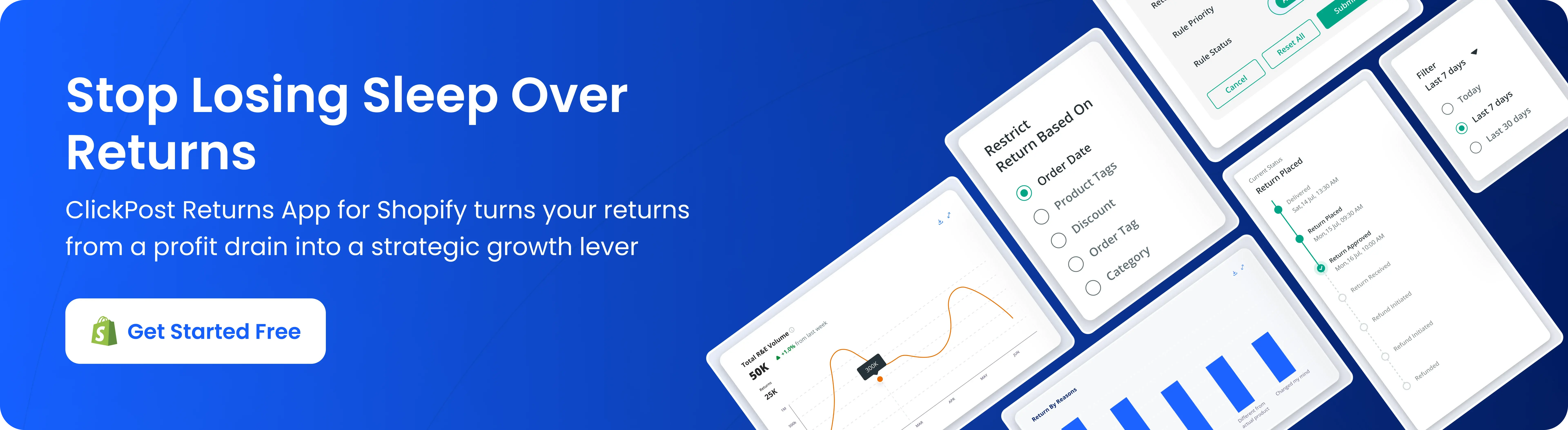
ClickPost Returns & Exchanges streamlines return and exchange management with automation, refunds, and a self-serve portal. Customers get real-time tracking, automated updates, and quick refunds. Merchants manage all return and exchange requests in one dashboard with customizable policies, eligibility rules, and reasons. Detailed return analytics and reporting give insights to cut costs and boost repurchases. Setup is fast, with everything ready in under 30 minutes.
-
Automated self-serve portal for easy returns, exchanges & refunds.
-
Dashboard to manage, track, and resolve return & exchange requests.
-
Process refunds to via gift cards or original payment methods.
-
Customizable return and exchange policies, rules, and eligibility.
-
Analytics & reporting with insights on return and Exchange trends.
ClickPost Returns Plus offers a free plan for up to 100 monthly returns. Paid plans start at $49/month. You can also integrate our returns management product with your ecommerce website. The total reviews on the ClickPost tool at Shopify are a testament to the ease it offers to merchants. The app support provided also makes it one of the best in the app categories for returns, exchanges, and refunds.
Conclusion: Subscriptions are now an operating system
Recurring revenue only works when customers feel in control and operations feel predictable. In 2026, the strongest Shopify subscription apps are those that quietly manage billing, retries, and fulfillment cadence while giving customers the freedom to adjust without leaving. Whether you are optimizing for DTC retention or long-term B2B relationships, the right subscription tool is the one that aligns revenue predictability with operational sanity.