.png?width=193&height=27&name=ClickPost%20Logo%20(Blue).png)
.svg)
.svg)
.svg)
.svg)
.svg)
.svg)
.svg)
.svg)
.svg)


.svg)
.svg)
.svg)
.svg)
.svg)


.svg)
.svg)
.webp?width=286&height=206&name=ROI%20Calculator%20(1).webp)
.svg)
.svg)

.svg)

.webp?width=286&height=206&name=RTO%20Playbook%20(1).webp)


In this blog
TL/DR summary
Multi-vendor Shopify Apps in 2026 fall into two categories: full marketplace builders and specialist tools that enable marketplaces to operate at scale. The right choice depends on whether you are launching a marketplace or stabilizing an already growing one.
Key takeaways
-
If you are launching a marketplace, prioritize vendor onboarding, seller dashboards, and split-order handling before design tweaks.
-
If you are scaling, prioritize payout automation and reporting to reduce bottlenecks in finance.
-
Treat order routing like a fulfillment rule engine; mixed carts should not require manual work.
-
Use inventory sync tools when multiple stores or partner catalogs create oversell risk.
-
Add multi-currency and channel sync when your marketplace growth depends on international demand.
The best way to decide is to map your marketplace risk to the tool category: if seller ops is the risk, pick a marketplace suite. If finance and fulfillment are the risk, pick payout and routing tools. In 2026, the marketplaces that win will be the ones that keep vendors paid and customers informed without chaos behind the scenes.
Introduction
Multi-vendor Shopify Apps are getting more attention heading into 2026 because the marketplace model solves a real operator problem: you can expand assortment and capture demand without taking on the full inventory and fulfillment burden yourself. The apps in this guide are worth watching because they reduce that complexity in different ways, from full marketplace builds to the plumbing that keeps vendors paid and orders moving.
Key highlights
-
Marketplace growth in 2026 is less about adding vendors and more about maintaining consistent service levels across vendors.
-
Payout automation is a finance workflow first, and a marketing feature second; the best tools treat it that way.
-
Split-order logic and routing rules are now table stakes for mixed carts and multi-origin fulfillment.
-
International marketplaces are pushing multi-currency display and localized checkout expectations higher.
-
Strong vendor dashboards reduce support load by enabling sellers to self-serve orders, inventory, and earnings.
Top Multi-vendor Shopify Apps in 2026
Not every “multi-vendor” tool does the same job. Some apps turn Shopify into a marketplace. Others handle vendor payouts, order routing, or cross-channel syncing that make a marketplace usable at scale.
|
App |
Standout features (what you can actually run) |
Pricing |
|
Vendor portal, commission rules by SKU, order splitting, payout reporting |
From $19/month |
|
|
Deep marketplace configuration, seller dashboards, add-ons, bulk operations |
From $15/month |
|
|
Marketplace build with scale tiers, vendor dashboards, split orders, and payouts |
From $19/month |
|
|
Automated revenue sharing payouts for collaborators, multi-currency payouts |
From $19/month |
|
|
Vendor payout calculations, vendor dashboards, and reporting controls |
From $30/month |
|
|
Marketplace + shipping workflows, order routing, carrier integrations |
From $49/month |
|
|
Geolocation currency switching, 130+ currencies, rounding rules |
Free |
|
|
Rule-based order routing and split fulfillment, multi-store sync |
Free; from $9.95/month |
|
|
Real-time inventory and product sync across stores, order pushing |
Free; from $19/month |
|
|
Etsy listing, inventory, and order sync, centralized operations |
From $9/month |
1. Puppet Vendors
Puppet Vendors (by Panther Commerce) is built to convert a Shopify store into a marketplace-style operation with a focus on commission tracking and payout workflows. It is a good fit for consignment, dropshipping marketplaces, and multi-seller catalogs where the admin needs clean reporting and less manual reconciliation.
Key features
-
Vendor portal with white-labeled login and dashboards
-
Commission rules by vendor, product, or SKU
-
Automatic order splitting and routing to the right seller
-
Reports for commissions, payouts, and sales performance
-
Shipping handoffs through integrations like Shippo and ShipStation
Pricing starts at $19/month for the Basic plan, with higher tiers scaling by vendor count and workflow depth.
2. Webkul
Webkul MultiVendor Marketplace is a broad, configurable marketplace layer for Shopify that supports multiple marketplace models, including hyperlocal and B2B-style workflows. It is often chosen for its extensive add-on library and the ability to customize vendor onboarding, commissions, and seller pages without rewriting your theme from scratch.
Key features
-
Seller dashboards with configurable navigation and profiles
-
Commission rules by seller, category, product, and variant
-
Bulk product operations and CSV import workflows
-
Automated order calculations and marketplace policies
-
Add-ons for shipping, chat, RMA-style flows, and platform connector
Pricing starts around $15/month, with plans scaling to $40/month and $60/month depending on seller capacity and features.
3. Garnet
Garnet Marketplace is a Shopify marketplace builder that focuses on vendor onboarding, synced product catalogs, and automated operational workflows. It is positioned for stores that want a marketplace feel with separate seller dashboards, order splitting, and payout support, while keeping the admin experience manageable.
Key features
-
Fast vendor onboarding with separate seller dashboards
-
Automatic split orders with vendor-specific fulfillment tracking
-
Product and inventory sync designed for larger catalogs
-
Payout support through payment integrations like Stripe and PayPal
-
Marketplace administration controls for products, vendors, and performance
Pricing starts at $19/month and scales to $59/month and $99/month based on order volume, product counts, and vendor limits.
4. CollabPay
CollabPay is less of a “marketplace storefront” and more of a “revenue sharing engine,” which is precisely what some multi-vendor models need. If your “vendors” are creators, brands, sales reps, or collaborators who earn a share of sales, CollabPay automates the math and pays partners without finance teams living in spreadsheets.
Key features
-
Automated revenue splits and payouts via PayPal and Stripe
-
Percentage rules by product, collaborator, or order tagging
-
Collaborator dashboards for earnings, sales, and payout visibility
-
Multi-currency support for global partner payouts
-
Reporting controls with visibility settings for collaborators
Pricing starts at $19/month and scales to $39/month, $59/month, or $79/month based on collaborator count and payout method.
5. Vendor Payout ‑ MultiVendor
Vendor Payout ‑ MultiVendor is a finance-first tool for merchants who already run vendor-based catalogs and need a reliable way to calculate and distribute payouts. It supports commission percentages or fixed rates, reporting, and vendor dashboards, enabling sellers to track their owed amounts.
Key features
-
Vendor payout calculations using fixed or percentage-based commissions
-
Vendor login dashboards for sales, payouts, and inventory (by plan)
-
Reporting filtered by vendor, dates, products, and order status
-
Controls for discounts, fees, and expenses in payout reporting
-
Built to reduce manual reconciliation for recurring payout cycles
Pricing starts at $30/month, with higher tiers at $60/month and $150/month for broader vendor and inventory controls.
6. ShipTurtle
ShipTurtle Multi Vendor Marketplace Pro+ combines marketplace operations with fulfillment workflows, which matters when vendors ship from different locations, and you still want consistent delivery promises. It supports vendor onboarding, order splitting, and commission calculations.
Key features
-
Vendor dashboards with permissions and operational controls
-
Automatic order splitting and routing across vendors
-
Commission calculations and payout support through Stripe and PayPal
-
Carrier integrations for labels, tracking, and shipping workflows
-
APIs and workflow options for more complex marketplace operations
Pricing starts at $49/month, with higher tiers around $109/month and $179/month depending on scale and feature depth.
7. Nova: Multi-Currency Converter
Nova: Multi-Currency Converter is not a marketplace builder, but it solves a marketplace problem that appears quickly in multi-vendor models: international browsing and price trust. When you have vendors with cross-border demand, showing localized prices reduces friction in the discovery and add-to-cart stage.
Key features
-
Geolocation-based currency switching for international visitors
-
Support for 130+ currencies with customizable display options
-
Currency switcher styling that matches storefront branding
-
Rounding rules to keep prices clean after conversion
-
Exchange rates aligned with Shopify’s conversion systems and APIs
The app is listed as free. Nova is helpful when your marketplace attracts global traffic, and you want price context to feel native, even before a shopper reaches checkout.
8. Order Fulfillment Guru
Order Fulfillment Guru is a logistics-focused tool that matters in marketplaces because mixed carts create operational edge cases. It routes, splits, and syncs orders across vendors, warehouses, and partner stores using rules, ensuring fulfillment does not become manual triage.
Key features
-
Rule-based order routing to vendors, warehouses, or fulfillment partners
-
Automatic order splitting for multi-origin carts
-
Inventory and product sync between connected Shopify stores
-
Purchase order style workflows via email and web portal
-
Integrations for label creation flows, including ShipStation routing
Pricing includes a free plan, with paid tiers starting at $9.95/month and scaling to $19.95/month and $29.95/month, plus usage charges for higher volume.
9. Syncio Multi Store Sync
Syncio Multi Store Sync is built for brands running multiple Shopify stores or partner storefronts where inventory accuracy is non-negotiable. In a marketplace context, Syncio helps keep products, variants, and stock aligned across stores, and can push orders back to a source store for fulfillment.
Key features
-
Real-time inventory sync across connected Shopify stores
-
Product data sync for images, titles, descriptions, and pricing
-
Order pushing from destination stores to source stores for fulfillment
-
Two-way sync options to reduce manual catalog updates
-
A Setup that is designed for ongoing operations, not one-time migrations
Pricing includes a free plan, with paid tiers commonly starting around $19/month and scaling to $29/month and $39/month based on product import limits.
10. Etsy Integration & Sync
Etsy Integration & Sync (CedCommerce) connects Shopify and Etsy, enabling merchants to manage listings, inventory, and orders across both platforms. While it is not a marketplace builder within Shopify, it is a multi-vendor enabler if your strategy is to expand distribution on Etsy while keeping operations anchored in Shopify.
Key features
-
Bulk listing and bulk editing from Shopify to Etsy
-
Inventory and price sync to reduce cross-channel stock mismatches
-
Centralized order management inside the Shopify admin
-
Listing templates and profiling for consistent attributes at scale
-
Support for linking existing Etsy listings to Shopify products
Pricing starts at $9/month, with higher tiers around $29/month and $59/month based on listing limits and monthly order sync volume.
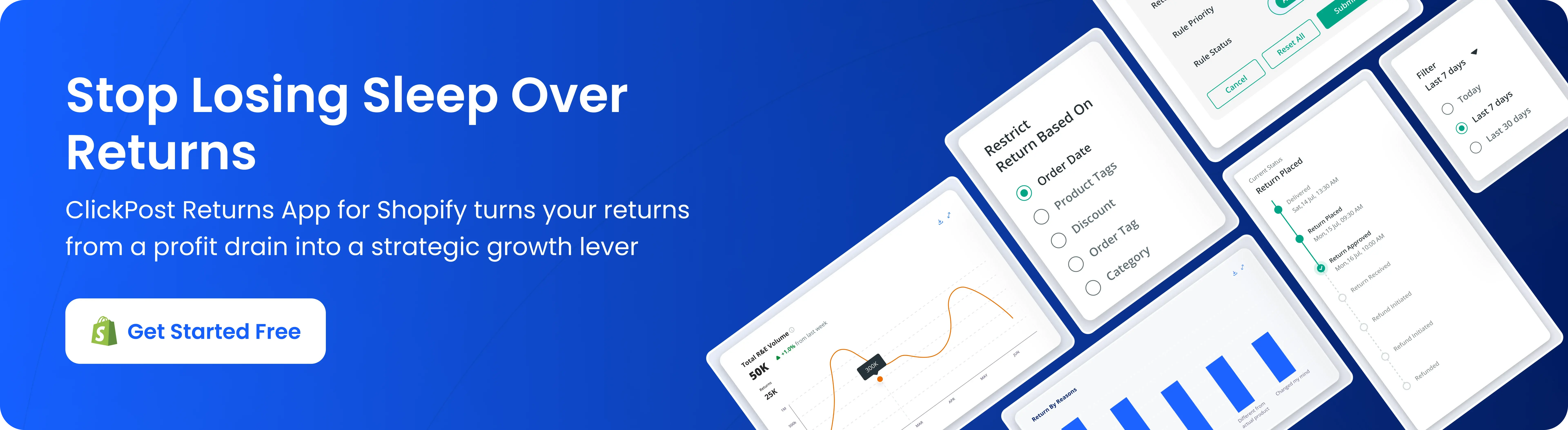
ClickPost turn returns into exchanges and repeat purchases, not losses
Automated returns & Exchanges with a self-serve portal, tracking, policies & analytics.
ClickPost Returns & Exchanges streamlines return and exchange management with automation, refunds, and a self-serve portal. Customers get real-time tracking, automated updates, and quick refunds. Merchants manage all return and exchange requests in one dashboard with customizable policies, eligibility rules, and reasons. Detailed return analytics and reporting give insights to cut costs and boost repurchases. Setup is fast, with everything ready in under 30 minutes.
-
Automated self-serve portal for easy returns, exchanges & refunds.
-
Dashboard to manage, track, and resolve return & exchange requests.
-
Process refunds to via gift cards or original payment methods.
-
Customizable return and exchange policies, rules, and eligibility.
-
Analytics & reporting with insights on return and Exchange trends.
ClickPost Returns Plus offers a free plan for up to 100 monthly returns. Paid plans start at $49/month. You can also integrate our returns management product with your ecommerce website. The total reviews on the ClickPost tool at Shopify are a testament to the ease it offers to merchants. The app support provided also makes it one of the best in the app categories for returns, exchanges, and refunds.
Conclusion: Build a marketplace that operations can survive
The marketplace idea is easy. The marketplace operation is the hard part. In 2026, the best multi-vendor teams will treat their stack as a supply chain system: vendor onboarding, order routing, inventory synchronization, and payouts must operate reliably under peak load. The best way is to map your marketplace risk to the tool category.