.png?width=193&height=27&name=ClickPost%20Logo%20(Blue).png)
.svg)
.svg)
.svg)
.svg)
.webp?width=286&height=206&name=ROI%20Calculator%20(2).webp)
.svg)
.svg)
.svg)
.svg)
.svg)
.svg)
.svg)
.svg)
.svg)
.webp?width=286&height=206&name=Frame%201171276203%20(11).webp)
.svg)
.svg)
.svg)
.svg)
.webp?width=286&height=206&name=ROI%20Calculator%20(3).webp)
.svg)

.svg)
.svg)
.svg)
.webp?width=286&height=206&name=ROI%20Calculator%20(4).webp)


In this blog
TL;DR
The wrong box can quietly raise your shipping cost, waste filler material, or leave an item underprotected. The right one does the opposite. This guide explains everything about UPS Boxes so you can understand what each packaging type is meant for, where it fits, and how to choose one without guessing.
Key points
- Choosing the right UPS box affects both shipping cost and in-transit protection.
- The most commonly used UPS packaging types include UPS Express Envelope, UPS Express Pak, UPS Express Box, UPS Express Tube, UPS 10 KG Box, and UPS 25 KG Box.
- UPS account holders can order many shipping supplies online for free through UPS.
- UPS also supports your own packaging for many services, including UPS Simple Rate.
- Standard shipping boxes at The UPS Store range from small cube formats to large moving and shipping cartons.
Why Choosing the Right UPS Box Matters
A box looks simple until it starts costing you money. Choose one that is too large, and you pay for dead space. Choose one that is too tight, and you risk crushed corners, split seams, or a damaged product showing up at the customer’s door.
That is why understanding UPS Boxes matters. UPS offers more than one packaging path. It offers branded express packaging, fixed-weight international boxes, tubes, paks, and standard shipping cartons sold through The UPS Store. Once you know what each one is suited for, packing decisions get easier and a lot more accurate. For a step-by-step walkthrough of the full shipping process, see our guide on how to ship a package.
Common UPS Box Sizes at a Glance
If you are looking at standard carton sizes available through The UPS Store, the range starts small and scales all the way up to large shipping and moving boxes. The UPS Store lists standard sizes ranging from 6 x 6 x 6 to 24 x 24 x 24, as well as 30 x 24 x 6.
Source: The UPS Store standard moving and shipping box listings. (UPS)
UPS Box Options: The 2 Main Categories
UPS packaging falls into two broad groups.
The first is UPS-branded service packaging, which includes envelopes, packs, express boxes, tubes, and fixed-weight international boxes. These are tied closely to specific UPS services and are especially useful for time-definite and export shipments.
The second is general shipping and moving cartons, typically available through The UPS Store. These are the more familiar brown boxes used for everything from ecommerce parcels to relocation jobs. They cover a much wider size range and are often the better fit when you need flexibility rather than service-specific packaging.
| # | Dimensions (L × W × H) | Category | Volume (in³) | Volume (ft³) | Dim. Weight (lbs) | Girth + Length | Best Use Cases |
| 1 | 6 × 6 × 6 | Small | $216.00 | $0.13 | $1.60 | 30" |
Jewelry, small electronics, candles, spice jars, small gifts
|
| 2 | 6 × 6 × 48 | Specialty | $1,728.00 | $1.00 | $12.40 | 72" |
Fishing rods, curtain rods, rolled posters, baseball bats, golf clubs
|
| 3 | 8 × 8 × 8 | Small | $512.00 | $0.30 | $3.70 | 40" |
Coffee mugs, small appliances, figurines, jars, snow globes
|
| 4 | 10 × 10 × 10 | Small | $1,000.00 | $0.58 | $7.20 | 50" |
Books, kitchen gadgets, toys, shoes, vases
|
| 5 | 12 × 12 × 6 | Flat | $864.00 | $0.50 | $6.20 | 48" |
Pizza stones, framed photos, board games, vinyl records, tablets
|
| 6 | 12 × 12 × 12 | Medium | $1,728.00 | $1.00 | $12.40 | 60" |
Toasters, blenders, stacked books, helmets, medium décor
|
| 7 | 14 × 14 × 14 | Medium | $2,744.00 | $1.59 | $19.70 | 70" |
Stand mixers, multiple shoe boxes, sports equipment, lamp shades
|
| 8 | 15 × 12 × 10 | Medium | $1,800.00 | $1.04 | $12.90 | 59" |
Laptops (with padding), document binders, handbags, tool kits
|
| 9 | 15 × 15 × 48 | Specialty | $10,800.00 | $6.25 | $77.70 | 108" |
Floor lamps, tripods, ski poles, long rolled artwork, curtain rods
|
| 10 | 16 × 16 × 4 | Flat | $1,024.00 | $0.59 | $7.40 | 56" |
Framed artwork, mirrors, cutting boards, clothing layflat
|
| 11 | 16 × 16 × 16 | Medium | $4,096.00 | $2.37 | $29.50 | 80" |
Medium appliances, bulk books, winter clothing, cookware sets
|
| 12 | 17 × 11 × 8 | Medium | $1,496.00 | $0.87 | $10.80 | 55" |
Laptops, document files, large textbooks, folded clothing
|
| 13 | 18 × 18 × 18 | Large | $5,832.00 | $3.38 | $42.00 | 90" |
Small furniture, bulk clothing, large kitchen appliances, sports gear
|
| 14 | 20 × 12 × 12 | Large | 2,880 | 1.67 | 20.7 | 68" |
Boots, power tools, wine/spirit bottles, tall vases
|
| 15 | 20 × 20 × 12 | Large | 4,800 | 2.78 | 34.5 | 84" |
Flat-packed furniture, large framed art, monitor stands, stacked linens
|
| 16 | 20 × 20 × 20 | Large | 8,000 | 4.63 | 57.6 | 100" |
Bulk household items, large appliances, moving clothes and bedding
|
| 17 | 24 × 18 × 6 | Flat | 2,592 | 1.5 | 18.6 | 72" |
Large artwork, mirrors, TV wall mounts, large cutting boards, maps
|
| 18 | 24 × 18 × 18 | XL | 7,776 | 4.5 | 55.9 | 96" |
Small furniture, bulk packing, large electronics, moving kitchen items
|
Source: UPS Assets (USA, Canada)
UPS Box Types: What Each One Is For
UPS does not treat every package the same, and neither should you. Different packaging formats exist because different shipments behave differently in transit.
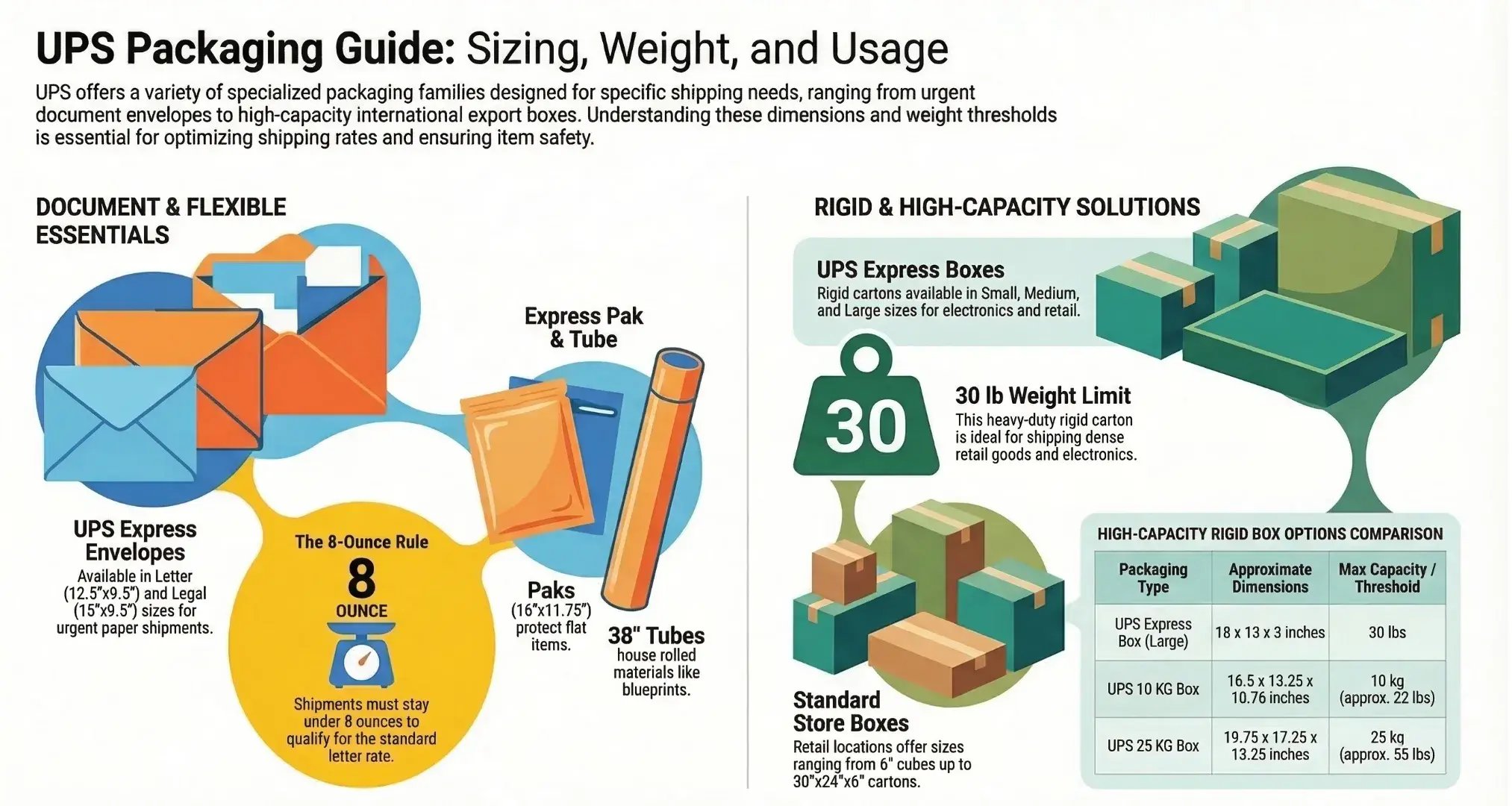
Here are the main packaging types worth knowing:
1. UPS Express Envelope
Best for urgent documents and correspondence. The letter-size version measures 12.5 x 9.5 inches, and the legal-size version measures 15 x 9.5 inches. For domestic letter rates, the actual weight must stay at or below 8 ounces.
2. UPS Express Pak
Built for flat items that need light protection, such as reports, forms, or slim soft goods. The standard Express Pak measures 16 x 11.75 inches. Pak-rate eligibility is limited and depends on service, customs value, and weight.
3. UPS Express Box
A versatile rigid option for small merchandise, documents, and lightweight goods. It comes in small, medium, and large sizes and is one of the most flexible UPS-branded formats.
4. UPS Express Tube
Made for rolled documents rather than folded ones. This is the right fit for blueprints, posters, maps, charts, and technical drawings.
5. UPS 10 KG Box
Designed for qualifying export shipments using UPS Worldwide Express Plus, UPS Worldwide Express, or UPS Worldwide Saver. The pricing logic is tied to the 10-kilogram threshold, and shipments over that limit are priced based on actual weight and selected service. For businesses managing cross-border shipments, understanding international logistics factors helps optimize box and service selection.
6. UPS 25 KG Box
Similar to the 10 KG version, but for heavier export shipments up to 25 kilograms under the same qualifying international services.
7. Standard Shipping Boxes From The UPS Store
These are general-purpose cartons sold in a wide size range, from small cube boxes to large-format shipping cartons and specialty moving boxes.
What Size Are UPS Boxes? Detailed Dimensions by Type
The most useful way to think about UPS box sizing is by packaging family. Some are built around documents. Some are built around rigid small-parcel shipping. Some are tied to international export thresholds. And some are simply standard cartons sold through The UPS Store.
One important note before the breakdown: Public UPS pages do not publish a universal U.S. list of minimum order quantities and order increments for every packaging item. UPS does let account holders order supplies online, but pack counts can vary by item, market, and ordering interface. That means dimensions and service rules are easy to verify publicly, while MOQ details are not always displayed in a stable public document.
1. UPS Express Envelope
A document-first format for urgent paper shipments.
- Sizes: 12.5 x 9.5 inches (letter), 15 x 9.5 inches (legal)
- Weight rule for letter-rate eligibility: Up to 8 ounces
- Best for: Correspondence, urgent documents, and electronic media within the allowed weight rules
- Availability: Free for UPS account holders through UPS supply ordering
2. UPS Express Pak
A flexible protective pack for flat contents.
- Size: 16 x 11.75 inches
- Weight rule for Pak-rate eligibility: Up to 2 pounds in qualifying export use
- Best for: Flat, low-profile contents that need more protection than an envelope
- Availability: Free through UPS supply ordering for eligible users
3. UPS Express Box
A rigid carton line for a wide variety of goods.
- Large: 18 x 13 x 3 inches
- Medium: 16 x 11 x 3 inches
- Small: 13 x 11 x 2 inches
- Weight: The large version is suitable for shipments weighing up to 30 pounds
- Best for: Electronics, accessories, boxed retail items, documents that should not bend
4. UPS Express Tube
A long, rigid tube for rolled materials.
- Size: 38 x 6 x 6 inches
- Best for: Posters, maps, architectural drawings, charts, blueprints
- Availability: Free through UPS supply ordering for account users
5. UPS 10 KG Box
A fixed-weight international export box.
- Approximate size: 16.5 x 13.25 x 10.75 inches
- Weight threshold: 10 kilograms
- Best for: Heavier international export shipments using qualifying UPS Worldwide Express services
- Important rule: If the shipment exceeds 10 kg, UPS rates it by actual weight, and the service chosen
6. UPS 25 KG Box
A larger fixed-weight international export box.
- Approximate size: 19.75 x 17.25 x 13.25 inches
- Weight threshold: 25 kilograms
- Best for: Dense international export shipments using qualifying UPS Worldwide Express services
- Important rule: If the shipment exceeds 25 kg, UPS rates it by actual weight, and the service chosen
7. Standard Shipping Boxes From The UPS Store
These are not one fixed product line. They are a size range.
- Small end: 6 x 6 x 6 inches
- Large end: 24 x 24 x 24 inches and 30 x 24 x 6 inches
- Best for: General parcel shipping, storage, relocation, ecommerce, oversized but non-freight items
- Availability: Purchased at The UPS Store locations; custom boxes may also be available at some locations
UPS Box Sizes and Packaging Details: Complete Comparison Table
| Box type | Size | Weight limit | MOQ | Best use |
| UPS Express Envelope | 12.5 x 9.5 in; 15 x 9.5 in | 8 oz for letter-rate eligibility | Varies by account/order interface | Urgent documents |
| UPS Express Pak | 16 x 11.75 in | 2 lb for Pak-rate eligibility in qualifying export use | Varies by account/order interface | Flat items needing light protection |
| UPS Express Box Small | 13 x 11 x 2 in | Not separately published in the public guide | Varies by account/order interface | Small merchandise |
| UPS Express Box Medium | 16 x 11 x 3 in | Not separately published in the public guide | Varies by account/order interface | General merchandise |
| UPS Express Box Large | 18 x 13 x 3 in | Up to 30 lb in UPS package type documentation | Varies by account/order interface | Larger small-parcel items |
| UPS Express Tube | 38 x 6 x 6 in | Not publicly specified on the service guide page | Varies by account/order interface | Rolled documents |
| UPS 10 KG Box | 16.5 x 13.25 x 10.75 in | 10 kg | Varies by account/order interface | Export shipments |
| UPS 25 KG Box | 19.75 x 17.25 x 13.25 in | 25 kg | Varies by account/order interface | Heavier export shipments |
| Standard UPS Store cartons | 6 x 6 x 6 in up to 30 x 24 x 6 in | Depends on box construction and shipment limits | Purchased by size/location | General shipping and moving |
Editor’s Note: Dimensions and service-use rules above were verified against UPS rate guides, UPS tariff language, UPS package type documentation, UPS order-supplies pages, and The UPS Store box-size listings. Public UPS sources do not publish a single, stable U.S.-wide MOQ or order-increment sheet for each supply item, so those fields are shown as variable when UPS does not provide a universal public figure.
How to Choose the Right UPS Box for Your Shipment
The right box is rarely the biggest one you have lying around. It is the one that fits the item cleanly, leaves room for protection, and does not push you into avoidable dimensional weight or surcharge territory.
A practical way to choose:
- Start with the product, not the box. Measure the item first.
- Leave space for cushioning. A couple of inches around the item is usually a sensible starting point for padding and void fill.
- Match the box to the service. UPS-branded express packaging is meant for specific UPS services, not every shipment type.
- Watch the dimensional weight. Large, lightweight packages can cost more even when they do not weigh much. Understanding flat rate shipping alternatives can help you avoid dimensional weight surprises.
- Use rigid packaging for rigid goods. Documents, posters, electronics, and dense export shipments all behave differently in transit.
- Do not overbox without a reason. Extra air increases filler use, carton size, and often the billable footprint.
A good rule of thumb is that if the item can shift freely inside the box, the box is probably too large or under-packed. For businesses shipping electronics specifically, see our guide on shipping electronics for packaging best practices.
UPS Size and Weight Limits You Should Know
UPS packaging choices still fall under broader shipping rules. Even if the box itself is available, the shipment must remain within UPS package limits unless it moves as freight or under a special service.
For standard package shipments in the U.S.:
- Maximum actual weight per package: 150 pounds
- Maximum length: 108 inches
- Maximum size: 165 inches in combined length and girth
- Large package trigger for domestic shipments: Length plus girth over 130 inches, length over 96 inches, weight over 110 pounds, or cubic size over 17,280 cubic inches
- UPS Simple Rate limit: 50 pounds actual weight and 1,728 cubic inches maximum size
These limits matter because they affect surcharge exposure, service eligibility, and whether a shipment should stay in small-parcel at all. Once a package gets too long, too heavy, or too bulky, the economics shift fast. For businesses comparing carrier weight and size limits, our FedEx vs USPS vs UPS comparison covers this in detail. (Source: UPS)
Where to Get UPS Boxes
UPS makes branded packaging fairly easy to source, especially if you already ship with a UPS account.
Your main options are:
- Order online through UPS: UPS lets account holders order shipping supplies online, including free materials such as boxes, labels, and envelopes.
- Visit a UPS customer-facing location: UPS and The UPS Store locations offer shipping supplies, and The UPS Store also sells general packaging and moving supplies.
- Buy cartons at The UPS Store: Standard shipping boxes, moving boxes, and custom boxes are available through The UPS Store network.
- Use your own packaging when appropriate: UPS packaging guidelines allow your own box if it is new or nearly new, and UPS Simple Rate is specifically designed to work with the shipper’s own box or poly mailer.
That last point matters more than many shippers realize. UPS packaging is useful but not mandatory for every shipment. For businesses printing their own labels, see our shipping label guide for formatting and compliance tips.
UPS Box Guide: What to Remember
Most shipping mistakes do not begin with the label. They begin with the packaging decision. A box that is too large drives up cost. A box that is too small compromises protection. A box tied to the wrong service can create confusion before the shipment even leaves the building.
That is why it helps to separate UPS packaging into clear buckets, such as express documents, packs, rigid express boxes, tubes, fixed-weight export boxes, and standard cartons from The UPS Store. Once you know which family your shipment belongs to, choosing the right box stops being a guess and becomes a straightforward packing decision. For businesses managing high shipping volumes across multiple carriers, a multi-carrier shipping platform helps standardize packaging decisions alongside carrier selection.
UPS Box Sizes FAQ
Are UPS boxes free?
Many UPS-branded supplies are free for account holders. Boxes, labels, and envelopes can be ordered at no cost through UPS.com. Standard retail and moving cartons sold at The UPS Store are purchased separately.
Where can I get UPS boxes?
You can order UPS-branded supplies online through UPS if you have an account, and you can also get packaging through UPS customer locations and The UPS Store. If you need general-purpose cartons, The UPS Store is usually the more practical option.
What are the different types of UPS boxes available?
The main types include UPS Express Envelopes, UPS Express Paks, UPS Express Boxes, UPS Express Tubes, UPS 10 KG Boxes, and UPS 25 KG Boxes. Beyond that, The UPS Store also sells standard shipping and moving cartons in a wide range of sizes.
What UPS box should I use for international shipping?
For export shipments over 10 kg, the UPS 10 KG Box or 25 KG Box is the purpose-built option. They are both designed for qualifying Worldwide Express services. It means that for lighter international items, UPS Express Envelopes, Paks, or Express Boxes work well if the selected service supports them. For a broader look at cross-border options, see our international shipping guide.
Does box size affect UPS shipping cost?
Yes, and it catches a lot of shippers off guard. UPS uses dimensional weight pricing. Hence, a large but light box can cost as much as a heavy one. Choosing the smallest box that safely fits your item is one of the simplest ways to avoid overpaying.
Can I use my own box instead of a UPS box?
Yes. UPS accepts shipments in your own packaging, and UPS Simple Rate is specifically built around that. You can bring the box or poly mailer, and the rate is based on size tier rather than weight. The main requirement is that your packaging meets UPS standards for the service you are using.
What is the weight limit for UPS boxes?
UPS accepts packages up to 150 pounds for standard shipments, with a maximum length of 108 inches and a combined length-plus-girth limit of 165 inches. UPS-branded packaging has its own thresholds on top of that. The 10 KG and 25 KG boxes cap out at their namesake weights for qualifying export services.
How much cushioning space should I leave inside a UPS box?
Two inches on all sides is the standard working rule. That gives you enough room for bubble wrap, foam, or paper fill to absorb impact and prevent the item from shifting. Skimping on that space is one of the more common reasons items arrive damaged.
Can I use UPS Express boxes for domestic shipments?
Yes, but only with qualifying express services. UPS-branded express packaging is not compatible with UPS Ground, UPS 3 Day Select, UPS Standard, or UPS Worldwide Expedited. If the service does not qualify, you will need to repack before it ships.
What is the UPS Express Tube used for?
The Express Tube is built for items that roll rather than fold, such as blueprints, technical drawings, maps, posters, and architectural plans. If you are sending anything that would crease or lose value when folded, this is the right format.
How do I calculate dimensional weight for a UPS box?
Multiply the length by width by height in inches, then divide by 139. The result is the dimensional weight in pounds. UPS charges based on whichever is greater: the number or the actual weight. For any box larger than a shoebox, it is worth running this calculation before you ship.
What is the cheapest way to ship a large box with UPS?
UPS Ground is almost always the lowest-cost option for large domestic shipments, especially for anything over 2 pounds going shorter distances. UPS Simple Rate is worth checking, too. It caps out at a flat fee based on box size, which can work out cheaper than standard rates for heavier items. For large shipments going regularly, a UPS account usually unlocks better pricing than retail counter rates. For businesses looking for the best shipping carriers across price points, comparing UPS Ground against other options is worth the time.
Can I reuse a UPS box for shipping?
1You can reuse a box as long as it is structurally sound with no soft spots, crushed corners, or compromised seams. Remove or cover any old labels, barcodes, and markings completely before shipping. If the box has been through a few trips and is showing wear, it is worth switching to a fresh one rather than risking a damage claim.
Related reading: Shipping Cost Guide | Shipping for Small Business | Expedited Shipping Explained | Standard Shipping Guide